Augmented reality (AR) and virtual reality (VR) have settled into one specific corner of product development: the design review. Instead of waiting for a milled or printed part, teams inspect a full-size model, walk around it, and mark it up while the geometry is still cheap to change. This guide covers what immersive prototyping does well in 2026, where the tooling has consolidated, what it costs, and when a physical prototype is still the right answer.
Key Takeaways
- AR and VR replace some physical prototypes – the saving comes from cutting review cycles, not from abolishing hardware.
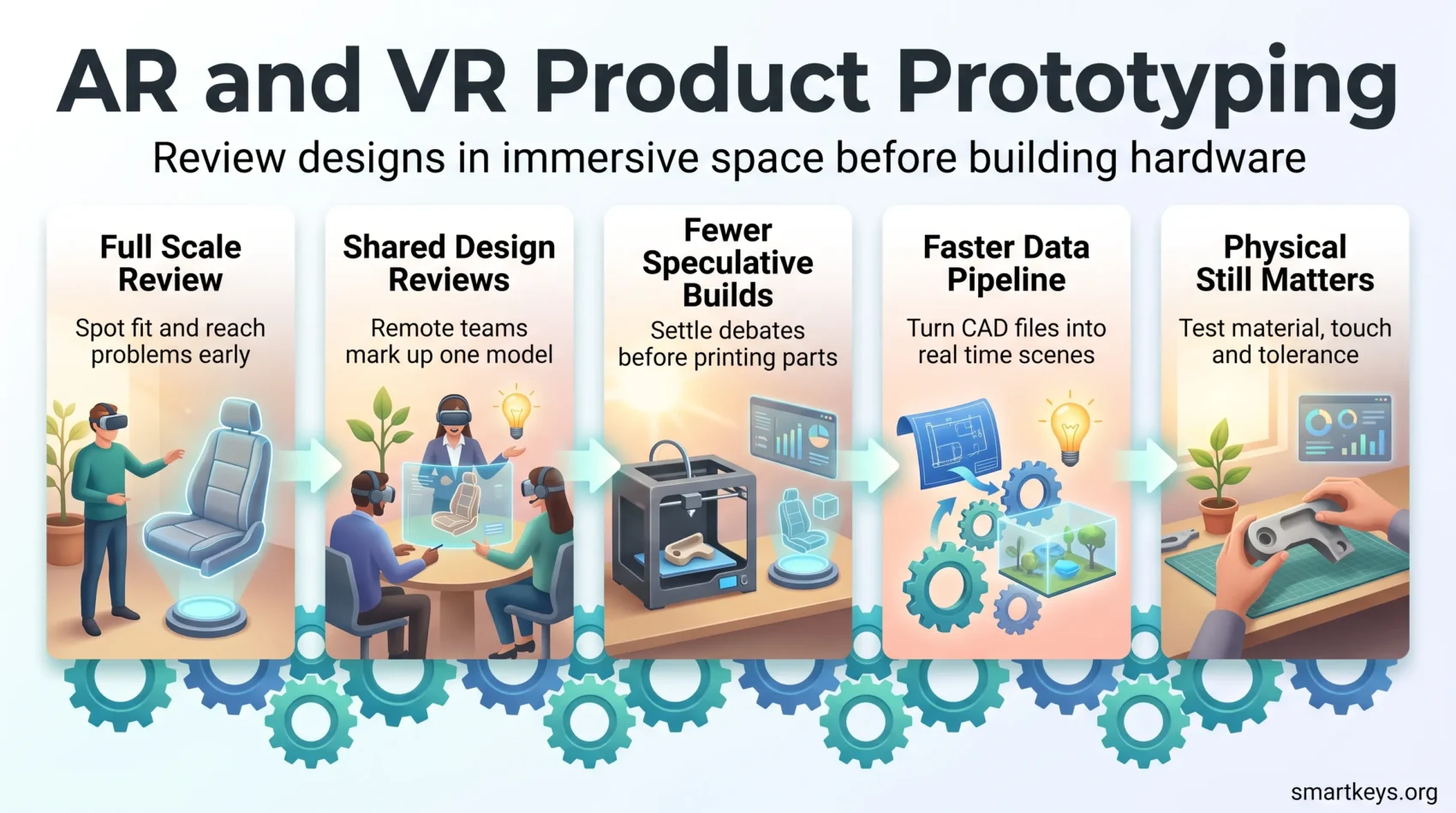
- Immersive review is strongest for scale, reach, sightlines and spatial fit, which flat screens represent badly.
- Distributed teams gain most, because a shared model takes travel out of the review calendar.
- The 2026 story is interoperability: OpenUSD is becoming the common format between CAD, PLM and real-time engines.
- The barrier is rarely the headset. It is turning CAD data into a usable real-time scene.
- Physical prototypes still win where material behaviour, tolerance or touch decides the outcome.
The Evolution of Product Design
Product design has moved through three phases: flat drawings, parametric 3D models, and now real-time scenes you can step into. Each step narrowed the gap between what a designer intended and what a reviewer understood – and that gap is where expensive rework originates.
From 2D Drawings to 3D Modeling
The move from 2D to 3D changed who could take part in a review. A section drawing requires training to read; a shaded model does not. CAD made intricate assemblies easy to modify and made them legible to procurement, marketing, manufacturing and safety.
Immersive review extends that logic further. A model on a monitor still has to be mentally scaled; a model at 1:1 in a headset does not. That matters most for anything a person sits in, reaches into or stands next to. It is design thinking applied to the review itself.
Why Cost-Effective Prototyping Still Matters
Prototyping budgets are finite, and every physical iteration consumes material, machine time and calendar days. Using AR and VR workspaces to sift concepts before committing to hardware means fewer builds reach the shop floor, and the ones that do are better resolved. The pairing that works is virtual review for form, fit and layout, then rapid physical builds for questions that need touching. 3D printing has made those builds fast enough that the methods complement rather than compete, and the wider digital transformation of engineering has made the handover far less manual.
The Role of Immersive Technologies in Design
AR and VR are often named in one breath, but they solve different problems, and knowing which one a question calls for saves a lot of wasted setup.
Understanding Augmented Reality (AR)
AR places digital content into the physical environment. In prototyping that means checking a new component against the machine it has to fit, or overlaying a service procedure onto real hardware to see whether a technician’s hands can reach the fastener.
Consumer-facing AR follows the same principle. Retailers let customers place a to-scale product in their own room before buying, which is a genuine prototyping loop: the retailer learns which configurations people place, resize and abandon. The same mechanics now shape AR in e-commerce more broadly.
Exploring Virtual Reality (VR)
VR replaces the environment entirely, which is what you want when the surroundings are part of the question. Vehicle interiors are the classic case: seating position, sightlines, control reach and display legibility only make sense inside a cabin, and a headset can supply that cabin months before a physical buck exists.
VR also supports a review format video calls handle poorly – several people around one model, pointing at the same edge. That is the problem holographic collaboration tools approach from the meeting-room side.

Benefits of Using AR VR Product Prototyping
The advantages are concrete rather than futuristic, and they concentrate before tooling decisions lock the design in.
Enhanced Visualization and Interaction
At 1:1 scale, problems announce themselves. A grab handle sits too high, a service panel opens into a wall, a display washes out at the angle a driver actually uses. These are not subtle findings, but they are routinely missed on a monitor because the reviewer supplies the missing scale from imagination. Reviewing a model alongside its live engineering data – the approach behind digital twin technology – extends this from geometry to behaviour.
Faster, Better-Informed Decisions
The decisive benefit is cycle time. When a review happens the day a model is ready rather than three weeks later when a prototype arrives, the iterations a project can absorb go up without the schedule moving. Decisions also stick better, because everyone saw the same thing at the same size.
The caveat is honest: immersive review shortens the feedback loop, it does not supply judgement. A team that made poor decisions quickly on a screen will make them quickly in a headset.
Improving Collaboration Across Teams
Product development is a negotiation between disciplines that rarely share a vocabulary. A shared model gives them a shared referent.
Real-Time Design Reviews
In a live session, participants annotate the model directly and see each other’s markup appear. Ambiguity drops sharply, because “the bracket on the left” becomes a thing someone is pointing at. Sessions can be recorded and replayed, which beats minutes. Teams already running structured collaborative workflows adopt this quickly.
Cross-Functional Team Engagement
Because an immersive model needs no CAD training to read, reviews can include manufacturing engineers, service technicians, accessibility specialists and customers – widening the range of objections raised while they are still cheap to answer. It is the argument behind open innovation models, applied inside the company walls.
Working Across Locations
Where design sits in one country and manufacturing in another, travel is the clearest line item: a weekly virtual review costs a headset session, a monthly on-site review costs flights, hotels and two lost days per participant. Pairing those sessions with AI-assisted collaboration tools keeps the decision trail intact in between.
Reducing Costs and Time Through Virtual Prototyping
Savings from virtual prototyping are real but specific, and easy to overstate. It is worth being precise about where they come from.
Fewer Physical Prototypes – and Where They Still Belong
The saving is not that hardware disappears. It is that fewer speculative builds happen. Concepts that would once have been printed to settle an argument get settled in a review instead, so the builds that remain are the ones testing what a screen cannot answer: stiffness, thermal behaviour, surface finish, assembly tolerances, how a latch feels after a thousand cycles. Where a physical build is needed, additive manufacturing has shortened the wait enough that the two loops run in parallel rather than in sequence.
Streamlining the Design Process
The second saving is coordination. Reviews that used to wait on a shipped prototype can be scheduled against a model release. Feeding them from the same data that drives digital twins in manufacturing means production constraints surface during design rather than after it.
Be sceptical of headline percentages here. Published savings vary enormously by industry, by what counts as a prototype and by who is publishing, so a number from an automotive programme tells you little about a consumer electronics project.

Case Studies in AR and VR Product Prototyping
Two sectors have used immersive prototyping long enough for the practice to be routine.
Automotive Industry Innovations
Carmakers were among the earliest adopters, for a structural reason: a vehicle programme runs for years, physical bucks are expensive, and most contested questions are spatial. Manufacturers including Ford have run dedicated immersive design facilities since the 2010s, using them to assess ergonomics, sightlines and interior layout before committing to hardware. What changed is the cost of entry: where early programmes needed a purpose-built room with tracked walls, a comparable review now runs on standalone headsets in an ordinary meeting room.
Furniture and Retail Transformations
Furniture retailers use AR at the opposite end of the lifecycle – not to design the product but to test how it lands with buyers. IKEA has offered room-scale AR visualisation in its apps for years, letting customers place to-scale products in their own homes. The design value lies in aggregate behaviour: which configurations get placed, which get removed, which rooms they end up in. That blend of digital preview and physical purchase is the core of phygital retail, and it turns a marketing tool into product feedback.

Enhancing Customer Engagement and Experience
Immersive tools put a product in front of customers before it exists, which changes what customer research can ask.
Interactive Product Demos
A configurable virtual model lets a customer see their own specification rather than a representative one, and lets a sales team demonstrate large or immovable equipment without shipping it. For industrial products that alone often justifies the investment. The prototyping payoff is behavioural: which options people combine, how long they spend on each, and where they abandon the configuration are signals about the product, not just the sale.
Feedback Loops Before Production
Concept tests in VR gather reactions before tooling is ordered – the point where change is still affordable. Treated properly this is a research instrument: define the question, control the conditions, and read the results with the scepticism any small-sample study deserves. Interpreting that mix of behavioural and stated feedback is where augmented analytics earns its place.
Challenges of Integrating AR and VR in Product Design
The obstacles are practical, and explain why adoption has been steady, not explosive.
Hardware and Licensing Costs
Headsets are a meaningful line item once multiplied across a review group, and enterprise-grade devices sit well above consumer prices. Licensing has been the less predictable cost, though it is moving in the customer’s favour: NVIDIA made its Omniverse platform free for development and production use as of May 2026, having previously required an AI Enterprise subscription for production (StorageReview). Support is paid separately.
The Data Pipeline Problem
This is what teams consistently underestimate. Native CAD assemblies are far too heavy for real-time rendering, so every model needs decimation, material assignment and often manual cleanup first. If that conversion takes three days, the promise of reviewing a model the day it is released evaporates. Automating the pipeline – not buying headsets – decides whether immersive review becomes routine.
Learning Curve and Adoption
Reviewers pick up navigation quickly; the harder shift is procedural. Teams must agree what an immersive review decides, who attends, and how findings re-enter the engineering record. Building that competence through cross-training rather than a one-off demo day separates a pilot that sticks from one that quietly stops.
The 2026 Toolchain and What Comes Next
The last two years have been less about new capability than about the plumbing between existing tools finally improving.
OpenUSD Is Becoming the Common Language
The most consequential development is a file format. OpenUSD, originally developed at Pixar, is now stewarded by the Alliance for OpenUSD – founded by Pixar, Adobe, Apple, Autodesk and NVIDIA, and run as a Joint Development Foundation project affiliated with the Linux Foundation – with the aim of making 3D data interoperable across tools.
That matters because the pipeline problem above is largely a format problem. Engineering vendors are joining directly: PLM supplier Aras announced in April 2026 that it had joined the Alliance to link 3D scenes to lifecycle data, so an immersive view carries the part numbers and revisions behind the geometry rather than being a disconnected picture of it.
Where the Headset Market Stands
Hardware supply has been choppy. IDC reported that the global AR/VR headset market grew 18.1% year over year in the first quarter of 2025, with Meta holding just over half of shipments, while forecasting a decline for 2025 as a whole before a rebound and sustained growth through 2029 as mixed-reality devices scale (IDC). The reading for buyers: device choice is still volatile, so treat hardware as replaceable and concentrate investment in content and pipeline. Cloud rendering pushes the same way, streaming a heavy scene to a light device – a grounded use of current cloud computing trends.
AI in the Design Loop
AI is entering immersive prototyping in unglamorous places: collision checks, packaging variants, mesh cleanup, summaries of what changed between review sessions. Combined with sensor data from products already in the field – the channel IoT in business operations opened up – it lets the next design start from how the last one behaved.

Conclusion
Immersive prototyping has stopped being a demo and become a review technique. It is very good at spatial questions, very good at getting distributed teams to agree on what they are looking at, and useless for anything depending on how a material behaves under load. The decision is not whether to adopt AR and VR, but which reviews to move into them.
What determines success is unglamorous: getting CAD data into usable real-time form quickly and repeatably, and agreeing what an immersive review is allowed to decide. Teams that solve those two problems get shorter loops and fewer late surprises; teams that buy headsets and skip them get an expensive novelty. For the wider picture, see our guide to virtual reality in remote work.
Found this useful?
Make SmartKeys a preferred source on Google, and our articles will surface more often in your Top Stories, AI Overviews, and AI Mode.
Add as Preferred Source