You don’t have to invent everything inside your own company to compete. Open innovation means combining your team’s ideas and technology with those of outside partners: universities, startups, suppliers, customers and sometimes even competitors.
Henry Chesbrough introduced the term in his 2003 book Open Innovation. This guide explains what open innovation is, the four models you can choose from, the tools and rules that keep it manageable, and how to measure whether it pays off.
Key Takeaways
- Open innovation combines internal research and development (R&D) with ideas, technology and skills from outside partners.
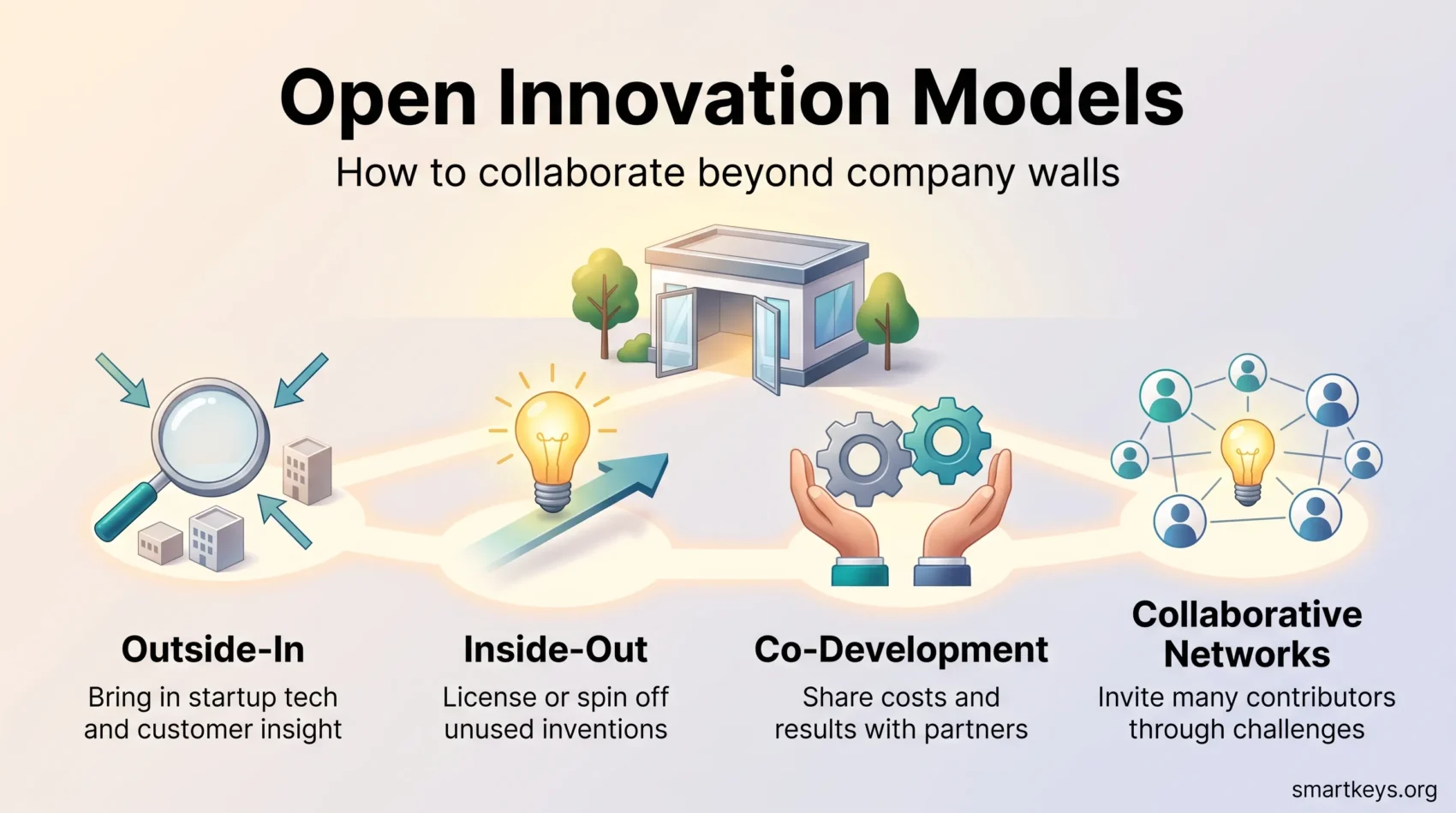
- There are four common models: outside-in, inside-out, coupled co-development and collaborative networks.
- Adoption is broad: 80% of corporates in a 2025 Sopra Steria survey call open innovation important or mission critical.
- The biggest risks are unclear ownership of intellectual property, weak partner coordination and culture clashes.
- A small scorecard (pipeline, speed, money, partner engagement) shows whether the program is worth scaling.
What Is Open Innovation? Core Definition and Principles
Open innovation is a strategy for developing products and technology with both internal and external knowledge. It does not replace your own R&D team. It widens the pool that team can draw from, and it gives your unused inventions a route to market.
The approach works in two directions:
- Inbound: you bring outside knowledge in. Examples include licensing a startup’s technology, funding a university project or running a public idea challenge.
- Outbound: you take internal knowledge out. Examples include licensing a patent you don’t use, spinning off a side project into a new company or releasing code as open source.
Many programs mix both directions. That mixed form is called coupled innovation, and it usually takes the shape of a joint project with shared costs and shared results.
A simple example: a mid-sized packaging maker wants a compostable coating. Instead of building the chemistry in-house, it co-funds a university lab that already works on the material, then pilots the result with two customers.
Why Closed Innovation Is No Longer Enough
Closed innovation means relying only on your own labs and staff. It still works for some core technologies. For most products, though, it creates three problems.
From internal R&D silos to ecosystem collaboration
First, the pool of ideas is limited to the people you employ. Second, development takes longer because every capability has to be built from scratch. Third, the finished product may already look dated when it ships, because the market moved while the project stayed inside.
Outside partners address all three: a startup may already have the software you need, and customers can tell you early whether a feature matters.
What the data shows
The shift from “not invented here” thinking is well documented. Sabine Brunswicker and Henry Chesbrough surveyed 125 large US and European firms with annual sales above 250 million US dollars. They found that 78% practiced open innovation and none had abandoned it. The most common inbound practices were customer co-creation, informal networking and university grants (Purdue University, 2014).
More recent figures point the same way. The Sopra Steria Open Innovation Report 2025 surveyed 1,643 organisations and startups in 12 European countries. It found that:
- 80% of corporates consider open innovation important or mission critical, up from 67% in 2023.
- 76% of corporates plan to work with startups within the next 24 months.
- 72% of corporates with more than 5,000 employees have partnered with startups on AI projects.
Artificial intelligence is now the main driver of these partnerships. For a wider view of how AI is changing everyday operations, see our guide to AI in business operations. For the startup side of the equation, this startup trends guide covers where young companies are heading.
Open Innovation Models You Can Use Right Now
Each model gives you a different way to source, build or earn money from ideas. Pick one that matches your goal and risk appetite, or combine several.

Outside-in: scout technologies and customer insight
Outside-in means pulling external ideas into your roadmap. Typical tools are technology scouting (systematically searching for promising startups, labs and patents), pilots with young companies and university research grants. University partnerships can also feed your hiring pipeline, as our article on talent pipeline partnerships shows.
Customers are an equally important source. Structured feedback programs and voice of customer analysis with AI reveal needs your team would not spot on its own.
The best-known case is Procter & Gamble’s Connect + Develop program. According to Harvard Business Review, it produced more than 35% of the company’s innovations, and R&D productivity rose by nearly 60%.
Inside-out: license, spin off, commercialize
Inside-out turns assets you don’t use into value. You can license a patent to a company in another industry or spin off a project that doesn’t fit your core business. You can also publish software as open source to build an ecosystem around your product. Our guide to open source strategy covers that last route in detail.
This model often requires rethinking how your company earns money. If that sounds relevant, read our piece on business model innovation.
Coupled models: co-development and alliances
Coupled models combine inbound and outbound flows in one project. Common forms are joint ventures, co-development contracts and strategic alliances. Two companies share costs and risks and split the results according to an agreement.
Competitors sometimes join too, usually in “pre-competitive” work such as common technical standards. Each company still competes on the final product. The key is agreeing milestones, decision rights and ownership terms before any work starts. A broader partner ecosystem strategy helps you manage many such relationships at once.
Collaborative networks: platforms and communities
Networks invite many contributors at once through online platforms, challenges or maker communities. They work well when you need a large number of ideas or an unusual solution. Three examples:
- LEGO Ideas: fans submit set designs. LEGO reviews every design that gathers 10,000 supporters. If one becomes a product, the fan designer receives a 1% royalty and credit on the box (Wikipedia).
- FirstBuild by GE Appliances: a co-creation community and microfactory founded in 2014 in Louisville, Kentucky. By 2024 it counted more than 245,000 co-creators and over 100 launched products and features, including the Opal nugget ice maker (GE Appliances).
- NASA Centennial Challenges: public prize competitions for hard technical problems, such as the LunaRecycle Challenge on recycling waste during lunar missions.
Crowd-based approaches have their own design questions around incentives and quality control. Our guide to crowdsourced innovation covers them in depth. Communities can also drive growth beyond the idea stage, as shown in our article on community-led growth. When a network becomes the product itself, you are looking at a platform business model.
Tools and Platforms That Support the Innovation Process
Software turns scattered ideas into a process you can manage and measure. Most programs use three categories of tools.
Idea management: capture, evaluate, implement
An idea management platform collects submissions from employees, partners and customers in one place. Reviewers score each idea against clear criteria, such as customer value, feasibility and strategic fit. The strongest ideas get a budget and an owner, and the platform tracks their progress.
Technology scouting: find and assess partners
Scouting tools monitor startups, research papers, patents and conference topics. They let you score technologies and log every contact with a potential partner.
Trend management: turn market signals into priorities
Trend tools gather market signals and forecasts so you can decide which topics deserve investment. In all three categories, AI features now group similar ideas and flag relevant startups, while a human makes the final call.
Connect these tools to your project management software so approved ideas move straight into delivery. Our guide to knowledge management explains how to keep the lessons from each pilot from disappearing when people change roles.
Advantages and Challenges: Balancing Opportunity with Risk
Open innovation can shorten development and lower costs, but it changes how you protect and share knowledge. Plan for both sides from the start.
Advantages
- Faster time to market: you use existing solutions instead of building everything yourself.
- Lower R&D costs and shared risk: partners share the cost of pilots and development.
- Access to skills and technology: you tap expertise you could not hire quickly, from AI specialists to materials scientists.
- Better market fit: early customer input reduces the chance of building something nobody wants.
Challenges
- Intellectual property (IP): without clear contracts, it is unclear who owns a jointly developed invention. Use non-disclosure agreements (NDAs) and define who owns what before sharing sensitive details.
- Partner coordination: several organisations mean more meetings, more approvals and more chances for delays.
- Culture: teams may resist outside ideas. Startups in the Sopra Steria survey named cultural differences with corporates as the biggest barrier to working together.
- Data sharing: joint projects often involve customer data, which must stay compliant with privacy rules.
A structured risk management framework helps you rate these risks before each partnership. Data questions belong in your data governance strategy, and resistance inside the company is a classic change management task.
How to Launch and Scale Your Open Innovation Program
Start with one clear, measurable goal so the program delivers business value from the first project. “Find a cheaper packaging material by Q3” is better than “become more innovative.”
Set goals, governance, and processes that align business and legal
Map a simple process: intake, screening, validation, pilot and scale. Define selection criteria and who decides at each stage. Involve your legal team from day one so IP terms, data rights and contracts match your business goals.
Structure pays off. A May 2026 INSEAD Knowledge analysis of the Sopra Steria data reports a 73% success rate for companies with a dedicated open innovation department, against 51% for those without one.
Engage stakeholders and build trust-based partnerships
Invite partners and internal teams to joint workshops. Give startups fast, honest feedback: slow decisions are one of the quickest ways to lose them. Targeted challenges and hackathons (short, intensive events where teams build prototypes) attract solutions that fit a specific problem.
Use design thinking methods to keep projects anchored in real user needs.
Scale what works
Pilot with a small number of trusted partners first. When a pilot meets its targets, give it a budget, an internal owner and a launch plan. Our go-to-market strategy playbook covers that final step.
Measuring Performance: Metrics That Prove Impact
Good metrics show leaders what the program delivers and which projects deserve more money. Keep the scorecard small so it gets used.
Idea volume, quality, implementation rate, and time to market
Track how many ideas enter the pipeline and how many become real projects. Score ideas on feasibility, customer value and strategic fit. Then measure the implementation rate and the time from idea to launch for each stage, so you can see where projects stall.
Financials, participation, and platform engagement
Report financial results in plain numbers: cost savings, new revenue and licensing income, each tied to a specific project. Monitor how many partners and employees take part, and watch review times for signs of friction.
- Combine numbers with short case stories in one dashboard.
- Review the scorecard every quarter and move resources to what works.
- Adjust the metrics themselves once you know which ones predict success.
Conclusion
Open innovation helps you move faster and spend less on development. It works best as a managed program, not a series of one-off experiments.
Choose the model that fits your goal, agree ownership and data rules early, and track a few clear metrics. Start with one pilot, measure the outcome and scale what proves repeatable.
Found this useful?
Make SmartKeys a preferred source on Google, and our articles will surface more often in your Top Stories, AI Overviews, and AI Mode.
Add as Preferred Source