Most teams now hold four or five age groups at once, from people in their first job to people who have been working for forty years. That mix brings fresh ideas, different habits and the occasional misunderstanding. Almost none of the friction needs a big program to fix. It needs clearer norms and better habits.
This guide to managing multigenerational teams covers what the numbers show about age in the workforce, and which differences are real rather than stereotype. Then it walks through the practical steps: communication norms, two-way mentoring, fair hiring, flexible schedules and a few measures that tell you whether any of it worked.
Key Takeaways
- Workers aged 55 and over are projected to make up 23.4% of the US labor force by 2035, so age-diverse teams are the default, not a special case (US Bureau of Labor Statistics).
- Research finds generational differences in work attitudes are small. Age, tenure and life stage explain more than the label on someone’s birth year.
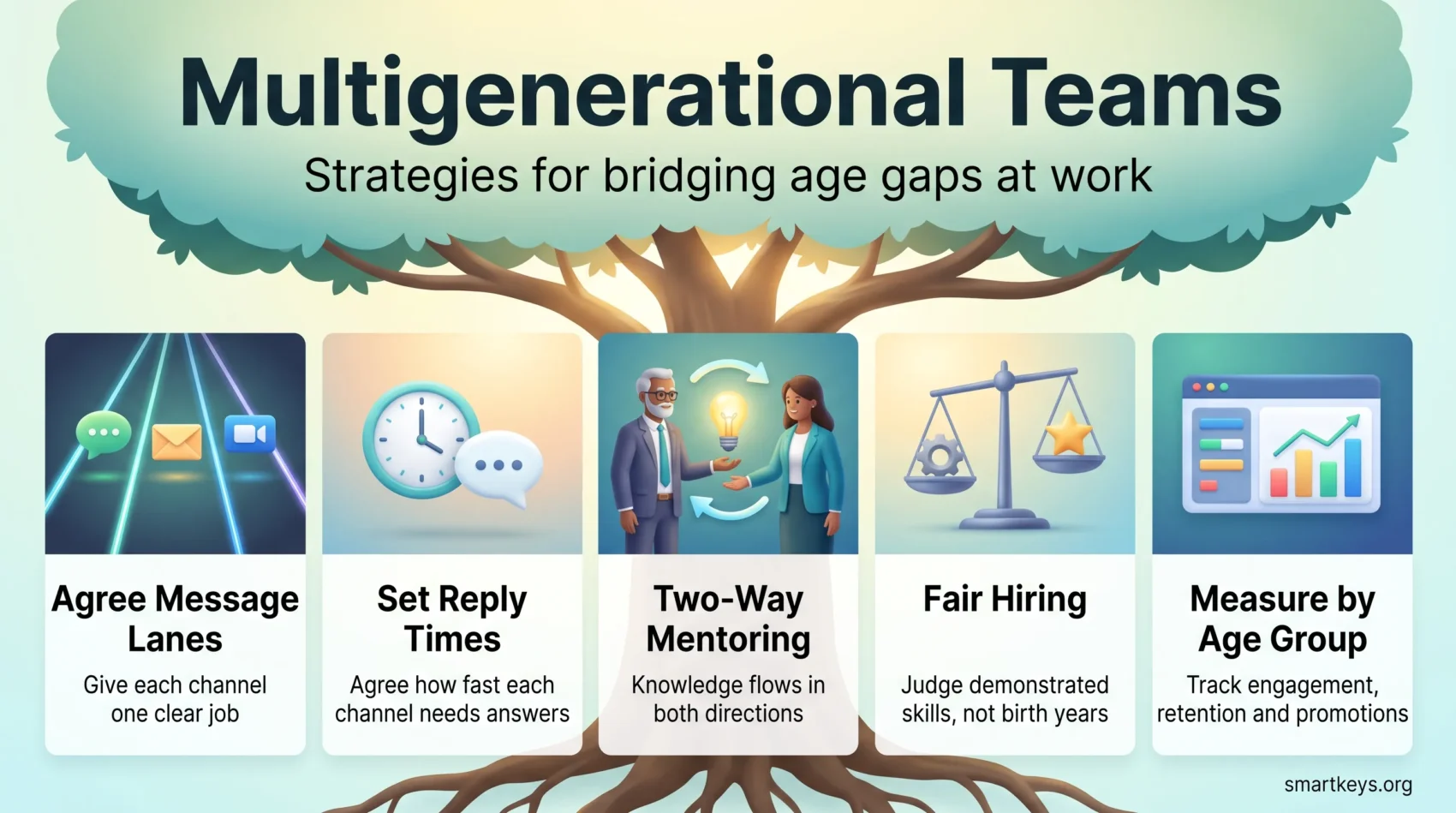
- Most friction is a communication-norms problem: agree which channel carries which kind of message, and how fast a reply is expected.
- Two-way mentoring moves knowledge in both directions and protects your team when an experienced colleague leaves.
- Age bias is common and measurable. In AARP’s 2025 survey, 64% of workers aged 50 and over said they had seen or experienced it.
- Track engagement, retention and promotions by age group. Without that split, gaps stay invisible.
Why multigenerational teams matter right now
People are working later in life, and the pipeline of young workers is thinner than it used to be. The US Bureau of Labor Statistics projects that workers aged 55 and over will make up 23.4% of the civilian labor force by 2035, with the 65-and-over group alone at 8.2%. Workers aged 16 to 24 are projected to fall to 11.4%.
You cannot fill a staffing gap from one age band, and you cannot treat the oldest part of your team as a group on its way out. Our overview of how demographic shifts are reshaping work covers the wider labor-supply picture.
So age diversity is a normal condition of the job, not a special project. The question is whether your meeting habits, feedback routines and promotion decisions work for everyone on the team.
Defining the generations, and what the labels are worth
Pew Research Center’s widely used birth-year ranges are:
- Silent Generation (1928 to 1945)
- Baby Boomers (1946 to 1964)
- Gen X (1965 to 1980)
- Millennials, also called Gen Y (1981 to 1996)
- Gen Z (1997 to 2012)
These labels are useful shorthand for describing the shape of your workforce. They are much weaker as predictions about individuals. A 2024 meta-analysis in the Journal of Organizational Behavior by Ravid, Costanza and Romero pooled 143 independent samples and found few systematic, meaningful differences between generations in work attitudes. Where differences showed up, age, tenure and life stage explained them better than generational membership did.
Use the labels for headcount and succession planning, not to guess what a colleague wants from their job. A 27-year-old with a mortgage and a 58-year-old retraining into a new field may want the same thing: predictable hours and a clear path to the next role. Ask people, then design around the answers.
What age-diverse teams actually give you
The main benefit is coverage. A team with a wide age range holds two kinds of knowledge at once: hard-won judgment about how things have gone wrong before, and current fluency with the tools everyone now uses. On a complex problem, that combination catches more failure modes than a uniform team does.
The second is continuity. Tacit knowledge, the know-how people carry in their heads rather than in documents, leaves when an experienced colleague does. Pairing people across age groups moves some of it first, as does writing down critical processes and rotating who owns them. That is the core idea behind modern knowledge management.
The third is a wider hiring pool. If your job ads, interviews and development paths work at different career stages, you choose from more candidates than a competitor who recruits one age band. That matters for talent retention too, because people stay where they can still grow.
Where the friction really comes from
Most age-related friction traces back to three things: channel habits, assumptions and unclear expectations. None is really about birth years, which is why fixing them does not require a generational strategy.
Channel habits. Some colleagues treat email as the record and a call as the fast lane. Others treat chat as the record and email as a formality. Neither is wrong, but if the team never agrees, context goes missing.
Assumptions. Age stereotypes work quietly. They shape who gets offered the visible project, who is assumed to need training and who is assumed to be winding down. The scale is not trivial: in AARP’s 2025 survey of 1,656 US workers aged 50 and over, 64% said they had seen or experienced age discrimination at work, and 22% said they felt pushed out of a job because of their age. Rates were similar or higher among Black, Hispanic and Asian American workers in that group.
Unclear expectations. People disagree about what earns a promotion and what counts as availability. Those disagreements look generational, but they are usually just an unwritten policy. Write it down and most of the argument disappears.
- Agree the norms: decide as a team which channel carries which kind of message.
- Replace labels with behavior: talk about what someone did or delivered, never about what “people that age” do.
- Make rewards legible: publish what progression and recognition require, so flexibility does not quietly cost people opportunities.
- Train managers: most age bias shows up in small staffing decisions, not in formal policy.
Communication that works across age groups
Consistent habits about when to message, call or meet remove most of the confusion.
Give each channel a job
Define message lanes. A workable default: chat for anything needed within the hour, email for decisions that need a record, a call or video for anything open to interpretation, and a shared document for anything the team will need again next month. Our guide to clearer workplace communication goes deeper on wording and structure.
Write the lanes down in one short page. A norm that lives only in people’s heads is one that new joiners break within a week.
Set response-time expectations
Agree how fast a reply is expected on each channel. This single rule removes a surprising amount of anxiety, because the colleague who answers chat at 22:00 and the colleague who answers at 09:00 stop reading each other as rude.
Add two rules that cost nothing: one topic per thread, and a subject line that states the decision. Then protect concentration with focus blocks, agenda-first invites and one recurring no-meeting window. Teams that lean on written updates can go further with asynchronous work practices, which suit different time zones and different life situations equally well.
Build feedback loops that include quieter voices
Run short pulse surveys and keep regular one-on-one meetings, so feedback has a route upward that does not depend on speaking up in a crowded room. In meetings, rotate who facilitates and use round-robins for decisions that matter. Both practices surface input from people who would otherwise stay quiet.
Record meetings, turn on captions and post a written recap. That helps anyone who missed the call, works in another time zone or takes in written information more easily. Review the norms once a quarter and drop the ones nobody follows.
Learning that sticks: mentoring, blended training and development
Learning systems work best inside normal work rather than beside it, so that development survives a busy quarter.
Two-way and reverse mentoring
Pairing should run in both directions. In reverse mentoring, a less experienced colleague coaches a senior one, usually on tools, platforms or how a younger customer segment behaves. Traditional mentoring runs the other way: client judgment, escalation instincts, knowing which risk is worth taking.
Run both in the same program and neither side feels like the charity case. Keep it concrete: one hour a fortnight, a stated goal, a defined end date. Open-ended mentoring quietly dies. At scale, mentorship matching platforms handle the pairing and tracking.
Blended learning for different preferences
Offer the same material as a short video, a written procedure and a live practice session. This is not about age: people learn a new system differently, and forcing one format on everyone slows adoption.
Keep the units small. Microlearning, meaning lessons short enough to finish between meetings, fits a real calendar better than a half-day workshop nobody can attend. For bigger transitions, such as moving into a new specialism, structured upskilling programs are the better frame.
Onboarding that ramps people faster
Codify shadowing checklists, short tutorials and a role-specific first-90-days plan. Ask new joiners to write down what confused them in week one, then fix those things for the next person. That single habit turns individual know-how into a reusable asset. Distributed teams need more structure here, which our guide to remote onboarding and training covers in detail.
Policies that bridge age gaps
When policy matches the realities of different life stages, managers gain room to act fairly. Start with your employee value proposition, or EVP: the plain statement of what someone gets in return for working here, covering pay, benefits, flexibility, development and culture.
Design an EVP that works at several life stages
A 24-year-old, a 38-year-old with young children and a 61-year-old planning the last stretch of a career value different parts of the same package. Make each part visible instead of assuming people will find it: learning budgets, caregiving support, retirement planning, phased schedules. Our overview of where employee benefits are heading covers what companies fund now.
Hiring that does not filter by age
Use neutral wording in job ads. Phrases like “digital native”, “high energy” or “recent graduate preferred” narrow your pool and, in several jurisdictions, create legal exposure. Set scoring criteria before interviews, use mixed-age panels and evaluate demonstrated skills rather than years since graduation. Automated screening needs its own scrutiny, as our guide to bias in AI hiring tools explains: a model trained on past hiring decisions will reproduce past age preferences.
Flexible schedules and phased pathways
Remote options, compressed weeks, part-time roles and phased retirement programs let people adjust work to life without leaving. The design question is how to keep flexibility from costing people opportunity. If the interesting projects always go to whoever is in the office, flexibility becomes a career penalty. Set core hours, response times and project assignment in writing. Our comparison of flexible work schedules lays out the trade-offs.
Address bias with training and visible modelling
Training alone rarely changes behavior. What moves it is managers doing the visible thing: giving a stretch assignment to the longest-serving person on the team, or putting the newest joiner in front of the client. Pair the training with continuous performance management, so decisions rest on a recorded track record rather than a manager’s recollection at review time. The same principle covers other differences in how people work, including the adjustments in our guide to neurodiversity at work.
Applying this in remote teams and clinical settings
Distance and high-pressure environments both reward predictable rituals. A short weekly team call, published office hours and one informal channel do more for cohesion than an occasional large event. Our guide to remote team building covers formats people actually attend.
Clinical settings show the pattern clearly. Longer-serving staff often prefer a direct conversation about patient care, while newer staff reach for the messaging tool inside the electronic health record system. Neither habit is safer by itself. Pair people across experience levels when you pilot a workflow change, so the pilot carries both the clinical judgment and the speed.
Leader visibility does the rest: walk the floor or its remote equivalent, hold short check-ins and publish a one-page playbook for handovers. Handover is where mixed-experience teams lose information, so it is worth documenting once, properly.
How to measure progress
Turn anecdotes into evidence by tracking a small set of measures, split by age group. The split is the important part: an engagement score that looks healthy in aggregate can hide a wide gap between your youngest and oldest cohorts.
What to track
- Engagement and pulse-survey scores, segmented by age band.
- Retention by cohort, and voluntary exits in the first year.
- Promotion rates and access to visible projects, compared across age bands.
- Training uptake and mentoring participation, which move before engagement does.
Keep the list short. Four measures reviewed every quarter beat twenty measures nobody opens.
Closing the loop
Run small experiments rather than company-wide rollouts. Change one thing, such as meeting norms in two teams, and compare after a quarter. Publish what you found, including what did not work: people stop answering surveys when nothing visible follows. Our look at where employee engagement is heading puts these measures in a wider context.
Conclusion
Age-diverse teams work well when the everyday mechanics are clear. Agreed channels, stated response times, written expectations about progression and mentoring that runs both ways cover most of what people call a generational problem.
Use the generational labels for planning and stop there. The research points the same way as most managers’ experience: the person in front of you is shaped by their career stage, their responsibilities outside work and what they want to learn next, far more than by the decade they were born in.
Measure a few things, split them by age, and act on what the split shows. The age range on your team then becomes what it should be: more coverage, more judgment and a deeper bench.
For a related view on fairness and measurement, see our practical diversity and inclusion playbook.
Found this useful?
Make SmartKeys a preferred source on Google, and our articles will surface more often in your Top Stories, AI Overviews, and AI Mode.
Add as Preferred Source