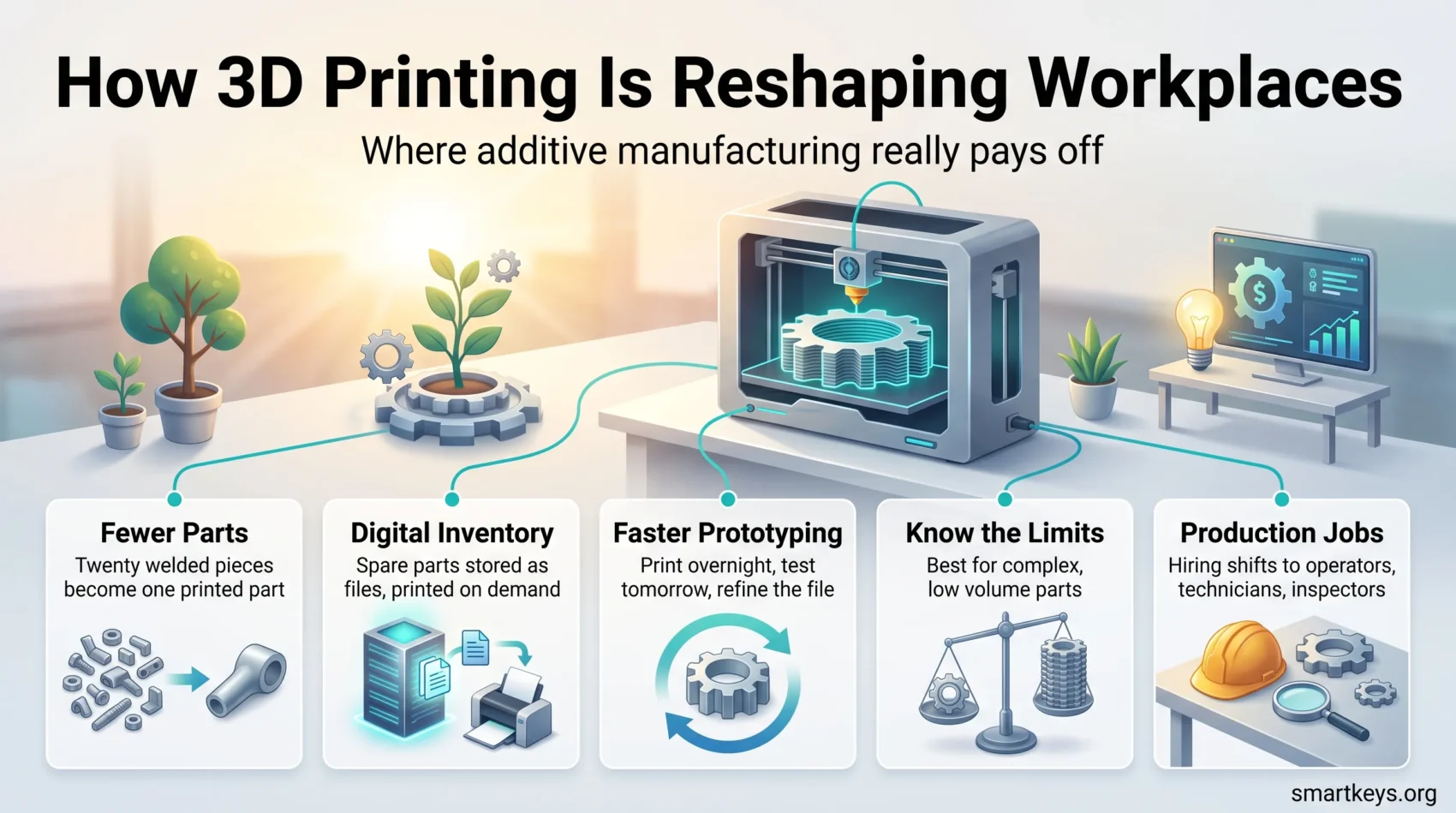
Additive manufacturing, better known as 3D printing, builds an object layer by layer from a digital file instead of cutting it from a solid block or pressing it in a mould. That single difference is why it keeps turning up in job descriptions, factory budgets and office design briefs.
According to the Wohlers Report 2026, global additive manufacturing revenue reached $24.2 billion in 2025, up 10.9% on the year before. The interesting part is not the headline number. It is where the money went: printing services grew 15.5%, while sales of new machines grew only 3.6%. Companies are squeezing more out of the printers they already own, or renting capacity from someone else, rather than buying more hardware.
This guide covers what that shift means in practice: which industries print production parts, what it does to costs, which jobs are advertised, and how printing changes teamwork.
Key Takeaways
- Global additive manufacturing revenue hit $24.2 billion in 2025, growing 10.9% (Wohlers Report 2026).
- Printing services are 48% of that revenue and grew four times faster than machine sales.
- Defence, aerospace, medical and research lead the sectors buying printed parts.
- Hiring has shifted towards production: operators, technicians, process engineers, quality inspectors.
- The case for printing a part is usually complexity or low volume, not cost per unit.
- Design files travel instantly, which is what makes on-demand spare parts possible.
Where 3D Printing Stands in 2026
The market is growing at different speeds in different places, and buyers have become more careful with capital.
Growth continues, caution sets the pace
The Wohlers Report 2026 draws on more than 1,200 responses from 570 companies. It splits 2025 revenue into printing services (48%), system sales and servicing (26%), materials (20%) and software (6%). Growth was uneven by region: Asia-Pacific 19.8%, the Americas 12.6%, and Europe, the Middle East and Africa 9.0%.
Report co-author Dr. Mahdi Jamshid summed up the mood plainly: growth continues, but it is “more uneven, more regional, and more closely tied to real production outcomes.” Buyers now want to see a printed part earning its keep before signing off on another machine. That is what a technology leaving its hype phase looks like, and the same pattern shows up in robotics on the factory floor and digital twins in manufacturing.
Which industries actually print parts
By revenue, the leading sectors are defence, aerospace, medical and research. Each needs small numbers of complicated, high-value parts, often certified to strict standards, and can absorb a higher cost per part in exchange for weight savings, faster availability or a shape no mould could produce.
Healthcare is the clearest example outside heavy industry. Surgical guides, dental aligners and patient-specific implants are each made once, for one person, which is what additive manufacturing handles better than mass production. It fits the shift described in digital transformation in healthcare. Volunteer networks such as e-NABLE apply the same idea at the other end of the budget scale, printing low-cost assistive hands from openly shared designs.
Construction is an earlier-stage case. Builders have printed concrete walls and small homes on site, but projects are still mostly pilots and small developments, limited to designs that suit the method.
What Additive Manufacturing Changes on the Factory Floor
Two changes matter most: parts get simpler to assemble, and inventory can move from a shelf to a server.
Twenty parts become one
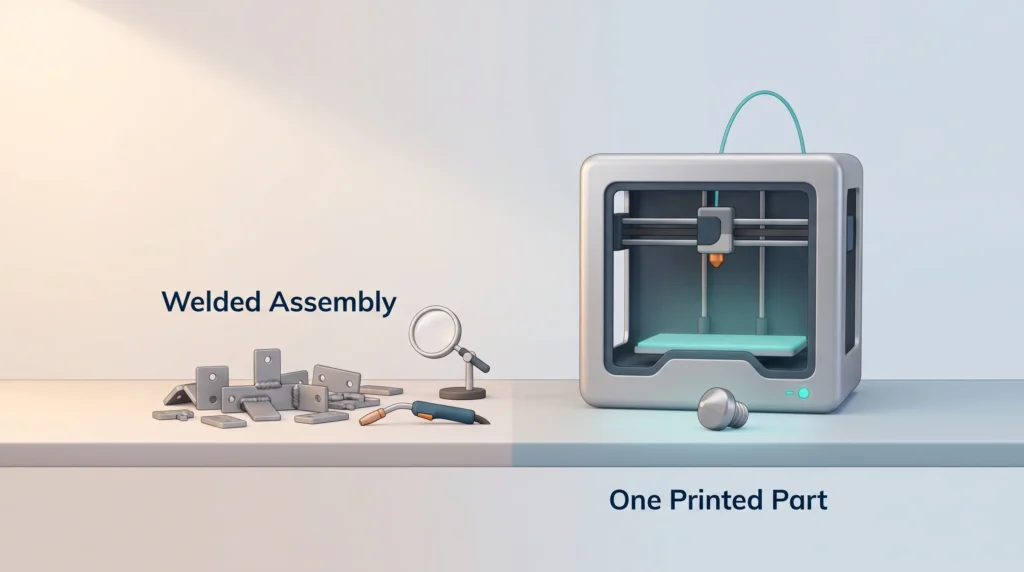
The best-documented example is still GE Aerospace’s fuel nozzle tip for the LEAP jet engine. The previous design was 20 pieces welded together. The printed version is one component with 14 internal fuel passages, built from more than 3,000 layers of powdered metal. GE reports it is 25% lighter and five times more durable than the part it replaced.
That is the real advantage, and it is easy to miss if you only look at the printer. The saving comes not from printing being cheap, but from deleting nineteen welds, nineteen inspections and nineteen chances for something to fail later.
Spare parts as files rather than shelves
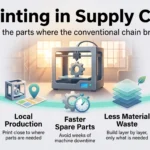
If a replacement part exists as a validated file, a company can print it where and when it is needed instead of warehousing it for years. This is called a digital inventory. It shortens lead times for obsolete components and frees capital tied up in slow-moving stock.
The caveat: this only works for parts qualified for printing, in a material the printer can handle, with documentation an auditor will accept. Reaching that state takes engineering time and money, so digital inventory usually starts with a few dozen high-pain components rather than the whole catalogue.
Wind turbine maker Vestas shows how this looks in practice. It prints tools such as blade alignment fixtures from shared digital files instead of machining and shipping each one. The same flexibility mattered during the COVID-19 pandemic, when manufacturers, hospitals and hobbyists printed face shields and test swabs while normal supply stalled, and the FDA published guidance on doing it safely. Our article on 3D printing and supply chain management covers the trade-offs, and supply chain resilience shows where local production fits a sourcing strategy.
Prototyping and Cost: Where the Savings Are Real
Prototyping is the entry point for most organisations.
Faster iteration, cheaper mistakes
A designer can print a part overnight, hand it to a colleague in the morning and change the file that afternoon. No tooling, no minimum order, no six-week wait. The value is not the printed object; it is how many design rounds a team can afford before committing to production. The same logic drives AR and VR in product prototyping, where reviews happen on screen before anything is made.
Where printing is still the expensive option
Additive manufacturing loses on cost as soon as volumes rise. Injection moulding is expensive to set up and then almost free per part; printing has almost no setup and a stubborn cost per part. Somewhere between a few hundred and a few thousand units, traditional methods win, and the crossover depends on the part, material and machine.
Printing also has limits on surface finish, build size and certified materials. Post-processing (support removal, heat treatment, machining, inspection) is routinely underestimated and can cost more than the printing itself.
The sustainability angle is mixed. Printing can cut material waste and remove long-distance shipping, which supports the case made in circular economy manufacturing and green supply chains. But industrial printers draw significant power and metal powders carry their own footprint, so the benefit has to be calculated per part rather than assumed.
What 3D Printing Means for Jobs
The employment story has changed shape since early predictions of millions of new roles. Current hiring data shows a shift in the kind of work, not an explosion in the amount of it.
Hiring has moved from the lab to the line
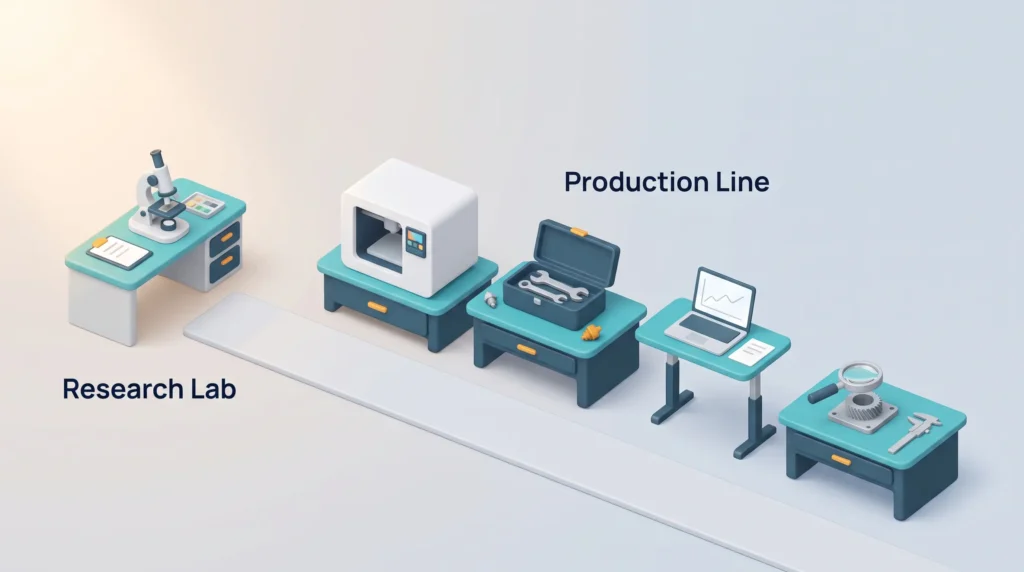
The 2026 additive manufacturing salary survey published by recruiter Alexander Daniels Global found that roughly 75% of employers are hiring for production roles: machine operators, technicians, process engineers and quality inspectors. Research and engineering still make up about 30% of the workforce, but that share is falling, while customer-facing roles have grown to nearly a third of positions.
The survey also reports salary growth of just under 8% in North America and close to 7% in EMEA for 2026, alongside a crowded candidate market of roughly 154 interested professionals per advertised role globally. Together those numbers describe a field where specialists are paid well and generalists face real competition.
Job creation, job change and the wider talent gap
Deloitte and The Manufacturing Institute estimate US manufacturing could need as many as 3.8 million new employees by 2033, with around 1.9 million roles going unfilled if the skills gap is not closed. Printing is one of several technologies raising the technical bar for factory work.
For individual workers the practical question is not whether a printer takes their job, but whether their job starts to include operating, programming or inspecting one. That pattern of tasks changing inside existing roles runs through adapting to job automation and automation in blue-collar jobs.
Skills Worth Building
The useful skill set splits into two halves, and most people are strong in only one.
Technical skills
Start with design for additive manufacturing (DfAM), the practice of designing a part around how a printer builds it rather than adapting a drawing meant for machining. Add CAD proficiency, a working knowledge of materials, and enough process understanding to judge why a build failed. Quality assurance and inspection skills are especially scarce, because certified industries cannot ship a part nobody can verify.
Commercial and quality skills
The second half is business judgement: knowing when printing is the cheaper answer and when it is not, costing a part honestly including post-processing, and writing a case a finance team will accept. People who hold both sides of that conversation end up leading programmes rather than running machines.
Two neighbouring specialisms grow alongside. One is software for preparing and monitoring builds. The other is intellectual property and licensing work, because a printable file can be copied as easily as it can be sent.
If you are starting out, a desktop printer or a local makerspace (a shared workshop open to members) is a cheap way to practise CAD and troubleshooting before paying for formal training. For planning your own development, see future job skills, upskilling and reskilling and mid-career retraining.
Collaboration Across Sites and Time Zones
Additive manufacturing quietly changes how teams are organised, because what moves between sites is a file.
Files travel, parts do not
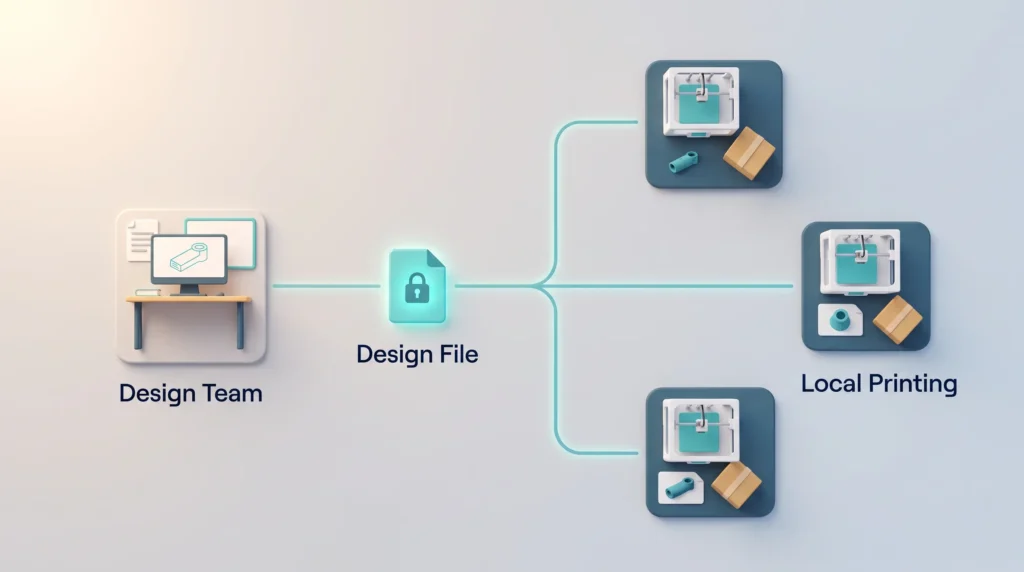
A design produced in one country can be printed near the customer in another the same week. That removes shipping time from the loop and lets a company keep design talent in one place while producing close to demand. It is one of the quieter reasons cross-border teams now work in hardware businesses, not just software ones.
It also creates obligations. A design file is intellectual property, and sending it to a print partner needs the same access controls, versioning and audit trail as source code. Modern printers report build status remotely, so an engineer can spot a failed layer without standing at the machine.
Tools that keep distributed work aligned
Shared CAD and product data management systems do the heavy lifting. Immersive tools add a spatial layer for design reviews, though adoption is still modest and the headset market has consolidated sharply, as covered in AR and VR in the workplace and holographic collaboration.
How 3D Printing Shows Up in Workplace Design
This is the smallest of the changes discussed here, and the one most often overstated.
Custom fittings and flexible layouts
Offices and labs use printing for parts nobody manufactures at scale: cable management pieces, monitor mounts, signage, jigs for shared equipment, replacement clips for discontinued furniture. Printed acoustic panels and modular dividers exist too, though most flexible-office furniture is still made conventionally.
Keep the claim proportionate. A desktop printer in a facilities cupboard fixes small physical problems cheaply. It does not redesign a building, and it belongs in a maintenance budget rather than a transformation strategy. The wider question of what workspaces are for is covered in future workspaces and the future of the office.
Where AR and VR Fit In
Augmented reality overlays digital content on the real world; virtual reality replaces it entirely. Both connect to additive manufacturing at two points.
Reviewing a design before it is printed
Viewing a part at full scale, in the space where it will be installed, catches clearance and ergonomics problems a screen view hides. Doing that before a build starts saves material and machine hours. It is the prototype argument, one step earlier and cheaper.
Training people on the equipment
Immersive training suits procedures that are expensive, risky or awkward to rehearse on live equipment, which describes plenty of work around industrial printers and powder handling. The evidence is encouraging but task-specific, and a good two-minute video still beats a headset for simple steps. See VR employee training for what the results support.
Conclusion
3D printing in 2026 is a $24.2 billion industry that behaves like an established technology rather than an emerging one. Companies are asking harder questions about utilisation and return, which is a healthier place to be than the enthusiasm of a few years ago.
The practical takeaways are narrow and useful. Printing wins where parts are complex, personalised or needed in small numbers, and loses on cost as volume rises. The jobs advertised are increasingly on the production side. The skills that pay are design for additive manufacturing, quality assurance, and the judgement to tell a good candidate part from a bad one.
For the broader picture, see our overview of AI and automation at work.
Found this useful?
Make SmartKeys a preferred source on Google, and our articles will surface more often in your Top Stories, AI Overviews, and AI Mode.
Add as Preferred Source