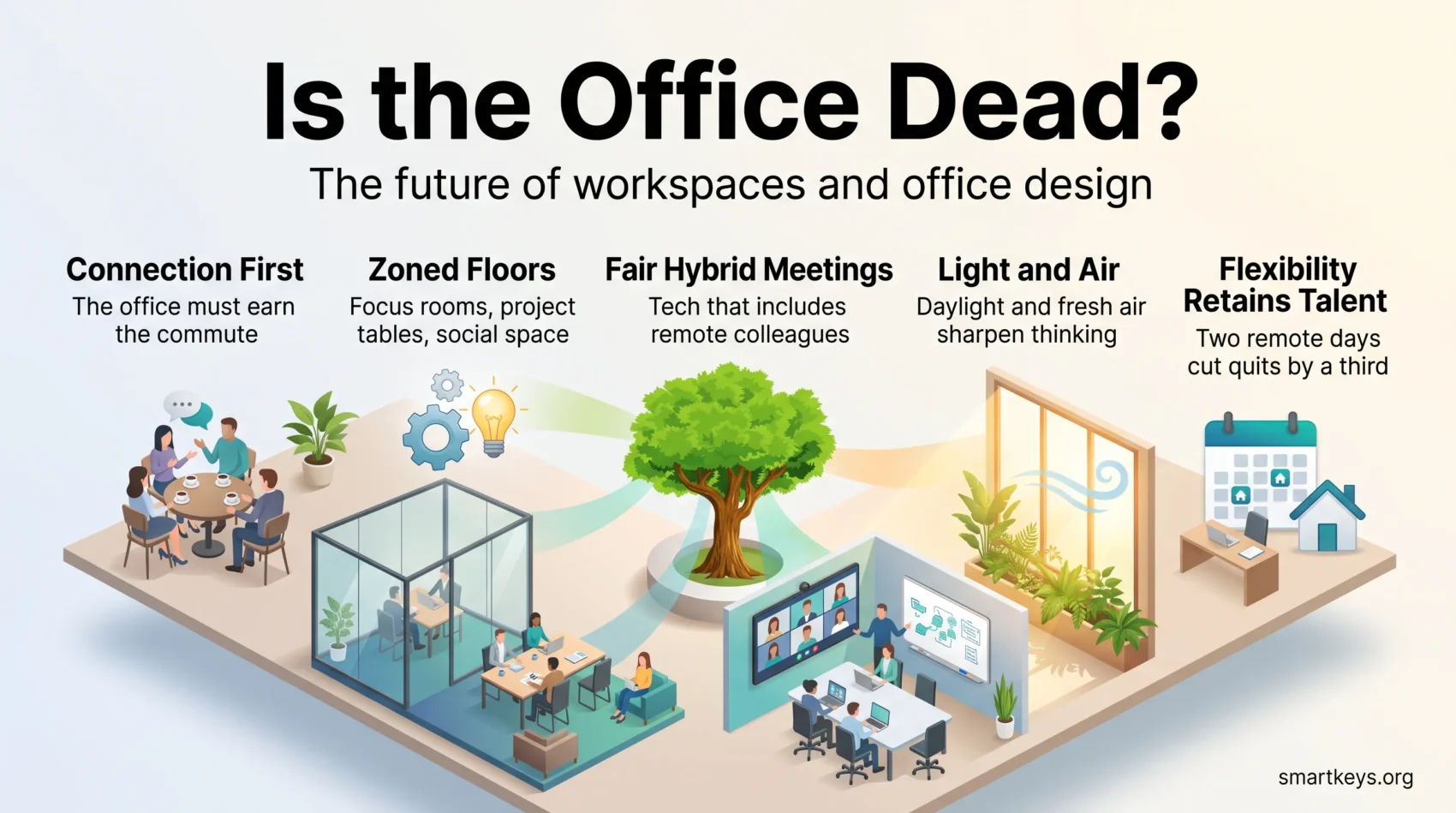
The office has not disappeared, but the case for it has changed. Years after the pandemic forced a sudden shift to remote work, most companies have settled into some version of hybrid work, and the building is being redesigned around what stays hard to do from a kitchen table: collaboration, mentoring, and contact that never appears on a calendar.
The market numbers describe an adjustment still in progress. Moody’s Analytics REIS put US office vacancy at 21% across 79 markets in the first quarter of 2026, up from 17% in 2020. Meanwhile CBRE’s 2026 Americas Office Occupier Sentiment Survey, published on 30 July 2026, found 89% of employers now expect at least three days a week on site. Buildings are emptier and attendance rules stricter at once, which is why office design has become a leadership question rather than a facilities afterthought.
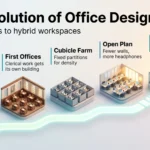
Today’s layouts did not appear overnight. For the longer story, our history of how office design evolved from cubicles to hybrid layouts traces the path from the first company offices to today’s activity-based floors.
Key Takeaways
- Hybrid work has settled rather than retreated: Gallup put 52% of remote-capable US employees in hybrid arrangements in May 2025, barely changed since 2022.
- Mandates and behavior diverge. CBRE recorded actual attendance of 2.9 days a week against an employer target of 3.2.
- Employers are unimpressed with their own space: 47% rate their workplace experience as average or below, and only 14% are attempting a meaningful redesign.
- The strongest evidence for hybrid is retention, not productivity. A randomized trial in Nature found two remote days cut quit rates by roughly a third at no measurable performance cost.
- Light, air and zoning have the most credible research behind them, and cost far less than a full fit-out.
The Evolution of Work Environments
Employee expectations and technological progress are reshaping how offices are built and used. Hybrid work models balance flexibility against the benefits of being in the same room, and that balance affects productivity and morale.
The Shift to Hybrid Work
The move to hybrid work triggered a broader rethinking of office layouts. Rows of cubicles left little room for spontaneous teamwork. Open-plan offices solved some of that and introduced a new problem: constant noise and almost no privacy for concentrated work, still the loudest complaint in workplace surveys. Our guide to managing distractions in an open office covers the acoustic and behavioral fixes.
Flexible workspaces have become the preferred middle ground. The practical version is zoning: a floor divided by activity rather than by department, with focus rooms, project tables and social space on the same plate.

What the Pandemic Changed for Good
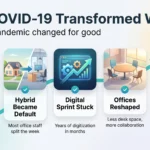
The sudden shift to remote work in 2020 proved something many companies doubted: plenty of knowledge work does not require a desk in a specific building. The data shows how firmly that stuck, and our look at what the pandemic changed about work for good covers the wider shifts. The Survey of Working Arrangements and Attitudes put roughly 25% of US paid days as work-from-home days in May 2026, against under 6% before the pandemic. Actual remote time has held near 1.25 days a week since mid-2022, and workers say they would like about half a day more.
Businesses offering genuine flexibility instead of a rigid mandate keep people more easily. A written hybrid work policy is the cheapest way to stop that question being renegotiated team by team.
What Employees Actually Want From an Office
As businesses debate returning to the office, the evidence points at one thing: people want a say in the matter, and they want the office to earn the commute.
The Return-to-Office Debate
Attendance has recovered, but not to 2019 levels, and the gap between policy and practice is the interesting part. CBRE found 89% of employers requiring three or more days on site in 2026, with only 11% still expecting one or two, down from 23% the year before. Measured attendance nonetheless came in at 2.9 days against a 3.2-day target. Rules tightened faster than behavior followed. Our analysis of which return-to-office mandates work and which backfire looks at how individual companies have handled that gap.
What closes that gap is not enforcement. Asked why people come in, employers pointed overwhelmingly to colleague engagement (77%). Asked what keeps them away, they named an inconvenient location (62%) and a lack of amenities (53%).
Collaboration vs. Individual Workspaces
Gallup’s May 2025 survey of 17,660 US workers found 52% of remote-capable employees working hybrid, 28% fully remote and 21% fully on site, with hybrid staff spending about 46% of the week in the office, or 2.3 days. The same people who value coming in for collaboration also want somewhere quiet once they arrive.
How the schedule gets decided matters as much as the schedule itself: 91% called their arrangement fair when the team set the rules, against 73% when the employer did. Watching for proximity bias matters too, since visible employees quietly accumulate opportunities remote colleagues never hear about.
The Destination Office: Borrowing From Hospitality
Because the commute now has to be justified, many companies design the office as a destination rather than a default. The idea borrows from hotels and from placemaking, the urban-design practice of shaping shared spaces around how people actually gather.
In practice that means a café-style area where people can work or meet over coffee, a welcoming reception instead of a bare security desk, comfortable lounge seating and, where the building allows it, a terrace or other outdoor space. The point is not luxury. It is to make the in-person days feel worth the trip, which answers the amenity gap employers themselves named in the CBRE survey.
Smaller firms can get a similar effect without signing a lease of their own. Our guide to what coworking spaces cost and who they suit compares the membership models.
Redesigning Workspaces for a Hybrid Era
Most companies are moving slowly. CBRE found 54% making incremental improvements only, against 14% attempting meaningful reinvention, while 47% rated their own workplace experience as average or worse. The two stated priorities pull against each other: optimizing space utilization (74%) and improving employee experience (62%).
Creating Flexible and Collaborative Zones
Modern office design leans into variety: different zones for different kinds of work. Common strategies include:
- Brainstorming areas separated acoustically from areas built for quiet, focused work.
- Neighborhoods assigned to teams rather than fixed desks assigned to individuals, so a half-full floor still feels populated.
- Spaces that reflect the company’s culture and mission, rather than generic corporate décor.
Activity-Based Working: A Setting for Each Task
Activity-based working takes zoning one step further. Instead of owning a desk, people pick the setting that fits the task in front of them: a quiet room for writing, a project table for planning, a lounge for an informal catch-up.
The approach only works with enough focus space. A floor full of open collaboration areas simply recreates open-plan noise. Movable walls, modular furniture and height-adjustable tables let the layout change as teams grow or routines shift, without a new fit-out each time. Acoustics deserve their own budget line too: sound-absorbing ceilings, soft furnishings and phone booths are what make a mixed floor usable for both conversation and concentration.
Integrating Technology for Modern Needs
Reliable video conferencing, shared displays and smart building solutions make hybrid meetings feel fair to remote participants. Priorities typically include:
- Conferencing setups that do not leave remote participants straining to follow the conversation.
- Booking and sensor data showing which rooms are genuinely in demand and which sit empty.
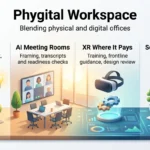
Our overview of hybrid workforce tools covers what belongs in that stack. For teams that split each week between rooms and screens, our piece on blending physical and digital offices shows how the two sides connect.
Workplace Trends Shaping the New Office
In more engaging, flexible work environments, a genuine collaborative workspace ties directly to innovation and employee satisfaction.
The Rise of the Collaborative Workspace
Employees who feel connected to colleagues report better wellbeing than those who feel isolated, whether remote or in an office that does not support connection. Our piece on remote employee engagement looks at where that isolation comes from.
If the people dialing in cannot hear the room, the office becomes a two-tier space, which is why hybrid meeting etiquette is worth agreeing on before the hardware budget is spent.
Flexibility in Work Arrangements
The strongest evidence comes from a randomized trial published in Nature in 2024. Nicholas Bloom and colleagues assigned 1,612 Trip.com employees either to a fully on-site schedule or to two work-from-home days a week. Quit rates fell by about a third, from 7.20% to 4.80%, with larger drops among non-managers (40%) and women (54%). Job satisfaction rose from 7.84 to 8.19 on a ten-point scale, and there was no measurable difference in performance reviews or promotions over the following two years.
That is the honest summary: hybrid is a retention instrument with a neutral productivity record. For a broader view, see our overview of flexible work schedules, and our guide on hybrid workspaces and employee wellbeing for supporting people across both kinds of day.

The Business Case for a Better Office
Companies that treat the workspace as a strategic investment rather than a cost center tend to see it pay off in retention. Portfolio decisions reflect that: CBRE found 38% of occupiers planning to expand their footprint over the next three years against 34% planning to contract, with 64% of technology companies expecting to grow.
Boosting Employee Morale and Productivity
Wellness rooms, sit-stand desks and ergonomic seating are inexpensive relative to the goodwill they buy, and the case for standing desks is better on engagement than on health outcomes. Two environmental levers have unusually direct evidence behind them.
Air is the first. In the Harvard COGfx study led by Joseph Allen, 24 participants scored on average 101% higher on cognitive function tests in a green building with enhanced ventilation (roughly 600 ppm CO2 and 40 cubic feet per minute of outdoor air per person) than in conventional conditions. The sample is small, so treat the size of the effect with caution.
Light is the second. Boubekri and colleagues put 30 knowledge workers through a week in each of two identical offices, one with roller blinds and one with electrochromic glazing. Participants in the daylight-optimized office slept 37 minutes longer and scored 42% higher on higher-order decision-making simulations. Practical guidance sits in our article on workspace lighting for focus.
Enhancing Workplace Wellbeing
Biophilic design, meaning natural light, plants and airflow brought deliberately into the workplace, is one of the more consistently effective ways to improve workplace wellbeing. Wellness-focused building standards have moved from novelty to norm: the International WELL Building Institute reported 6 billion square feet of space engaged with the WELL standard across 137 countries in July 2025, a twelvefold increase since early 2020. Many offices also add a small wellness or quiet room, a space with no desks and no calls where people can take a real break during a long day. Comfort is also becoming a compliance question as heat rules tighten, which our piece on how climate change is reshaping workspaces covers.

Technology’s Role in Transforming Workspaces
Companies investing in meeting room technologies and smart building solutions are building a technology workplace that supports comfort and efficiency, whether someone is in the room or joining remotely.
Upgrading Meeting Room Technologies
Outdated audiovisual equipment is a quiet productivity killer. Better microphones, cameras that track the speaker, shared digital whiteboards and conferencing that holds up under a weak connection are what make a hybrid meeting equitable rather than frustrating for whoever is not physically present. This is usually the highest-return line in a workplace budget.
Smart Building Solutions for Employee Comfort
IoT-connected building systems and adaptive lighting are becoming standard in newer fit-outs. Given the ventilation research above, automated climate control and air quality monitoring plausibly affect how people think across a workday, not just how comfortable they feel. Low-VOC paints and finishes, which release fewer chemical fumes into the room, support the same goal of cleaner indoor air.
Occupancy sensors raise a fair question about surveillance, so be explicit that the data sizes rooms rather than scores individuals.
Challenges in Adapting Office Spaces
Redesigning how a company works is not just a facilities project, it is a change management one. Resistance, from both leadership and employees, is often the hardest part of office adaptation.
Overcoming Resistance to Change
Change lands better when people join the process rather than hear about it afterwards. What tends to work:
- Workshops explaining the reasoning behind new layouts, not just the layouts themselves.
- Open forums where people can raise concerns before decisions are finalized.
- Pilot floors that run for a quarter before the change is rolled out everywhere.
- Letting teams, not individuals, set their in-office days, which Gallup’s fairness data supports directly.
Balancing Costs and Employee Needs
Office redesigns require real investment. Consider the impact on:
- Employee satisfaction from improved, more usable facilities.
- Productivity gains from spaces built around how teams actually collaborate.
- Retention, which is where the Nature trial found the clearest effect.
Weighing these honestly points to an office future that matches what the workforce needs. Our analysis of remote versus office ROI frames that comparison in numbers.

How to Actually Implement Office Changes
Start with a proper space utilization analysis. Badge data, room-booking logs and sensor counts tell you which rooms sit empty and which desks are never touched. Measure a full quarter, not a single busy week, and separate peak days from the weekly average: a hybrid office has to absorb its Tuesday-to-Thursday peak.
Training matters as much as the redesign itself. New spaces and technology only pay off if people know how to use them, and a culture that encourages experimenting is what makes the change stick.
If a hybrid setup is on your roadmap, our piece on virtual offices in a hybrid workforce walks through how to connect remote and in-person teams, and our outlook on future work trends sets the longer-term context.
Found this useful?
Make SmartKeys a preferred source on Google, and our articles will surface more often in your Top Stories, AI Overviews, and AI Mode.
Add as Preferred Source