Open-plan floors are still the default office layout, and in 2026 they carry a heavier load than they used to. Hybrid schedules mean the days people spend on site are increasingly the collaboration-heavy ones: more talking, more video calls at the desk, more spontaneous huddles. The quiet work still has to happen somewhere, and for most people that is the same open floor.
The friction shows up in the data. Leesman’s workplace database, covering more than 600,000 employee responses collected between the start of 2022 and the third quarter of 2025, puts satisfaction with office noise levels at just 33 to 36 percent, while 89 percent of employees rate individual focused work as an important part of their job. Almost nine in ten need to concentrate; barely a third say the room lets them.
This guide covers what the research shows about open offices, the acoustic and layout changes that matter most, and the habits worth building when you cannot change the floor plan. Combined with a task management system you trust, they turn a noisy day into a workable one.
Key Takeaways
- Noise satisfaction has sat around a third since 2022, while 89 percent of employees call focused work important (Leesman, N=601,570, 2022 Q1 to 2025 Q3).
- After two companies moved to open-plan, face-to-face interaction fell roughly 70 percent while email rose 56 percent and instant messaging 67 percent (Bernstein & Turban, 2018).
- Open-plan offices of more than six people show 62 percent more days of sickness absence than cellular offices (Pejtersen et al., 2011).
- People average 47 seconds on a screen before switching, down from about two and a half minutes in 2003 (Gloria Mark, UC Irvine).
- Microsoft’s June 2025 Work Trend Index found employees interrupted every two minutes during core hours, roughly 275 times a day.
- Fix the room first: acoustics, zoning and agreed norms outperform individual willpower, which works best on top of them.
The Challenges of Open Office Environments
Open layouts were sold on collaboration, and the most careful test of that promise found the opposite. Ethan Bernstein and Stephen Turban tracked employees with wearable sensors before and after two Fortune 500 companies removed walls, and reported in Philosophical Transactions of the Royal Society B in 2018 that face-to-face interaction dropped by around 70 percent, while email between the same people rose 56 percent and instant messaging 67 percent. Take away the walls and people build their own, digitally.
The second problem is health rather than output. A Danish national survey by Pejtersen and colleagues, published in the Scandinavian Journal of Work, Environment & Health in 2011, found occupants of open-plan offices with more than six people recorded 62 percent more days of sickness absence than people in cellular offices, with two-person and three-to-six-person offices in between. Shared air and shared interruptions both play a part.
None of this makes open plan indefensible. It makes the unmanaged version indefensible. Offices that treat acoustics, zoning and behaviour as design decisions perform very differently from those that removed the partitions and hoped.
Understanding the Role of Noise in Distraction
Not all noise is equal. Steady mechanical sound fades into the background, but speech does not, because the brain processes language whether or not you want it to. Overheard conversation is the single most disruptive sound in an office, and it is the one an open floor produces most reliably.
The consequences show up in how people rate their own workplace. Among employees dissatisfied with noise, Leesman finds agreement that the workplace enables productive work is 46 percentage points lower, and agreement that it supports wellbeing 45 points lower. Noise is not a comfort issue sitting alongside productivity; in the data it tracks with it almost one to one.
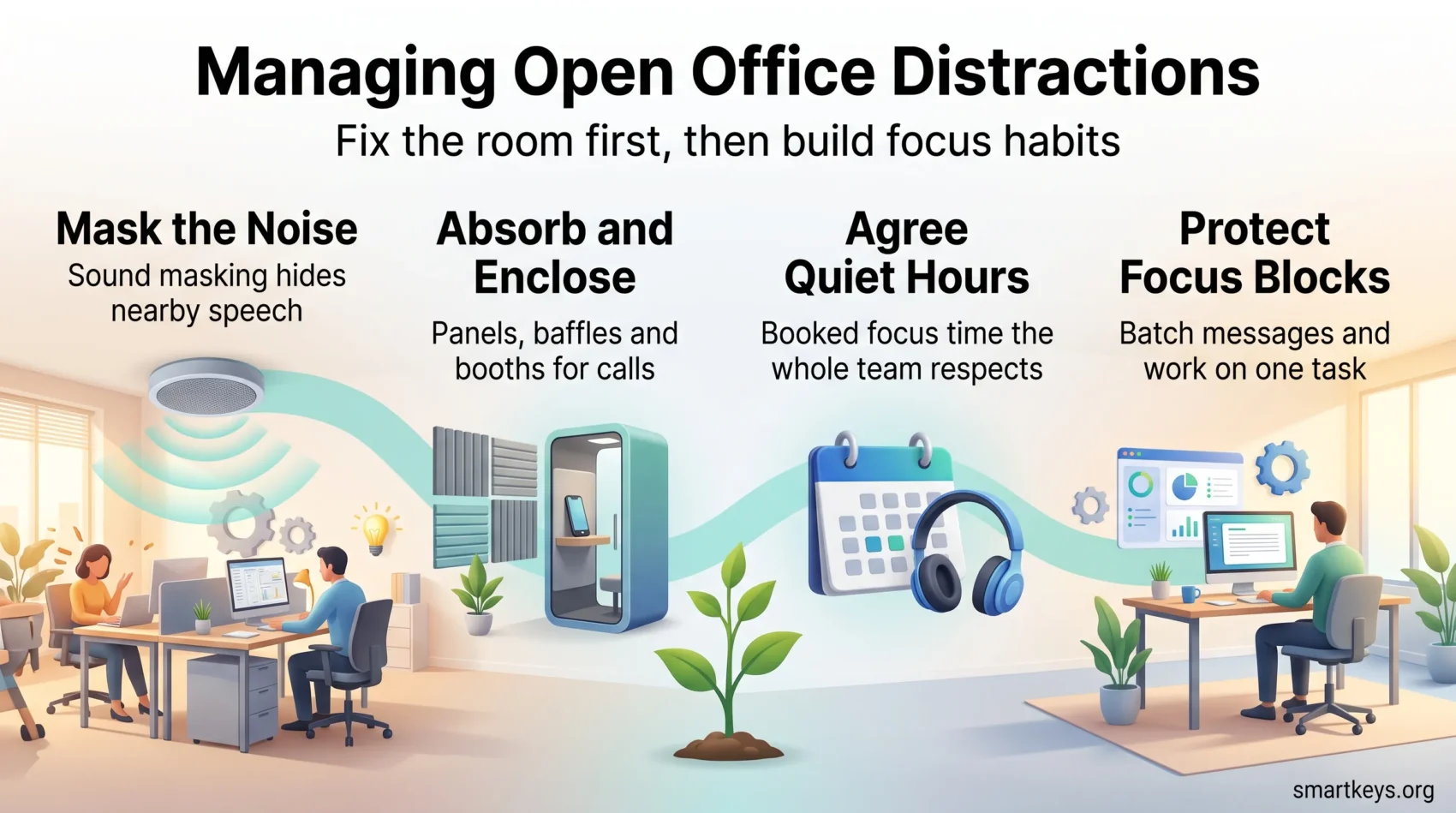
Three interventions have the best evidence behind them. Sound masking adds a low, engineered background sound that raises the threshold at which nearby speech becomes intelligible; systems such as Biamp’s Cambridge Qt range are built for this. Absorptive materials such as ceiling baffles, wall panels, soft flooring and screens reduce how far speech travels. Enclosed pods and booths, of the kind Framery and its competitors make, give people somewhere to take a call without broadcasting it. Used together they change the room; alone, each is partial.
Effective Work Habits for Enhanced Focus
The room matters most, but your routine decides how much of the good hours you use. Start the day by deciding what would make it a success rather than by opening your inbox, and keep the list short enough to finish. If you are unsure which methods suit you, identify your productivity style before adopting someone else’s system wholesale.
Protect a focus block. One or two uninterrupted stretches, scheduled in your calendar rather than hoped for, do more than a full day of fragmented availability. Paul Graham’s distinction between the maker and manager schedule explains why a single badly placed meeting costs far more than its thirty minutes, and there are focus management techniques that make those blocks hold. A short written parking list for anything that interrupts you costs seconds and saves the thread you were holding, which is also the fastest way to close open loops instead of carrying them around.
Talk to the people around you. Most interruptions in an open office are well-intentioned and easy to redirect once colleagues know when you are available. Short regular check-ins cut the taps on the shoulder more effectively than any headphone signal, and that shared understanding is what genuine workspace optimization rests on.
Open Office Productivity: Strategies to Improve Concentration
Two agreements do most of the work in a shared space: a shared quiet period, and a clear personal signal.
Establish Quiet Hours Among Colleagues
Designating quiet hours removes the social cost of not responding. When a team agrees that the first two hours after standup are for heads-down work, nobody has to decide individually whether ignoring a question is rude. Make it specific, put it in the shared calendar, and let managers model it. A vague aspiration to respect focus time fails; a booked block usually holds.
Utilize Noise-Canceling Headphones
Active noise cancellation is very good at steady sound and only partly effective against speech, which is what actually disrupts concentration. That is why many people add masking audio underneath: instrumental music, rain or brown noise. Headphones also carry a social function that matters as much as the acoustics, since they are the most widely understood do-not-disturb signal in an office. Agree as a team what they mean, so everyone reads the signal the same way.
Designing your Workspace for Reduced Distractions
Layout decisions outlast every individual coping strategy, and cost less than people assume.
Implementing Physical Barriers
Desk screens and dividers do two things at once: they absorb some sound and they cut the line of sight that makes every passing colleague a potential interruption. Height matters more than material, and a screen sitting below seated eye level mostly decorates. Storage units, planting and acoustic partitions break a long open run into smaller zones without construction work.
Creating Designated Quiet Zones
A quiet zone only works if the rule is explicit and socially enforced: no calls, no conversations, library norms. Place them away from circulation routes, kitchens and meeting rooms, and give the floor a matching space for the opposite behaviour, otherwise the talking simply relocates. Involving the people who will use the zones in setting the rules is what makes them stick.

Time Management Techniques to Increase Productivity at Work
Time management in an open office is mostly about reducing the number of switches you make, because each one costs more than it appears to.
Gloria Mark’s longitudinal research at UC Irvine found the average time people spend on a screen before switching fell from about two and a half minutes in 2003 to 75 seconds in 2012 and to roughly 47 seconds in recent years, with a median of 40 seconds. Microsoft’s June 2025 Work Trend Index reported interruptions every two minutes during core hours, around 275 times a day, from meetings, emails and chats.
Three habits push against that. Batching similar work, so email, approvals and messages happen in defined windows rather than continuously. Timeboxing, where a task gets a fixed slot rather than an open-ended intention, which is the practical use of Parkinson’s Law. And deliberate single-tasking, since frequent task switching quietly consumes the time it appears to save.
Keep the daily list short: five to nine items you can realistically finish beat a comprehensive list you cannot, and a not-to-do list is often the faster route to a workable day. Plan around your energy too, since the post-lunch dip is physiological and there are practical afternoon slump cures worth scheduling around rather than fighting.
What Employers Can Change
Individual tactics have a ceiling, and in a badly designed room that ceiling is low. Measure before rebuilding: a short survey asking where people go to concentrate, and how often they fail to find anywhere, identifies the problem faster than a floor plan review. Then match the space to the day. If hybrid policy pulls everyone in on the same two days, the floor hits peak density exactly when calls and collaboration peak, and staggering team days removes that pinch point at no cost.
Set norms in writing, covering which spaces allow calls, what quiet hours mean and how meeting-free blocks are protected, because norms that live only in culture erode with every new hire. Watch the digital layer as well, since tool sprawl and constant pings generate their own interruptions regardless of the acoustics. Some organisations add company-wide unplug periods, which work when leadership takes part and fail when it does not.
Tools That Reduce Digital Noise
The distraction that matters most in an open office often arrives through a screen rather than through the air, so tooling deserves the same attention as acoustics. Start with notifications, the highest-yield setting in any workplace stack. Most teams tolerate defaults that were never designed for their rhythm, and simply tightening what is allowed to interrupt you removes a large share of daily interruptions. Chat platforms make this easy with status, do-not-disturb schedules and per-channel rules, but only if the team agrees on what a reasonable response time actually is.
For the pull side of distraction, a blocker helps: tools such as Freedom cut access to your worst time sinks across devices during a focus session, and a short review of the available website blockers is enough to pick one. Beyond that, a small set of focus tools beats a large one, since every extra app is another thing to check.
Developing Personal Strategies to Boost Productivity Levels
The habits that survive contact with a real office are matched to how you actually work rather than to an ideal you admire.
Find your peak hours and defend them. Most people have a window of one to three hours where difficult work is genuinely easier, and spending it on email is the most expensive routine mistake in knowledge work. Shallow tasks can move to the noisier parts of the day.
Treat concentration as trainable. The steps to extend your attention span are unglamorous: fewer inputs, longer sessions, deliberate recovery. The same logic underpins deep work as a practice rather than a good day you occasionally get. Once a week, note which blocks held and which collapsed; two or three specific fixes beat a resolution to focus harder.
Conclusion
Managing distraction in an open office is a design problem before it is a discipline problem. Removing walls did not increase collaboration, noise remains the loudest complaint employees have about their workplace, and interruption rates have climbed to a point where uninterrupted work has to be created deliberately rather than assumed.
That points at a sequence. Fix the acoustics and zoning, which set the ceiling for everything else. Agree the norms, because a shared rule beats a private strategy. Then build the routine that turns a workable room into a productive day.
Found this useful?
Make SmartKeys a preferred source on Google, and our articles will surface more often in your Top Stories, AI Overviews, and AI Mode.
Add as Preferred Source