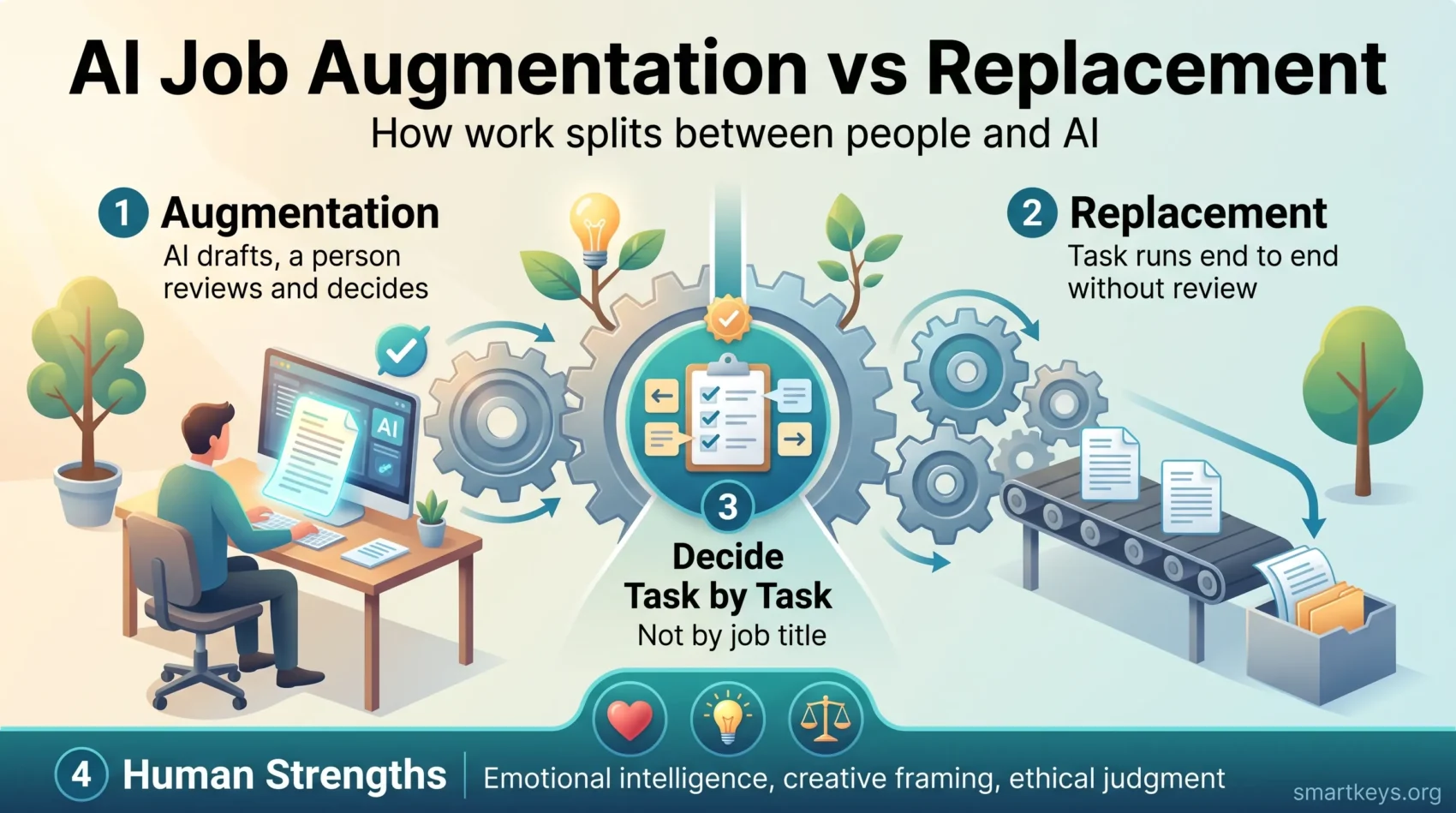
AI job augmentation means using software to make a person faster or better at their work, rather than removing the person from the process. Replacement is the other option: the task runs end to end without anyone in the loop. Almost every practical decision a manager or an employee makes about AI in 2026 sits somewhere between those two ends.
The headline question, whether AI is taking jobs, has a clearer answer now than it did two years ago. Three separate bodies of evidence point the same way. The mix of jobs in the economy is changing at a fairly ordinary pace. Productivity and pay are rising fastest where AI has taken hold. And actual tool use is far narrower than the risk models predicted.
This guide walks through what that evidence says, where it is weaker than the headlines suggest, and what to do with it. You will find a task-mapping method, a way to measure whether a pilot worked, and the compliance dates that now apply in the EU.
Key Takeaways
- Occupational change since late 2022 looks similar in pace to earlier technology waves, not like a sudden collapse.
- PwC measured a 62% pay premium for AI skills in 2026, up from 57% a year earlier.
- Exposure scores predict where AI could help. They are a poor guide to where it is actually being used.
- Entry-level work is the part of the market showing the clearest strain.
- EU transparency duties for AI systems apply from 2 August 2026, while the rules for AI in hiring were pushed back to December 2027.
Augmentation and Replacement: What the Difference Really Means
Augmentation keeps a person in the decision. A lawyer reads a contract summary the model produced, then decides which clauses to challenge. A support agent edits a drafted reply before sending it. The software does the first pass; the human owns the outcome.
Replacement removes that step. A password reset handled entirely by a bot, an invoice matched and posted without review, a report generated on a schedule and emailed to nobody’s desk in particular. Nothing is inherently wrong with either. The mistake is choosing between them by job title instead of by task.
Why Tasks, Not Job Titles, Decide the Impact
Every job is a bundle of activities. A marketing manager writes copy, briefs an agency, reads performance data, sits in planning meetings and handles a budget. Those five activities have five different levels of AI exposure, meaning how much of the work a model could realistically take over. Averaging them into one score for “marketing manager” hides everything useful.
The most cited study on this, published by OpenAI researchers in Science, took exactly that task-level approach. It estimated that around 80% of US workers could have at least 10% of their tasks affected by large language models. Roughly 19% could see at least half their tasks affected. Read the second figure carefully. It describes what a model could plausibly speed up, not what any employer has done.
So the practical unit of analysis is the task. That is also the unit you can act on. You cannot pilot a job title, but you can pilot the weekly reporting pack.
“The same job title can carry very different exposure across two teams in the same company.”
What the Labor Market Data Actually Shows in 2026
The jobs apocalypse has not arrived, and the reason is worth understanding rather than celebrating. Adoption of AI tools has been fast. Redesign of actual work has been slow, and redesign is what moves employment numbers.
Researchers at the Budget Lab at Yale have been tracking the composition of the US labor market since ChatGPT launched, using Current Population Survey data. Their update covering November and December 2025 found no substantial acceleration in the rate at which the job mix is changing. The mix is shifting, but the shift started around 2021, before generative AI reached the public, which makes it hard to pin on the technology.
The Occupational Mix Is Moving at a Normal Pace
Brookings reached a similar conclusion from a different angle. The share of US workers in jobs with high, medium and low AI exposure has stayed remarkably steady since late 2022. When the same researchers looked at people who had lost jobs, they found no pattern of higher AI exposure among them.
That is a genuine finding, and it has a genuine limit. Both teams are measuring what has already happened in aggregate. Neither claims the picture holds for the next three years. If your plan depends on nothing changing, this data does not support it.
Early-Career Work Is the Part Under Strain
One signal keeps surfacing. Entry-level roles are being reshaped faster than the rest of the market.
PwC’s 2026 Global AI Jobs Barometer found that entry-level jobs in AI-exposed fields are seven times more likely to ask for skills that used to appear in senior postings, such as leadership, judgment and creative problem solving. Those “seniorised” entry roles have grown 35% since 2019. Other entry-level roles fell 10% over the same period.
The Yale data adds a caution. Comparing recent graduates aged 20 to 24 with slightly older peers, the researchers found the two groups doing meaningfully different work. But the gap is not widening in the way an AI-driven squeeze would produce. A soft hiring market explains part of what people are seeing.
Both things can be true. The first rung of the ladder is being rebuilt rather than removed, and the rebuild asks more of the people standing on it. If you manage juniors, our guide to how humans and AI share the work in hybrid jobs covers what those redesigned roles look like in practice.
Exposure Scores Versus Real Usage
The single most useful thing to know about AI exposure research is that it does not describe adoption. Exposure is a forecast of technical possibility. Usage is what people actually do.
The gap between them is large. Brookings noted that coding and writing dominate real AI use, while heavily exposed professions in regulated fields, law, finance and medicine, show comparatively little adoption. Privacy rules, liability and internal governance slow those sectors down regardless of what a model can do.
Anthropic’s Economic Index, which analyses anonymised usage of its own assistant, shows the same skew from the vendor side. In its June 2026 report, computer and mathematical occupations accounted for around 30% of survey respondents, against roughly 4% of US employment. Transportation, food service and construction were heavily underrepresented. The report also found that 93% of conversations produced an identifiable artifact: an explanation, a document, a set of instructions. These are drafting and thinking tools first.
What to Do With That Gap
Treat exposure research as a prioritisation hint and your own telemetry as the truth. Concretely:
- Use exposure findings to pick which three tasks to pilot, not to forecast headcount.
- Measure cycle time on those tasks before you start, so you have a baseline to compare against.
- Log what people accepted, edited and rejected. Edit rate is the clearest early signal of whether output quality is good enough.
- Compare tools on the same task rather than on benchmark scores, because performance varies by domain and prompt style.
A digital skills gap analysis is a sensible companion exercise here, since it tells you which of those pilots your team could actually run today.
Productivity and Pay: Where the Gains Are Landing
PwC’s 2026 Barometer is the most detailed public dataset on this, and its central message is a widening split rather than a uniform lift.
Between 2018 and 2025, sectors most exposed to AI recorded 34% productivity growth, against 24% for the least exposed sectors. That is a real gap, though not a revolution. The interesting number sits inside it: among the top fifth of AI-exposed firms, labour productivity grew 163%. The average conceals a small group of companies pulling far ahead.
Employment in those exposed companies grew too. Headcount at the most AI-exposed firms rose 52% against a 2018 baseline, compared with 36% at the least exposed. That runs against the intuition that AI-heavy firms shed staff.
The 62% Skills Premium
Workers who can demonstrate AI skills earned a 62% wage premium in 2026, up from 57% the year before. Postings for AI-specific roles grew 69% while the overall job market grew 9%.
The premium varies enormously by sector, from 118% in consumer markets down to 16% in government and the public sector. If you are deciding where to invest your own learning time, that spread matters more than the headline average.
The Two-Track Split
PwC’s framing is worth borrowing. Some roles are being “professionalised”: AI raises what the job demands, the work becomes more skilled and pay rises with it. Others are being “democratised”: AI lowers the barrier to entry, more people can do the work, and wage growth flattens. Professionalised roles showed twice the job growth and 42% faster salary growth.
Neither track is a moral judgment. But knowing which one your role is on tells you whether to invest in depth or in breadth. Our guide to upskilling and reskilling covers how to build that plan, and measuring upskilling ROI covers how to prove it worked to whoever signs the budget.
Who Is Most Exposed Right Now
Exposure clusters in middle-to-high-wage cognitive work, and in clerical tasks that are standardised enough to document.
- High exposure, high upside: software, data analysis, business and finance, law, media and marketing. Lots of structured text in, structured text out.
- High exposure, slow adoption: clerical and back-office processing. Technically very automatable, often blocked by legacy systems and audit requirements.
- Lower near-term exposure: skilled trades, construction, care work, hospitality. Physical presence and judgment in unpredictable settings remain hard to replicate. Automation in blue-collar jobs looks at where robotics changes that picture.
- Mixed: customer-facing service roles, where the documentation and drafting parts are highly exposed but the relationship parts are not.
Being in a high-exposure category is not bad news on its own. The same PwC data shows exposed sectors adding both productivity and headcount. What changes is the composition of the working day.
The Skills AI Does Not Replace
The human share of a job is not whatever is left over once the software has done its part. It is a specific set of abilities that current tools handle badly, and it decides which way a role tips.
Three stand out in almost every task map:
- Emotional intelligence: reading how a colleague or customer is really doing and responding to it. A model can flag a frustrated message, but it cannot rebuild trust after a bad week or calm a tense negotiation.
- Creative framing: deciding which problem is worth solving in the first place. Tools generate options quickly. Choosing the question and spotting the unusual answer is still human work.
- Ethical judgment: weighing a decision that affects people, such as a dismissal, a credit refusal or a diagnosis. Someone has to be accountable for the call, and software cannot carry that responsibility.
Employers are pricing this in. The World Economic Forum’s Future of Jobs Report 2025 names analytical thinking as the most sought-after core skill, rated essential by seven in ten companies, followed by resilience, flexibility and agility. The PwC finding above points the same way: the entry-level roles that grew are the ones asking for judgment and leadership.
There is a catch. Leaning on AI can weaken the very skills that keep you valuable. A 2025 survey of 319 knowledge workers by Microsoft Research and Carnegie Mellon University found that the more people trusted the tool, the less critical thinking they reported applying. So keep one step in every AI-assisted task where you check, question and decide yourself. Our guide to soft skills for the future of work covers how to build these abilities deliberately.
A Playbook for Employers
Designing for augmentation is mostly an operations problem, not a technology problem. The four steps below are in order for a reason: skipping the first makes the rest guesswork.
1. Map the Tasks
Pick one team. List what they actually do in a typical week, at the level of “produce the Monday pipeline report” rather than “reporting”. Aim for 20 to 40 items. Then score each on three things: how often it repeats, how easily an error would be caught, and how much time it consumes.
The candidates for a first pilot are the items that repeat often, are easy to check, and eat real hours. Leave anything with legal, safety or ethical weight for later, when you have evidence and a review process.
2. Pilot With Guardrails
Set the accuracy threshold before you start, and write down what happens if the tool falls below it. Decide who reviews the output and what they are accountable for. Keep a human decision point on anything affecting a customer, an employee or money. If you want a working model for those decision rights, our guide to setting up human-AI collaboration in a team walks through roles, a pilot roadmap and the KPIs to track.
Data handling deserves an explicit rule rather than an assumption. Write down which systems staff may paste company information into, and which they may not. Our template for generative AI usage guidelines covers the clauses most policies miss, and an AI governance model sets out who owns the decisions once you scale past one team.
3. Reskill Against Real Tasks
Generic AI training produces enthusiasm and little else. Training tied to the tasks you mapped in step one produces artifacts you can look at.
Short, repeated sessions built around the team’s own work beat a one-off workshop. Our guide to building a microlearning strategy covers the format, and mid-career retraining deals with the harder case of experienced staff whose core skill is the part being automated. Where the work is reshaped rather than removed, automation redeployment covers moving people into adjacent roles instead of out of the door. An internal talent marketplace makes those moves visible to the people who would take them.
4. Track Value Honestly
Pick metrics before the pilot and keep them stable. Four usually suffice: time to complete the task, error or rework rate, throughput, and revenue per employee for the team as a whole.
Then hold yourself to the comparison. If the drafting step got 40% faster but review now takes twice as long, the process did not improve. That result is common enough that measuring only the first half of the workflow is the most frequent way pilots produce fake wins. Broader data literacy across the team is what stops those numbers being read badly.
“Measure the whole workflow, not the step you automated.”
A Playbook for Your Own Role
The individual version of this is simpler and takes about a month.
Start with two tasks you do at least weekly and dislike. Common candidates: turning meeting notes into a summary someone will read, writing the first version of a recurring document, cleaning a data export, drafting code tests. Pick things where you can judge the output yourself, because you will be the reviewer.
Build a reusable prompt for each one rather than starting fresh every time. Save it somewhere you will find it. Note how long the task took before and after, roughly. Precision is not the point; direction is.
Then do the part most people skip. Write down what changed, with a number attached. “Cut the monthly report from four hours to ninety minutes, same review comments from finance” is a sentence that belongs in a performance review. “I use AI a lot” is not. The 62% premium PwC measured attaches to demonstrated skill, and demonstration means evidence.
Keep one habit alongside it: check what the model gives you. Confident wrong answers are the failure mode that damages credibility fastest, and the person who sent the output owns it.
The Rules You Now Have to Work With
The EU AI Act’s transparency obligations took effect on 2 August 2026, and they reach ordinary employers, not just AI vendors.
From that date, people must be told when they are interacting with an AI system unless it is obvious. AI-generated or manipulated audio, image, video and text must be marked in a machine-readable format. Anyone subject to an emotion recognition or biometric categorisation system must be informed. Deepfake content has to be disclosed. Penalties reach 15 million euros or 3% of worldwide annual turnover, whichever is higher.
The high-risk rules, which cover AI used in recruitment, promotion and performance evaluation, were pushed back. Under the Digital Omnibus agreement, obligations for Annex III high-risk systems now apply from 2 December 2027, with high-risk systems embedded in regulated products following in August 2028. That is a delay, not a cancellation, and it gives compliance teams a longer runway rather than a way out. Our breakdown of EU AI Act compliance maps the tiers and dates in full.
Two related areas deserve the same care. If you use AI in hiring, AI hiring tools and AI employee monitoring cover the rules and the evidence on what these systems actually do. And where software starts allocating work or scoring performance, algorithmic management examines what happens to trust when it does.
Worker Voice Is a Design Input, Not an Obstacle
Involving the people who do the work in pilot design is not a courtesy. It surfaces the failure modes early, when they are cheap to fix, and it reduces the quiet non-adoption that kills rollouts.
Practical version: ask the team which parts of their job they would happily hand over and which they would not, before you choose the pilot. The answers are usually more accurate than the exposure scores. Where formal representation exists, worker organising in tech has shaped how monitoring and evaluation clauses get written.
Conclusion
The evidence supports urgency about skills and patience about headcount.
Nothing in the 2026 data suggests AI is emptying offices. It does suggest that pay, productivity and opportunity are separating between people and firms that redesigned their work and those that only bought licences. That separation is a slower story than mass unemployment, and a more consequential one for most careers.
The practical move is small and specific. Map the tasks in one team this month. Pilot two of them with a measured baseline. Write down what changed. Everything else in this guide, the governance, the reskilling, the compliance work, follows from having that first honest measurement in hand.
For the wider picture, see our overview of AI and automation at work. If you are planning your own transition, start with this adaptation guide and the practical AI assistants guide.
Found this useful?
Make SmartKeys a preferred source on Google, and our articles will surface more often in your Top Stories, AI Overviews, and AI Mode.
Add as Preferred Source