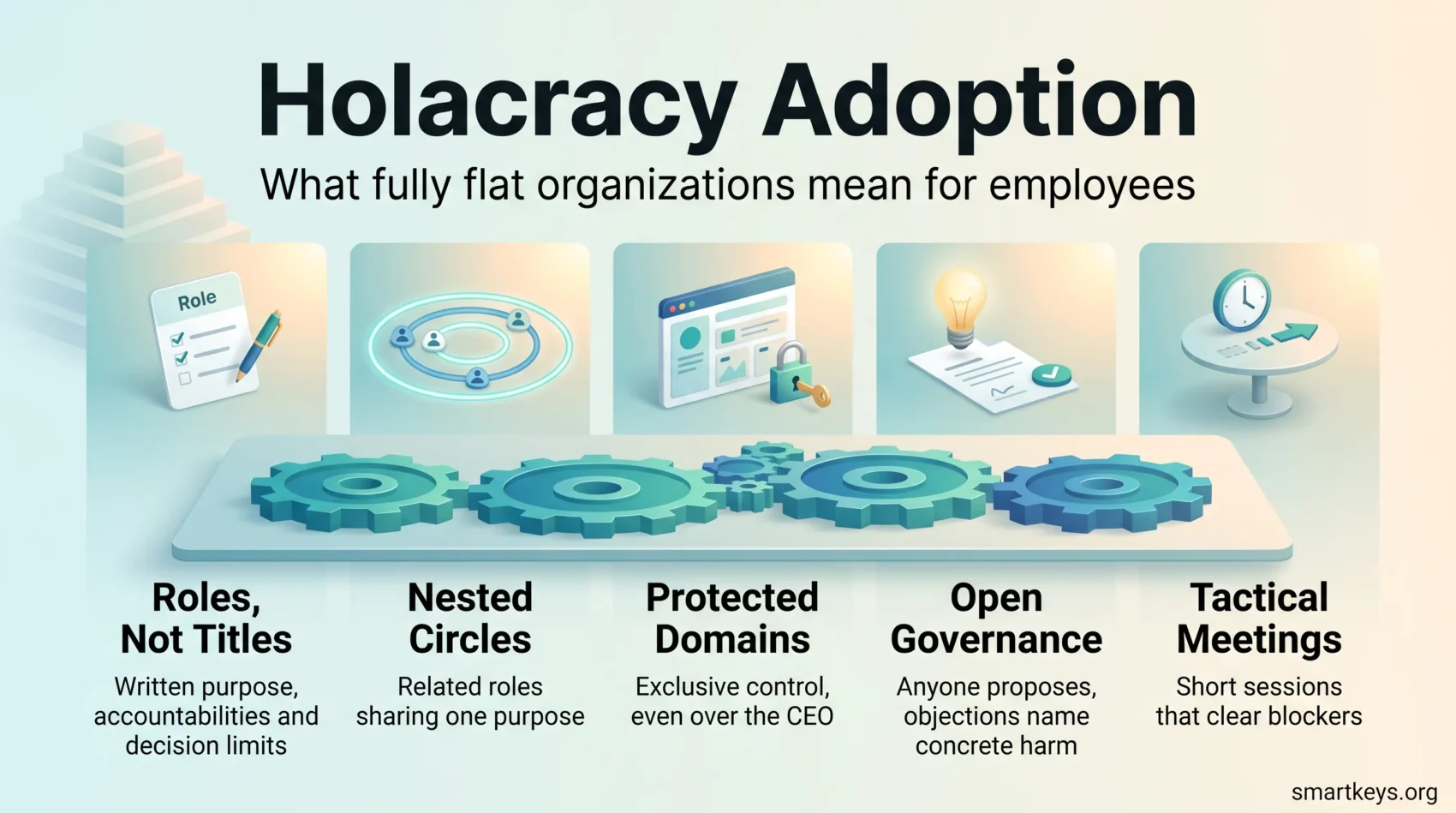
Holacracy trades vague job titles for clear, written roles. Holacracy is a governance system: a fixed set of rules that says who decides what, how those decisions get made, and how the structure itself can be changed. Instead of a job description that says “Marketing Manager,” you get named roles with a written purpose, a list of accountabilities, and explicit decision limits.
That single swap changes how your day works. Tasks belong to roles, so responsibilities become visible, searchable, and easy to hand over. Domains give one role exclusive control over a specific asset. A Website Manager truly owns the site, and even a CEO has to ask before changing it.
Short tactical meetings and a small rule set keep leaders informed without letting them direct every decision. You lead your role with real authority, work inside clear guardrails, and stop waiting on approvals.
The practical effect for employees is simple. You can find who to ask, argue about work instead of status, and treat management as a set of written accountabilities rather than a person. For the process side of that, writing down how work actually gets done, see our guide to standard operating procedures for team productivity.
Key Takeaways
- Roles replace titles, so responsibilities become visible and actionable.
- Domains protect critical assets and limit overrides from leadership.
- Tactical meetings focus on blockers and transparency, not status theater.
- You gain authority to act in your role while following clear, written rules.
- In 2026 the label matters less than the mechanics. Most companies now borrow Holacracy’s parts without adopting the whole system.
- Flattening without written accountabilities is the failure mode to avoid.
Holacracy in 2026: Where Fully Flat Organizations Actually Stand
If you are reading about Holacracy in 2026, it is probably because your own company is getting flatter. That context matters, because the numbers have moved a long way since Zappos made the term famous.

The corporate middle is being compressed. Korn Ferry surveyed 15,000 workers across ten countries. In the US, 44% said their employer had removed management levels, and 40% said they now lack direction as a result. Among senior executives at US companies, 72% reported feeling stretched beyond their capacity by those cuts. The work did not disappear with the managers; it landed somewhere else.
Span of control means the number of people who report to one manager. Gallup, drawing on Bureau of Labor Statistics data, put the US average at 12.1 direct reports in 2025, up from 10.9 in 2024 and 8.2 in 2013. One caveat is worth knowing: the median has stayed at five or six, and about two-thirds of managers still lead fewer than ten people. A minority of very large teams is pulling the average up.
The trend has a name now: the Great Flattening. In 2024, Gartner projected that through 2026 one in five organizations would use AI to flatten structure and remove more than half of their middle-management positions. Two years on, the measurable change is less dramatic than that headline and more awkward. Teams got bigger. Coordination work moved rather than vanished. MIT Sloan researchers found spans stretching from a historical norm of about seven to as high as fifteen in divisions running AI agents at scale.
Why this puts Holacracy back on the table
Removing a layer of managers removes the people who used to answer three questions every day. Who decides this? Who owns that? What happens if we disagree? Holacracy’s core contribution is that it answers all three in writing, before the layer disappears.
That is the practical case for studying it in 2026 even if you never adopt the full system.
Flat vs. hierarchical: the basic trade-off
A hierarchical structure is the classic pyramid. The CEO sits at the top, several management layers sit below, and every level knows who approves its work. A flat structure removes most of those middle layers and pushes decisions down to the teams doing the work.
Neither model wins by default. Each one buys you something and costs you something.
- Hierarchy buys clarity. Reporting lines, promotion paths, and approval rights are obvious, which makes onboarding easier and helps in regulated work. The price is slower cross-team decisions, extra approval steps, and higher management cost.
- Flat structures buy speed. Fewer handoffs mean faster decisions and more direct communication. The price, especially as headcount grows, is role ambiguity and people who are unsure who has the final say.
- Size and type of work decide the fit. A 20-person product team can often run flat on conversation alone. A 2,000-person operation with audit and compliance duties usually cannot.
Holacracy is an attempt to keep the speed of a flat structure while rebuilding, in writing, the clarity that hierarchy used to provide. Three lessons follow for anyone flattening today:
- Flattening is now the default, not the experiment. The question is no longer whether to remove layers but what replaces them.
- Coordination work does not vanish. It moves, often upward into chief-of-staff style roles, unless roles absorb it explicitly.
- Written accountabilities are the cheap insurance. They cost a governance meeting; ambiguity costs months.
Why You’re Exploring Holacracy Now: Intent, Fit, and What’s at Stake
Most people arrive at this topic with a specific irritation: decisions sit in a queue, and nobody can say who owns the outcome. You want a system that aligns your organization around purpose and cuts that friction without adding another layer of management.
Think carefully about the shift in authority. Moving from title-based power to role-based authority changes how employees and managers interact. Roles make responsibilities explicit, so your team knows who can act and when to escalate.
Structural change then runs through a decentralized process. Anyone can propose an update to a role or a policy, and objections act as safety checks so change does not derail daily work.
What is at stake is whether the system speeds up decisions close to the work, or creates new confusion because roles and accountabilities were never properly defined.
- Fit signals: cross-functional collaboration and a willingness to separate identity from role.
- Support needed: training, disciplined meetings, and time to keep governance light and useful.
- People impact: less reliance on a single manager, more authority for role-holders to move work forward.
- Risk balance: decentralized proposals with objection checks shift power without freezing change.
Holacracy Adoption: Start Small, Learn in Public
Shifting an organization to clear roles and written governance is a learning process, not a launch date. Practitioners who have guided hundreds of teams describe the framework as a toolbox rather than a blueprint.

Start small. Run governance and tactical meetings in one team, write a few high-impact roles, and test changes against real friction in your work. Two meeting types do the heavy lifting here. A governance meeting changes the structure itself: roles, accountabilities, policies. A tactical meeting changes nothing structural; it clears blockers and re-prioritizes the week.
Plan for learning time. People need space to practice. Early meetings will feel awkward and slow. Over a few months they cut confusion and speed up decisions.
- Pilot one circle, run a few governance rounds, then adjust.
- Define early roles around critical work and write clear accountabilities.
- Set milestones: first governance cycle, a cross-team policy, your first delegated domain.
- Measure something: decision cycle time, escalations per week, or handoff rework.
Pick the pilot group with care. Look for people who communicate clearly, manage their own time well, and can live with some ambiguity. One or two internal advocates who can show visible progress within a few weeks make the case far better than any slide deck.
Scaling from one circle to many
The rules scale because they are rule-based rather than chart-based. The same processes apply to a startup and to a division of 5,000 people, which makes training repeatable and outcomes easier to predict.
Run several circles as live pilots so people learn the meeting rhythms on real problems. Invest in internal coaches who sit with circles during the work rather than running theory workshops. Teach managers to shift from gatekeeper to context-setter, a transition we cover in our look at whether AI is making traditional managers obsolete.
- Phase the rollout: enable, practice, measure, then expand.
- Track outcomes: cycle time, role clarity, and fewer handoff issues.
- Leaders sponsor: they remove blockers, model participation, and fund training.
- Let roles evolve: avoid overdesign until teams gain experience.
From Blueprint to Toolbox: The Holacracy Framework and Constitution
The constitution is the rulebook. It is a compact document, currently version 5.0, that an organization formally adopts so everyone works from the same expectations. Think of it less as a mission statement and more as the rules of a sport: it tells you how play proceeds, not which team you should field.
The rules define roles, policies, governance steps, and meeting processes. They do not dictate your org chart, the number of circles, or how you group teams.
A rule-based system that increases flexibility
Consistent rules free people to act. You stop asking for ad hoc approvals and start making decisions inside clear guardrails. Nobody has to guess whether a call is theirs to make.
What the constitution does not prescribe
The constitution provides building blocks and a process, not a single design. Two companies running the same rulebook can look nothing alike on paper. That variation is evidence of adaptability, not inconsistency.
Purpose as the north star for structure
Let purpose guide choices about roles and structure. When you test options, ask one question: does this move the organization closer to its aims?
“The system is empty until you fill it with your roles, policies, and purpose-driven decisions.”
- Anyone can trigger the process to evolve structure when something is not working.
- Pair the rulebook with lightweight documentation so new hires can find answers themselves.
Roles, Circles, and Domains: Redesigning Your Organizational Structure
Three words carry most of the model. Get them straight and the rest follows.
Roles: work defined as function, not job title
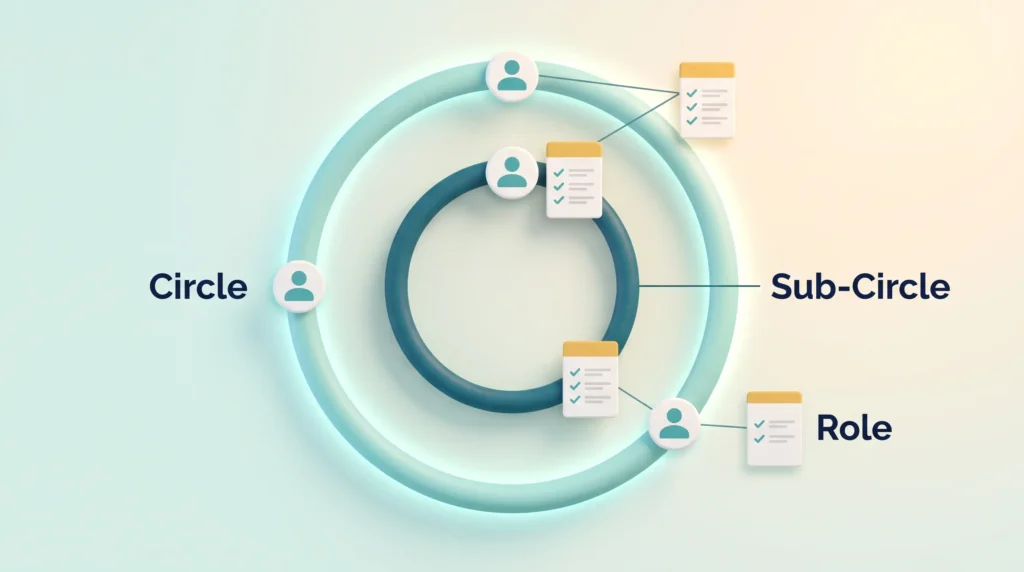
A role is a unit of work written around a function such as Invoicing, Content, or Vendor Contracts. Each role lists its purpose, its accountabilities, and its decision limits. When you look up a role in the directory, you see who to ask and what you can expect from them. Titles become optional, and people can hold several roles at once.
Circles: nested teams with shared accountabilities
A circle is a group of related roles that owns a purpose together, roughly where you would expect a team or department. A circle can contain sub-circles. Because a circle holds accountabilities rather than headcount, overlaps between teams become visible instead of being negotiated in private.
Holding several roles without burning out
You can hold multiple roles in different circles. That only works with explicit priority agreements: flag conflicts in a tactical meeting early rather than quietly absorbing them. Companies that run an internal talent marketplace often find role-based structures easier to staff, because skills and openings are already described in the same language. The same is true of a deliberate cross-training strategy, where coverage is planned rather than improvised.
Domains: exclusive control, even over the CEO
A domain is an asset that one role controls exclusively: a website, a pricing table, a customer database. The Website Manager owns the site, and the CEO has to request a change like anyone else. This is the part that surprises people most, and it is the mechanism that prevents quiet overrides.
- Split broad roles: break a bloated role into two focused ones so work actually gets done.
- Make authority explicit: publish domains so anyone can see who controls what.
- Check capacity: list every role a person holds and set realistic priorities.
What Bayer’s Dynamic Shared Ownership Teaches About Going Flat at Scale
The most instructive live experiment in flat organizing is not a startup. In January 2024, Bayer, a 160-year-old company with more than 100,000 employees, began dismantling its own hierarchy under a model it calls Dynamic Shared Ownership (DSO).
The mechanics rhyme with Holacracy, even though the label is different. Bayer reports cutting management levels by half and management positions by two-thirds, and describes a full shift from “span of control” to “span of coaching.” Annual budgets gave way to 90-day resource cycles. Thousands of small, self-directed teams took over decisions that used to climb several approval levels, and the internal rulebook was heavily pruned. Around 3,500 internal “DSO Champions” carry the model into local teams, and the company put roughly two billion euros of organizational savings between 2023 and 2026 on the target list.
Early signals are mixed but real. Bayer points to specific compressed timelines. A hemophilia solution was developed in 90 days rather than two years. A crop protection answer arrived in about half the usual time. A consumer health product reached the market in nine months. At the same time, the transition eliminated thousands of positions, most of them managerial, and managers have openly described anxiety about handing decisions to frontline teams.
Three transferable lessons
- Shift resources, not just reporting lines. Flattening only pays off if freed-up capacity lands on customer-facing work.
- Give teams a rhythm. Ninety-day cycles replaced annual planning and gave autonomous teams a cadence to re-prioritize against.
- Retrain the managers who stay. Their job becomes coaching and context-setting, closer to participatory management than to supervision.
Governance That Scales: How You Evolve Structure Together
Governance works when your team treats structure as a living thing rather than a one-time design.

Everyone can propose changes. Any person can suggest a new role, add an accountability, or update a policy. That removes single-point bottlenecks and spreads ownership across the organization. In practice it also replaces the annual reorganization with a steady trickle of small corrections.
Proposing a role or policy update
Use a simple submission format. Templates lower friction and make participation easier. Document each decision so later hires can see why a change was made, the same discipline that underpins strong organizational memory in distributed teams.
Objections are safety checks, not vetoes
An objection is a claim that a proposal would cause concrete harm, and it has to be reasoned. It forces a clarifying question or better wording rather than killing the idea. That distinction is what keeps governance fast while still protecting critical assets, and it sits close to the logic behind structured decision-making models.
Add an accountability or create a new role?
If a task fits the scope and workload of an existing role, add the accountability there. Create a new role when responsibilities grow, cross boundaries, or would overload one person.
- Example: add a rollout documentation policy before software releases.
- Model governance habits so roles reflect how your team actually works.
- Help managers shift from gatekeepers to contributors who refine structure with others.
Treat governance as your evolution engine: frequent small updates beat rare, disruptive reorganizations.
Circle Leads and Delegation: Authority Without Micromanagement
A Circle Lead sets strategy and clears obstacles instead of ordering day-to-day tasks. You get context, priorities, and resources from the lead. You keep control over how your role does the work.
What Circle Leads can and cannot do
Circle Leads assign people to roles, monitor performance, set priorities, and allocate resources. They can remove someone from a role when accountabilities are not met.
They do not hire or fire, set compensation, or dictate how you complete your work. Those decisions sit outside the Circle Lead’s remit, which keeps employment processes separate from governance.
Delegation happens in writing
Good delegation starts with written authority, not whispered expectations. When you add an accountability to a role or create a new role through governance, the handoff is explicit and visible to everyone. That principle also sits at the heart of effective delegation in conventional structures.
Control does not disappear; it becomes a published rule. A founder can let each business line design its own pricing while a Pricing Strategy policy requires sign-off from one coordinating role. Everyone can read where the boundary sits.
Strategy and role clarity instead of task direction
Written accountabilities replace micromanagement. When expectations are documented, you know which outcomes matter and can pick your own approach, the logic behind outcome-based work environments.
Use tactical meetings for fast updates, triage, and reprioritization. Keeping those sessions short is its own discipline: our meeting reduction playbook covers the mechanics, and much of the status reporting can move into asynchronous updates instead.
Visibility without surveillance
The duty of transparency lets a lead ask what you are working on, what comes next, and why. That gives visibility without eroding your authority over the work. Feedback then flows continuously rather than annually, much like continuous performance management. Gallup’s span-of-control research is blunt about why that matters. Managers who give meaningful weekly feedback see engagement of roughly 68% to 70% on their teams. Where feedback is rare, it sits nearer a quarter. That gap holds at almost any team size.
Autonomy with Guardrails: Rules That Protect Employees
Your role comes with real latitude and a few well-placed limits that keep things fair.

Authority to act and interpret your role
By default, you may act in any way that advances your role. If a request falls outside your accountabilities, you can decline and explain why. That protects employees from being quietly loaded up, and it lets the organization move faster.
Requests are not assignments
Work can be requested from your role, but it cannot be assigned to you without consent. That one distinction is what stops a flat structure from drifting back into task-directed habits within a quarter.
Constraints that create clarity
Three simple constraints balance freedom and safety: Circle Lead prioritization, spend approvals, and domain ownership. Openness about those rules is what makes them work, which is why a transparency culture tends to be a prerequisite rather than a nice-to-have.
- You operate with real autonomy while following shared rules.
- You use tactical meetings to align competing work and priorities.
- You protect other people’s work by asking before affecting their domains.
- You gain psychological safety through consistent expectations.
When roles collide: a path for resolving conflict
Tensions between people and roles are normal. A flat organization needs a predictable way to settle them, because there is no boss to call in. A simple three-step path works for most teams:
- Talk directly. The two people involved try to settle it in a short, private conversation.
- Bring in a mediator. If that fails, a colleague both sides trust helps them reach an agreement.
- Take it to a small panel. As a last step, a few people affected by the issue hear both sides and decide.
In Holacracy, many recurring clashes end up in governance instead. If two roles keep colliding, the fix is usually to clarify their accountabilities, not to argue the same case again. Basic training in facilitation helps. So does psychological safety, because people only raise a tension early when they expect to be heard rather than punished.
Where Holacracy Goes Wrong: Lessons from a Decade of Experiments
An honest 2026 guide has to include the failures, because they are well documented and they repeat.
Zappos remains the cautionary case. After the 2015 ultimatum to commit or take a buyout, roughly 18% of staff left. Employees described up to five extra hours of meetings per week while they learned the vocabulary and reorganized into circles. Zappos later moved toward a market-based model and today keeps some holacratic principles without running a pure Holacracy. Medium, an early high-profile adopter, dropped the system entirely.
The pattern in the failures is consistent. Process crowded out work. Roles overlapped. People spent more time debating how to work than working. And in Zappos’s case, a parent company subject to Sarbanes-Oxley, the US law that requires documented financial reporting lines, still needed formal reporting relationships underneath the flat surface. Legal and compliance structures do not disappear because an org chart does.
Warning signs to watch for
- Governance theater: meetings grow while decisions do not get faster. Measure cycle time, not attendance.
- Role sprawl: dozens of thin roles nobody can staff. Consolidate before adding.
- Hidden hierarchy: informal power reassembles around whoever ran things before.
- Career fog: without titles, promotion paths blur. Pair role clarity with explicit growth and pay logic, as in transparent pay frameworks.
- Overload: autonomy plus a doubled span of control is a recipe for exhaustion. Watch for the drivers of employee burnout.
What the lasting flat organizations have in common
Not every flat experiment fails. Valve, the game studio, has long described itself as a company without managers, where employees choose which projects to join. Buurtzorg, a Dutch home-care provider, runs on small, self-organizing teams of nurses supported by coaches instead of managers. Morning Star, a US tomato processor, asks colleagues to agree in writing with each other what they will deliver each year.
None of them runs Holacracy. What they share is the idea underneath it: decision rights are explicit, and they sit with the people closest to the work.
Your Team’s Lived Experience: Decisions and Daily Work
Everyday work feels different when authority maps to written roles instead of whispered instructions. You stop guessing who should act and start checking a directory that lists purpose, accountabilities, and domains.
You find who does what quickly by searching roles rather than pinging a manager. That cuts interruptions and speeds handoffs. Published domains and cross-team policies make boundaries visible, so fewer things fall between two teams.
You also move from asking permission to acting within your role’s authority. Tactical meetings give quick triage instead of long approval loops.
One caveat for 2026: when software starts routing tasks and flagging performance in a flatter structure, the guardrails around algorithmic management matter as much as the governance rules themselves.
- Accountability sharpens as requests go to roles with explicit scopes.
- Governance becomes the tool you use when structure does not fit the work.
- Managers focus on strategy and priorities, which supports employee autonomy.
Should You Adopt Holacracy, Borrow From It, or Skip It?
Most organizations in 2026 land in the middle option, and that is a legitimate answer rather than a cop-out.
Adopt the full system if
You have executive sponsorship, patience for a long learning curve, work that genuinely changes shape often, and a culture already comfortable separating identity from role.
Borrow the parts if
You are flattening anyway. Take the highest-value mechanics without the constitution: written accountabilities per role, published domains, a standing process for proposing structural change, and short tactical meetings. This is effectively what Bayer’s DSO and most self-managing team models do.
Two lighter tools are worth knowing at this stage. The first is the advice process, common in self-managing companies. Anyone can make a decision, but only after asking for input from people with relevant expertise and from those the decision affects. Nobody needs approval or full consensus, yet skipping the advice step is not allowed. The second is a hybrid structure. Keep clear reporting lines where compliance, finance, or safety demand them, and run product or discovery work in flatter teams. Then define where the two meet, so everyone knows when a decision has to go up.
Skip it if
Your work is stable and standardized, your compliance regime demands rigid reporting lines, or you cannot fund training. A poorly implemented flat structure is worse than a well-run hierarchy, and the executive layer keeps expanding regardless, as our look at emerging C-suite roles shows.
Conclusion
Shared rules give a company predictable freedom to experiment safely. The constitution turns vague power into clear processes that you fill with roles, policies, and purpose.
Start small: pilot a circle, invest in training, and refine accountabilities as you learn. That keeps structure aligned to real work over time. The system scales because it treats governance as iterative rather than final. Managers shift from directing work to shaping context, and explicit domains let people move fast without stepping on each other.
In 2026 the honest verdict is this: pure Holacracy remains a niche choice, but its core mechanics have quietly become mainstream inside the Great Flattening. If your organization is removing layers, the question is not whether to adopt Holacracy. It is whether you will write down who decides what before the layer disappears.
Found this useful?
Make SmartKeys a preferred source on Google, and our articles will surface more often in your Top Stories, AI Overviews, and AI Mode.
Add as Preferred Source