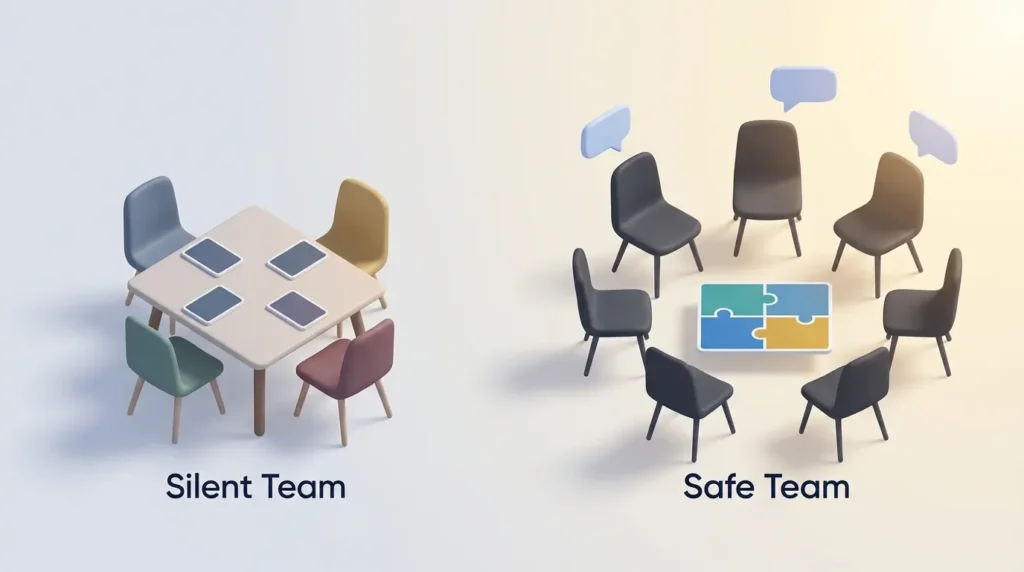
Picture a familiar meeting: everyone notices a serious problem, yet no one speaks. The group leaves with a polished plan and a costly blind spot. This gap between private concerns and public decisions can shape your results at work.
Psychological safety is a shared quality that grows within a team. It is not a personality trait, a management trick, or a vague workplace mood. It helps people ask questions, admit mistakes, and offer ideas before small issues become major ones.
Carl Rogers described something close to it in 1954, arguing that people do original work when they feel accepted and free from outside judgment. William Kahn brought the idea into organizational research in 1990. In 1999, Amy Edmondson gave it the definition teams still use and tied it to learning behavior and stronger performance.
The topic matters more in 2026. Gallup’s State of the Global Workplace 2026 report put global engagement at 20% in 2025, down from 21% and the lowest since 2020, after a peak of 23% in 2022 and 2023. Disengaged people stay quiet, and quiet teams are exactly the ones now being asked to adopt AI tools and admit what they do not yet know, which is why employee engagement trends and candor belong on the same agenda.
This guide shows you how to review team norms, model candor, invite participation, and connect accountability with learning. You will see how better communication supports more thoughtful decisions and healthier work relationships.
Key Takeaways
- Psychological safety is a team-level condition, not a personality trait. The same person can speak freely in one team and stay silent in another.
- It is not the same as comfort. Safe teams argue more, not less.
- Google’s Project Aristotle ranked it the most important of the five dynamics it found in its strongest teams.
- Only 39% of leaders rate their own organization’s psychological safety as very high, according to MIT Technology Review Insights.
- Accountability and safety reinforce each other. You cannot enforce a standard on a problem nobody reports.
What Is Psychological Safety at Work?
At work, psychological safety means you can raise questions, share ideas, request help, or admit mistakes without fear of humiliation or punishment. It creates a clear sense that honest input matters, even when your view challenges the group.
How Psychological Safety Differs From Trust and Comfort
Trust often describes one person’s belief about another person. Psychological safety describes how team members expect the wider group to respond. You may trust a colleague yet stay quiet when a manager makes a risky decision.
This approach does not make every conversation easy. You can feel comfortable enough to disagree, set ambitious goals, and discuss hard problems while treating colleagues with respect. A culture of open communication makes that kind of disagreement routine rather than risky.
What a Psychologically Safe Workplace Looks Like
A psychologically safe workplace shows four patterns: willingness to help, inclusion, learning from failure, and open conversation. In daily work, people might say “I don’t know,” flag a near miss (a mistake caught before it did any damage) while it is still small, or challenge an idea without making the discussion personal.
- Members ask for help before delays grow.
- Employees discuss mistakes and improve the process.
- Team members include different voices in decisions.
- Leaders welcome questions and thoughtful risk.
Why Psychological Safety Matters for High-Performing Teams
Psychological safety helps your team act with speed and care when conditions change. People can test ideas, coordinate across functions, and use different skills without hiding concerns. That openness supports better decisions in complex markets.
“The belief that this team is safe for interpersonal risk taking.”
Google’s Project Aristotle put the idea in front of a wider audience. Between 2012 and 2014 the company studied 180 of its own teams and roughly 250 attributes, and psychological safety emerged as the dynamic that separated the strongest teams from the rest. Two related norms stood out: people took turns speaking, and they read each other’s signals well.
Academic work points the same way. Edmondson and Lei’s 2014 review connected the condition with learning, innovation, and team performance. Frazier and colleagues published a meta-analysis in Personnel Psychology in 2017, pooling the results of 136 separate samples. It supported both the standard measure and its links to outcomes.
The value reaches beyond discussion. Carmeli, Reiter-Palmon and Ziv’s 2010 study in the Creativity Research Journal found that inclusive leadership relates to greater involvement in creative work, and that psychological safety is what carries the effect. Leaders who invite input do not make people creative directly. They make it safe to try, and the trying produces the ideas.
Diversity alone does not guarantee success. Caruso and Woolley’s 2008 research found that varied perspectives improve results only when people feel comfortable sharing them. A mixed team that never voices its differences performs like a uniform one, which is where diversity and inclusion efforts quietly stall. The same principle shapes everything from design thinking workshops to organizational design decisions.
Why It Matters More in the AI Era
AI adoption raises the cost of silence. A December 2025 MIT Technology Review Insights report, produced with Infosys Topaz, surveyed 500 business leaders. It found that 83% believed psychological safety measurably improves the success of AI initiatives, while only 39% rated their own organization’s psychological safety as very high. In the same survey, 22% said they hesitated to lead an AI project because they feared blame if it failed. Note who was answering: 73% of these leaders felt safe giving honest feedback themselves. The view from the top is usually the most comfortable seat in the building.
The pattern is familiar. People who worry about looking incompetent hide the failed prompt, the wrong output, or the workaround they invented. Your organization then plans its AI-supported collaboration on a picture of how the tools behave that nobody has corrected.
Leaders influence the climate, but daily behavior across the group is what makes it last.
Assess Your Team’s Psychological Safety
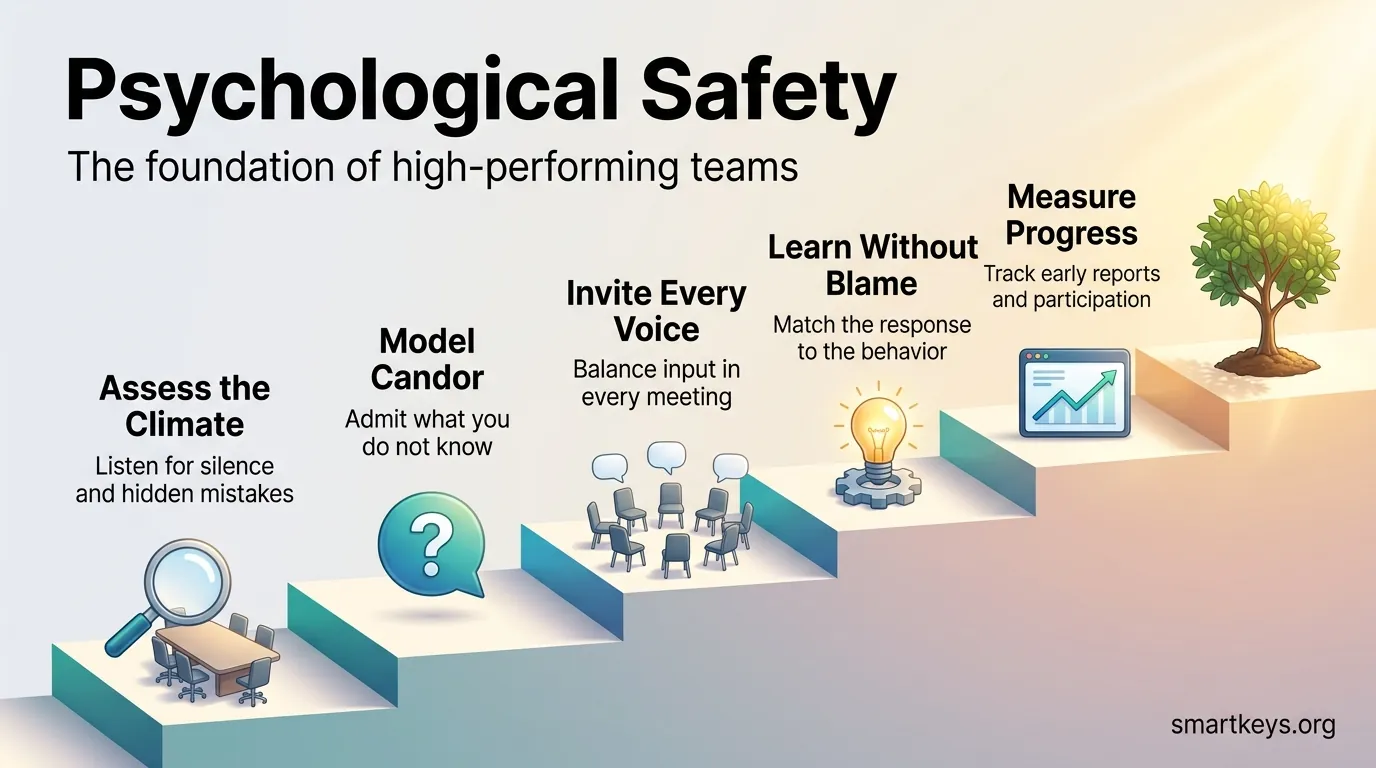
Before changing team habits, look for signals that reveal how people respond to risk. Quiet meetings may hide concerns, delayed problems, or private hallway conversations. These clues show whether employees can speak honestly at work.
Listen for Silence, Hidden Mistakes, and Unspoken Concerns
Ask what happens to the person who reports bad news first. Sociologist Ron Westrum used that one question to sort organizations into three types: those that welcome facts, those that ignore them, and those that punish the messenger. In hospital units, teams that trust they will not be punished for reporting errors record more errors, not fewer, because the mistakes stop being hidden.
Track questions, requests for help, near misses, dissent, and early feedback over time. More reports may signal stronger learning, not worse performance. Treat the same signals as inputs to your risk management framework, since risks people will not name never reach a register.
Use Surveys and Open Conversations to Find Gaps
Edmondson’s seven-item scale asks people to rate seven statements from strongly disagree to strongly agree. One statement asks whether team members feel comfortable requesting help. Pair this baseline with regular one-on-one check-ins. Anonymous averages can hide differences among newer, junior, remote, or marginalized members.
Consider Who Feels Least Safe to Speak Up
Tiered huddles at Veterans Affairs Medical Centers gave staff a regular path upward. They are short daily stand-ups where an issue a frontline team cannot solve is passed to the next level, and on again until someone can act. Use a similar structure so every voice can reach the right decision-maker. Pay attention to the groups most easily missed: distributed colleagues who depend on accessible remote work practices, colleagues whose neurodiversity makes an interruption-heavy meeting the worst possible forum, and teams working across languages where real-time translation tools decide who can follow a fast discussion.
Set Clear Expectations for Candor and Learning
Strong team norms turn honest input into a normal part of daily work. When your organization defines the response to concerns, people know what to expect. This clarity supports a psychological safety workplace where questions, dissent, and early warnings improve decisions.
Start by asking leaders to “drive out fear,” a management principle W. Edwards Deming promoted in 1982. Explain how leadership will respond when someone reports defects, risks, or weak processes. A calm review should replace blame.
“Drive out fear, so that everyone may work effectively for the company.”
Define How Your Team Handles Questions, Risks, and Mistakes
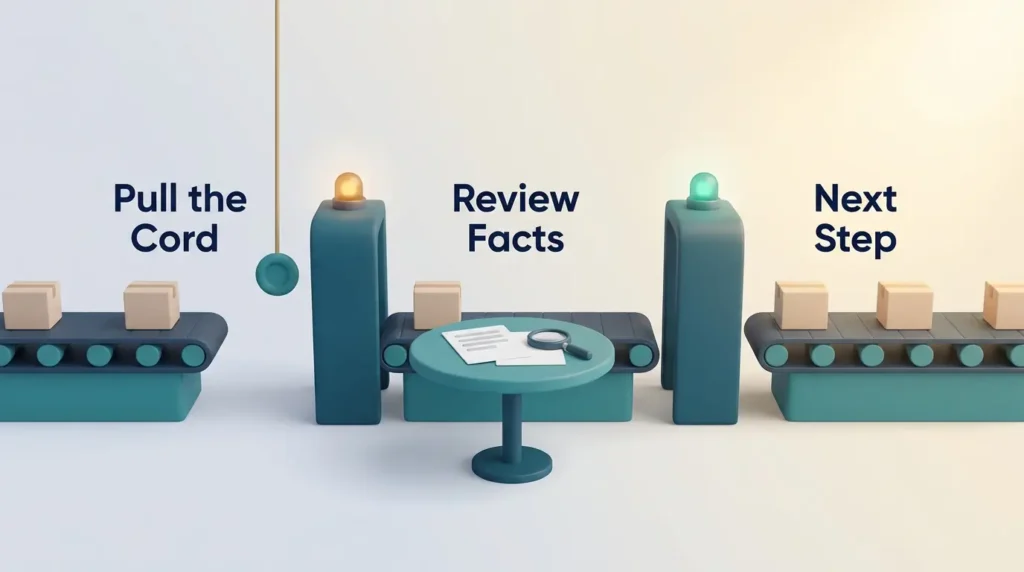
Toyota’s Andon Cord offers a useful model. Any worker on the line can pull a cord and stop production when something looks wrong, because stopping the line is part of the process rather than an act of defiance. Your team can use the same rule: anyone may call a pause, the group reviews the facts, and only then does it decide the next step.
- Thank people who raise concerns early.
- Consider ideas without promising automatic approval.
- Review mistakes by examining conditions and choices.
- Record lessons and update the process.
None of this lowers standards. Schein and Bennis argued for careful experiments and tolerance of failure without retaliation: openness does not prevent every error, it helps your workplace learn from each one. Write the expectation down, the way you would document a workforce contingency plan, so it survives a change of manager.
Model the Behaviors That Build Psychological Safety
Your daily reactions teach the team what candor really means. When leaders show humility and care, people learn that honest communication belongs in the workplace. That habit runs through most current leadership trends, and it is harder to fake at a distance, which is why remote leadership skills put so much weight on visible follow-through.
Invite Feedback and Admit What You Do Not Know
Start with a clear example. Say, “I may be missing something. What is your view?” You can also share a decision you would change after learning new information. These behaviors show that feedback and learning matter more than appearing perfect.
Per Hugander’s work with the Swedish bank SEB popularized “jazz dialogues”: conversations where you listen more, speak less, build on others’ ideas, and respond to what emerges. Offer chat, email, meeting, and written options so quieter members can contribute without pressure. In distributed teams, a well-run digital headquarters gives those options a permanent home.
Respond With Curiosity Instead of Blame
When mistakes occur, ask what conditions shaped the choice before asking who made it. That habit supports a culture where colleagues request help and strengthen their skills.
- Thank people for raising questions or concerns.
- Explain which feedback you used and why.
- Invite team members to review risks together.
- Use inclusive leadership to support creativity and trust.
Create More Opportunities for Every Team Member to Contribute
Great ideas can come from any seat in the room, but only if the person in that seat speaks up. Psychological safety gives varied skills room to shape better decisions and support innovation.
Design meetings for balanced input: a short speaking round, silent brainstorming, written comments, and a follow-up channel all help people who need time to form an idea. When some people are in the room and others are on a screen, the mechanics matter even more, which is what hybrid meeting etiquette is really about. Participatory management takes this further by mapping which decisions people actually influence.
Teams now cross functions, industries, time zones, and languages. Set clear response times and offer several ways to contribute. A psychologically safe workplace should help remote, junior, and less vocal members take part before a decision becomes final. An internal talent marketplace can surface skills that never show up in a job title.
- Invite feedback before approving major changes.
- Ask whose knowledge the discussion may be missing.
- Track which solutions receive action.
- Notice who stays silent despite useful skills.
The tiered huddles described earlier do the same job upward, giving frontline people a route to senior leaders.
Make Accountability Support Psychological Safety
Psychological safety and accountability work best together. Your team needs honest information before it can address performance concerns, service failures, or safety risks. A fair response helps people report issues without fear while keeping standards clear.
Not every failure has the same cause. In Right Kind of Wrong (2023), Amy Edmondson separates basic failures from a known process going wrong, complex failures from several small factors combining, and intelligent failures: affordable experiments that produce new knowledge. Only the third deserves applause, but none deserves a hunt for someone to punish.
Match the Response to the Behavior
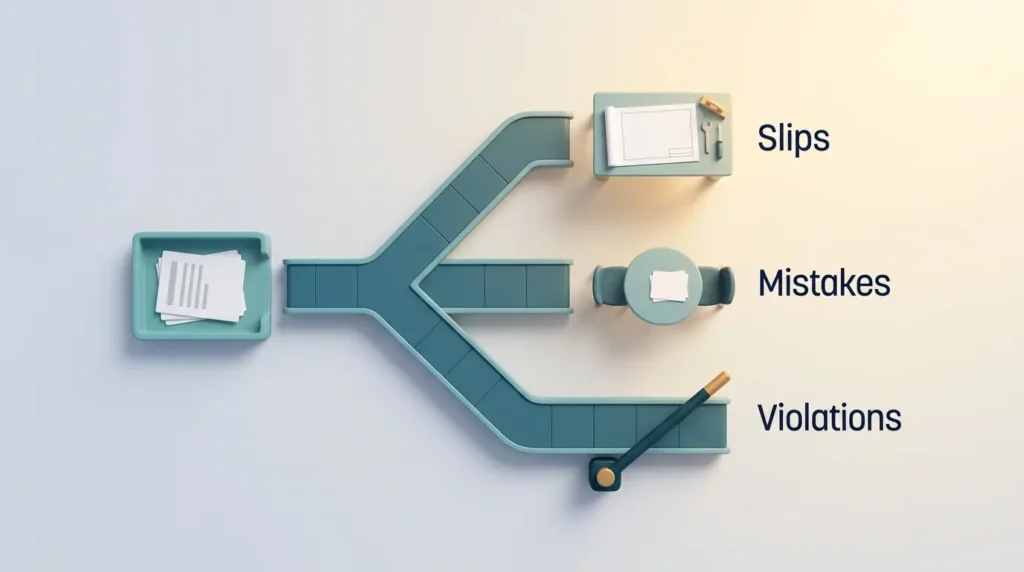
Error researchers draw a further line between slips and lapses (the right intention carried out wrongly, such as clicking the wrong button), reasonable mistakes (a sound decision made on incomplete information), and intentional violations (knowingly ignoring a rule). The case of Hadiza Bawa-Garba, the UK pediatrician prosecuted after a child died in her care in 2011, shows why individual blame can hide system problems. Heavy workloads, limited resources, weak procedures, and poor communication may shape one event. An organization should examine these conditions before assigning personal fault.
- Review workload, training, procedures, and communication.
- Ask what support could have prevented the error.
- Use coaching for learning and proportionate consequences for misconduct.
- Protect honest reporting while addressing deliberate harm or deception.
Westrum’s model contrasts pathological cultures, which blame messengers, with generative cultures, which investigate failure and reduce shared risk. Fair treatment is easier to demonstrate when the surrounding rules are visible, which is part of why pay transparency and clear promotion criteria reduce suspicion. It also keeps a safe workplace from becoming a place where repeated disregard for standards goes unchecked.
Measure Progress and Strengthen a Safe Workplace Over Time
Psychological safety grows through steady review, not one annual survey. Use Edmondson’s seven-item scale with a five-point response format. Compare scores across time, teams, roles, and locations to find meaningful change.
Numbers need context. Pair survey results with short conversations and real examples from daily work.
“Progress is a practice, not a one-time survey.”
Track leading signs of a healthy culture. These measures show whether people use the opportunities your organization creates:
- Early reports of problems and requests for help
- Dissenting ideas and useful feedback
- Participation from quieter team members
- Learning, retention, innovation, and decision quality
Use an established scale rather than inventing your own, so the numbers can be compared with something. Still, higher scores do not prove business impact by themselves. Review whether new behaviors produce better solutions and stronger results, and pair the measurement with practical support such as team resilience training when pressure is the real constraint.
Treat the climate the way you would treat physical fitness. It responds to regular practice and fades without it. Review progress, adjust leadership habits, and keep building a psychologically safe workplace.
Conclusion
A strong team begins with psychological safety: a shared belief that people can ask questions, challenge ideas, seek help, and report mistakes without shame. Edmondson’s 1999 study, Google’s Project Aristotle, and two decades of pooled research all point the same way.
You can build it through clear standards, curious leadership, useful feedback, and fair chances to contribute. Review human error and reasonable mistakes with care, while addressing intentional violations and system conditions. Safety does not mean avoiding conflict or approving every idea.
A psychologically safe workplace stays candid, inclusive, and focused on learning. Measure change often, listen for hidden concerns, and act on what people tell you. These habits help create a safe workplace where people and results can grow.
Found this useful?
Make SmartKeys a preferred source on Google, and our articles will surface more often in your Top Stories, AI Overviews, and AI Mode.
Add as Preferred Source