Team resilience is a group’s ability to keep working well when conditions get hard: a reorganisation, a lost client, a system outage, a colleague leaving mid-project. It is not about individual toughness. It is about the habits, roles and conversations a team has agreed on before the pressure arrives.
The case for paying attention is in the numbers. Gallup’s State of the Global Workplace 2026 report puts global employee engagement at 20% in 2025, down from a 23% peak in 2022. Forty percent of employees said they felt a lot of stress the previous day. Only 34% are thriving in their lives overall. Gallup estimates the lost productivity at roughly $10 trillion a year, about 9% of global GDP.
This article covers what team resilience actually is, what the research does and does not support, how to design a program that survives contact with a busy calendar, and how to tell afterwards whether it worked.
Key Takeaways
- Team resilience lives in shared routines and norms, not in individual willpower.
- Gallup’s 2026 data shows engagement at 20% and daily stress at 40%, so the need is real.
- The research supports modest, reliable gains, not the dramatic numbers often quoted.
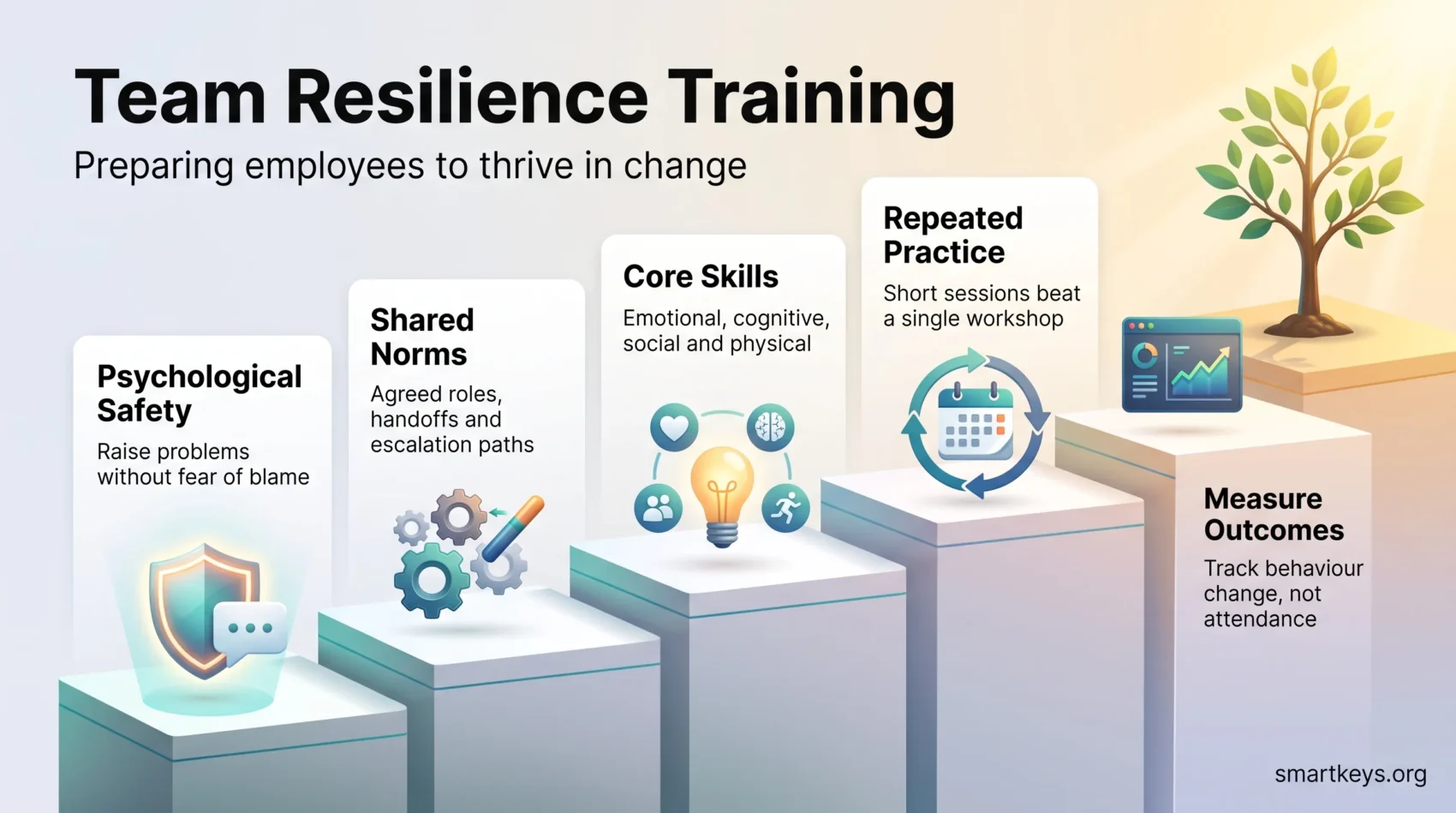
- Psychological safety is the foundation; without it, no curriculum takes hold.
- Short repeated practice beats a single workshop.
- Measure behaviour change and outcomes, not attendance.
Why resilience at work matters now
Most workplace pressure does not arrive as a single crisis. It arrives as a steady drip: a reorganisation announced in March, a hiring freeze in June, a tool migration in September. Each one is survivable. Together they wear people down.
Gallup’s 2026 figures describe that drip. Globally, 40% of employees reported a lot of stress the previous day, 23% sadness, 22% anger and 22% loneliness. Manager engagement fell from 31% in 2022 to 22% in 2025, which matters because managers set the tone for everyone reporting to them.
The practical consequence is simple. When a team has no agreed way to absorb a shock, every shock costs the same amount of improvisation. People rediscover the same fixes, repeat the same mistakes and quietly burn out. If that pattern sounds familiar, our guide to managing employee burnout covers the organisational causes in more depth.
What team resilience is, and how it differs from individual resilience
Individual resilience is a personal capacity: how one person recovers from a setback. Team resilience is a property of the group. Two teams can contain equally capable people and respond to the same disruption completely differently, because one has routines for it and the other does not.
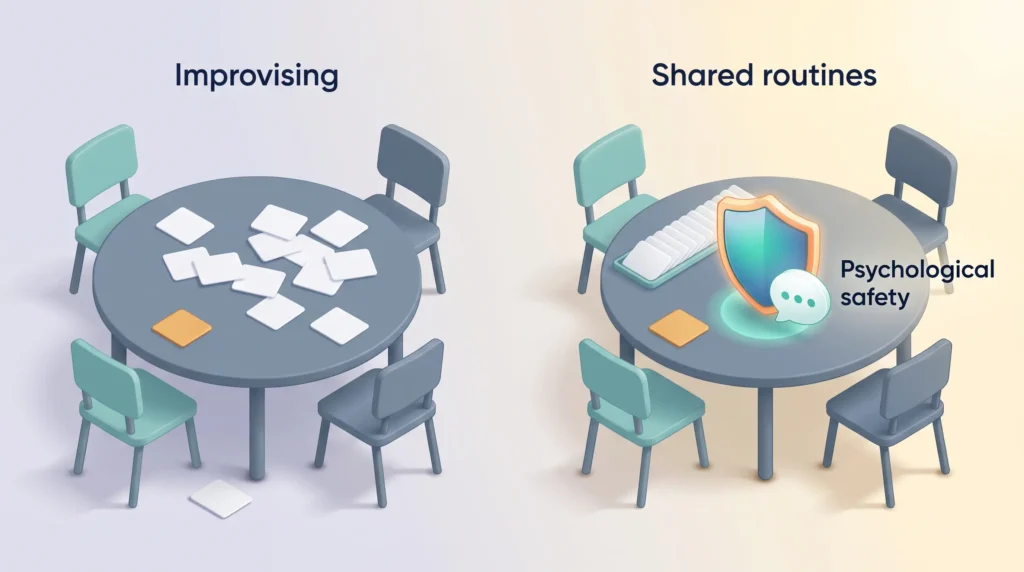
Psychological safety comes first
Psychological safety means people believe they can raise a problem, admit a mistake or ask a basic question without being punished for it. Google’s Project Aristotle, a multi-year internal study of what made some of its teams effective, identified it as the single strongest differentiator.
The reason is practical. In a team without it, a junior engineer who spots a flaw in the deployment plan says nothing. In a team with it, she says something on Tuesday and the outage never happens. A culture of open communication is what turns that into a habit rather than an exception.
Shared norms and clear handoffs
Resilient teams have agreed answers to unglamorous questions. Who decides when we disagree? What counts as urgent enough to interrupt someone? Who picks up a task when its owner is out? Writing these down takes an afternoon. Not having them written down costs an hour every time something goes wrong.
Foundational skills
Three abilities show up repeatedly in resilience curricula: emotional awareness (noticing your own reaction before acting on it), reframing (finding a second reading of a setback that suggests a next step), and structured problem solving. These are teachable. They are also useless in isolation, which is why the group norms above come first.
What the evidence actually supports
Resilience training is often sold with striking statistics. The honest picture is more modest, and knowing it will help you set expectations with your leadership team.
A 2021 scoping review in Frontiers in Psychology examined 48 workplace resilience programs. Of the studies measuring resilience itself, 17 of 27 found a significant positive effect, with small to large effect sizes. For stress, 16 of 25 found significant reductions. For mental health outcomes such as anxiety, depression and burnout, only 14 of 26 found significant change. The review also flagged real weaknesses: fewer than half used randomised controlled trials, and 19 of the 48 had no control group at all.
On the employee-experience side, an American Heart Association CEO Roundtable survey of 1,001 US working adults, conducted by The Harris Poll, found that 73% of participants in workplace health and resilience programs said taking part had improved their health a great deal or a fair amount.
Two things follow. First, resilience training works, but the effect is real rather than transformative, so do not promise a step change in retention. Second, the reviewers were clear that one session is not enough: the skills need repeated practice, and follow-up sessions were present in only a few of the studies they examined. Design for repetition from the start.
The business case for resilient teams
Translate resilience into outcomes your finance team recognises, or the program will be the first thing cut.
Fewer errors under pressure. Stressed people skip checks. A team that runs a two-minute pre-flight review before a release catches the misconfigured setting instead of rolling it back on Saturday.
Faster recovery from change. When a priority shifts, a team with clear handoffs re-plans in one meeting. A team without them loses a week to confusion about who owns what. This is the day-to-day half of any change management strategy.
Better retention. People leave managers and chaos more often than they leave jobs. Supportive routines are one of the cheaper levers available, and they pair well with broader talent retention strategies.
More usable engagement. Teams that can raise problems early tend to score better on employee engagement measures, because the survey is finally telling you something people already say out loud.
How to design your team resilience training program
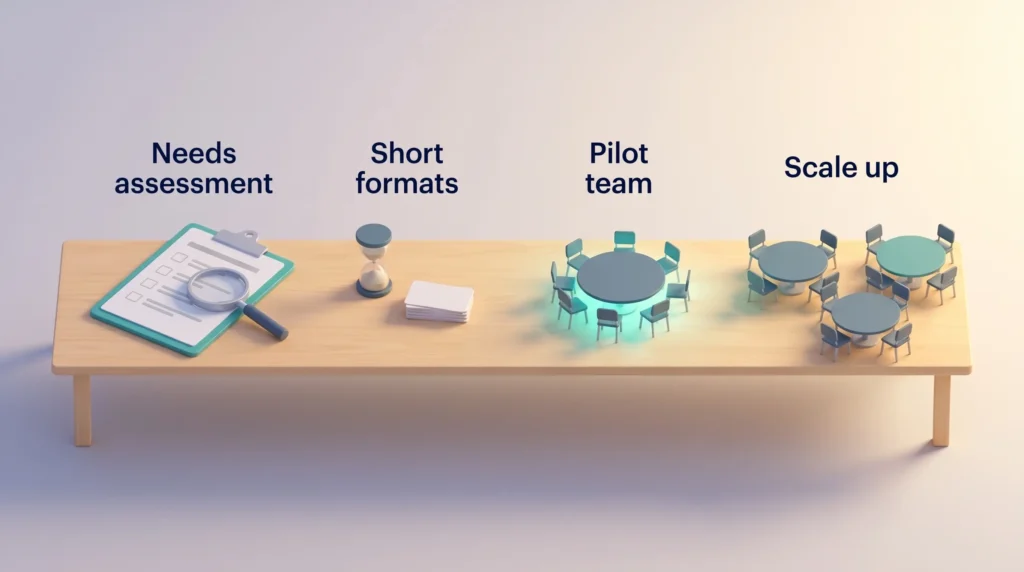
Start with a needs assessment
Do not buy a curriculum before you know the problem. Spend two weeks gathering three inputs: a short pulse survey, six to eight manager conversations, and whatever your HR data already shows about turnover, absence and overtime. Workforce analytics tools can surface patterns that a survey misses, such as one department consistently working late.
Turn the findings into two or three measurable goals. “Reduce unplanned overtime in support by a fifth over two quarters” is a goal. “Build resilience” is not.
Choose formats people can actually attend
Match the format to the working week, not to the training budget. A distributed team will not protect four consecutive Friday afternoons. Options that hold up in practice:
- Short live workshops of 60-90 minutes, spaced two weeks apart.
- Microlearning, meaning five to ten minute lessons delivered between sessions. Our microlearning strategy guide covers how to sequence them.
- Peer practice pairs, where two colleagues run a ten-minute exercise together.
- Manager coaching, which is usually where the money is best spent.
For distributed teams, the delivery mechanics matter as much as the content; remote corporate training has its own failure modes.
Pilot before you scale
Run the program with one team of 10 to 15 people first. Pick a group that is under real pressure, not the easiest volunteers. Collect honest feedback on pacing and relevance, fix what breaks, then expand. A pilot also gives you a comparison group for measurement later.
What to put in the curriculum
A useful curriculum pairs a named skill with a short exercise people can run without a facilitator.
Emotional skills
Teach people to notice a stress reaction before it drives a decision. The exercise is small: a 60-second pause, a slow exhale, then the reply. Breathing techniques work here because they are quick, private and need no equipment.
Cognitive skills
Reframing and structured problem solving. A good drill is the pre-mortem: before a project starts, the team imagines it has failed and writes down why. It surfaces risks that a normal planning meeting politely ignores.
Social skills
Trust and escalation. The practical exercise is agreeing, in writing, what each person should do when they are stuck: who to ask, after how long, and through which channel. Remote team building activities help, but only once this scaffolding exists. In multigenerational teams, expectations about interrupting a colleague often differ by a lot, so make them explicit.
Physical recovery
Resilience has a physical floor. Short movement breaks, protected lunch, and enough sleep do more for a team’s tolerance of pressure than most workshop content. Teach people to defend these, and back it up by setting boundaries that managers respect.
Leader practices that make it stick
A program survives or dies on what managers do the week after it ends.
Answer the first mistake well. The first time someone admits an error after the training, the team watches closely. Ask what the system allowed, not who slipped. That single response teaches more than the workshop did.
Use one-on-ones properly. A regular, short, predictable check-in is the cheapest early-warning system a manager has. A one-on-one meeting template keeps it from drifting into status reporting.
Give feedback continuously. Annual reviews are too slow to help anyone recover from a bad quarter. Continuous performance management makes the correction small and timely.
Adapt for distance. Remote managers lose the incidental signals they would pick up in an office, so they have to ask more deliberately. Our guide to remote leadership skills covers the substitutes that work.
For more on the broader capabilities leaders need as work changes, see future leadership skills.
Routines that build resilience week by week
Training introduces skills. Routines are what keep them alive.
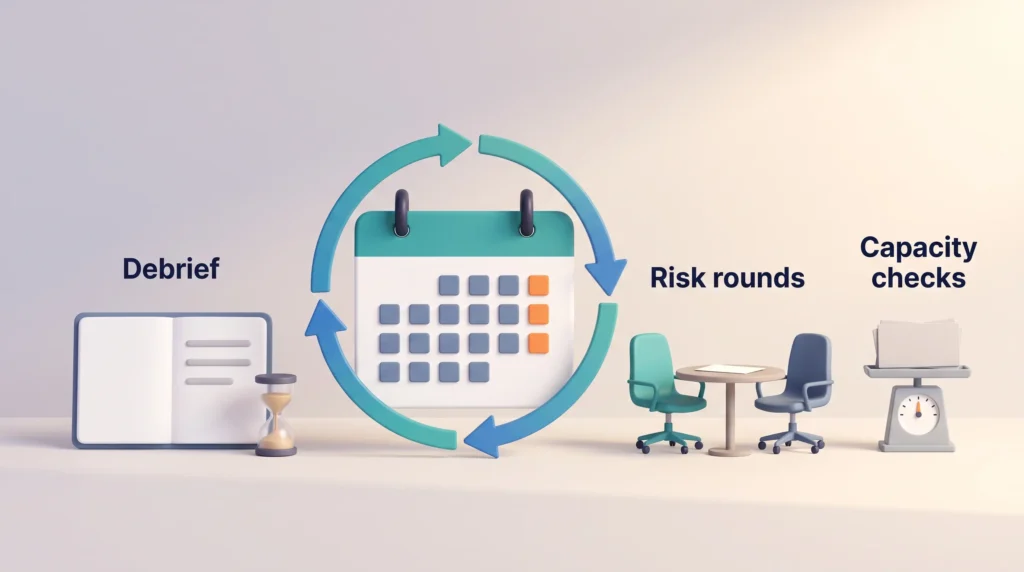
The short debrief
A debrief is a brief structured review after a milestone or a miss. Fifteen minutes, three questions: what happened, what signals did we miss, what will we try differently. Write the answers where the team can find them.
Rotate who runs it. When the same person always facilitates, the practice becomes their job rather than the team’s habit.
Risk rounds
Once a fortnight, spend ten minutes on a single question: what could go wrong in the next two weeks that we have not talked about? Pair people from different functions. The value comes from someone outside the process noticing an assumption the owners stopped seeing.
Capacity checks
Ask directly whether workload is sustainable, and do it before the quarter end rather than after someone resigns. Burnout prevention is far cheaper than replacement hiring.
Close every routine the same way: named owner, date, and one measure. Otherwise the meeting becomes a discussion group.
How to measure whether it worked
Attendance is not evidence. Build the measurement plan before the first session, so you have a baseline.
Track four things. Participation and completion, so you know whether the format fits. Sentiment, from a short repeated pulse question. Strain indicators such as unplanned overtime, sick days and voluntary turnover. And one or two operational measures the team already cares about, like cycle time or reopened tickets.
Use more than one method. Surveys tell you what people report. Observation tells you whether debriefs actually happen. Comparing your pilot team with a similar team that has not yet been trained tells you more than either. The approach mirrors how you would calculate upskilling ROI for any other development program.
Review quarterly. Keep what shows movement, cut what does not, and refresh the content against whatever the business is actually facing now. Two or three numbers per leader is enough. A dashboard nobody reads is not a measurement system.
Finally, connect the program to your wider planning. Resilience training is one input into workforce contingency planning, and it sits alongside the structural work described in building resilient workplaces in the age of automation.
Conclusion
Team resilience is built from unremarkable parts: agreed norms, a safe way to raise problems, short repeated practice, and managers who respond well when something goes wrong. The research supports real but modest gains, so promise accordingly and measure honestly.
Start with one routine this week. Run a fifteen-minute debrief after the next milestone, write down what you learn, and see whether the team wants a second one. That is a more reliable beginning than a full curriculum nobody has time to attend.
Found this useful?
Make SmartKeys a preferred source on Google, and our articles will surface more often in your Top Stories, AI Overviews, and AI Mode.
Add as Preferred Source