You are working in the one sector that was long assumed to be union-proof, and that assumption no longer holds. Repeated layoff rounds, thinner budgets, and AI-driven restructuring have pushed technical staff to ask what actually protects their pay and their jobs.
The proof is now contractual. Between June 2025 and January 2026, Microsoft signed three separate union contracts with video game workers. In May 2026, more than 2,000 IT professionals at the University of California voted to organize. The Communications Workers of America (CWA) calls it the largest tech organizing campaign in U.S. history. CWA represents most organized technical and media staff in the country.
This guide maps where tech worker unionization stands in 2026. A union is a group of employees who bargain pay and conditions together instead of one by one. The result is a written contract both sides must follow. You will see which groups won contracts and what those contracts contain. You will also see how federal labor law shifted once the National Labor Relations Board (NLRB) could decide cases again, and where organizing still stalls. The NLRB is the federal agency that runs union elections and enforces bargaining rights.
You will also see the honest limits. Membership stays small, employer resistance is well funded, and a first contract still takes years rather than months.
Key Takeaways
- Three ratified Microsoft contracts turned tech organizing from a campaign story into a bargaining story.
- U.S. union membership held at 10.0% in 2025, but professional and business services sits at just 2.1%.
- New contracts increasingly set rules for AI use, layoff recall rights, and credit for work shipped.
- The NLRB could decide cases again from January 2026 and now runs a 3-1 Republican majority.
- California’s AB 1340 opened collective bargaining to roughly 800,000 app-based drivers.
What changed in tech worker unionization
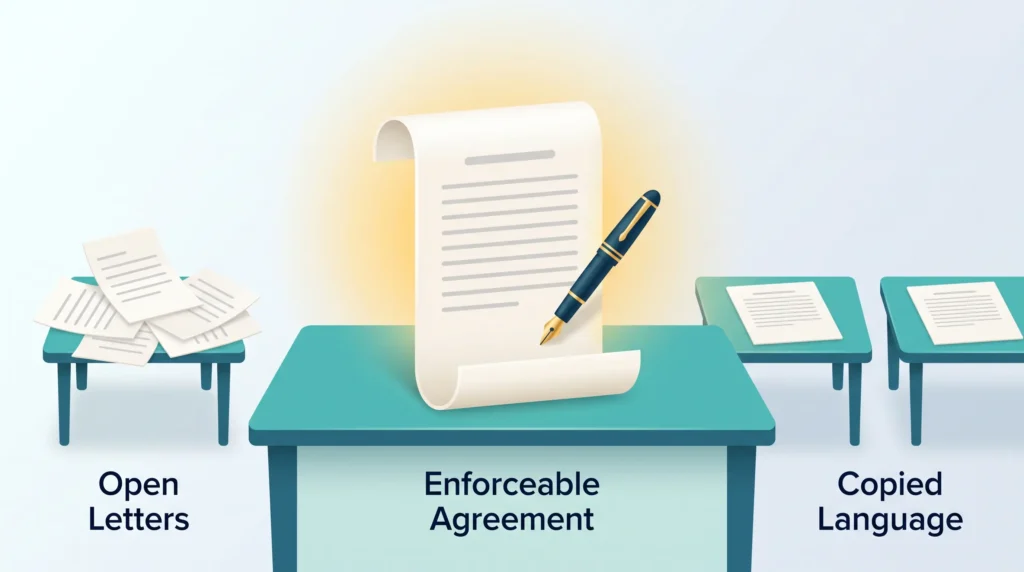
Organizing in the sector has moved past petitions and open letters. The defining development of the past two years is that groups of workers are signing enforceable agreements, and other groups are copying the language.
Microsoft’s three contracts
ZeniMax Workers United-CWA ratified the first one on 24 June 2025, covering more than 300 quality assurance staff in Maryland and Texas after roughly two years of bargaining. Quality assurance, or QA, is the team that tests games for bugs before release. Raven Software followed in August 2025. On 30 January 2026, more than 60 Blizzard QA workers in Albany and Austin ratified a three-year agreement.
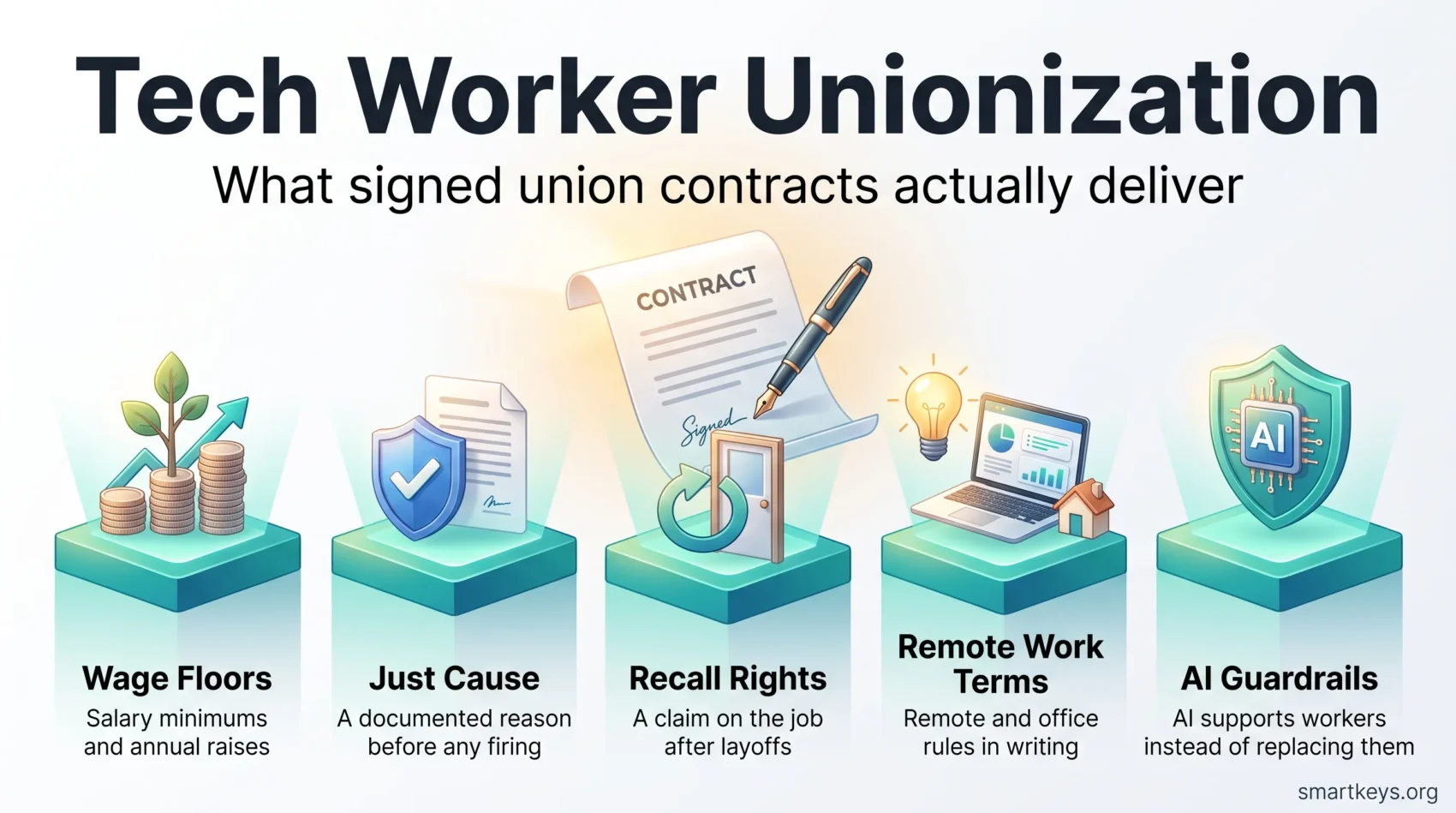
Each round added protections the previous one lacked. The Blizzard contract sets rules for generative AI so that it supports rather than replaces the people covered. It also pairs layoff protection with recall rights. A laid-off worker keeps a claim on the job if the employer hires again. It also limits mandatory crunch, the long stretches of forced overtime before a game launch.
Newsroom technologists set the template
At The New York Times, the Times Tech Guild ratified its first contract on 19 December 2024 with 93% support, covering more than 700 members. It arrived three years after the 2022 election win and an eight-day strike in November 2024. The agreement locked in just cause, which means the employer must show a documented reason before firing someone. It added salary minimums, on-call pay, remote-work terms, protections around generative AI, and fixed minimums that settled location-based pay questions.
At The Washington Post, more than 300 engineers, product designers, and data staff formed the Tech Guild in April 2025. They certified it a month later by a vote of 171 to 38 with the NewsGuild-CWA. It was the paper’s first successful organizing effort under Jeff Bezos’s ownership. A first contract there is still being negotiated. The Times deal put salary floors in writing, part of the wider move toward pay transparency.
The largest tech unit yet
In May 2026, about 2,100 IT workers at the University of California voted to join UPTE-CWA Local 9119. That brought the group to roughly 8,400 IT professionals: application programmers, systems and data analysts, database administrators, and instructional designers. Their stated priorities were layoff protection, wage increases, and a voice in how AI augmentation gets deployed rather than imposed.
The numbers behind the trend
Membership data and appetite point in opposite directions. The Bureau of Labor Statistics put the U.S. union membership rate at 10.0% in 2025, little changed from the prior year. The public sector sat at 32.9% and the private sector at 5.9%. Professional and business services, the category that counts most technical staff, registered 2.1%, among the lowest of any industry.
Interest runs far ahead of that. A September 2024 survey by the workplace platform Blind, covering 1,900 verified professionals, found 67% would likely join a union if one were available. The gap between 2.1% coverage and 67% stated interest is the whole story here.
Layoffs keep resetting the calculus
Job security stopped being theoretical. Tech layoffs tracked by Layoffs.fyi passed the full-year 2025 total during the summer of 2026. That is roughly four months ahead of the previous year’s pace, with Oracle, Salesforce, and ServiceNow among the larger contributors. Cuts on that scale change how people read employee benefits, severance terms, and workforce contingency planning.
They also reframe adjacent debates: whether automation widens inequality, whether a robot tax could fund the transition, and whether a universal basic income belongs in the answer. For a broader look at workforce change and remote patterns that affect organizing, see remote work trends.
Barriers, labor law, and the gig frontier
You still face employer resistance, contested legal ground, and long timelines. None of the 2026 wins removed those.
Employer resistance and the joint-employer fight
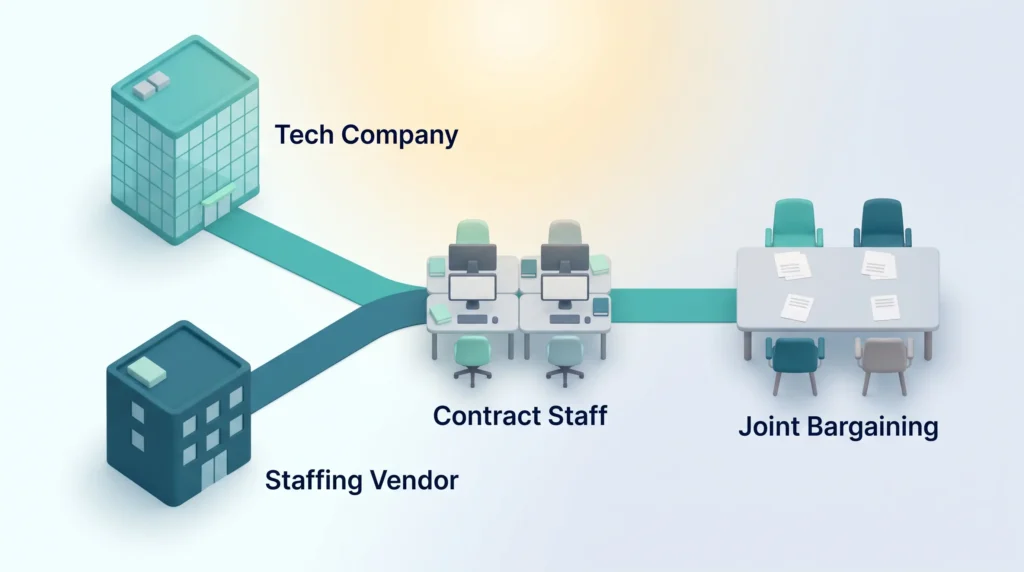
The sharpest legal battle concerns contractors. In January 2024 the NLRB found that Google unlawfully refused to bargain with the Alphabet Workers Union. The workers were YouTube Music content staff hired through the firm Cognizant, and they had voted 41 to 0 to organize. The board ordered Google to the table as a joint employer. That finding means two companies share enough control over the same staff that both must bargain. Google is appealing in federal court.
Because contract and vendor staffing is standard across the industry, that outcome decides how much of the workforce can bargain at all. It also shapes the contract-to-hire trend and multi-role careers.
What the 2026 labor board looks like
The NLRB spent most of 2025 without a quorum, the minimum number of seated members it needs to decide cases. It could not issue final rulings. Regional offices kept running elections and investigating charges. The quorum returned on 7 January 2026 when James Murphy and Scott Mayer were sworn in alongside David Prouty. On 7 August 2026 the Senate confirmed James Macy and reconfirmed Prouty, leaving a 3-1 Republican majority with one seat vacant.
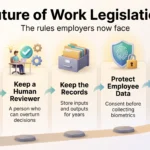
Expect a backlog review and closer attention to future of work legislation at state level, where rules on algorithmic management and employee monitoring keep advancing.
Gig work: AB 1340 and the limits of Prop 22
California signed AB 1340 in autumn 2025, effective 1 January 2026. It grants roughly 800,000 rideshare drivers the right to unionize and bargain collectively. Proposition 22, the 2020 ballot measure backed by the platforms, still classifies them as contractors rather than employees. The earliest union votes were set for 1 May 2026, and the process runs long. Uber and Lyft dropped their opposition after lawmakers passed SB 371, which cut required per-incident insurance coverage from $1 million to $300,000. Other states have not copied the model. Our guide to gig economy regulation covers the wider legal picture.
What these contracts actually deliver
Look past the headlines and the pattern is consistent. Ratified tech agreements cover guaranteed wage floors and annual increases, just cause and grievance procedures, and layoff notice with recall rights. They also put remote and return-to-office terms in writing, secure credit for work shipped, and limit how generative AI is applied to the jobs the contract covers.
That last item is the newest and the most contested. It is also why some employers prefer to move first, through participatory management, a genuine transparency culture, clearer PTO policy, or honest organizational design, rather than bargain later.
Conclusion
You can weigh a formal union against other routes to influence. Documentation, written proposals, and collective requests often fix schedules, severance, and tooling faster than a campaign.
What has changed is the fallback. Where earlier organizing produced press coverage, current organizing produces contracts, and those contracts are read, copied, and improved by the next group. Skills still matter as leverage, whether through micro-credentials in hiring or keeping pace with productivity trends.
Whether you pursue a union or another structure, the practical wins start when people act together and keep the record straight.
Found this useful?
Make SmartKeys a preferred source on Google, and our articles will surface more often in your Top Stories, AI Overviews, and AI Mode.
Add as Preferred Source