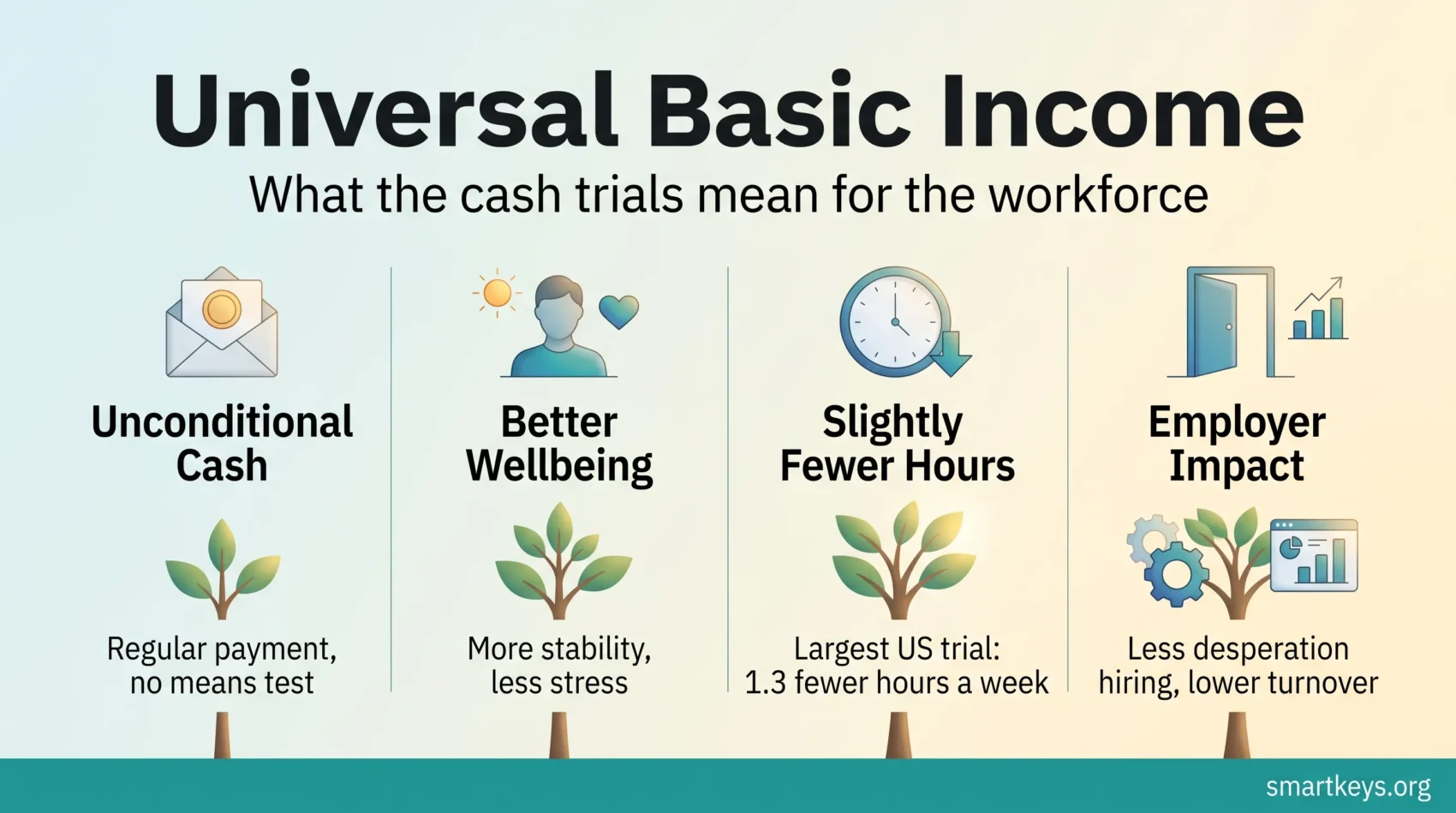
Universal basic income (UBI) is a regular cash payment sent to everyone in a defined group, with no conditions attached. No job search to prove, no means test to pass, no forms to file when your hours change. The money simply arrives.
The idea moved from the fringe to the front page during the pandemic, when stimulus checks showed how quickly a government can put cash in millions of accounts, and how little a one-off payment does for a household facing months of instability. Since then, more than 160 local programs have tested the idea in the United States, and the largest privately funded trial ever run has published results.
This article is written for people who have to plan around the answer: employers, team leads and anyone budgeting for a workforce. It covers what the policy is, what the trials measured, who would pay for it, and what all of that would mean for hiring, retention and scheduling. Every figure below comes from a named source.
Key Takeaways
- UBI means unconditional, regular cash. It is not the same as a means-tested top-up or a negative income tax, and the difference changes both cost and behaviour.
- Trials consistently find better financial stability and mental health. The employment picture is mixed and depends heavily on the payment size.
- The largest US trial found recipients worked slightly less: 1.3 fewer hours a week, and a 2 percentage point drop in employment in years two and three.
- Funding is the hard part. Most serious proposals combine income tax changes with other revenue and keep targeted benefits for housing, disability and child costs.
- The US picture is split: Cook County made its program permanent in the 2026 budget while four states have banned local programs outright.
What Universal Basic Income Actually Is
Think of UBI as a predictable cash floor. Every eligible adult receives the same regular payment, monthly or yearly, whether they work or not. There is no test of income, wealth, family status or job-seeking effort.
That unconditionality is the whole point, and it is what separates UBI from almost every existing benefit. Most safety nets spend a large share of their budget deciding who qualifies and checking that they still do. A universal payment skips that step. Nobody has to document a job search or report a small change in earnings to keep the money coming.
Philosophers Fabian Wendt and Doug MacKay, who have written extensively on the policy, describe unconditional cash as a platform to build a life on rather than a replacement for earnings. That framing matters for the workforce question: the design assumption is that most people keep working, and the cash changes which work they choose.
How UBI differs from similar-sounding policies
Three designs get confused with each other constantly, and the differences drive the cost.
- Universal basic income: everyone gets the same amount, regardless of other income. Simple to administer, expensive to fund, because high earners receive it too (though they usually pay more of it back in tax).
- Minimum income guarantee: payments top earnings up to a set threshold. Cheaper, because only people below the line receive anything, but it requires means testing and creates a phase-out that can penalise extra work.
- Negative income tax: proposed by economist Milton Friedman, this runs support through the tax system. If you earn below a threshold, the tax office pays you rather than the reverse. The timing differs from a monthly transfer, which matters if you are trying to cover rent in a bad month.
Most US proposals use $1,000 a month per adult as the reference figure, which is the amount Andrew Yang put forward as the “Freedom Dividend” during his presidential campaign. That number is a starting point for discussion rather than a settled design.
Why UBI Returned to the Agenda
Two pressures brought the idea back: sudden income shocks and the fear of automation.
The pandemic supplied the first. One-off stimulus checks proved the plumbing works. Washington can move money to households fast. They also exposed the limit of a single payment when the disruption lasts eighteen months rather than three weeks.
The second pressure is slower and more contested. If software absorbs a growing share of routine work, a floor under household income looks less like charity and more like infrastructure. Our analysis of AI job augmentation versus replacement covers what the labour market data actually shows here, and the short version is that outright replacement is rarer than the headlines suggest. The broader picture in automation and jobs and in how workers are adapting to job automation points the same way. The anxiety is real regardless, and it shapes the politics.
Mayors for a Guaranteed Income, a coalition of US city leaders, drove much of the testing that followed. Jack Dorsey contributed $15 million to fund pilots. Individual cities picked their own target groups: Durham, North Carolina, for example, designed a program paying $500 a month to 55 formerly incarcerated residents, a group that faces documented barriers to both housing and hiring.
What the Trials Actually Found
This is where the debate gets useful, because there is now real evidence rather than speculation. The results are genuinely mixed, and the mix is informative.
Finland: better wellbeing, small employment gain
Finland ran a randomised trial from January 2017 to December 2018, paying 2,000 unemployed people €560 a month, tax-free, with no obligation to look for work.
Over a twelve-month measurement window, recipients worked 78 days on average against 72 in the control group, a difference of six days. The Finnish Ministry of Social Affairs and Health described the employment effect as small. The wellbeing findings were much stronger: recipients reported greater life satisfaction and less mental strain, depression, sadness and loneliness, along with more trust in institutions. The ministry also cautioned that Finland introduced a stricter unemployment benefit rule partway through, which complicates the second-year numbers.
Stockton: financial stability and faster full-time hiring
The Stockton Economic Empowerment Demonstration (SEED) paid $500 a month to 125 residents starting in February 2019. After the first year, researchers at the University of Pennsylvania reported that recipients moved into full-time employment at more than twice the rate of the comparison group. Income volatility fell, and recipients reported better mental health.
The mechanism matters for employers: a steady floor let people take unpaid time for interviews, training and applications that hourly shifts had crowded out.
OpenResearch: the biggest US trial, and the most uncomfortable finding
The Unconditional Cash Study run by OpenResearch is the largest privately funded UBI trial in the United States. It paid $1,000 a month for three full years, from November 2020 to October 2023, to participants in Texas and Illinois, with a control group receiving a nominal amount.
The labour findings were modest but real. Recipients worked 1.3 fewer hours per week than the control group across the three years. In years two and three they were 2 percentage points less likely to be employed, roughly eight fewer working days a year. Household income excluding the transfers fell by $2,500 to $4,100. Counting the transfers, recipients still came out substantially ahead, with individual income around $10,000 higher.
That result cuts both ways. The reduction in work is real, and critics were not wrong to expect one. It is also small: a little over an hour a week from a payment worth $12,000 a year. The same study found improvements in housing mobility and in the ability to absorb an emergency expense.
Kenya and Manitoba: the long view
GiveDirectly is running the longest UBI experiment anywhere, across roughly 200 Kenyan villages, with one group receiving payments for twelve years. Results from the first two years found no drop in total hours worked. Instead, recipients shifted out of wage labour, mostly agricultural, and into self-employment. A group given the same money as a single lump sum started noticeably more businesses than the group receiving it monthly, which suggests the payment schedule shapes what people do with it.
Manitoba’s Mincome experiment in the 1970s remains the oldest community-scale evidence. Its main finding, that the people who reduced their hours were largely mothers of young children and teenagers staying in school longer, still frames how economists interpret labour-supply effects today.
What pilots cannot tell you
Every trial above shares the same blind spot. Pilots pay a small group from an outside budget. A national program would have to raise the money through taxes, and those taxes would change behaviour across the whole economy. No pilot tests that.
Trials also run for two or three years. They cannot show what happens to career decisions, savings or retirement over a working life. Treat them as evidence about households, not as evidence about macroeconomics.
How UBI Would Be Funded, and Who Pays
Funding decides almost everything about who wins and who loses, which is why it deserves more attention than the payment amount.
Income tax changes
Many proposals adjust the income tax base: removing tax-free personal allowances and raising marginal rates. The effect is that the payment is clawed back gradually as earnings rise, so high earners become net contributors even though they technically receive the transfer.
For employers this is a payroll planning question rather than a policy question. Net pay would shift across your whole salary range, and the shift would not be uniform. Anyone doing compensation benchmarking would need to rerun it, much as teams already do when reviewing pay transparency requirements.
Mixed revenue sources
Funding a meaningful payment purely from income tax would require rates most electorates reject. Serious proposals therefore spread the load across wealth taxes, targeted consumption taxes or carbon charges. Each choice changes the distribution: a sales tax component, for instance, takes proportionally more from lower-income households and partly cancels the benefit it funds.
Winners, losers and the child problem
The distributional results depend entirely on design, and the most consistent warning in the research concerns children and single parents. A flat adult payment that replaces targeted family benefits can reduce poverty on average while leaving some households, particularly large families and lone parents, worse off than before.
This is why most credible designs are described as “UBI plus”: a universal cash floor with housing support, disability payments and child-specific benefits kept in place on top. The simplification argument gets weaker, but the protection holds.
What UBI Would Mean for Employers
If a national program ever arrived, the effects on your organisation would be concrete rather than abstract.
Turnover and job quality
The clearest workforce signal in the evidence is that people with a financial floor stop taking jobs out of desperation. They wait for a better match, negotiate harder and leave bad roles sooner.
For employers with decent conditions, that is good news. Lower crisis-driven turnover means training investment pays back, and institutional knowledge stays in the building. Our guide to internal talent marketplaces covers how to capture that retention benefit deliberately.
For employers competing on price alone, it is pressure. Roles with unpredictable scheduling, no progression and low pay would get harder to fill, because the alternative to taking them would no longer be nothing. Expect that to show up first in shift-based and seasonal work.
Hours, part-time and gig work
The OpenResearch result points to a modest reduction in hours rather than people leaving the workforce. Practically, that looks like some employees dropping a shift for caregiving or study, and others moving toward higher-responsibility roles because they can afford the transition risk.
Part-time and flexible roles would likely become easier to fill, not harder, because a base payment makes reduced hours financially survivable. That matters more each year, because the workforce is shrinking at the young end, as our piece on how work adapts to demographic shifts sets out. That intersects directly with how companies already structure flexible work schedules and how they design on-demand workforce strategies around contractors and freelancers. The regulatory backdrop matters too, and the rules on gig economy regulation are moving faster than the cash-transfer debate.
Training and internal mobility
A floor under income makes retraining feasible for people who currently cannot afford to stop earning. That is a genuine opportunity for employers who have struggled to fill skilled roles internally, and it strengthens the case for the kind of short, repeatable formats covered in our microlearning strategy guide, for structured cross-training and for wider upskilling and reskilling programmes.
It also raises the stakes on knowing which of your roles are actually exposed to change. An automation risk assessment and a current digital skills gap analysis are worth more than any forecast about UBI itself.
Benefits strategy
If a cash floor existed, some of what employers currently provide would become less valuable and some would become more so. Basic income protection matters less. Health coverage, childcare support, development budgets and wellbeing stipends matter more, because they are the things cash does not easily buy. Anyone rebuilding a package should read this alongside broader shifts in employee benefits.
Where the US Actually Stands in 2026
The practical picture is not one policy but a patchwork, and it is diverging.
On the expansion side, roughly 163 local programs have run across 18 states and the District of Columbia, with 41 active as of 2025. In November 2024 Cook County, Illinois, became the first government body in the country to make guaranteed income permanent, and its 2026 budget funds $500 a month for 3,250 households at a cost of $7.5 million a year. That followed a $42 million pilot financed by the American Rescue Plan Act, which ran from 2022 with final payments in January 2025. Connecticut, Hawaii, Massachusetts, New Mexico, New York and Vermont have all considered statewide pilots or feasibility studies.
On the restriction side, Arkansas, Idaho, Iowa and South Dakota have passed laws prohibiting local guaranteed income programs. Kansas passed a similar measure, HB 2101, in April 2025 without the governor’s signature. Several other states considered restrictions during the same session. The objection is usually framed around work incentives and dependency.
The Child Tax Credit as the closest real-world test
The United States has already run something close to a national child-focused cash payment. The 2021 expansion of the Child Tax Credit raised the credit to $3,600 for children under six and $3,000 for ages six to seventeen, made it fully refundable and paid part of it monthly.
The result was the sharpest drop in child poverty on record. The US Census Bureau reported that the supplemental poverty measure for children fell from 9.7% in 2020 to 5.2% in 2021, a 46% decline, with the credit expansion alone keeping 2.1 million children out of poverty. The expansion expired at the end of 2021 and the rate rose again.
That episode is the strongest available evidence that unconditional monthly cash reduces hardship quickly at national scale. It is also the strongest evidence that political sustainability, not effectiveness, is the binding constraint.
How to Think About This as a Planner
No US employer needs to plan for a national UBI arriving next year. What is worth doing is separating the parts of the debate that already touch you from the parts that do not.
Already relevant: local cash programs in the cities where you hire, the state laws restricting them, and the income volatility in lower-paid work that started the debate. Those shape your applicant pool now. Not yet relevant: national funding design, marginal tax rates and economy-wide labour supply. Follow those, but do not model them.
The practical move is to test your own assumptions against the trial evidence rather than the rhetoric. If a steady floor mainly reduces desperation hiring and slightly reduces hours, then the roles most exposed in your organisation are the ones people currently accept only because they have no alternative. Those are worth fixing regardless of what happens to the policy, and the same conclusion falls out of our wider reading of future work trends and HR trends.
Conclusion
The evidence on universal basic income is better than it was five years ago and less decisive than either side claims.
What holds up across every trial: unconditional cash improves financial stability and mental health, and it does not cause people to stop working. What also holds up: at a meaningful payment level it reduces hours modestly, and funding it nationally would require tax changes no country has yet tested at scale.
For workforce planning, the useful takeaway is not a prediction. It is a diagnostic. The jobs that would struggle most under a cash floor are the jobs people currently take because refusing them is not an option. Knowing which of your roles fall into that category is valuable whether or not a single UBI cheque is ever posted.
Found this useful?
Make SmartKeys a preferred source on Google, and our articles will surface more often in your Top Stories, AI Overviews, and AI Mode.
Add as Preferred Source