Decentralized Finance, or DeFi, moves money between businesses using public blockchains and smart contracts instead of banks, brokers and clearing houses. In 2026 it looks less like a gold rush than an infrastructure market: DefiLlama data reported by CryptoRank shows total value locked, the total amount of money deposited in these protocols, falling from roughly $115 billion in January 2026 to about $70 billion by June, while the parts businesses actually use, stablecoins and tokenized assets, kept growing.
That split matters for anyone evaluating DeFi for company finance. Speculative yield farming, the practice of chasing high returns by shifting funds between protocols, has cooled; payment rails, tokenized treasuries and programmable settlement have not. This guide covers what decentralized finance can realistically do for a business operating across borders in 2026, and which risks belong on your register first.
Key Takeaways
- DeFi lets businesses settle payments peer-to-peer, without waiting on correspondent banks.
- Smart contracts automate escrow, collateral and payout logic that used to need paperwork.
- DeFi total value locked fell about 39% in the first half of 2026, so treat headline growth claims with care.
- Stablecoins, not tokens, are the practical entry point: the market sat near $322 billion in May 2026.
- The US GENIUS Act and the EU’s MiCA regime have replaced regulatory guesswork with real rulebooks.
- Security is still the binding constraint: DefiLlama counted more than 140 exploits and over $1 billion lost by mid-2026.
What Decentralized Finance Looks Like in 2026
Decentralized finance is a set of financial services that run as code on a public blockchain. Lending, trading, collateral management and payments happen through open protocols rather than an institution’s balance sheet, and every action is recorded on a ledger participants can inspect.
DeFi payment solutions now cover a narrower but more useful range than during the 2021 boom. Lending markets such as Aave, decentralized exchanges such as Uniswap, and stablecoin protocols, which issue tokens designed to hold a fixed value such as one US dollar, make up the bulk of real activity. Ethereum still hosts the largest share of value locked, roughly $39 billion in June 2026.
The contraction is worth naming. Yields compressed, capital left, and two April exploits, the Drift Protocol breach at about $295 million and the KelpDAO incident at about $293 million, accelerated the outflow. A sector that shrinks by a third in six months is no place for working capital you cannot afford to lose.
What survived is the interesting part. Stablecoin settlement, tokenized money market funds and on-chain treasury management are used by companies with no interest in crypto trading. Against wider shifts in financial technology, that is the trend line to follow.
Understanding the Fundamentals of Blockchain Technology
Blockchain technology is the base layer of decentralized finance. It works as a distributed ledger: transactions are grouped into blocks, each block references the one before it, and rewriting history means overturning everything built on top. That is what makes secure blockchain transactions auditable after the fact.
Public blockchains expose transaction history to anyone who wants to check it. For a finance team, that means a shared source of truth with a counterparty instead of two reconciliations matched by hand. For applications outside finance, see our overview of blockchain trends in business and the case for blockchain in logistics.
Security rests on consensus mechanisms that validate transactions across independent nodes, plus signatures tying every instruction to a key. Verification replaces trust in a named counterparty. That is a genuine advantage, and the source of the sector’s hardest problem: if the code is wrong, there is no chargeback.

Since 2009 the technology has expanded from one payment network to programmable platforms running lending markets, exchanges and tokenized securities, and now underpins decentralized identity systems.
Key Components of DeFi in Business
Two building blocks do most of the work in a business context: smart contracts and direct peer-to-peer transfers.
Smart Contracts and Their Role in Automation
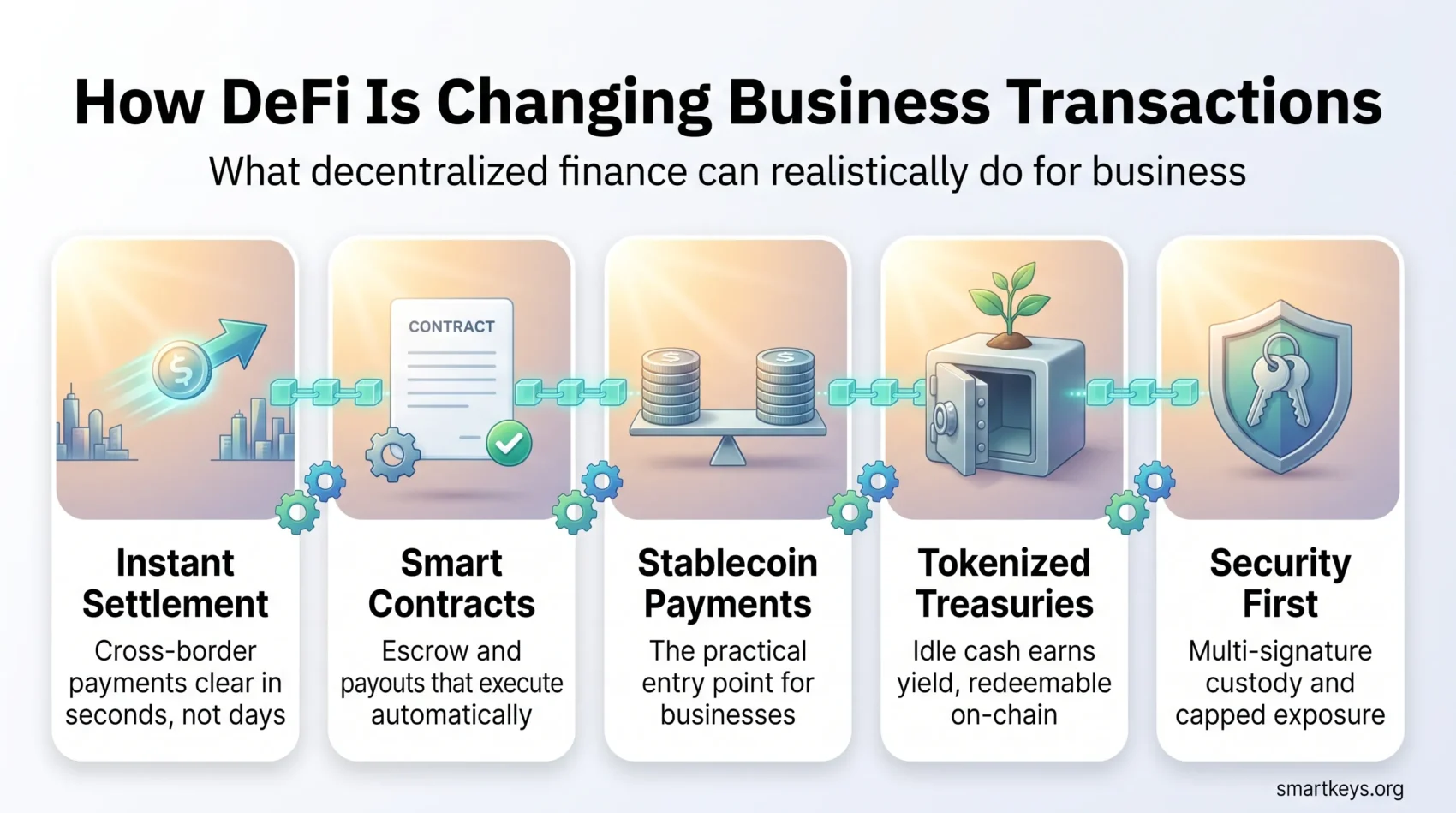
Smart contracts are self-executing agreements with the terms written into code. Payment on delivery, staged release of escrowed funds, automatic liquidation of collateral: each becomes a rule the network enforces instead of a clause someone has to chase.
The payoff is fewer manual handoffs. A supplier payment that clears when a shipment is confirmed removes a reconciliation step, the same logic behind broader finance automation and smart contracts in commercial agreements.
The caveat is symmetrical: code that executes without human review also executes bugs. Audited contracts, conservative limits and a tested rollback plan are not optional.
Peer-to-Peer Transactions and Their Advantages
Peer-to-peer transfer is the other half of decentralized financial services. Two parties settle directly on-chain, with no correspondent banking chain in between. Fees drop, cut-off times disappear, and weekend settlement stops being a problem.
This matters most for cross-border flows. A company paying contractors in six countries can move stablecoins in minutes instead of routing wires through intermediaries, which is why crypto payroll and global payroll platforms are converging. The trade-off: you now own key management and counterparty screening.

Lending Markets and Decentralized Exchanges
Two application types carry most of the remaining activity, and both work differently from their banking equivalents.
Lending markets such as Aave let a business borrow against crypto assets it already holds. There is no credit check, and that is exactly the constraint: because the protocol knows nothing about the borrower, it requires collateral worth more than the loan and sells that collateral automatically if its value falls too far. DeFi borrowing is a way to raise cash against assets you already own, not a substitute for a working capital line.
Decentralized exchanges such as Uniswap swap one token for another without an order book. Users deposit pairs of assets into shared liquidity pools, and a pricing formula sets the rate from whatever sits in the pool. You keep control of your own funds until the moment of the trade, so an exchange cannot fail with your balance on it. In return you accept price slippage on large orders and the risk that the pool’s code is flawed.
How DeFi Is Transforming Business Transactions
Traditional cross-border settlement still runs on business days. DeFi for company transactions collapses that to block time, seconds on most major networks. For a treasury team, faster settlement is working capital released from float.
Tokenization is the second shift. Representing a real-world asset as a token lets it be transferred, pledged or fractionalized on the same rails as everything else. RWA.xyz and other independent trackers put the tokenized real-world asset market near $34 billion in May 2026, roughly $15 billion of it in tokenized US Treasuries.
Tokenized Treasuries are the clearest business case in the sector right now. A company can hold a yield-bearing, redeemable instrument that settles on-chain instead of leaving idle balances in a non-interest account. That is a treasury management decision before it is a crypto decision, and deserves the same discipline as any cash flow management choice.
Third, programmable money changes what a payment can carry: conditions, invoice references and compliance attestations travel with the transfer instead of arriving in a separate file. That is the convergence also driving embedded finance and open banking.
DeFi Business Transactions: Efficiency and Cost Reduction
The efficiency argument is narrower than the marketing suggests, but where it holds, it holds well.
Reducing Intermediaries and Transaction Costs
Removing correspondent banks and card networks removes their fees. For high-value or high-frequency cross-border transfers the saving is measurable. For domestic card payments in a mature market it usually is not, because existing rails are already cheap and well protected.
Be honest about what replaces the intermediary: you take on custody, key management, sanctions screening and on-chain monitoring. At smaller volumes those costs can exceed the fees you removed, which is where a clear risk management framework earns its keep.
Instant Settlements and Their Impact on Liquidity
Instant, final settlement is DeFi’s most durable advantage. Funds received are funds usable, with no pending window and no clawback, so treasury teams can hold smaller buffers. Finality cuts both ways: an erroneous transfer is not reversible, so approval workflows and multi-signature controls have to be in place before volume grows, not after the first mistake.

Security and Transparency of DeFi Transactions
Security decides whether DeFi belongs anywhere near your balance sheet. Chainalysis put total crypto theft above $3.4 billion in 2025, dominated by the $1.5 billion Bybit breach at a centralized exchange, with compromised personal wallets at about 20% of stolen value. In 2026 the pressure moved back toward protocols: DefiLlama recorded more than 140 exploits and over $1 billion in losses through mid-year.
Read those numbers as a control requirement, not a verdict. The recurring failure modes are known: unaudited or freshly upgraded contracts, oracle manipulation (feeding a protocol a false price so it releases funds at the wrong value), compromised admin keys and social engineering of the people holding them. Almost none of the large 2026 losses came from a flaw in blockchain cryptography itself.
Practical controls follow directly. Use multi-signature or MPC (multi-party computation) custody, which splits signing power so no single person can move funds. Restrict interaction to audited, long-lived protocols. Cap exposure per protocol. Revoke stale token allowances. Treat every new integration like a new vendor under your cybersecurity programme.

Transparency creates its own problem. On a public chain, counterparties can see your balances, payment patterns and supplier relationships: a commercial confidentiality issue as much as a data privacy one. Address separation, dedicated operating wallets and privacy-preserving Layer 2 networks, which bundle transactions on a secondary chain before recording them on the main one, reduce the exposure without removing it.
Challenges and Risks Associated with Decentralized Finance
DeFi’s advantages come attached to risks a traditional bank normally absorbs on your behalf.
Vulnerability to Hacks and Theft
Protocol risk is unavoidable. Even audited contracts have failed, and the 2026 loss figures show better tooling alone has not solved it. There is no deposit insurance, no fraud department and, in most cases, no route to recovery once funds have moved.
The workable response is containment, not elimination: limit how much sits on-chain at any moment, diversify across protocols, and rehearse an incident response that assumes funds are gone. Some firms buy on-chain cover, though capacity is thin and exclusions broad.
Regulatory Concerns and Compliance Requirements
The regulatory picture in 2026 is far clearer than it was. In the United States, the GENIUS Act was signed in July 2025 as Public Law 119-27, setting reserve, custody, redemption and disclosure rules for payment stablecoins, and prohibiting issuers from paying yield to holders. Its provisions take effect on the earlier of January 18, 2027 or 120 days after final implementing rules.
In the European Union, MiCA is in active enforcement. Circle’s USDC and EURC obtained authorization, while Tether’s USDT was removed from major EU trading venues after failing to secure it, and by the first quarter of 2026 there were 19 authorized e-money token issuers covering 29 tokens.
The practical consequence is that stablecoin choice is now a compliance decision tied to where you operate. AML and know-your-customer obligations apply regardless of how funds move, so regtech tooling and a documented compliance framework are how you keep evidence auditors will accept.
Institutional Adoption of DeFi and Its Implications
Institutional DeFi has moved past pilots. J.P. Morgan’s Kinexys unit expanded its blockchain settlement network through 2026 and extended its JPM Coin deposit token to additional networks. Other large banks run comparable programmes for tokenized deposits and intraday repo.
Two things follow for smaller businesses. The plumbing is being standardized by institutions with compliance departments, which raises the floor for everyone. But most of this activity happens on permissioned or hybrid networks, not fully open ones: the technology is shared, the access model is not.
Stablecoin scale explains the interest. The market stood near $322 billion in May 2026, with Tether around $189 billion and USDC around $79 billion, and quarterly transfer volume in the trillions. At that size stablecoins are payment infrastructure, and banks respond to payment infrastructure they do not control.
Integration remains the hard part. Connecting on-chain settlement to an ERP, a general ledger and an audit trail is an ordinary systems project with unusual failure modes, raising the same questions that shape API-driven business models and cloud infrastructure decisions.
Effective DeFi Business Tools for Organizations
The tooling has consolidated. A handful of protocols carry most legitimate business volume, so start with the shortest possible list.
Where Most Business Activity Happens
- Stablecoin transfers for cross-border payments and supplier settlement.
- Tokenized money market funds and Treasuries for idle balances, via regulated issuers.
- Aave and comparable lending markets for collateralized borrowing against on-chain assets.
- Uniswap and other decentralized exchanges for converting between assets.
Note what is missing. Leveraged yield strategies and unaudited high-yield pools are where most losses happen, and have no place in corporate treasury.
Features of Secure DeFi Transactions
The control set matters more than the protocol brand. Look for:
- Multi-signature or MPC custody, requiring several approvals before any transfer executes.
- Policy engines that enforce whitelists, per-transaction caps and role-based limits.
- Screening and monitoring of counterparty addresses against sanctions and risk lists.
- Exportable audit trails that reconcile to your accounting system without manual work.

Judged against those criteria, most organizations find their first real DeFi use case is unglamorous: paying someone abroad faster, or parking cash in a tokenized Treasury fund.
How to Start Without Betting the Company
A sensible pilot is small, narrow and reversible. Pick one process where the current rails visibly fail: contractor payments to a country where wires take four days, or an operating balance earning nothing.
Then work through four steps in order. Agree with finance and legal which stablecoin is authorized in each market you operate in, because that is now a compliance question with a documented answer. Open custody with multi-signature approval before any money moves. Run the new process alongside the existing one for a month, so you can compare cost, speed and reconciliation effort against a real baseline. Only then decide whether to retire the old rail.
Keep the pilot at a size the company could write off. The point of a first project is to find out whether the operational overhead is worth the saving, and that answer differs by payment corridor and volume.
Conclusion
The future of DeFi in business is narrower and more credible than the 2021 pitch. Total value locked fell sharply through the first half of 2026, and speculative activity went with it. What remained solves an actual corporate problem: settlement that clears in seconds, cash that earns yield without leaving an auditable ledger, and payment logic that enforces itself.
Regulation shaped 2026 more than any protocol upgrade. With the GENIUS Act on the books in the United States and MiCA enforced in the European Union, businesses can ask which stablecoin is compliant in a given market and get a real answer. That clarity is what makes a treasury pilot defensible to a board.
The remaining constraint is security, and it is not close to solved. Size your exposure to what you can afford to lose, keep custody controls ahead of volume, and revisit the decision as the rules and loss data evolve.
Found this useful?
Make SmartKeys a preferred source on Google, and our articles will surface more often in your Top Stories, AI Overviews, and AI Mode.
Add as Preferred SourceFAQ
What is Decentralized Finance (DeFi)?
Decentralized Finance, or DeFi, is a set of financial services that run as code on a public blockchain rather than inside a bank. Lending, trading, collateral management and payments are handled by open protocols anyone with a wallet can use, and every transaction is recorded on a ledger participants can inspect. For a business the practical meaning is narrower than the label suggests: DeFi lets you settle payments directly with a counterparty, hold tokenized cash instruments, or borrow against on-chain collateral, without a correspondent banking chain in between. It does not remove your compliance obligations, and it shifts custody and security responsibility onto you.
How do smart contracts work in DeFi transactions?
A smart contract is an agreement written as code that the blockchain executes automatically when its conditions are met. In a DeFi transaction it can hold funds in escrow until delivery is confirmed, release staged payments against milestones, or liquidate collateral if a loan falls below its required ratio. Because the network enforces the terms, no third party has to verify that each side performed. The trade-off is that the code runs exactly as written, bugs included, so businesses should stick to contracts that are independently audited and have been live long enough for failures to surface.
Is DeFi safe enough for company funds in 2026?
Only with strict limits. DefiLlama recorded more than 140 exploits and over $1 billion in losses through the middle of 2026, including two April incidents of roughly $295 million and $293 million. There is no deposit insurance and, in most cases, no recovery once funds move. Businesses that use DeFi successfully treat it as a controlled exposure rather than a bank account: multi-signature or MPC custody, caps on how much sits with any one protocol, audited long-lived contracts only, and regular revocation of unused token approvals. Size the position at what the company could write off without operational damage.
What are the benefits of using DeFi for business transactions?
The strongest benefit is settlement speed with finality. A cross-border transfer that would take days through correspondent banks clears in seconds, and received funds are immediately usable, freeing working capital that would otherwise sit in float. Fees on high-value international transfers are typically lower because no chain of intermediaries takes a cut. Tokenized Treasuries and money market funds let idle balances earn yield while remaining redeemable on-chain, and payments can carry conditions and references that remove reconciliation steps. These gains are real for cross-border and treasury use cases, and much weaker for ordinary domestic payments.
How is DeFi regulated after the GENIUS Act and MiCA?
Stablecoins are now regulated products in both major markets. The GENIUS Act was signed in the United States in July 2025 as Public Law 119-27, setting reserve, custody, redemption and disclosure requirements for payment stablecoins and barring issuers from paying yield to holders; its provisions take effect on the earlier of January 18, 2027 or 120 days after final rules. In the European Union, MiCA is being enforced: Circle’s USDC and EURC secured authorization, Tether’s USDT was delisted from major EU venues, and 19 e-money token issuers covering 29 tokens were authorized as of Q1 2026. Lending protocols and decentralized exchanges remain less clearly covered, so per-jurisdiction legal review is still needed.
How are large institutions using DeFi technology?
Mostly on permissioned networks rather than open ones. J.P. Morgan’s Kinexys unit expanded its blockchain settlement network through 2026 and extended its JPM Coin deposit token to additional chains, and other large banks run comparable tokenized deposit and intraday repo programmes. Asset managers have pushed tokenized money market funds, a large part of why tokenized real-world assets reached roughly $34 billion by May 2026. For smaller companies the significance is indirect: institutions are standardizing custody, reporting and compliance practices that eventually reach ordinary payment and treasury providers.
Which DeFi platforms do businesses actually use?
The realistic list is short. Stablecoin transfers handle cross-border payments and supplier settlement. Tokenized money market funds and Treasuries from regulated issuers hold idle balances. Aave and similar lending markets provide collateralized borrowing against on-chain assets, and Uniswap and other decentralized exchanges convert between assets. Ethereum still hosts the largest share of value locked, around $39 billion in June 2026. What to avoid is equally clear: leveraged yield strategies, unaudited high-yield pools and newly launched protocols promising unusual returns account for a disproportionate share of losses.
Can a business borrow money through DeFi?
Yes, but only against assets it already holds. Lending protocols such as Aave run without credit checks, so instead of assessing the borrower they require collateral worth more than the loan, and they sell that collateral automatically if its value falls below the required level. In practice this makes DeFi borrowing a liquidity tool rather than a credit facility: a company holding crypto assets can raise cash without selling them and triggering a taxable disposal, but a company with no on-chain assets cannot borrow at all. Undercollateralized lending based on credit scoring exists only in early pilots. Treat the liquidation threshold, not the headline interest rate, as the number that matters.