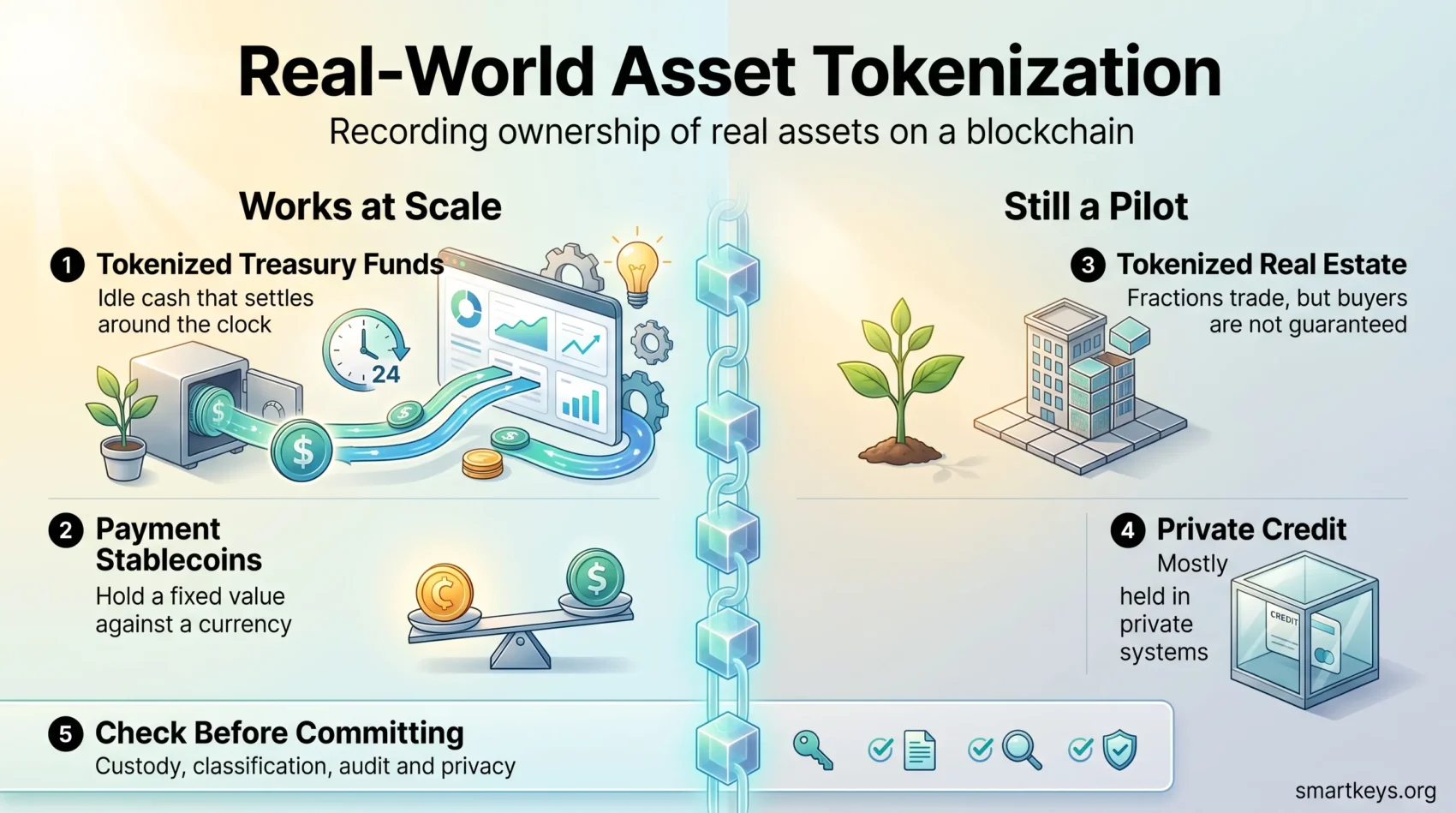
Asset tokenization means recording ownership of a real asset – a bond, a fund share, a building – as a digital token on a blockchain. That is a shared ledger everyone can read and nobody can quietly rewrite. The asset itself does not move. What changes is how ownership is recorded and settled.
What changed in 2025 and 2026 is that regulators wrote rules and large asset managers shipped products. This article shows where tokenization works with real money and where it is still a pilot.
Key Takeaways
- Tokenization records ownership of an existing asset; the asset itself is unchanged.
- Two uses are production-ready in 2026: tokenized US Treasury funds and payment stablecoins.
- Tokenized real estate and private credit stay small and are hard to sell on quickly.
- US rules arrived with the GENIUS Act; the EU is still reworking its DLT Pilot Regime.
- Most tokenized value is closed to retail investors, so check eligibility.
What Asset Tokenization Actually Means
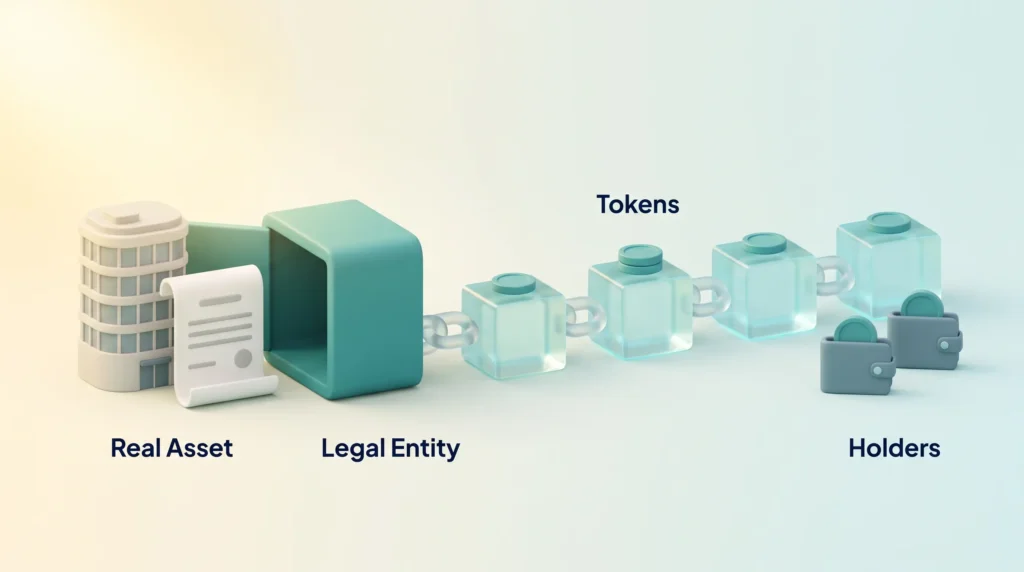
In a typical structure, a legal entity holds the real asset and tokens represent shares in it. A token gives you a claim on the entity, not a deed in your hand. In a tokenized rental property, a company owns the building and token holders receive a slice of the rent. If the land registry does not recognise the token, the legal owner on paper is still the company.
The automation comes from smart contracts – small programs stored on the blockchain that run by themselves when a condition is met. They can pay a coupon on schedule, block a transfer to an unapproved wallet, or move cash and asset in the same instant so neither side can default mid-trade.
That last point is the prize. In traditional settlement, money and securities move on separate systems and someone reconciles them afterwards. On one ledger they move together – the logic behind blockchain adoption.
Where the Market Stands in 2026
The numbers grow fast but stay small next to traditional finance. InvestaX put the tokenized real-world asset market at roughly $27.5 to $29 billion at the end of Q1 2026, up about 30% in one quarter. Growth is concentrated: a July 2026 market review counted about $15 billion in tokenized US Treasury products, $23.7 billion in asset-backed credit and near $8.3 billion in commodities, mostly gold. Tokenized real estate came to about $457 million and shrank over the year.
One figure matters more than the totals: how much of that value can actually move. In the Treasury category, 99% sits in tokens that circulate on public networks. In asset-backed credit, only about 10% does; the rest sits in private systems, closer to a database entry than a tradable instrument.
Access is the other constraint. The same review found roughly 97% of tokenized asset value sits outside the reach of US retail investors, so verify eligibility early.
What Already Works: Treasuries and Stablecoins
Two things work today at scale, both about cash rather than property. The first is tokenized money market and Treasury funds. BlackRock’s BUIDL, distributed through Securitize, held around $2.4 billion in early 2026 and Circle’s USYC around $2.7 billion, with further products from Ondo Finance, Franklin Templeton and WisdomTree. For a company with idle cash, these behave like a money market fund that settles around the clock, not at a daily cut-off. That helps corporate treasury management and cash flow planning.
The second is stablecoins – tokens designed to hold a fixed value against a currency such as the dollar. Total stablecoin market capitalisation reached about $308 billion on 13 August 2026, per DefiLlama. Treat volume claims carefully. Gross transfers ran into tens of trillions in 2025. But real-economy payments were only $350 to $550 billion, per McKinsey and BCG, and business-to-business payments near $226 billion a year. For supplier settlement, weigh them against open banking rails, embedded finance and digital wallets. For contractors abroad, compare crypto payroll with global payroll providers on total cost, not speed.
Rules, Risk and the Integration Checklist
Regulation moved from vague to concrete, which is why institutions engaged. In the US, the GENIUS Act was enacted in July 2025 and takes effect no later than 18 January 2027. Through 2026 the OCC, FDIC, NCUA and the Treasury proposed rules on who may issue a payment stablecoin, what reserves back it, and how anti-money-laundering checks apply. One provision matters commercially: a permitted payment stablecoin may not pay yield for merely holding it. The SEC stated in January 2026 that tokenized securities are securities under existing law.
The European Union is less settled. The Commission has proposed overhauling the DLT Pilot Regime, the sandbox for trading tokenized securities, lifting the per-platform issuance cap well above today’s €6 billion. None of it is law yet.
Before committing budget, check:
- How the token is classified in every country where you offer it, and who may hold it.
- Who holds the private keys. Losing key custody means losing the asset, with no chargeback.
- Whether the smart contract has an independent audit; a code bug is a bug in your legal plumbing.
- What a public blockchain reveals about counterparties and volumes, against your data privacy obligations.
- Accounting, wallet operations and staffing: RegTech tooling and security controls both need extending.
Smart Contracts and Blockchain Technology Insights
Banks did not adopt public blockchains wholesale. They built permissioned networks, where membership is controlled and transactions stay private. JPMorgan runs Kinexys, rebranded from Onyx in 2024, for tokenized deposits and intraday repo. Goldman Sachs built GS DAP on Digital Asset’s technology, the stack behind the Canton Network. It has worked to spin the platform out so rivals can join without sitting on a competitor’s books.
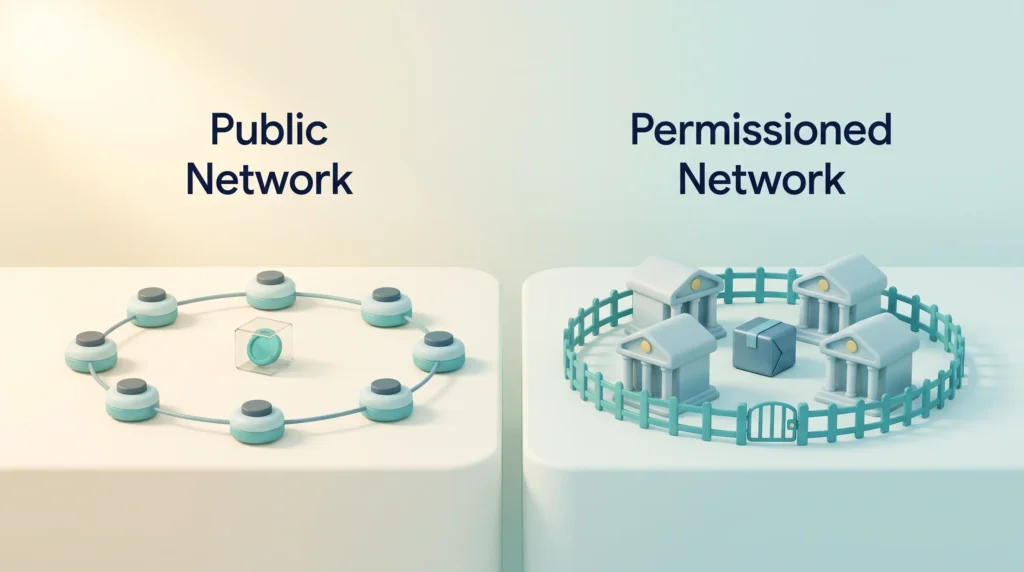
That spin-out is instructive: a platform is only valuable if many institutions use the same one, the adoption problem also seen in blockchain in logistics. Public networks give reach and cheap access; permissioned networks give privacy and a clearer legal position. Most issuance chooses privacy, which is why so little tokenized credit circulates.
Real Estate, Credit and the Liquidity Question
Fractional ownership is the promise everyone repeats: split a building into small units so more people can invest. Dubai shows the appeal and the limit. Its Land Department tokenized about AED 18.5 million of property on the PRYPCO Mint platform between March 2025 and February 2026 – a real result, and a very small one. A second phase added secondary trading from AED 2,000.
Here the word liquidity needs care. Splitting an asset into small units makes trading possible; it does not create buyers. A token is liquid only if someone will buy it at a fair price on the day you want out. Tokenized real estate shrank in 2026 partly because that demand never arrived – the same caution applies to tokenized private credit and P2P lending.
For property firms, the nearer-term gains sit in operations – the ground covered by PropTech. Anyone weighing token-based ownership should also review Web3 business models, how decentralized finance and cryptocurrency in business transactions have performed, and broader fintech trends.
Conclusion
Tokenization in 2026 is neither hype nor a finished revolution. One narrow band of finance works well; a wider band is still in pilot.
If you hold idle cash or pay suppliers across borders, tokenized Treasury funds and regulated stablecoins deserve a look. Start small, with named custody and a compliance sign-off. If you want to tokenize your own property, invoices or equity, treat it as a two-year project, not a quick funding route. The legal work is real and buyers are not guaranteed. Take advice from a qualified lawyer and accountant in each jurisdiction involved.
Found this useful?
Make SmartKeys a preferred source on Google, and our articles will surface more often in your Top Stories, AI Overviews, and AI Mode.
Add as Preferred SourceFAQ
What is asset tokenization?
Asset tokenization records ownership of an existing asset as a digital token on a blockchain. The asset can be financial, such as a bond or fund share, or physical, such as a building or gold. In most structures a legal entity holds the asset and tokens represent shares in that entity, so a holder has a claim on the entity rather than direct title. It does not change what the asset is worth, only how ownership is recorded.
Does tokenization really create liquidity?
Only sometimes, and this is the most oversold claim in the field. Splitting an asset into small tradable units makes a market possible, but it does not create buyers. Tokenized Treasuries trade well because the underlying instrument was already liquid. Tokenized real estate does not, which is one reason the category shrank during 2026 to around $457 million. Before counting on an exit, ask who the buyers would be.
Which regulations should I know about?
In the United States the GENIUS Act was enacted in July 2025 and takes effect no later than 18 January 2027. During 2026 the OCC, FDIC, NCUA and the Treasury proposed rules on who may issue payment stablecoins, what reserves are required and how anti-money-laundering duties apply. One provision bars paying yield for merely holding one. The SEC confirmed in January 2026 that tokenized securities are securities. In the EU, a proposed expansion of the DLT Pilot Regime is not yet law.
Can retail investors buy tokenized assets?
Mostly not, at least not in the United States. A mid-2026 market review found around 97% of tokenized asset value sits outside the reach of US retail investors, leaving roughly $1.7 billion accessible to them. Most issuance targets institutions or accredited investors. Some jurisdictions are more open: Dubai’s PRYPCO Mint lets UAE residents buy fractions of listed properties from AED 2,000. If your model depends on retail demand, verify eligibility market by market.
What challenges might businesses face when adopting this technology?
Key custody is the sharpest risk: whoever controls the private keys controls the asset, and there is no chargeback if they are lost or stolen. Next come legal classification, which varies by country and decides who may hold your token, and smart-contract defects, which can lock or misroute funds. Privacy is often underestimated, since a public blockchain can expose counterparties and transaction sizes. Exit risk is real too – if no secondary market forms, you may hold the position for its full term.