Stablecoin payments let a business send dollars or euros across a blockchain instead of through a chain of correspondent banks. A stablecoin is a digital token whose value is tied to an ordinary currency, usually one token for one US dollar. That peg is what separates it from cryptocurrency in global business transactions more broadly, where prices can move sharply in a day.
The market is now real infrastructure. On 13 August 2026 the total value of all stablecoins in circulation was about $308 billion, based on DefiLlama data compiled by Reap. That is about 14 percent above a year earlier.
The payments side is smaller than those headlines suggest. McKinsey put genuine stablecoin payment activity at about $390 billion for 2025, of which roughly $226 billion was business to business. That is near 0.02 percent of global payment flows, so stablecoins suit specific corridors rather than everything. This guide covers how a payment works, where it beats a wire, what the 2026 rules require and which controls come first. For wider context, see our overview of blockchain in business in 2026.
Key Takeaways
- Stablecoins settle in seconds or minutes; bank transfers take two to five business days.
- Total supply was about $308 billion on 13 August 2026, roughly 14 percent up year over year (DefiLlama via Reap).
- Real payment activity reached about $390 billion in 2025, some $226 billion of it B2B (McKinsey).
- The GENIUS Act and MiCA define who may issue a payment stablecoin, but US final rules were still pending through 2026.
- On-chain transfers cannot be reversed, so address checks matter more than at a bank.
Understanding Stablecoin Payments in Modern Finance
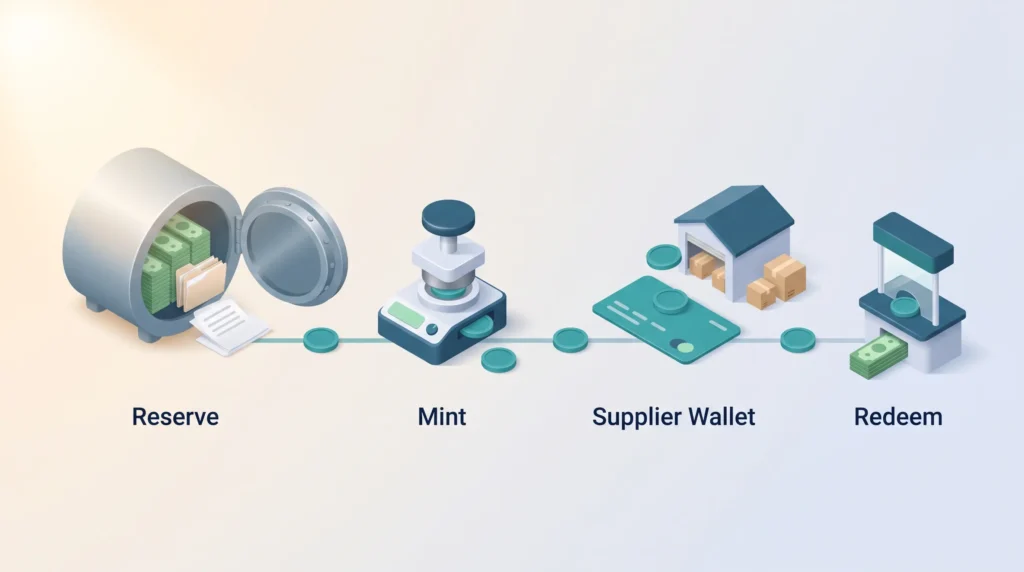
A stablecoin issuer takes your money, holds it in reserve, and puts a matching token on a public ledger. Because that reserve sits in cash and short-term government debt, the token should stay worth one dollar.
Two tokens carry nearly all traffic. In August 2026, USDT accounted for roughly 59 percent of supply and USDC for about 23 percent, according to DefiLlama. That concentration helps: your counterparties almost certainly hold one already.
How a Stablecoin Is Created and Redeemed
The mechanics are simpler than the jargon. A company wires $1 million to an issuer such as Circle. The issuer mints 1 million tokens and sends them to the company’s wallet, an account on the blockchain identified by a long string of characters.
The company then pays a supplier by sending tokens to that supplier’s wallet. The supplier keeps them or redeems them with the issuer for ordinary dollars. Redemption is the exit door, so check its terms first.
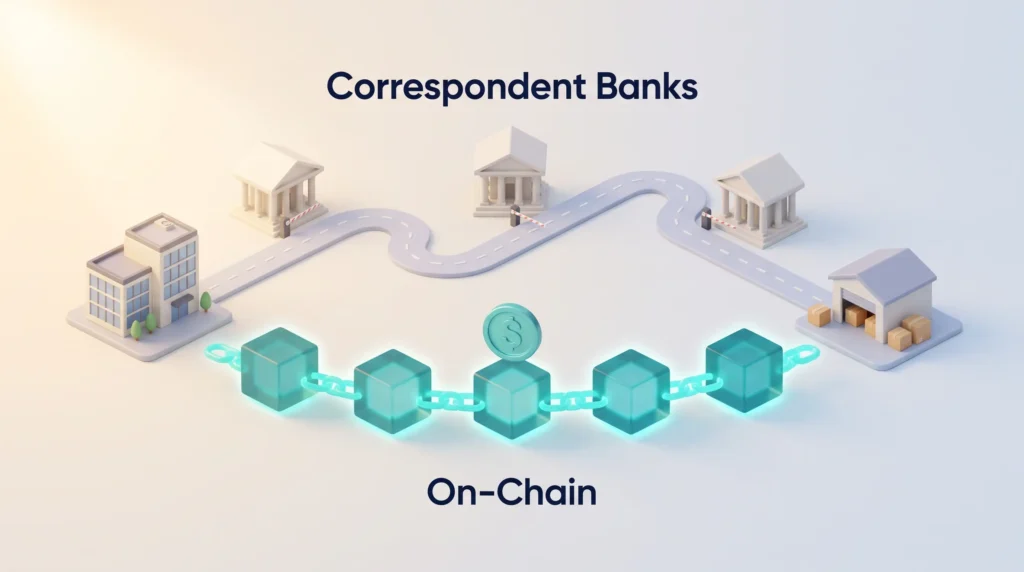
Compare that with a SWIFT payment, the messaging system banks use for international transfers. It may pass through three correspondent banks, each adding a fee and a compliance check. The on-chain version replaces those hops with one shared record, the shift toward programmable money behind newer Web3 business models.
How Big the Market Really Is in 2026
Gross transfer figures are widely quoted and widely misread. Analysis by BCG with Allium and the Bank for International Settlements found $28 trillion to $62 trillion in raw stablecoin transfers during 2025. Only about 7 percent reflected genuine economic activity. The rest was trading and automated movement between exchanges.
Adjusted volume is cleaner. Artemis data reported by Bloomberg put USDC at $18.3 trillion and USDT at $13.3 trillion for 2025. USDC moved more value on less supply, which reflects heavier use in payments than in trading. For a finance team the reading is simple. Stablecoins are past the pilot stage in a few corridors, but they are not yet a mainstream rail. That places them alongside the shifts in our look at fintech business trends.
Benefits of Stablecoin Payments for Your Global Business
The clearest gain is time. A transfer settles in seconds or minutes against two to five business days at a correspondent bank. That shortens the gap between shipping goods and getting paid, one of the most direct levers in cash flow management.
Cost is the second gain, and it depends on the corridor. The World Bank put the global average cost of sending $200 in remittances at 6.36 percent in the third quarter of 2025. The UN and G20 target is 3 percent by 2030. On expensive routes, removing two intermediaries changes the arithmetic. Inside SEPA, it does not.
Visibility is the third gain. Every transfer carries a timestamp, an amount and a unique transaction hash, so your accounts team can match payment to invoice without waiting for a statement. That fits wider finance automation work. Payment logic can also sit inside the transfer itself: release on delivery, split across recipients, or hold in escrow until a milestone is signed off. Blockchains run continuously, so a Saturday payout is no harder than a Tuesday one.
Here is the practical version. A London agency owes a contractor in Manila $4,200 on a Friday evening. A bank transfer leaves on Monday and lands midweek; a stablecoin transfer arrives that evening, and the contractor converts it locally. That is the curve traced in our piece on digital wallets and work payments.
The recurring use cases are supplier payments, contractor payroll, treasury transfers between your entities, and marketplace payouts. Each shares a pattern: many recipients, several countries, and a slow or expensive bank route.
How Stablecoin Payments Streamline Cross-Border Transactions
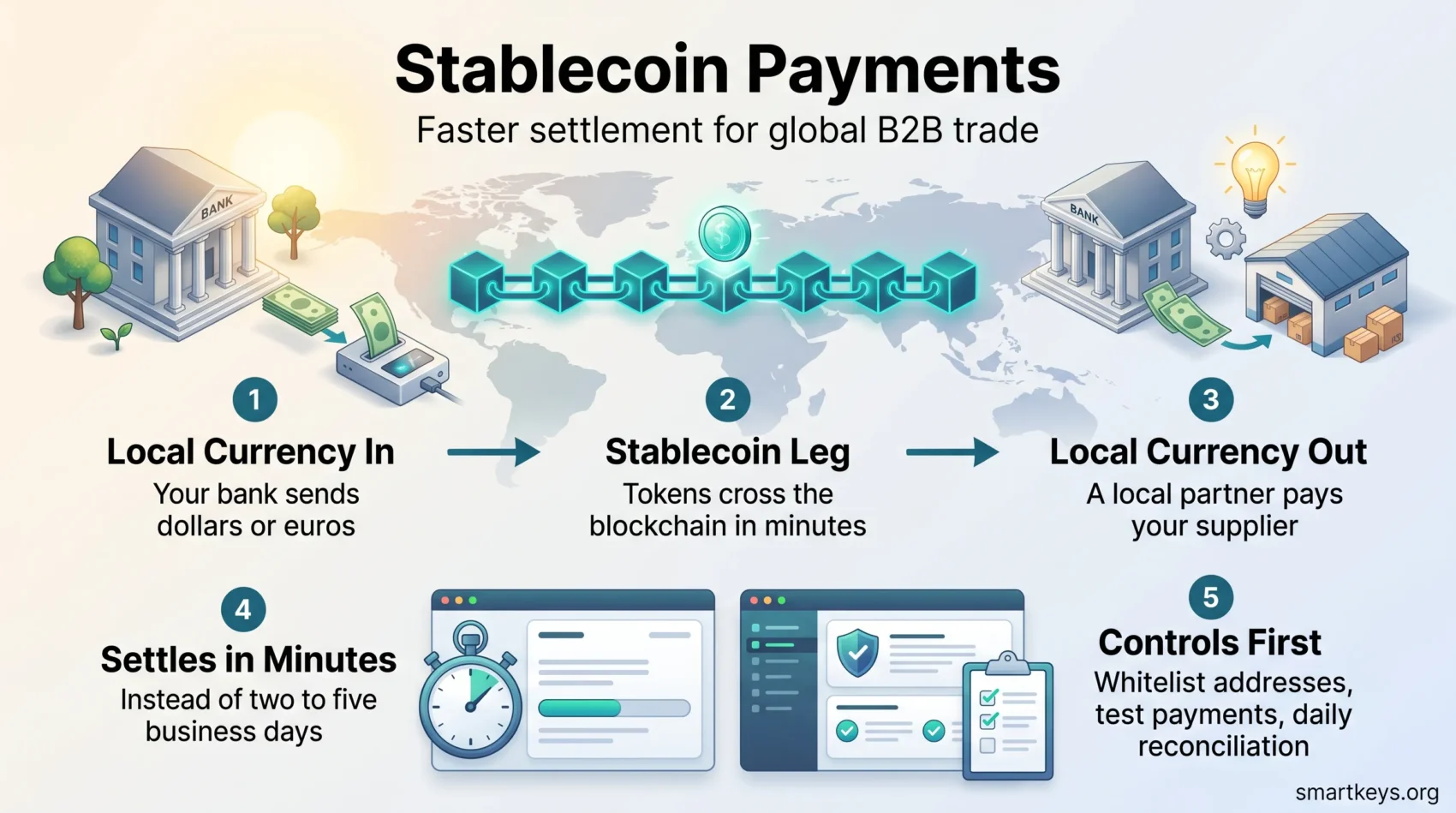
Cross-border payments are where stablecoins earn their place, because the friction comes from the number of parties involved. A provider moving money from the United States to Argentina shows the pattern. It takes dollars, converts them to USDC and sends the tokens on-chain in minutes. A local partner then pays out pesos. The customer never touches a wallet. If you are building such a route as part of a global expansion strategy, the corridor matters more than the technology.
Simplifying Remittances and Currency Exchange
- Fewer correspondent banks means fewer currency markups and fewer reconciliation delays at month end.
- The same route works for paying people, which is why crypto payroll for remote workers and global payroll solutions increasingly overlap.
Exploring the Stablecoin Sandwich Model
The stablecoin sandwich is the standard design. Local currency goes in at one end, a stablecoin carries the value across the middle, and local currency comes out at the other end. The bread is the banking you already use; the filling is the blockchain leg. Your supplier still receives a normal bank payment, so nobody outside the payment company needs to understand blockchains.
One-legged transfers are the other variant. A marketplace collects card payments in local currency but pays sellers in USDC, so only the payout side is on-chain. That suits paying freelancers, and it pairs with the freelance talent platforms many companies now use.
Regulatory Clarity and Compliance in the Digital Currency World
Two rulebooks now decide who may issue a payment stablecoin: the GENIUS Act in the United States and MiCA in the European Union. Both matter to you as a payer, because they determine which tokens your bank and auditor will accept.
What the GENIUS Act Requires
The GENIUS Act was signed on 18 July 2025. It defines a payment stablecoin as a digital asset used for payment or settlement and redeemable at a fixed amount. Issuers must hold reserves of at least 100 percent in cash and short-term US Treasuries, and publish that composition monthly.
Timing needs care. The rules take effect on the earlier of 18 January 2027 or 120 days after the main federal regulators finalise them. Those regulations were still drafts through 2026. The Office of the Comptroller of the Currency proposed its rules in February 2026, and the Federal Deposit Insurance Corporation published its proposal that April. Treat any 2026 claim of full GENIUS compliance as a statement of intent.
How MiCA Works in Europe
MiCA treats a currency-pegged stablecoin as an e-money token and sets reserve, governance and redemption rules for the issuer. Adoption has been uneven: as of March 2026 the ESMA register listed 19 authorised e-money token issuers across 11 countries, covering 29 tokens. The transition period for firms under older national regimes closed on 1 July 2026.
Banks are moving into the gap. ClearBank Europe said in April 2026 that it was the first Dutch credit institution cleared to provide crypto asset services under MiCA. It offers EURC and USDC through Circle’s Mint platform. Check an issuer’s licence, redemption terms and anti-money laundering controls before routing volume. The same diligence applies as in data privacy compliance and open banking.
Key Infrastructure and Technology Behind Stablecoin Payments
Three things sit between you and a working payment: the blockchain, the provider handling conversion and compliance, and your own bank.
The Role of Blockchain Networks
- Ethereum, Solana and Tron carry most payments. Each is a separate network with its own fees and confirmation times.
- Sender and recipient must agree on the network. Tokens sent on the wrong one can be lost, and no support desk can pull them back.
- Network fees are paid in that network’s own token, so your wallet needs a small balance of it.
Integration with Traditional Banking Systems
Most companies never touch a blockchain directly. A payment provider sits in front of it and handles the awkward parts: converting currency, sending the transfer, screening the counterparty and producing auditable records. That is the packaging logic behind embedded finance.
ClearBank shows how the worlds join up. It mints stablecoins through Circle and connects them to SEPA and SEPA Instant, the euro rails European banks already run. Circle’s own Payments Network does the same at larger scale. It links banks and companies so they can settle in USDC and EURC without each pair needing a correspondent relationship. That is one concrete outcome of the shift described in how decentralized finance is changing business transactions. Supply chain teams watch the same rails for document flows, a theme in blockchain and logistics. Payment authentication is changing alongside it, as our review of biometric payment systems shows.
Navigating Risks and Addressing Operational Challenges
Stablecoins remove some risks and add others, so compare the new failure modes with the ones you already manage. Not every stablecoin is backed by cash: the Terra network collapsed in 2022 because its token relied on an algorithm rather than real reserves. Fiat-backed tokens work differently, but read what stands behind the peg before you accept it.
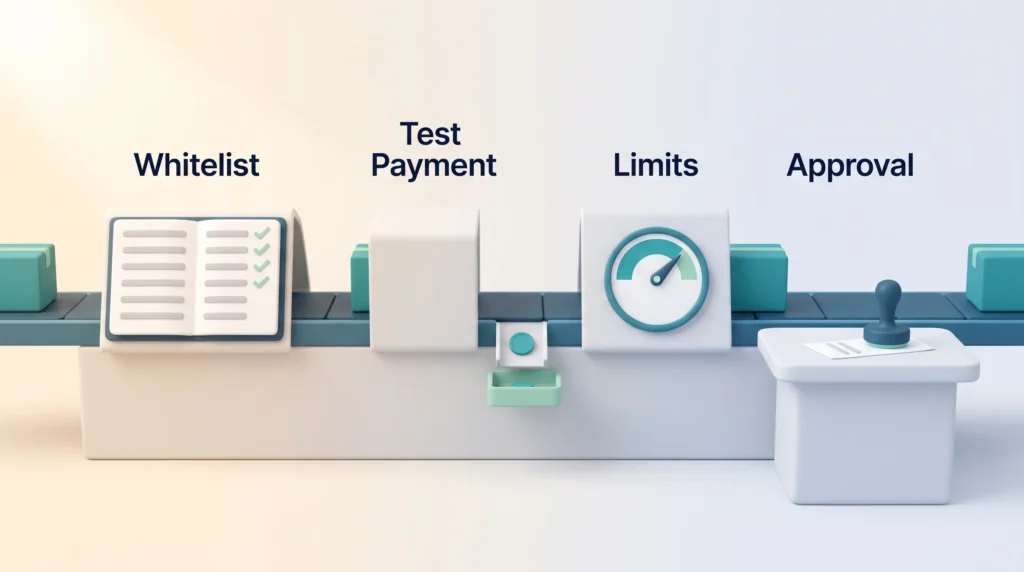
Irreversibility is the risk finance teams underestimate. Once confirmed, a transfer cannot be recalled, so a wrong address or one extra zero is permanent. Compliance is not built in either: a blockchain confirms that a transfer happened, not that the recipient passed know your customer and anti-money laundering checks. Network fees also spike when a chain is busy, which makes frequent payouts hard to budget. A workable control set looks like this:
- Use regulated providers and a short approved token list, reviewed quarterly.
- Whitelist counterparty addresses and send a small test payment before the first large transfer.
- Set per-payment and daily limits, and separate who creates a payment from who approves it.
- Reconcile transaction hashes against your ledger daily.
These controls belong inside your existing risk management framework. If you hold token balances overnight, the custody and accounting questions in crypto treasury management apply too.
Conclusion
Stablecoin payments move value across borders in seconds while both ends stay in local currency. About $390 billion in real payment activity during 2025, roughly $226 billion of it business to business, shows this has passed the pilot stage. It is still a small share of global payments, so pick corridors rather than converting everything.
Deploy with the basics in place: check reserve backing and the issuer’s regulatory status, verify every address, and insist on auditable records. The sandwich model is the sensible entry point because it keeps your bank at both ends. Round-the-clock settlement helps most at weekend peaks, as our analysis of mobile commerce trends shows.
Start small: run your two most expensive corridors for a month with real invoices, then compare total cost, including conversion spread, against what your bank charges today.
Found this useful?
Make SmartKeys a preferred source on Google, and our articles will surface more often in your Top Stories, AI Overviews, and AI Mode.
Add as Preferred Source