An AI governance model is the written set of rules, roles and checks that decide how your company builds, buys and uses artificial intelligence.
It answers four questions. Who is allowed to approve an AI system? What has to be tested before it goes live? What evidence do you keep? And who is accountable when something goes wrong?
Without those answers, teams improvise. A support chatbot invents a refund policy. A screening tool quietly filters out a group of applicants. Nobody can say who signed off, because nobody did.
This is also where ethical AI in business stops being a slogan. Fairness and transparency only mean something once a person owns them, tests for them and keeps the evidence.
This guide shows how to build the model in practical steps: the principles, the roles, the lifecycle controls, the frameworks worth copying, the rules that actually bind you in 2026, and a 90 day plan to start. For the day to day decision side of the same problem, see our guide to AI decision making for managers.
Key Takeaways
- An AI governance model turns vague principles into named owners, approval gates and records you can show an auditor.
- Most organisations are still immature: only about a third reach a middle level of governance maturity, according to McKinsey’s 2026 survey.
- Start with an inventory of every AI system in use. You cannot govern what you have not listed.
- Scale the controls to the risk. A marketing copy generator does not need the same gates as a credit scoring model.
- Three reference documents do most of the work: the NIST AI Risk Management Framework, ISO/IEC 42001 and the EU AI Act.
- The rules moved again in 2026. Several EU high risk deadlines slipped to December 2027, and Colorado replaced its AI law entirely.
What an AI governance model actually is
Governance sounds abstract, so it helps to name the parts.
A governance model has three layers. Policies say what is allowed. Processes say how a system moves from idea to production. Oversight says who checks, who approves and who can stop a release.
Those layers cover the whole lifecycle. That means the problem you are trying to solve, the data you train on, the testing before launch, the monitoring after launch, and the day you switch the system off.
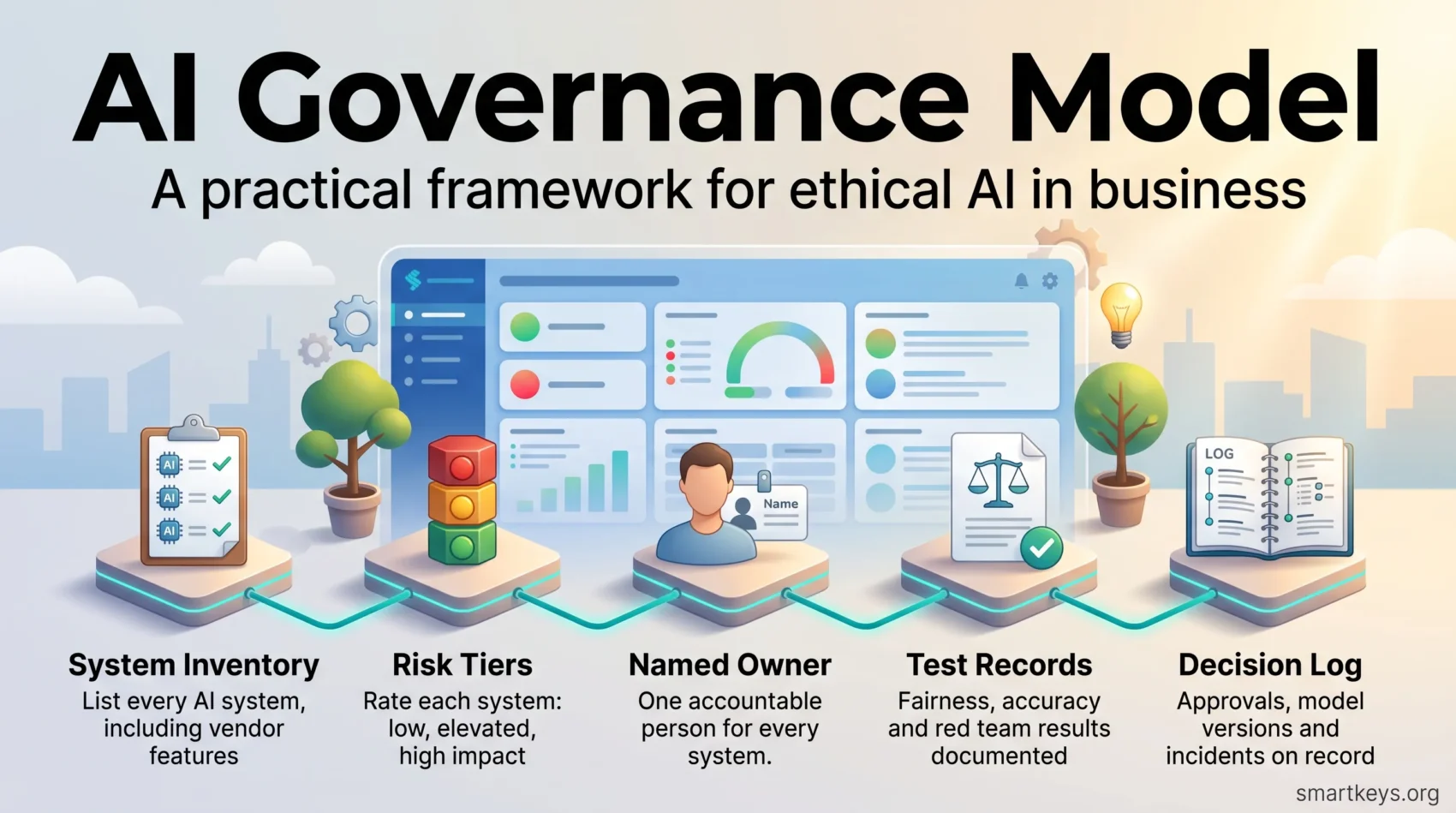
The output of a good model is boring and useful: a list of systems, a risk rating for each one, a named owner, a test record, and a log of decisions.
What it is not
It is not an ethics statement on your website. A statement commits nobody to anything.
It is also not a single committee that reviews everything. That creates a queue, and queues get bypassed. The work has to sit inside the processes your teams already use.
Why this matters more in 2026 than it did in 2024
Two things changed. AI moved from pilots into live customer processes, and the rules caught up.
The gap between awareness and action is the striking part. McKinsey surveyed around 500 organisations between December 2025 and January 2026. Only about a third reached level three or higher on its governance maturity scale, which covers strategy, oversight and controls for AI agents.
Ownership was the difference that showed up most clearly. Organisations with explicit accountability for responsible AI averaged a maturity score of 2.6. Those without averaged 1.8.
Incidents are not rare, and responses are poor. Roughly 8 percent of organisations reported an AI related incident, a share that held steady year on year. Of those, nearly 60 percent rated their own response as unsatisfactory or worse.
The failures that made the case are well known. Microsoft took its Tay chatbot offline in 2016, less than a day after users taught it to post offensive messages. The same year, a ProPublica investigation of the COMPAS risk score used in US courts found that Black defendants who did not reoffend were nearly twice as likely as white defendants to be labelled high risk.
Neither was a coding bug in the usual sense. Both were governance gaps: nobody had defined what the system must never do, or tested for it before launch.
The pattern is consistent. Companies know the risks. Far fewer have the controls, the owner or the playbook to deal with one when it lands. Our overview of how AI is transforming business operations covers the same gap on the value side.
Five principles to anchor the model
Principles are only useful when each one turns into a test somebody runs. Here are five that convert well.
1. Fairness you can measure
Fairness means the system does not produce systematically worse outcomes for a group of people without a justifiable reason.
Turn it into acceptance criteria before a model ships. Decide which groups you will compare, which metric you will use, and what gap triggers a rework. Record the result either way.
A simple first metric is the ratio of selection rates between groups. US employment guidance uses a rule of thumb: if one group is selected at less than four fifths of the rate of the most selected group, that signals possible adverse impact and needs a closer look.
When a gap shows up, you can fix it in three places. Before training, check that the data represents the people the system will affect, and look for fields that stand in for protected traits, such as a postcode that tracks ethnicity. During training, some methods penalise the model for unequal outcomes. After training, you can adjust how outputs are turned into decisions, where the law allows it. Then keep measuring, because a model that was fair at launch can drift.
Hiring is where this gets tested hardest. Our guides to AI hiring bias and AI hiring tools and what the law requires go into the specific checks.
2. Transparency about what the system is
People should know when they are dealing with a machine, and what it is deciding.
In practice that means a disclosure line in the chat window, a note on an automated decision letter, and internal documentation that says what data trained the model.
3. Explainability proportionate to the stakes
Explainability means you can say why a system produced a given output.
You do not need this everywhere. You do need it where a decision affects someone’s job, money, housing or health. Our guide to explainable AI covers the methods and their limits.
4. A human in the loop where it counts
A human reviewer only adds value if that person can actually overrule the system, has time to look, and is not punished for disagreeing. Rubber stamping is worse than no review, because it creates a false record of oversight.
5. Privacy and security by design
Decide what data may enter a prompt or a training set before anyone builds. Then enforce it with access controls, not with a reminder email. Our generative AI usage guidelines give a one page version your team will actually read.
Roles: who decides, who checks, who answers
Governance fails quietly when everyone assumes someone else is watching.
Use a RACI table, which simply lists who is Responsible for doing the work, Accountable for the outcome, Consulted along the way, and Informed afterwards. Build one per system type, not per system, or you will never finish.
A workable split
- Senior leadership: sets the risk appetite, funds the work, and decides what the company will not build.
- Product owner: accountable for one system end to end, including its retirement.
- Engineering and data teams: responsible for testing, monitoring and documentation.
- Legal and privacy: consulted on classification, disclosures and contracts with vendors.
- Security: responsible for threat modelling, access control and incident handling.
- Internal audit: independent check that the controls exist and work, with access to systems, data and logs.
Some companies now appoint a single named owner for the whole portfolio. Our profile of the AI ethics officer role covers what that job does and where it sits.
Whatever the titles, one rule matters most. Every AI system in production has exactly one person whose name is on it.
The board needs a view too, but a short one. A regular report with the number of systems per risk tier, open audit findings, incidents and approval times is enough to show whether the model works. Bring finance into the loop as well, because every control costs money and the budget should follow the risk.
Controls across the AI lifecycle
Risk work is continuous, not a gate you pass once. Five stages carry most of the load.
Inventory and classification
List every AI system in use, including the ones bought inside other software. Vendor features count. So does the tool a team signed up for on a credit card.
Then rate each one. A simple three tier scale works: low impact, elevated, and high impact where the system affects someone’s rights, money or safety. The tier decides how much of the rest applies.
Pre-launch testing
Define what “good enough to ship” means before the build starts. That usually includes accuracy on a held back test set, fairness comparisons, robustness under odd inputs, and a red team pass where people deliberately try to break the system.
Write down what failed as well as what passed. Auditors trust a record with failures in it far more than a clean one.
Package the results in a model card: a one or two page summary of what the system does, what data trained it, how it performed in testing, and where it should not be used. Google researchers proposed the format in 2019, and enterprise buyers and auditors now often ask for something like it.
Monitoring after launch
Models degrade. The world changes, the input data shifts, and accuracy quietly drops. That slow decay is called drift.
Set automated alerts on the things that matter: accuracy against a benchmark, input distributions, latency, cost, and refusal or error rates. Agents that take actions need tighter monitoring than models that only produce text. Our AI agent workflows playbook covers what changes when a system can act on its own.
Response thresholds
Decide in advance what triggers a pause, a rollback, a retrain or a retirement. Write the number down. A threshold agreed during an incident is not a threshold.
Decommissioning
Retiring a system is a governance event. Archive the logs, revoke the access, tell the people who relied on it, and note what replaced it.
For the broader company view of how this slots into existing controls, our risk management framework guide covers the structure.
Data governance is the foundation underneath
Almost every AI failure traces back to data. Wrong data, stale data, data you had no right to use.
Four practices carry most of the weight:
- Quality rules: agreed checks for completeness, accuracy and freshness, run automatically rather than by eye.
- Lineage: a record of where each dataset came from and what was done to it. Without lineage, you cannot answer “why did the model say that” months later.
- Minimisation: collect only what the purpose needs. Less personal data means less exposure and fewer disclosure duties.
- Retention and access: delete on a schedule, and restrict who can see sensitive fields by role.
This is ordinary data management done properly. Our data governance strategy guide covers the roles and tooling, and data privacy at work covers the employee data angle specifically.
One practical note. Employee data is now among the most regulated categories you hold, and monitoring tools are where companies get caught out. Our guide to AI in employee monitoring sets out what is permitted where.
Frameworks worth building on
You do not need to invent a structure. Three references cover most of it, and they fit together.
NIST AI Risk Management Framework
The US National Institute of Standards and Technology published a voluntary framework built around four functions: govern, map, measure and manage.
It is useful precisely because it is voluntary. You can adopt the structure, map your existing controls onto it, and use the gaps as your backlog. A companion profile covers generative AI specifically.
ISO/IEC 42001
Published in December 2023, ISO/IEC 42001 is the first international standard for an AI management system. It follows the same plan, do, check, act shape as ISO 27001 for information security, with 39 controls in its annex.
Its practical advantage is certification. An accredited auditor can certify you, which gives customers and regulators an external signal rather than your own word. Certification typically takes six to twelve months and is valid for three years with annual checks.
One caveat matters. ISO/IEC 42001 certification does not by itself satisfy EU AI Act duties. The Act is binding law with penalties; the standard is a management system. The documentation you produce for one does support the other.
OECD AI Principles
The OECD Principles, updated in May 2024, give you the value language: human centred values, transparency, robustness and accountability. They are a good benchmark when you write your own policy, because they are widely recognised and deliberately short.
For the ethics side in more depth, see our guide to the five core principles of an AI ethics framework.
The rules that actually bind you in 2026
This is the part that changed most, and where old advice is now wrong.
European Union
The EU AI Act sorts systems into risk tiers and attaches duties to each tier. Some of its dates moved in 2026.
EU institutions reached a provisional political agreement on the Digital Omnibus package on 6 May 2026, confirmed by member state representatives on 13 May. Under that agreement, duties for Annex III high risk systems, which include hiring, credit, education and essential services, move from 2 August 2026 to 2 December 2027. High risk systems embedded in regulated products under Annex I move from August 2027 to August 2028.
Two things did not move. Obligations for general purpose AI models have applied since 2 August 2025. And the Article 50 transparency duties, which cover telling people they are interacting with AI and labelling generated content, still apply from 2 August 2026.
The package was formally adopted as Regulation (EU) 2026/1744. It was published in the Official Journal on 24 July 2026 and has been in force since 27 July 2026. Generative systems already on the market before 2 August 2026 have until 2 December 2026 to mark their output as machine generated. The Omnibus also added a new ban on AI systems that generate child sexual abuse material or non-consensual intimate images of real people.
Fines scale with the breach. Prohibited practices can cost up to EUR 35 million or 7 percent of worldwide annual turnover, whichever is higher. Most other violations can cost up to EUR 15 million or 3 percent. For small and medium sized companies, the lower of the two amounts applies.
Our guide to EU AI Act compliance for SaaS teams tracks the risk tiers and duties in detail.
United States: federal
The federal picture reversed in 2025. President Trump revoked President Biden’s 2023 executive order on AI on his first day in office. He then signed Executive Order 14179 on 23 January 2025. It reframes federal policy around removing barriers to AI development rather than setting safety duties.
A second order followed. Executive Order 14365, signed on 11 December 2025, sets out to limit state level AI regulation. It directs the Attorney General to create an AI litigation task force to challenge state laws. It gives the Commerce Department 90 days to identify burdensome state rules. It also allows agencies to condition federal funding on alignment with federal policy.
The practical effect for a business is uncertainty. State obligations may be challenged, but they have not disappeared.
United States: states
Colorado is the clearest example of how fast this moves. A federal magistrate judge blocked enforcement of the Colorado AI Act on 27 April 2026, after xAI filed a constitutional challenge and the Department of Justice intervened in support. The state then passed a replacement, SB 26-189, signed on 14 May 2026 and effective 1 January 2027.
The replacement is lighter. It drops the impact assessment and anti-discrimination duties of the original. Instead it requires developers to hand technical documentation to the companies deploying their systems. It also requires notice to consumers when AI makes a consequential decision about education, employment, finance, healthcare, housing or insurance. Violations carry a 60 day notice and cure period.
Illinois, New York City and California all have their own rules on automated decisions in employment. Our guide to global AI regulation and compliance tracks the current state of play, and algorithmic management covers the employment law angle.
Sector rules you may already be under
Banks have governed models for years. The Federal Reserve and OCC guidance known as SR 11-7 requires an inventory of models, independent validation, documented assumptions and ongoing performance monitoring.
That structure predates the current AI debate and holds up well. If your company is not a bank, it is still one of the better templates available.
Privacy law applies regardless of any AI specific rule. Our privacy compliance framework covers what that means in practice.
Beyond the EU and the US
If you operate in other markets, three approaches are worth knowing.
The United Kingdom still has no general AI law. Existing regulators, such as the data protection authority and the financial and competition regulators, apply their own rules to AI in their sectors.
Canada’s Directive on Automated Decision-Making binds federal government bodies rather than private companies. It is still a useful template. It requires an algorithmic impact assessment before launch, and higher impact levels bring extra duties such as peer review and a human making the final decision.
China regulates specific uses. Interim measures for generative AI services have applied since 15 August 2023, and labelling of AI generated content has been mandatory since 1 September 2025. Singapore takes the voluntary route, with a Model AI Governance Framework, an edition for generative AI, and the AI Verify testing toolkit.
The practical answer for a company in several markets is a crosswalk. List your internal controls once, then map each one to the rules of every market you serve. The strictest market usually sets the baseline.
Turning the model into an operating model
A model that lives in a document changes nothing. Four moves make it operational.
Put approvals where the work already happens
Attach the gates to your existing release process. A review that requires a separate meeting gets skipped; a check inside the pipeline does not.
Give the committee a real charter
If you form a governance committee, write down its membership, how often it meets, what it decides, and what it explicitly does not decide. Committees without a charter drift into either rubber stamping or blocking everything. Our guide to setting up an automation ethics board with a working charter covers membership, review gates and decision rights in detail.
Measure the governance itself
Track how long an approval takes, how many systems have a named owner, how many have current test records, and how many incidents were caught by monitoring rather than by a customer. Slow approvals are a governance failure too, because they push teams to route around the process.
Write the policy people actually read
The written AI governance policy is the part of the model most employees will ever see, so keep it short and concrete. A policy that fits on three pages usually covers seven things:
- Scope: which systems and teams it applies to, including AI features inside bought software.
- Approved tools: which AI tools staff may use, and how to request a new one.
- Data rules: what may never go into a prompt or a training set, such as customer records or unreleased financials.
- Approval: which risk tiers need sign off, and from whom.
- Human review: which decisions a person must check before they take effect.
- Reporting: how to raise a concern or report an incident, and who responds.
- Review cycle: when the policy is updated, and who owns that update.
Everything more detailed, such as test protocols or documentation templates, belongs in the operating procedures that sit behind the policy.
Instrument it
Build a simple dashboard showing each system, its risk tier, its owner, its last review date and its current health. Keep audit logs for training data changes, model versions, approvals and incidents.
Where you run your own models, this overlaps almost entirely with the operational side. Our LLM Ops strategy guide covers the tooling.
Training and culture
Policy only works if people know it exists and understand why.
Keep training role specific and short. Engineers need to know the testing and logging requirements. Product owners need to know the classification rules. Everyone else needs to know what data must never go into a public AI tool, and who to tell when something looks wrong.
Two things make training stick. Use real examples from your own company, including near misses. And make it safe to raise a concern, because the person who spots a problem first is usually junior.
Give people a simple, confidential way to report a concern about an AI system. The easiest route is the whistleblowing channel you already run. In the EU, companies with 50 or more workers must have an internal reporting channel under the Whistleblowing Directive, so extend its scope to AI rather than building a second one.
Curiosity needs a safe outlet too. An approved sandbox with test data lets staff try new tools without pasting customer records into a public chatbot.
Basic data skills help more than AI specific training, because most bad AI decisions start with someone misreading a number. Our guide to AI ethics in the workplace covers what employees are owed.
Audits, monitoring and incident response
Three activities give you assurance that the model works.
Independent review checks whether controls exist and operate. Set the scope, the method and the acceptance criteria in advance, and map every finding to a named owner with a date.
For high impact systems, bring in an outside reviewer from time to time. An external auditor or specialist sees blind spots an internal team has stopped noticing, and their report carries more weight with customers.
Continuous monitoring catches problems between reviews. Alerts should reach a person who can act, not a shared inbox nobody reads.
Incident response needs a written playbook, because an AI incident is unusual. You may need to pause a service, notify regulators under privacy or AI rules, correct decisions already made, and explain what happened to affected customers. Decide the escalation path now, and rehearse it once.
Security incidents involving AI systems follow the same route as any other, so route them through the process your security team already runs rather than inventing a parallel one.
What this looks like in high-stakes sectors
The model scales up rather than changing shape.
In healthcare and finance, the additions are human review on every consequential decision, tighter validation before release, and clinical or credit specialists in the sign off. Errors there cost money or health, so the evidence bar is higher.
In hiring, the specifics are already written into law in several places: notice to candidates, bias testing on a schedule, and records you can produce on request. The tooling matters less than the paper trail.
In customer service, the main duties are disclosure and escalation. People should know they are talking to a machine, and should be able to reach a human without a fight.
Emotion detection deserves a special mention, because it is restricted in workplaces and schools under EU rules. Our guide to emotion recognition AI at work covers what is allowed.
A 90 day plan to start
You do not need a finished framework to begin. You need the first three months.
Days 1 to 30: see what you have. Build the inventory of AI systems in use, including vendor features. Assign a provisional owner to each. Rate each one into three tiers. Expect surprises; most companies find systems nobody knew about.
Days 31 to 60: write the short version. Draft a policy of no more than three pages. It should state what data may go into AI tools, which systems need approval, who approves them, and what to do when something goes wrong. Circulate it and fix the parts people argue with.
Days 61 to 90: put one gate in place. Pick the highest risk system you found. Run it through the full process: documentation, testing, sign off, monitoring alerts and a response threshold. Use what you learn to adjust the process before you apply it more widely.
At the end of the quarter you should have a list, a policy, one worked example and a named owner for each system. That is a functioning governance model, and it is far more than most organisations have.
Conclusion
An AI governance model is not paperwork for its own sake. It is the difference between knowing what your company has deployed and finding out from a customer.
The work is unglamorous: a list, a rating, an owner, a test, a log. Done properly, it lets teams move faster, because the answer to “can we ship this” is already written down.
The rules will keep moving. EU deadlines shifted in 2026, US federal policy reversed, and Colorado rewrote its law within a month of a court blocking the old one. A model built around named owners and repeatable checks survives that churn. A model built around one specific regulation does not.
Found this useful?
Make SmartKeys a preferred source on Google, and our articles will surface more often in your Top Stories, AI Overviews, and AI Mode.
Add as Preferred Source