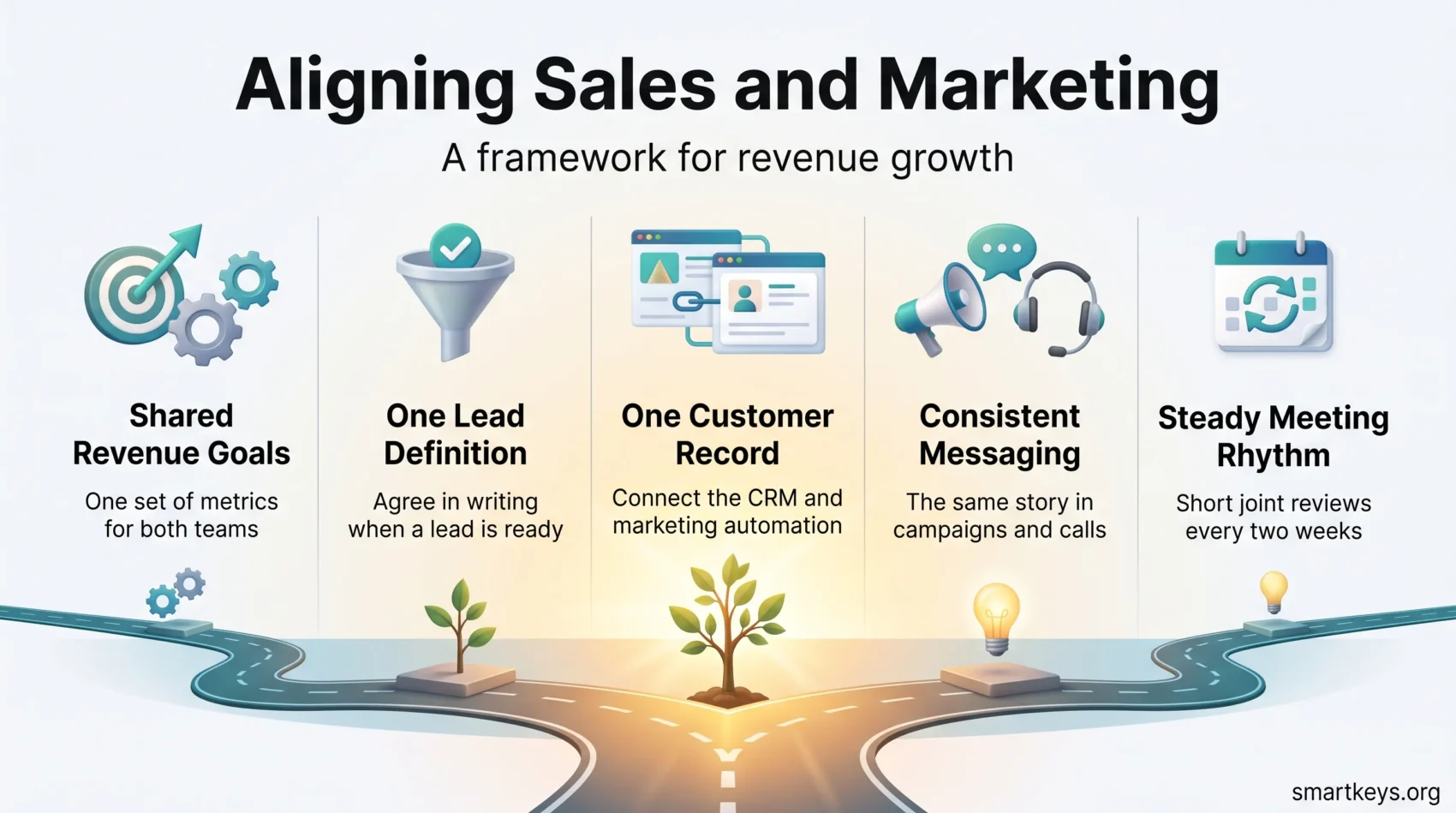
Sales and marketing alignment means running both teams as one revenue motion, with shared goals, shared definitions and shared data. It is not a workshop or a culture campaign. It is a short list of written agreements: who owns which part of the funnel, when a lead counts as ready, and which numbers both sides report.
This guide walks through those agreements step by step. You will see what buyers now expect before they ever speak to a rep, which metrics the two teams should share, how to define a qualified lead so nobody argues about it, and what to fix in your tools and content so the plan survives a real quarter.
Key Takeaways
- Alignment is a set of written agreements, not a culture initiative.
- Buyers now do most of their research alone, so the handoff has to be fast and well informed.
- Shared revenue metrics stop the two teams optimizing against each other.
- One customer record in one system is the difference between a dashboard and an argument.
- A short, regular meeting rhythm is what keeps alignment alive after the launch.
Why Alignment Matters More Now
Buyers reach your sales team later and better informed than they used to. Gartner surveyed 646 business buyers in late 2025 and published the results in March 2026. Two thirds of them, 67%, said they would prefer to buy without a sales rep involved at all. Seventy percent said they would prefer a completely digital, self-service purchase. Forty-five percent had used generative AI, meaning software that writes answers from a typed prompt, during a recent purchase, mostly to gather information about vendors and products.
That does not make sales redundant. In the same research, 69% of buyers said they prefer to check AI-generated claims with a sales rep before acting on them, and buyers drew on an average of seven different information sources per purchase.
Read those two findings together and the job description changes. Marketing now owns most of the research phase. Sales gets a shorter, higher-stakes window in which the buyer expects the rep to already know what they read. If the two teams do not share what they know, the rep walks into that conversation blind and asks questions the buyer answered on a form three weeks earlier.
Here is what that looks like in practice. A finance director downloads your pricing guide, watches a demo recording, compares you against two competitors using an AI assistant, then books a call. If your rep opens with “so, tell me what you are looking for,” the buyer has just been sent back to the start. That is a misalignment problem, not a rep problem.
What You Actually Gain, and What Silos Cost You
Alignment removes specific, visible waste. Two figures circulate widely online, a 208% revenue uplift and a $1 trillion annual cost of misalignment, and neither traces back to a source you can check, so they are not used here. The gains below are ones you can observe in your own numbers within a quarter or two.
Fewer wasted leads. When marketing and sales agree in writing on what a qualified lead looks like, marketing stops sending contacts that reps quietly ignore, and reps stop discarding leads that were actually good.
Faster follow-up. A written response-time commitment turns “someone will call them” into “a named rep calls within four business hours.” You can measure whether that happens.
Consistent messaging. When a campaign promises one thing and a rep says another, the buyer notices. Shared positioning removes that contradiction and protects trust, which is closely tied to how you handle brand storytelling across channels.
Less duplicated work. Two teams building two versions of the same case study is a cost you can see on the content calendar.
Better retention. A buyer who was sold accurately is a customer who renews. Aligned teams promise less and deliver more of it, which supports the customer retention strategies your business already runs.
What Alignment Really Means, and How to Tell If You Are Ready
Start by agreeing what “one motion” means, so work stops overlapping and progress becomes measurable.
One go-to-market motion means both groups operate as a single team with shared goals and shared wins. Go-to-market is simply the combined plan for how you find, win and keep customers. Marketing creates and qualifies opportunities, sales converts them, and both own the same funnel and report the same success criteria. If you are rebuilding that plan from scratch, it is worth reading a full go-to-market strategy playbook alongside this one.
Readiness check
Audit your current state by looking for three common blockers:
- Silos that create duplicated work and unclear ownership.
- Communication gaps where handoffs have no agreed steps.
- Mismatched metrics that reward each team for different outcomes.
The third does the most damage. If marketing is paid on lead volume and sales on closed revenue, the teams are being asked to pull in different directions, and goodwill does not fix that.
What day-to-day looks like when it works
You see shared dashboards, clear handoffs, and joint planning against the same metrics. Meetings have a set cadence rather than ad-hoc invites. A rep can see every campaign a prospect touched without asking anyone. A marketer can see which deals their campaign influenced without waiting for a monthly report.
Practical first steps: separate symptoms from root causes, get both leaders to agree on what changes, and write the operating model down so the fix outlives the people who negotiated it. For broader trends and a data-driven view on how teams evolve, see RevOps business trends.
Set Shared Goals and KPIs That Tie to Revenue
Tie both teams’ daily work back to the single number that matters most: revenue. That turns vague objectives into a clear operating rhythm the whole company can follow.
Pick a small set of metrics that measure business outcomes rather than activity. Four are usually enough:
- Lead-to-customer conversion rate: of the leads marketing passes over, what share become paying customers. This is the single best test of whether your lead definition is honest.
- Pipeline velocity: how fast deals move from first qualified conversation to signature. If it slows, something in the handoff or the content is missing.
- Customer lifetime value against acquisition cost: what a customer is worth over the whole relationship, divided by what it cost to win them. Often written as CLV and CAC.
- Qualified pipeline generated: the total value of deals that met the agreed bar, which both teams can claim credit for.
Map ownership across the funnel so accountability is shared rather than split by function. Agree who owns each step and which dashboards you review together, usually every two weeks. If compensation can be adjusted, tie part of it to shared outcomes. For a deeper treatment of which numbers to track, see our guide to revenue operations metrics.
Build Buyer Profiles Together, With Sales Input
A buyer persona is a short, written profile of the kind of person who buys from you: their job, their pressures, and what would make them say no. An ideal customer profile, or ICP, describes the kind of company worth selling to at all. Both are more useful when reps help write them, because reps hear the objections firsthand.
Capture concrete pain points, decision criteria, and who sits on the buying committee. Most business purchases involve several people, so a profile naming only the champion is incomplete. Forrester’s research on B2B revenue makes the same point: teams get further tracking buying groups and opportunities than individual leads.
How to build profiles people actually use
- Pair what reps hear in the field with what your data and research show.
- Record decision criteria, buying committee roles, and the objections that come up most.
- Keep the documents in one place so both teams use the same wording.
- Review them each quarter, because markets and competitors move.
- Link each profile to the content and outreach built for it, so nothing is written into a vacuum.
Deliver the Right Leads at the Right Time
You win more deals when lead quality, timing and speed match what reps actually need. Start by defining readiness together, in writing.
Three labels do most of the work, and they are worth spelling out because teams often use them differently:
- MQL, a marketing qualified lead: someone who has shown enough interest to be worth a sales conversation.
- SAL, a sales accepted lead: a lead sales has looked at and agreed to work.
- SQL, a sales qualified lead: a lead a rep has spoken to and confirmed has a real need, budget and timeline.
Agree the scoring rules that move a contact between those stages, and write them somewhere both teams can see. A lead should advance only when it meets the shared threshold.
Adapt the criteria each quarter
Review what the sales team needs based on pipeline health. When pipeline is thin, reps may want more leads at a lower bar. When it is full, they want fewer and better. Neither is wrong, but the change should be a decision rather than a drift.
Short stand-ups to tune the handoff
Run a short meeting every two weeks with the reps who work new leads and the marketers who generate them. Look at conversion rates, response times and the objections coming up most. Add a written response-time commitment, often called an SLA or service level agreement, so no lead sits untouched. Keeping these sessions tight is its own skill, and our guide to running effective meetings covers the mechanics.
Unify Your Tech Stack: CRM, Automation and Data Visibility
Centralize customer touchpoints so the company can see the full journey in one place. When every interaction is logged, real signals guide the next action instead of guesswork.
Start by connecting your CRM, the system that stores customer records, to your marketing automation platform, the tool that sends campaigns and tracks responses. Both teams then see the same contacts and accounts. HubSpot, for example, offers a two-way sync with LinkedIn Sales Navigator that matches LinkedIn leads and accounts to CRM contacts and companies and logs activity automatically. Check the licence terms first: HubSpot’s documentation lists Sales Hub Professional or Enterprise plus a Sales Navigator Advanced Plus plan, so it is not available on entry-level tiers.
Standardize the definitions behind every stage name so a number means the same thing in both dashboards. Shared definitions are what make reporting trustworthy. If your data is messy today, a data governance strategy is the prerequisite, not an optional extra.
- One source of truth: connect CRM and automation so contact, account and engagement records live together.
- Track every interaction: cut repetitive questions and keep continuity from first touch to renewal.
- Shared dashboards: build views that show campaign influence, pipeline and conversion side by side.
- Tools and governance: pick tools both teams will use, then enforce the data rules that keep records clean.
If you are still choosing a platform, our comparison of Salesforce and HubSpot covers the trade-offs, and the wider CRM trends piece explains where these systems are heading. Teams looking to automate the plumbing between tools will find options in our overview of revenue operations automation tools.
Keep Messaging Consistent and Equip Reps With Content
Content that matches the buyer’s stage removes friction and answers the questions they are actually asking. Build a short messaging playbook that keeps your voice steady across campaigns and calls.
Write one messaging framework
Codify the value propositions, the proof points and the tone, so everyone uses the same words with customers. Keep it short enough that a rep can recall it under pressure: a few one-line descriptions, the three or four objections you hear most with an answer for each, and the use cases you win on.
Map content to the buyer’s journey
Match assets to stage. Guides and explainers for the awareness stage, when the buyer is still defining the problem. Case studies and webinars for the consideration stage, when they are comparing options. Demos, pricing detail and return-on-investment calculators for the decision stage, when they need to justify the purchase internally.
Build the assets that move deals
Prioritize what shortens a deal: concise case studies, objection-handling sheets, demo scripts and simple ROI models. Our overview of sales enablement trends covers where teams are investing now.
Keep it all in one findable library
Centralize everything in a searchable library tagged by stage, persona and use case. Set a quarterly refresh and pair the people writing content with the people using it, so new pieces reflect real conversations rather than assumptions.
Focus Effort With Account-Based Strategies
Account-based marketing, usually shortened to ABM, means picking a defined list of target companies and directing marketing and sales at those accounts together, rather than casting a wide net and sorting the responses.
It is now mainstream: in Demand Gen Report’s 2026 ABM Benchmark Survey, close to 80% of organizations said they were actively running an ABM program. The practical version is a tiered account list, where tier one gets genuinely bespoke outreach and the lower tiers get lighter personalization and standard nurture. Building that list forces both teams to agree out loud which companies deserve real effort, and that agreement is the alignment payoff: one shared account list, one scoring rule, one quarterly review as buying signals change. For the full mechanics, from picking and tiering the target accounts to mapping the buying committee and measuring the program, see our guide to an account-based strategy for high-value accounts.
Break Down Silos With Cadence and Candor
A steady meeting rhythm, honest feedback and shared ownership turn two groups into one operating unit. Problems get solved rather than passed across the handoff.
Start with short stand-ups, weekly or fortnightly. They turn updates into decisions and surface issues early.
- Recurring cross-functional meetings: review goals, share what you are hearing, and clear bottlenecks.
- Put marketers on sales calls: hearing a real objection is worth more than reading a summary of one.
- Have the hard conversation early: raise mis-targeted accounts or weak content before a quarter is lost.
- Write decisions down: document what was agreed so context is not lost between meetings.
Distributed teams have an extra hurdle here, because the informal corridor conversation does not exist. Our guide to asynchronous communication tools covers how to replace it deliberately, and a periodic meeting audit keeps the new cadence from turning into calendar clutter.
Measure, Learn and Improve
Continuous improvement happens when you close the loop between results and the next decision. Make measurement part of the routine so outcomes actually change what you do.
Joint post-mortems
Run regular reviews that bring reps and campaign owners together to look at both wins and losses. Use the shared data to adjust lead criteria and scoring. The point is to change a rule, not to assign blame.
Cross-training
Train each side on the tools the other uses. A marketer who has watched a rep work the CRM writes better campaigns, and a rep who understands how a campaign is built asks for better support.
Make the dashboard the source of truth
Shared analytics let you spot trends, test changes and scale what works. Pair them with a forecasting process both teams trust, which our guide to RevOps forecasting covers. For a data-driven view on how teams evolve, see RevOps business trends.
Conclusion
Alignment is a set of agreements you can write down this month and test next quarter.
Agree the shared metrics. Co-write the buyer profiles and the lead definitions. Connect the CRM to the marketing platform so both teams read the same record. Build one messaging framework and one content library. Then set a cadence and hold it.
Buyers already run most of their research without you. The teams that win are the ones whose sales conversation picks up exactly where that research left off, which only happens when marketing and sales are working from the same page. Start with the lead definition, because it is the agreement that exposes every other gap.
Found this useful?
Make SmartKeys a preferred source on Google, and our articles will surface more often in your Top Stories, AI Overviews, and AI Mode.
Add as Preferred Source