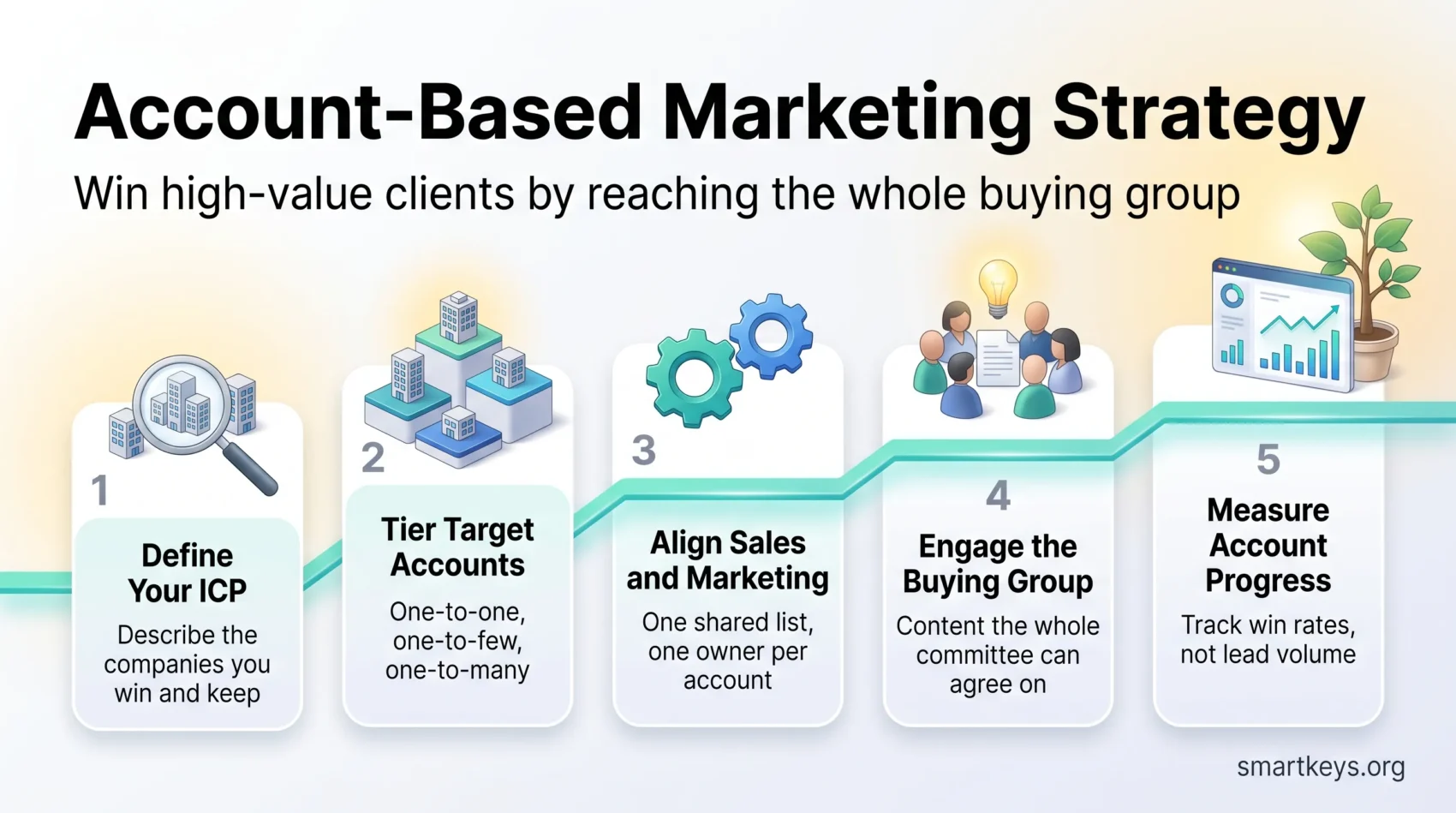
Most B2B deals are not won by reaching more people. They are won by reaching the right handful of companies, and then convincing everyone inside them who gets a vote.
That is the whole idea behind an account-based strategy. Instead of collecting as many leads as possible and hoping some of them fit, you name the companies you want as customers first. Then sales and marketing work that shared list together.
The formal name for it is account-based marketing, usually shortened to ABM: a go-to-market approach that treats an individual company, not an individual contact, as the unit you market to. It is no longer a niche experiment. In the 2026 ABM Benchmark Survey from Demand Gen Report, close to 80% of the B2B organizations surveyed said they were actively running an ABM program.
This guide covers how to build an account-based marketing strategy in practice: how to choose those accounts, and how to get two teams working from one list. It then looks at what to send to whom, and how to tell whether any of it is working.
Key Takeaways
- An account-based strategy targets companies and their buying groups, not single leads.
- A typical B2B purchase involves several people across different departments, so one champion is never enough.
- Sales and marketing need one shared account list, shared targets and one owner per account.
- Content that speaks to the group beats content aimed at one individual, because the group has to agree internally.
- Measure account progress and win rates, not lead volume, and expect to spend months rather than weeks proving it works.
What an Account-Based Marketing Strategy Actually Is
Classic demand generation is a funnel: attract a wide audience, capture contact details, qualify the ones that look promising. An account-based strategy runs the other way round. You decide which companies are worth winning, identify the people inside them who will shape the decision, and build outreach for that specific situation.
The practical difference is where your time goes. A lead-volume model rewards reach. An account model rewards depth, because a small number of the right customers can carry a quarter.
Inbound marketing does not disappear when you do this. Search visibility, useful content and events still create awareness across your market, and they surface interest you had not planned for. The account program is what you do once a company on your list shows up.
Two things are worth being honest about before you start. First, an account-based approach concentrates risk: if you pick the wrong twenty companies, a whole quarter of effort goes with them. Second, it takes time to show results. The same 2026 Demand Gen Report survey found that proving measurable return was one of the three biggest barriers practitioners named. The other two were stitching the technology stack together and internal skills gaps around AI. Marketers in that survey rated AI’s usefulness for ABM at an average of 7.3 out of 10. It helps, but it is not what makes a program work.
The Buying Group Is the Real Target
The single most useful thing to understand about B2B selling is that you are rarely persuading one person.
Gartner research published in May 2025 surveyed 632 B2B buyers. It found buying groups ranging from 5 to 16 people, spread across as many as four different business functions. Finance, IT, legal and the team that will actually use the product each bring their own concerns.
Those people do not agree with each other. In the same research, 74% of buyer teams showed what Gartner calls unhealthy conflict during the decision process: disagreement that stalls the purchase rather than sharpening it.
This has a direct consequence for how you write and target. Gartner found that messaging tailored to individuals had a 59% negative effect on the group reaching consensus. Content pitched at the level of the whole buying group had a 20% positive effect. Buyers who felt the content spoke to their group were three times more likely to complete a high-quality deal, and groups that reached agreement internally were 2.5 times more likely.
Read that carefully, because it cuts against the usual advice. Hyper-personalizing a message to one contact can make that person more confident and the group less aligned, since each member is being sold a different version of the story. The job is to give the whole committee a shared account of the problem and what it is worth fixing.
How B2B Buyers Actually Behave in 2026
The second thing shaping account strategy is how much of the decision now happens without you.
Gartner surveyed 646 B2B buyers in late 2025 and published the results in March 2026. Two thirds of them, 67%, said they prefer a purchasing experience without a sales rep. Seven in ten would rather buy through a completely digital, self-service route. Buyers consulted an average of seven information sources during a purchase, and 45% used generative AI, mostly to research vendors and products.
Yet the same buyers do not fully trust what they find. Gartner reported in May 2026 that 69% prefer to check AI-generated insights with a sales representative. Roughly half worry about being misled by AI output, and roughly half worry about being misled by a sales rep. Buyers who combined digital tools with a rep were 1.8 times more likely to close a deal they later judged to be high quality. Going it alone digitally produced worse outcomes.
The practical reading: your account program has to work when nobody is talking to you, and it has to give a rep something useful to say when someone finally does. That means public, findable material that answers real questions, plus people who can confirm or correct what the buyer already read. This is the same shift reshaping B2B sales more broadly.
Get Sales and Marketing Onto One Account List
An account-based strategy fails quietly when the two teams keep separate lists. Marketing runs campaigns against one set of companies, sales works another, and the reporting never reconciles.
Fix that first, before any campaign work. The wider job of aligning sales and marketing around shared definitions and revenue metrics has its own guide; for an account program, the part that matters is agreeing one named list of target companies before any campaign goes out.
Shared targets and one owner per account
Agree the list, agree the tiers, and agree what success looks like. Both teams should be measured on the same revenue goals rather than on lead counts for one side and closed deals for the other. Assign a single named owner to each account so there is never a question of who moves it forward.
Where handoffs are messy or deals stall between stages, the underlying problem is usually process rather than effort. A revenue operations review will usually find where the leakage sits.
Working rhythms that survive a busy week
- Create a channel per top-tier account in Slack or Teams so context lives in one place.
- Run a short joint pipeline review on a fixed day, based on live account data rather than opinion.
- Keep a one-page account plan per company: who is involved, what they care about, what happens next.
- Give sales ready-made messaging blocks and assets, so sales enablement is not improvised for every conversation.
Build Your ICP and Choose the Accounts
The ideal customer profile (ICP) is your filter: a written description of the kind of company you win, keep and make money on. Without it, account selection turns into a wish list of famous logos.
Start with firmographics, then add fit
Firmographics are the basic descriptive facts about a company: industry, headcount, revenue band, region, and often the technology it already runs. These remove poor fits quickly and cheaply.
Then add the qualities that actually predict success for you. Do your best customers share a trigger, such as a recent funding round, a compliance deadline or a system reaching end of life? Do they have a role in-house that owns the problem you solve? Companies without that role tend to stall, however good the fit looks on paper.
Finally, sketch the buying group. Say the purchase normally involves an operations lead, a finance approver and someone from IT security. Then you know how many people you need to reach before the deal is real.
Use the data you already have
Your own systems usually know more than you think. Your CRM holds win and loss patterns. Your website shows which companies keep coming back to pricing or product pages. Your marketing automation platform records who opened, clicked and attended.
Combining these gives you a ranked list rather than a hunch. A customer data platform can unify those records when they are scattered across tools, and a deliberate first-party data strategy keeps the inputs reliable as third-party tracking continues to shrink.
Tier the result. Tier one gets custom work. Tier two gets adapted work. Tier three gets efficient, automated work. That is how you keep effort proportional to opportunity.
The Three Types of ABM and When Each Fits
The three standard models trade depth against scale. Most teams run more than one at the same time.
One-to-one: strategic accounts
A handful of companies, each treated as its own campaign. Custom research, tailored business cases, executive introductions. Use it only where a single win genuinely changes the year, because the cost per account is high.
One-to-few: clusters that share a problem
Groups of five to fifteen similar companies with the same pressure. You build one core asset and adapt the specifics: the numbers, the regulations, the job titles. This is where most mid-sized teams get the best return on effort.
One-to-many: programmatic
Hundreds of accounts reached through automation, with creative that varies by industry or company size. Less depth per account, but it keeps a broad list warm and tells you which companies are worth promoting into a higher tier.
A concrete example. A software vendor selling to healthcare might build a bespoke business case for one large hospital group. That is one-to-one. It then adapts that case for a dozen regional clinics facing the same reporting rules, which is one-to-few. Finally it runs industry-specific ads across several hundred smaller providers. Same product, three levels of investment.
Account-Based Strategy: A Practical Framework
A framework is only useful if it survives contact with a normal week. This one has four parts: who is targeted, who does what, what each tier gets, and how decisions are made.
Roles and qualification
Sales owns direct outreach and the relationship. Marketing owns content, campaigns and the systems that carry them. Both share the account list and the same definition of a qualified account, so nobody is arguing about whether a company counts.
Define the go-to-market motion per tier before you launch, not after. A tier-one account with a nine-month cycle and a tier-three account bought off a web form need different sequences, different content and different expectations.
Resources and governance
- Budget by tier. Custom research and events for the top tier; templates and automation for the rest.
- A fixed review rhythm. Weekly for movement and risk, quarterly for the list itself.
- Clear decision rights. Say in advance who can approve a custom asset or an executive meeting.
- One dashboard. Account health, stage and next action, visible to both teams.
Dashboards that pull from several systems are worth the setup effort. Standard business intelligence tools will do the job without a custom build.
Tactics That Move the Whole Buying Group
Individual tactics matter less than whether they add up to one coherent story. A buyer who sees an ad, reads an article and takes a call should recognize the same argument each time.
Advertising and landing pages
Paid media aimed at a defined account list keeps your name present while the buying group does its private research. Send that traffic to a page written for their situation rather than your homepage. Keep the promise on the page identical to the promise in the ad.
LinkedIn and public credibility
LinkedIn remains the most direct route to senior B2B roles, mainly because people research vendors and colleagues there. Useful posts from named people in your company do more than brand posts, which is why B2B influencer marketing has shifted toward employees and practitioners rather than celebrity endorsements.
Email and follow-up
Email is still where most account conversations happen. The winning pattern is a small number of specific, relevant messages rather than a long automated drip. Well-built email workflows handle the timing and the follow-up so your team can spend its attention on the message itself.
Events and meetings
Small invitation-only formats work well for tier-one accounts: a roundtable with peers from similar companies, or a working session about a problem they have already named. The value is peer conversation, not your slides.
Content That Builds Agreement, Not Just Clicks
Given what the Gartner research shows about consensus, content for an account program has one specific job. It has to help a group of people who report to different bosses agree on the same version of the problem.
That changes what you produce.
- A shared business case that finance, operations and IT can all read, rather than three documents that quietly contradict each other.
- An honest scope of what changes for each function, including the work involved. Committees stall on unpleasant surprises more often than on price.
- Comparable examples from companies of similar size and sector, with real figures where you are allowed to publish them.
- A simple calculation the buyer can run on their own numbers, so the value discussion happens in their terms.
Role-specific material still has a place. A security questionnaire response is for the security reviewer and nobody else. The rule of thumb: use role-specific content to remove individual objections, and group-level content to build the shared case. Where value is hard to express, a clear pricing framework makes the conversation concrete instead of defensive.
AI drafting tools genuinely help with the adaptation work, producing sector variants of a core asset in minutes. They do not supply the customer evidence, and buyers increasingly recognize generic output. The current thinking on where AI belongs in marketing is worth reading before you scale content production.
The Stack You Actually Need
Technology integration was one of the three top barriers in the 2026 Demand Gen Report survey. That is a good argument for keeping the stack small.
Four capabilities cover most programs:
- A CRM as the single record of each account and everyone in it. Salesforce suits complex enterprise setups; lighter tools are enough for smaller teams.
- Marketing automation for sequences, nurture and campaign reporting, such as HubSpot Marketing Hub.
- Account identification to recognize which companies visit your site and which pages they read.
- Reporting that connects campaign activity to pipeline movement rather than to clicks.
Add enrichment if your contact data is thin, and personalization tooling only once you have enough traffic for it to matter. AI-driven personalization works best on top of clean data; on messy data it simply makes mistakes faster.
One warning. Every tool you add is another integration to maintain and another place where account records drift apart. If the CRM and the automation platform disagree about who works at a target company, sales will trust neither.
Turning Intent Signals into Action
An intent signal is any behavior suggesting a company is researching a purchase. Repeated pricing page visits count. So do several people from one email domain reading the same guide, or a download followed by a visit to the demo page.
First-party signals come from your own properties and are the most reliable, because you know exactly what happened. Third-party intent data, bought from providers who observe research activity across the web, is broader but noisier. It is best used to widen the list, not to trigger outreach on its own.
Score at the account level
Score the account, not the contact. One person reading three pages might be a student. Four people from three departments reading the same material in one week is a buying group forming.
Weight the signals that historically preceded real deals in your own data. Review that model quarterly, because signals decay: a page that predicted intent last year may just be popular now. The methods behind this are covered in more depth in behavioral analytics.
Then act quickly, and lightly
Alert the account owner when a threshold is crossed, and make the follow-up proportionate. A helpful, specific message referencing the topic beats a generic “I noticed you visited our site”, which mostly makes people uneasy.
Enterprise ABM: Long Cycles and Complex Committees
Large accounts differ in degree rather than kind, but the degree matters. Cycles can run well over a year, the committee grows, and people change roles mid-deal.
Map influence, not just job titles
The org chart tells you who reports to whom. It does not tell you whose opinion carries weight. Look for the person others quote, and for the reviewer who can quietly stop a purchase, which is often security, procurement or legal. Engage them early, when their objection is still a question rather than a veto.
Reuse a core story across divisions
Build modular assets: a stable core argument plus swappable sections for the division, region or product line. This keeps the message consistent across a long cycle while avoiding a rewrite for every conversation.
Bring in product and customer success
On complex deals the most convincing voices often are not in sales. A product manager explaining a roadmap constraint honestly, or a customer success lead describing what onboarding really involves, builds more credibility than another pitch. It also sets expectations that make renewal easier later, which is where retention is actually decided.
Measuring an Account-Based Strategy
Lead counts are the wrong measure here, because the whole point was to pursue fewer, better companies. Measure accounts instead.
Engagement and progression
Track how many people from a target account engaged, from how many functions, and whether that number is growing. One contact reading everything is weaker than four contacts reading a little. Then track movement between stages: an account that engages heavily but never progresses is telling you something specific.
Outcomes
Win rate by tier shows whether your selection was any good. Average deal size shows whether you picked companies with real budget. Cycle length shows whether the coordination is helping. Acquisition cost against customer lifetime value keeps the whole program honest, because ABM is expensive per account by design.
Attribution, with realistic expectations
With a group of ten people and a dozen touchpoints over months, no attribution model will cleanly assign credit. Use multi-touch attribution to see which plays appear in winning journeys, and treat it as a directional guide rather than a verdict. Give the program a realistic window: judging an account strategy on one quarter will tell you almost nothing.
A Six-Step Rollout You Can Start This Quarter
Start small enough to finish. A pilot of 10 to 30 accounts is enough to learn from and small enough that both teams can actually cover it.
- Write the ICP. One page, based on your existing wins, agreed by sales and marketing.
- Build and tier the list. Name the companies, sort them into three tiers, cap the top tier ruthlessly.
- Map the buying groups. For each account, list the roles that will be involved and note which ones you have no contact with yet.
- Prepare the content. One shared business case per cluster, plus the role-specific pieces that remove predictable objections.
- Run coordinated outreach. Ads, email, social and direct contact on a shared rhythm, with one owner per account.
- Review and adjust. Weekly on movement, quarterly on the list itself. Drop accounts that show nothing after a fair attempt.
That last step is the one teams skip. An account list nobody prunes becomes a wish list, and a wish list quietly turns an account-based strategy back into ordinary marketing with fewer people in the audience.
Conclusion
An account-based strategy is a decision about focus. You accept a smaller audience in exchange for knowing far more about it, and you accept that results arrive in months rather than weeks.
The evidence points in a consistent direction. Buying groups are large and often internally divided. Buyers do most of their research alone, but still want a person to check it against. And content aimed at the group works better than content aimed at one flattered individual.
Start with one page describing your ideal customer, twenty companies that match it, and one shared list both teams work from. That is a real program. Everything else in this guide is refinement.
Found this useful?
Make SmartKeys a preferred source on Google, and our articles will surface more often in your Top Stories, AI Overviews, and AI Mode.
Add as Preferred Source