Agile started in software, but the problems it was built for are not unique to software. Marketing teams run campaigns that take three months to launch and two days to become irrelevant. HR teams lose good candidates because an approval sat in someone’s inbox for a week.
Scrum and Kanban are the two ways of working that came out of agile software development. Scrum organises work into short fixed cycles called sprints, usually one to four weeks, with planning at the start and a review at the end. Kanban uses no fixed cycles: work moves across a visible board, and the team limits how many items may sit in progress at once. This guide covers what both look like outside a development team, what the adoption data shows, and how to start without turning your department into a ceremony factory.
Key Takeaways
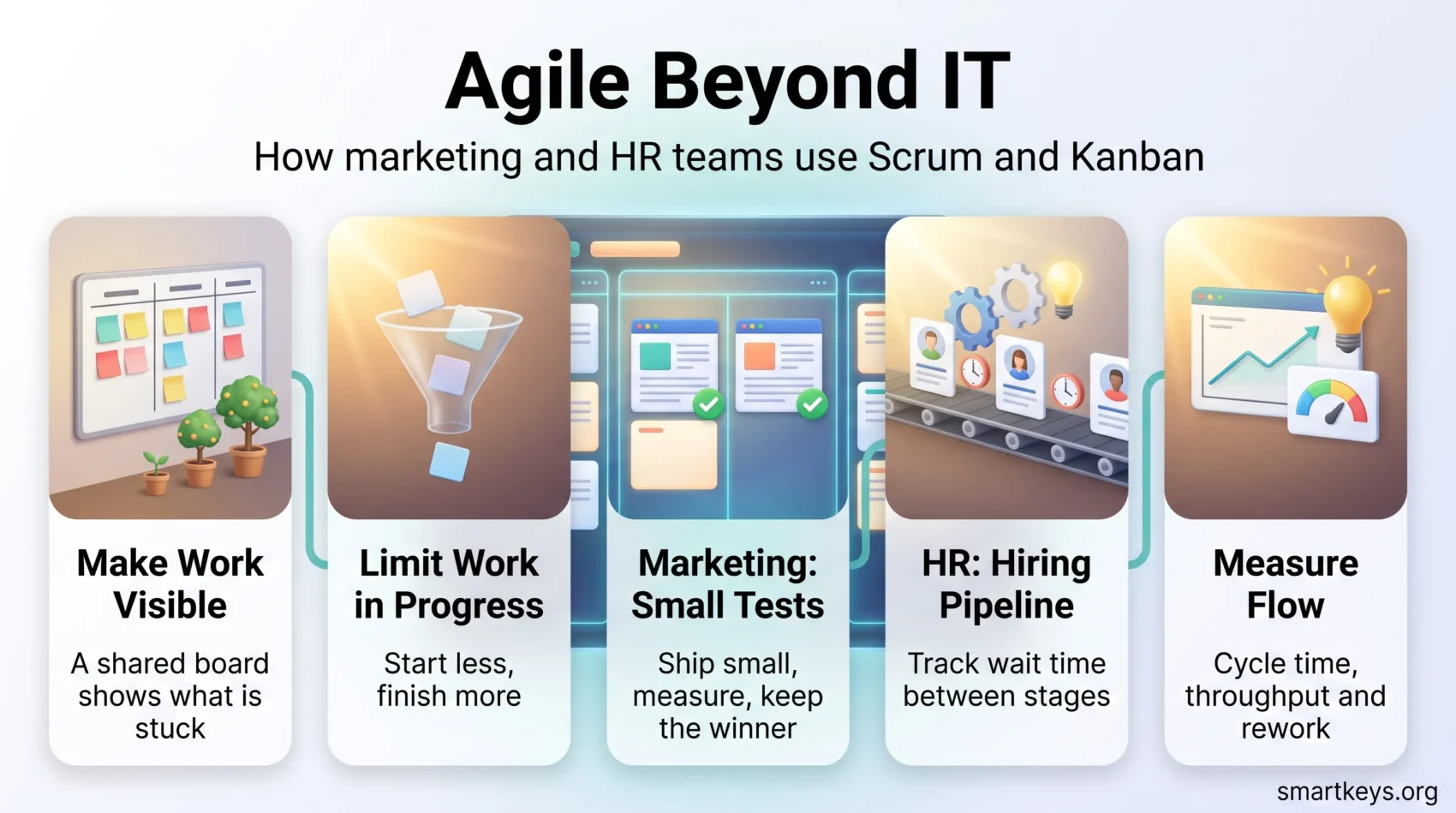
- Treat work as a product: campaigns and hiring programs get iterated on, not launched once.
- Make the work visible: a shared board shows what is stuck before a status meeting does.
- Limit work in progress: fewer things started at once means more things finished.
- Scrum or Kanban: Scrum suits planned campaigns, Kanban suits pipelines that never stop.
- Measure flow, not activity: cycle time and throughput tell you more than a task count.
- Expect a slow start: most organisations report partial adoption, not transformation.
Where agile outside software actually stands
Agile has spread past engineering, but the picture is less impressive than the conference talks suggest. In Digital.ai’s 18th State of Agile Report, only 13% of respondents said agile was deeply embedded across their organisation. Most described it as partial, inconsistent or siloed, and just 22% reported meaningful involvement from the business side rather than IT alone.
Marketing shows the same pattern. AgileSherpas’ 2026 State of Agile Marketing Report found around a quarter of marketers use agile marketing, while a similar share had never heard the term. Among users, 47% called themselves only “somewhat agile”, a polite way of saying they adopted the meetings and skipped the harder parts. In the same report, 87% said their productivity improved, though that is self-reported.
Why this matters for your team
Two problems drive most of the interest. The first is queue time: in a typical campaign or hiring process, the work takes hours and the waiting takes weeks. The second is starting too much. When a team of six has fourteen things open, everything is 60% done and nothing ships. Both are visibility problems before they are process problems, which is why almost every rollout starts with a board rather than a new job title.
- Release in smaller pieces so a mistake costs a week, not a quarter.
- Put people who need each other on one team, not one email thread.
- Judge the work by outcomes and business impact, not by a busy calendar.
The ideas underneath: Lean and systems thinking
Lean: define value, remove the rest
Lean came out of Toyota’s production system. Its core move is to define value from the customer’s point of view, then remove every step that does not add any. In an office, that waste is usually waiting, rework and handoffs rather than inventory.
Toyota also let frontline staff stop the line when they spotted a defect. The office version is less dramatic: anyone may flag a problem the moment they see it, instead of passing it downstream where it gets more expensive. That habit is the point of continuous improvement.
Systems thinking: look at the whole chain
A value stream is the full path a request takes from the moment someone asks for something to the moment they get it. Systems thinking means improving that whole path rather than one department’s slice, because local improvements often make the whole worse. A recruiting team that doubles its screening speed while hiring managers still take ten days to respond has not made hiring faster. It has moved the queue.
- Write down what “done and valuable” means before work starts.
- Map the process and mark every point where work waits.
- Catch problems at the step that created them, where they are cheapest to fix.
Scrum and Kanban in marketing: smaller bets, faster answers
A marketing team that works this way behaves like a product team: it ships something small, measures what happened, and decides what to do next. That is the core of agile marketing.
Minimal Viable Marketing: the smallest test that answers the question
Instead of building a full campaign around an untested assumption, you build the smallest thing that tests it. One landing page and two ad variants can tell you whether a positioning line lands before anyone commissions the video. A/B testing is the mechanism: run two versions, send comparable traffic to each, keep the winner. The discipline is resisting the urge to change five things at once, because then you cannot tell which one worked.
Build a backlog and work in sprints
A backlog is a single ordered list of everything the team could do, ranked by expected value. It replaces the scattered requests sitting in inboxes and chat threads. The ordering is the hard part and the useful part: if two things cannot both be first, someone has to decide. In Scrum, the team then pulls the top items into a sprint. If you need a way to rank them, several scoring methods are compared in our guide to task prioritization frameworks.
Use a Kanban board and cap work in progress
A Kanban board is a set of columns showing the stages work passes through, with each piece of work as a card. Work in progress limits, usually written as WIP limits, cap how many cards may sit in a column at once. When a column is full, nobody starts anything new until something moves.
That constraint feels wrong for two weeks and then it starts finishing things. It also exposes dependencies: if the paid social card cannot move until design delivers, the board shows it. It pairs well with asynchronous communication tools, since a board answers most “where is it” questions without a meeting.
Measure what the campaign produced
Pick a small set of numbers and keep them stable. Conversion rate shows how many people took the action you wanted. CAC, customer acquisition cost, is what you spent to win one customer. ROAS, return on ad spend, is revenue divided by ad cost. Velocity, how much the team finishes per sprint, forecasts your own capacity and means nothing as a comparison between teams.
Reporting only works if sales and marketing agree on what counts as a lead, the practical half of sales and marketing alignment. Teams working large named accounts pair this with an account-based strategy, where the unit of work is an account rather than a campaign.
Scrum and Kanban in HR: pipelines, onboarding and people operations
Recruiting is a queue with people in it, which makes it a good fit for a Kanban board.
Map the hiring value stream and put it on a board
Write out every stage from sourcing to signed offer, then add how long candidates wait between them. Most teams are surprised: the interviews take four hours and the process takes six weeks. Columns become stages, cards become candidates. The board makes stalls visible to recruiters, hiring managers and finance at once, which is usually enough to remove an approval step nobody could justify. Wider context sits in our overview of HR trends.
Time-box the steps that drift
Set explicit windows: 48 hours to review a shortlist, five working days to schedule an interview, three days to decide after a final round. Their value is less about speed than fairness, since long and uneven waits quietly disadvantage candidates who cannot wait around.
If you use software to screen or rank applicants, the legal position has moved. Several jurisdictions now require notice, bias auditing or both, covered in our guide to AI hiring tools.
Sync hiring with what the business is planning
Join quarterly planning so hiring cadence matches real demand. Hiring three engineers for a project that slips two quarters is expensive in a way no recruiting metric captures. The same applies after the offer: a fast hire followed by a vague first month wastes the speed you just bought, which is why structured onboarding belongs in the same value stream, and why talent retention is the measure at the far end of it.
- Measure wait time between stages, not just total time to hire.
- Cap open requisitions per recruiter.
- Use the same scorecard for every candidate in a role.
- Write the onboarding plan before the offer goes out.
Transparency, leadership and keeping it alive
Most rollouts fail not on mechanics but because the visibility the boards create is uncomfortable, and someone quietly turns it off.
Make the work visible, then go and look at it
An information radiator is any display that shows status without anyone having to ask: a board, a wall chart, a dashboard on a shared screen. The test is whether a passing colleague can read the state of the work in ten seconds.
Gemba is a Lean term meaning “the actual place”. Practising it means watching the work where it happens rather than reading a summary two levels up. For a recruiting lead, that is sitting in on a screening call. For a marketing director, it is watching how long an asset takes to get approved.
What leaders have to do differently
Three behaviours decide whether this survives past the pilot. Leaders remove blockers the team raises, and are seen doing it. They ask about outcomes rather than activity. They accept that a team which stops work to fix a quality problem has done the right thing, even when it costs a deadline.
The opposite pattern is familiar: boards become status reports, WIP limits get overridden whenever something is urgent, and retrospectives turn into a slot nobody prepares for. Our overview of leadership trends covers the wider shift, and remote employee engagement is where the effects show first in distributed teams.
For more on collaboration across distributed groups, see our guide to decentralized teams and the future of work.
How to start: pilot, tools and the numbers that matter
Run one pilot team before changing anything else. It gives you a real example to argue from, and limits the damage if the first version is clumsy.
Pick one team, one cadence, one board
Choose a team with a clear output and a manager who wants this. Decide between sprints and continuous flow: sprints suit planned work with deadlines, flow suits requests that arrive unpredictably. Do not run both in the first quarter. Define who orders the backlog, who protects the team from interruptions, and who does the work. Then hold a short retrospective each cycle: fifteen minutes with one agreed change beats an hour of general reflection.
Track flow, not effort
Four numbers cover most of it. Cycle time is how long one item takes from start to finish. Throughput is how many items finish per week. WIP is how many are open right now. Rework is how often something has to be redone. Watch the trend rather than the absolute value, and never compare two teams’ numbers directly, because they count different things. Connect them to the goals the team already committed to, as covered in our guide to goal setting.
Tools, and how not to over-buy
A whiteboard works for the first month. When you outgrow it, Jira suits teams that want strict workflow rules and reporting, while Asana and similar tools suit cross-functional teams that want something lighter. Write down the repeatable parts so the process survives people leaving, which is what standard operating procedures are for, and automate the copying and chasing rather than the thinking, using the patterns in digital workflows.
- Start with one team and a cadence that matches how work arrives.
- Set a WIP limit from day one, even if it feels too low.
- Measure cycle time, throughput, WIP and rework.
- Buy tools last, once you know what the process actually is.
Conclusion
Agile outside IT is not a rebranding exercise. It is a decision to make work visible, do less of it at once, and check the results more often.
The data suggests most organisations only get part of the way there, and that sets a realistic bar. A marketing team that ships smaller tests and a recruiting team that stops losing candidates to silence are both real wins, even if nobody calls it a transformation. Start with one team, one board and a WIP limit. Keep the practices that produce decisions and drop the ones that produce meetings.
Found this useful?
Make SmartKeys a preferred source on Google, and our articles will surface more often in your Top Stories, AI Overviews, and AI Mode.
Add as Preferred Source