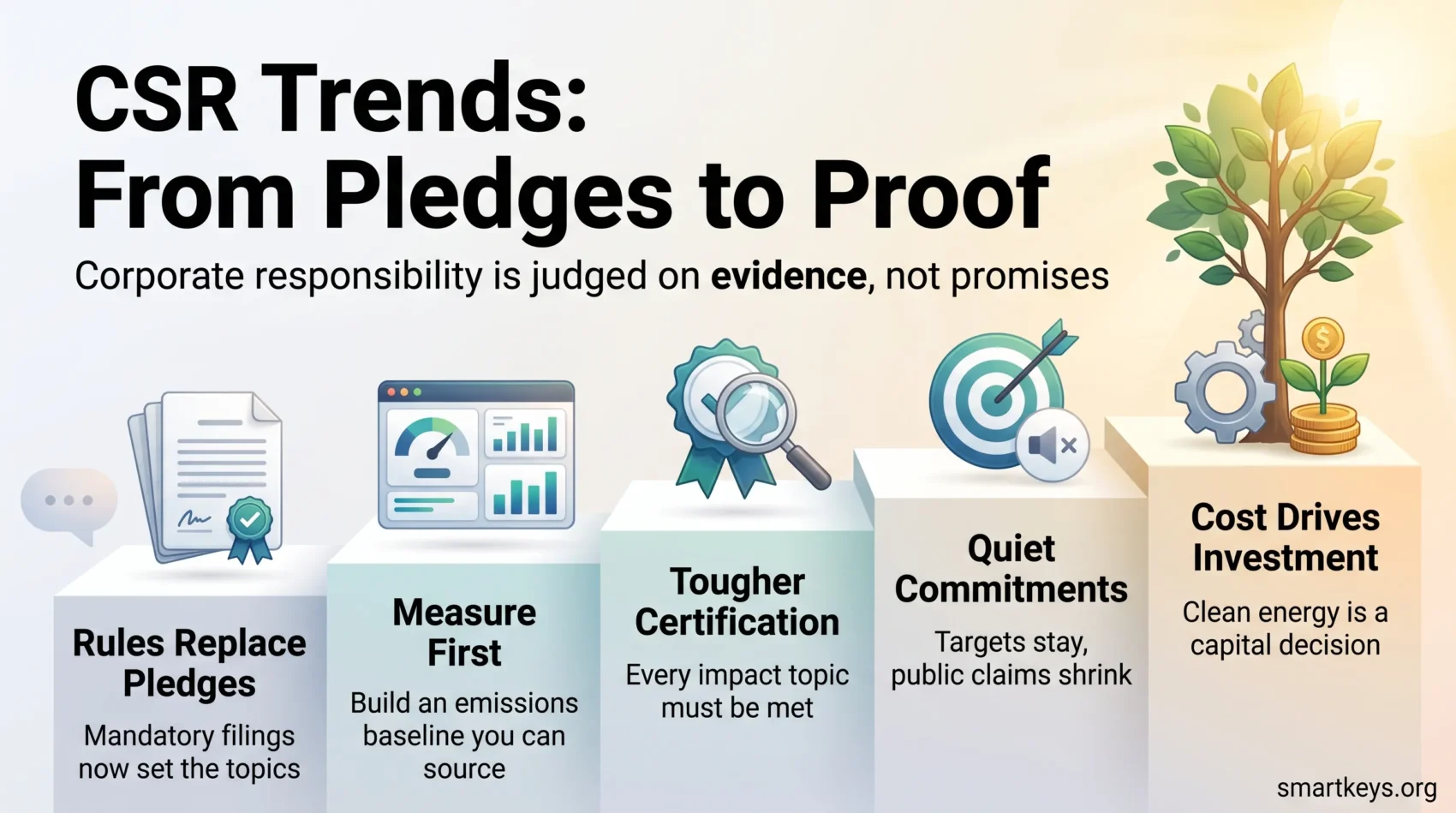
Corporate social responsibility in 2026 is judged on filings, not pledges. The question is no longer whether your company has a CSR programme. It is whether the claims in it survive an auditor, a regulator and a sceptical customer.
Two forces pulled in opposite directions over the past eighteen months. Europe narrowed the scope of mandatory sustainability reporting while keeping the substance. The United States pulled back federally but tightened at state level, and California’s first emissions filings came due in August 2026. The result is a split landscape where the same company can face a hard reporting deadline in Sacramento and a softened one in Brussels.
This guide covers what actually changed, which CSR trends are backed by evidence, and how to run a programme you can defend when someone asks for the workings.
Key Takeaways
- The EU’s Omnibus I package cut CSRD scope to companies with more than 1,000 employees and over €450m net turnover, and pushed the second reporting wave to 2028.
- California SB 253 set a 10 August 2026 deadline for Scope 1 and 2 emissions from companies above $1bn in global revenue.
- B Lab scrapped the 80-point B Corp score in favour of mandatory requirements across seven impact topics.
- Many companies now practise “greenhushing,” keeping commitments but talking about them less.
- Talent still weighs environmental credentials: 70% of Gen Z and millennial respondents told Deloitte it matters when choosing an employer.
- Measurement discipline beats storytelling. Numbers you cannot source will eventually be checked.
What corporate social responsibility means in 2026
Corporate social responsibility is the set of commitments a company makes about its impact on people and the environment, and the evidence it produces to back them. The second half of that sentence is what changed.
For most of the past decade, CSR lived in a glossy annual report. It now sits closer to finance: scoped, assured and filed. Emissions data feeds regulatory submissions. Supply chain claims attract due diligence. Diversity commitments get read against actual pay and promotion data.
That shift has practical consequences. Programmes that were designed to generate goodwill now need owners, baselines and audit trails. A well-documented sustainability strategy is the difference between a CSR function that can answer questions and one that scrambles when they arrive.

Employee engagement still matters, and remote and hybrid teams changed how it works. Virtual volunteering, skills-based pro bono work and employee-giving campaigns keep participation alive when nobody is in the same building. Volunteer paid time off and employee resource groups remain the two mechanisms most companies use to make participation practical rather than theoretical.
Why CSR trends look different this year
Keeping up with CSR trends used to mean tracking what leading brands announced. In 2026 it means tracking what regulators require and what auditors will accept.
From voluntary framework to filed disclosure
The old model was voluntary reporting against frameworks such as GRI, with companies choosing which topics to cover. Selective reporting is now much harder to sustain. Where mandatory regimes apply, the topics are set for you, and third-party assurance means someone checks the arithmetic.
That does not make voluntary frameworks obsolete. Most companies still use them for the topics no regulator has standardised. But the centre of gravity moved from communication to compliance, and the skills a CSR team needs moved with it, closer to ESG framework design and data governance than to campaign management.
Why it still matters commercially
Two commercial pressures survived the political noise. Procurement teams at large buyers ask suppliers for verifiable environmental and social performance, because their own disclosures depend on it. And talent still reads company behaviour as a signal, which is one reason Gen Z expectations at work keep showing up in employer branding research.

Emerging CSR trends in business
Two shifts do most of the work this year: money moving into decarbonisation technology, and a quieter, more careful approach to talking about it.
Investment follows cost, not sentiment
The commercial case for clean technology strengthened. A Boston Consulting Group and World Economic Forum analysis cited by ESG Dive put the green economy above $5 trillion in annual value, with decarbonisation solutions now cost-competitive in most cases and the market projected to approach $7 trillion a year by the end of the decade.
That reframes the conversation internally. Energy efficiency, electrification and waste reduction are capital allocation decisions with payback periods, not gestures. Practical starting points include:
- Metering and submetering before efficiency projects, so savings are provable
- Power purchase agreements or on-site generation where load profiles justify them
- Material recovery and reuse programmes, the operational core of the circular economy
Investor appetite follows the same logic, which is why green finance instruments increasingly price on measured performance rather than stated ambition. For a wider view of where the technology is heading, see climate tech trends and the broader green technology landscape.
Greenhushing: commitments stay, publicity goes
The most visible communication trend runs the other way. Companies are keeping targets while saying less about them. ESG Dive reported that only 25% of S&P 100 companies used the term “ESG” in their 2024 annual reports, down from 40% a year earlier, while 41% of the world’s 2,000 largest companies still hold net-zero supply chain targets.
“Silence protects you from criticism. It does not protect you from disclosure.”
Greenhushing is a defensible short-term tactic and a poor long-term one. Where mandatory disclosure applies, the data becomes public regardless. A company that stopped talking about its programme and then files unflattering numbers has lost the chance to frame them. The safer position is fewer claims, better evidenced, which is also what a functioning business ethics framework should produce.
CSR trend: disclosure rules replaced declarations
This is the change that reshaped everything else. Three regimes matter most.
Europe: CSRD after Omnibus I
The EU adopted the Omnibus I package in early 2026, substantially narrowing the Corporate Sustainability Reporting Directive. Mandatory reporting now applies to EU companies with more than 1,000 employees and net turnover above €450 million, and to non-EU groups generating more than €450 million of turnover in the EU.
The timeline moved too. The first wave, large listed companies and public-interest entities, already reported. The second wave, originally due to report in 2026, now publishes its first CSRD report in 2028 covering financial year 2027. Listed SMEs were removed from mandatory scope entirely and pointed towards a lighter voluntary standard.
For most companies in scope, 2026 is a planning year: confirm scope, run the materiality assessment, and fix the data pipeline before the deadline is real.
Europe: due diligence obligations
The same package revised the Corporate Sustainability Due Diligence Directive, easing the compliance burden and delaying application. The direction of travel is unchanged: large companies remain responsible for identifying and addressing human rights and environmental harms in their value chains, but the mechanics are lighter and more risk-based than the original text. Supply chain programmes built around social sustainability practices remain the practical foundation.
United States: states move, the federal level retreats
The SEC stopped defending its climate-risk disclosure rule in court and dropped several related proposals; a federal judge returned the rule to the agency to decide its fate.
California went the other way. Under SB 253, companies doing business in the state with more than $1 billion in global annual revenue faced a 10 August 2026 deadline for their first Scope 1 and Scope 2 greenhouse gas disclosures, after the California Air Resources Board adopted initial implementing regulations in February 2026. SB 261, covering climate-related financial risk reporting for companies above $500 million in revenue, was subject to a Ninth Circuit injunction and is currently voluntary.
If you operate across both markets, plan for the strictest applicable rule rather than the average. Broader regulatory context is covered in our guide to future of work legislation.
Green energy initiatives that hold up
Renewable procurement is now a cost and risk decision as much as a reputational one. Long-term power agreements hedge price volatility. On-site generation reduces exposure to grid constraints. Efficiency work usually pays back faster than either.
What corporations actually get
- Price stability: fixed-price renewable contracts remove part of your exposure to volatile wholesale energy markets.
- Lower operating cost: efficiency measures reduce consumption before you pay to green what remains.
- Cleaner reporting: contracted renewable supply simplifies Scope 2 accounting under mandatory regimes.
- Employee response: credible environmental action correlates with engagement, though it does not substitute for pay and management quality.
How to run the programme
Start with measurement, not procurement. You cannot verify a reduction without a baseline, and Scope 1 and 2 baselines are exactly what California and the CSRD now ask for.
- Build the inventory first, using dedicated carbon accounting software rather than spreadsheets once you pass a few sites.
- Set targets you can hit with identified projects, not with offsets you have not bought.
- Separate reduction from compensation in your reporting, which is the core discipline behind credible carbon neutrality goals.
- Review Scope 3 last and honestly, because it is where most claims quietly fall apart.

The pattern that works is unglamorous: measure, cut what you control, contract for the rest, and report the difference plainly.
Localised CSR: programmes people can point at
The localisation of CSR continues, for a straightforward reason. Local programmes are easier to measure, easier for employees to join, and harder to dismiss as public relations.
Focusing spend near your sites also reduces the travel and coordination overhead that made distributed philanthropy expensive. Partnerships with local nonprofits give you delivery capacity you do not have to build, and a partner who can evidence outcomes.
Three programme types travel well across industries:
- Support for education and skills programmes in the communities you hire from
- Long-term partnerships with a small number of local nonprofits rather than one-off grants
- Environmental projects tied to a site (land, water and waste) where results are visible
Concentration beats breadth. A handful of multi-year commitments produces more measurable change, and better internal stories, than a long list of small cheques. That logic also underpins the shift in consumer expectations around sustainability: people trust specifics more than statements.
Diversity and inclusion under pressure
Diversity and inclusion work is politically contested in the United States and legally required in parts of Europe. Companies operating in both are rewriting programmes to be defensible on the merits rather than on sentiment.
That means measurable objectives tied to business processes: how roles are scoped, how candidates are assessed, how promotion decisions are documented. Programmes framed as fair-process improvements survive scrutiny better than programmes framed as targets alone.
What tends to hold up
- Structured interviews and consistent scoring, which reduce variance in hiring decisions
- Benefits designed for a range of family structures rather than one default
- Employee resource groups with a budget, an executive sponsor and a remit
- Mentoring and sponsorship that connect people to decision-makers, not just to advice
B Lab’s revised standards make this concrete: justice, equity, diversity and inclusion is one of the seven impact topics a certified B Corp must now address, alongside fair work and human rights. Software can help with the measurement layer (see our overview of DEI tech tools), but tooling does not fix an unclear promotion process.

Community engagement and employee participation
Community engagement is the part of CSR employees actually experience. It is also the part most likely to be run without measurement, which makes it the first thing cut when budgets tighten.
Corporate support for local nonprofits
Corporate giving works best when it is treated like any other partnership: a defined objective, a named owner on both sides, a multi-year commitment and an agreed way to report results. Nonprofits can rarely absorb restricted one-off grants efficiently, and companies rarely learn anything from them.
Skills-based volunteering is often worth more than cash. A finance team helping a nonprofit rebuild its reporting, or an IT team fixing its infrastructure, transfers capability that outlasts the engagement.
Making volunteer programmes work
Participation rates depend on friction more than enthusiasm. Volunteer paid time off that requires three approvals will not be used. The practical checklist is short:
- Grant volunteer hours as an entitlement, not a request
- Offer both in-person and remote options so distributed teams can join
- Track participation and outcomes in the same system you use for other people data
- Let teams choose from a shortlist rather than dictating causes centrally
When employees talk publicly about this work, the reach compounds, which is the mechanism behind most employee advocacy programmes.
Environmental impact and responsibility
Modern corporate responsibility starts with an honest footprint. You cannot reduce what you have not measured, and mandatory regimes now ask for the measurement first.
Begin with the boundary question: which entities, which sites, which activities. Then Scope 1 and 2, which are tractable. Scope 3 comes last because it depends on data you do not own, and because it is where the largest share of most companies’ emissions actually sits.
The commercial argument no longer rests on a reputational premium. It rests on cost, on access to capital, and on customer requirements: large buyers increasingly pass their own disclosure obligations down the chain. That is the same dynamic driving sustainable business innovation and, in software, ESG requirements in SaaS.

Certification and measurement: what counts as proof
For corporations, the credibility question comes down to what an outsider can verify.
B Corp certification changed fundamentally
B Lab retired the 80-point B Impact Assessment score. Certification now requires meeting foundation requirements plus mandatory sub-requirements across seven impact topics: purpose and stakeholder governance, climate action, human rights, fair work, environmental stewardship and circularity, justice, equity, diversity and inclusion, and government affairs and collective action.
The practical difference is that strength in one area no longer offsets weakness in another. Companies must be legally incorporated and operating for at least twelve months, adopt the B Corp legal requirement on stakeholder accountability, and complete a risk assessment that determines what additional due diligence applies. Treat it as a multi-year governance programme, not an application, and expect the gap assessment to surface work in topics you have never formally measured.
Measuring without inventing numbers
The failure mode in CSR reporting is a number nobody can source. A defensible measurement approach looks like this:
- Pick a small set of indicators tied to decisions someone actually makes
- Document method and boundary for each one, so a successor can reproduce it
- Use proxies where direct data is missing, and label them as proxies
- Report direction of travel alongside absolute figures, including where you moved backwards
Aligning to the UN Sustainable Development Goals is useful for communication and weak for management. Keep the SDG mapping if stakeholders expect it, but manage against your own indicators.
Climate action plans
A climate plan is credible when it names the projects that deliver the reduction, the capital behind them and the years they land. Plans that consist of a target and a date invite greenwashing accusations, and increasingly attract regulatory attention.

Your next 90 days
Days 1-30: Establish which disclosure regimes apply to you, including through customers. Confirm revenue, headcount and market thresholds against the current CSRD and California rules. Name an owner for emissions data.
Days 31-60: Build or verify the Scope 1 and 2 baseline. Audit every published CSR claim against a source. Retire the ones you cannot evidence.
Days 61-90: Cut your indicator set to what you will actually manage. Set multi-year commitments for two or three community partnerships. Decide, deliberately, how much you will say publicly, and make sure it matches what you will have to file.
Conclusion
CSR in 2026 rewards companies that can show their working. The regulatory picture is uneven and will stay that way, but the underlying direction is consistent: claims that cannot be evidenced are becoming liabilities rather than assets.
Build the measurement layer first. Concentrate community investment where you can prove outcomes. Make diversity work defensible on process. And resist the temptation to solve a communication problem with silence. If the data will be filed anyway, you are better off explaining it yourself.
Found this useful?
Make SmartKeys a preferred source on Google, and our articles will surface more often in your Top Stories, AI Overviews, and AI Mode.
Add as Preferred Source