Employee advocacy turns the people who already work for you into your most credible media channel.
When colleagues share company news or join industry conversations from their own accounts, audiences tend to pay more attention than they do to a logo. People trust people they recognize, and a named colleague with a real opinion stands out in a feed full of branded and AI-written posts.
This guide explains what employee advocacy is, what changed in 2026, and how to build a program step by step. You will also get a practical way to win executive support, write rules people actually follow, pick a tool, and measure results a finance team will accept.
Key Takeaways
- Advocacy moved closer to revenue. In DSMN8’s 2026 benchmark survey, sales teams account for 33% of advocacy activity, more than any other department.
- Executives are the biggest lever. 79.5% of surveyed programs involve senior leaders, and getting leaders involved is the top priority for the rest.
- AI is standard, so authenticity is the edge. 92% of program managers use AI to produce content; the stronger programs add tone-of-voice rules and let employees rewrite.
- It can cost less than paid social. 29.4% of programs that track it report a cost per click under $2, against a typical $5-$10 for LinkedIn ads.
- Confidence is the bottleneck, not motivation. The most common barrier is uncertainty about what to share, which training can fix.
What Is Employee Advocacy?
Employee advocacy means helping employees share company content and their own professional views on their personal social media accounts. Instead of one company page posting into a feed, dozens of real people join the conversation.
In practice, your team posts company updates, product news, culture stories, job openings and industry commentary. The main channels are LinkedIn, X, Facebook, Instagram and, more and more, short-form video.
How sharing works day to day
Most programs give employees approved text, images and links. Each person can then adjust the post before sharing it. A few simple rules keep the message on brand while leaving room for a personal voice.
Picture a product launch. Instead of one post on the company page, three people share it. A sales rep adds a line about the customer problem it solves. An engineer explains what was hard to build, and a recruiter mentions that the team is hiring. Same news, three audiences the company page would never reach.
- Networks add up. Employees’ combined connections usually far exceed the followers of a company page, and they reach communities the brand never touches.
- Personal posts get more attention. Companies in the DSMN8 benchmark report nearly eight times the reach from advocacy compared with their corporate channels. Treat this as a direction, not a promise, and measure your own baseline.
- Tools remove friction. Advocacy platforms connect accounts, queue content and let people share in a few taps.
Employee advocacy vs. social selling vs. B2B influencers
These three ideas overlap and often get mixed up:
- Employee advocacy is company-wide. Anyone can join, and the goal is reach, credibility and culture.
- Social selling is a sales method. Reps use their social profiles to build relationships with specific prospects and shorten deals.
- B2B influencer marketing is external. You work with experts outside the company and usually pay them.
Advocacy is the cheapest of the three to start, and it supports the other two.
What Changed in 2026
If you still think of employee advocacy as “marketing asks people to reshare the blog post,” your picture is out of date. The most detailed recent data comes from DSMN8’s Employee Advocacy Benchmarks 2026, a survey of 187 people, most of whom manage advocacy programs. DSMN8 sells advocacy software, so read the figures as a useful snapshot rather than a neutral census. Three shifts stand out.
Sales teams took over the posting
Sales now makes up 33% of advocacy activity, the largest share of any function. Ownership is split differently: HR runs 39.6% of programs, marketing 33.9% and corporate communications 17%.
That gap matters. If sales does most of the posting but HR owns the budget, the program may be judged on engagement scores instead of pipeline. Agree on the KPIs, the key performance indicators you will report, before launch.
AI is normal, personal voice is the difference
92% of program managers use AI to scale content production, and another 7% plan to. The programs that work have not traded authenticity for volume. 47% keep clear tone-of-voice guidelines, and about 41% actively encourage employees to rewrite suggested posts in their own words.
Most also keep a human in the loop. 57% mix automated and manual posting, 29% post mainly by hand, and only 14% rely mainly on automation. If you introduce AI drafting, add it to your existing generative AI usage guidelines instead of writing a separate rulebook.
The cost argument got stronger
CPC, or cost per click, is what you pay (or would pay) for each visit a post sends to your site. Among programs that track it, 18% achieve a CPC under $1 and 29.4% under $2. For comparison, the same report cites typical ranges of $5-$10 for LinkedIn ads and $2-$6 for broader B2B paid social.
2026 benchmarks at a glance
| Benchmark (DSMN8 survey, 2026) | Figure |
|---|---|
| Programs involving senior executives | 79.5% |
| Advocates posting 3+ times per week | 68% |
| Program managers providing training | 87% |
| Programs using a dedicated platform | 67% |
| Teams tracking KPIs | 77% |
| Teams benchmarking against peers | 44% |
Why Employee Advocacy Matters Right Now
Trust has moved toward people and institutions close to us, and that changes how your messages land.
People trust people they know
The 2026 Edelman Trust Barometer found that 78% of employees trust their own employer, well ahead of trust in business in general (64%) and government (53%). Trust in coworkers has also risen over the past five years.
That is the core logic of advocacy. A post from a colleague borrows trust that a company page has to earn. And as AI-generated marketing fills every feed, a recognizable name attached to a specific opinion becomes rarer and more valuable.
More reach for less spend
Most employees are already on social media, and many already post about work. A program does not create that activity from nothing. It gives it direction, content and a way to measure the results.
- Higher engagement: more comments and clicks from people who actually know the poster.
- Wider reach: combined networks reach buyers and candidates your brand page never sees.
- Lower cost: earned reach at a fraction of paid CPC.
Business Benefits: Awareness, Pipeline and Consistent Messaging
Once you know why advocacy works, the next question is what it delivers for the business.
Awareness and audience growth
In the DSMN8 survey, 81% of programs name brand awareness as their main goal. Employee engagement follows (60%), then amplifying culture and values (53%) and lead generation (46%).
That extra reach also feeds your other channels. Advocacy works best as part of your wider social media strategy and your overall digital marketing mix, not as a separate project.
Pipeline, referrals and employer brand
Posts shared by trusted contacts start warmer conversations. Respondents in the 2026 report describe a 64% improvement in win rate on opportunities touched by advocacy. That is self-reported, but it points to a real mechanism: a whole sales team starts working from the same message. If you run a sales enablement program, advocacy is often the missing distribution layer. It also fits naturally with account-based marketing, where reps warm up a defined list of target companies.
On the hiring side, employee posts do steady employer-brand work. It is the same idea behind talent pipeline partnerships and corporate alumni networks: relationships built before a vacancy opens.
Consistent messaging without scripts
Protect the core message with approved talking points and ready-made assets. Then let people add context in their own words. Scripted posts read as scripted, and audiences discount them.
Employee Benefits: Visibility, Networks and Career Growth
Programs last when participants get something real out of them.
The strongest data point is simple: 94% of employee advocates in the DSMN8 survey say posting on LinkedIn has helped their careers. That is your best pitch when you recruit volunteers.
Time savings for busy people
Ready-made content lets someone post in under a minute. Program managers supply an average of four new pieces of content per week. That is enough to stay visible without turning anyone into a part-time content marketer.
Confidence for people who rarely post
The top reported barrier is uncertainty about what to share (18%). Next come resistance to social media (16%) and lack of interest in the content offered (16%). None of these are motivation problems. Short training, clear examples and good content solve most of them.
Professional growth
Regular sharing builds a visible track record. A sales engineer who posts useful notes on customer problems every week becomes known in that niche, which helps both the company and the person’s next career move.
Foundation First: Executive Support, Culture and Guardrails
Before you launch anything, make sharing feel safe and legitimate. Without that, participation stalls at the few enthusiasts.
Leaders set the example
79.5% of programs now involve senior executives. For programs without them, getting leaders involved is the most common priority (75%). Among involved executives, 45% actively share content, 29% are highly engaged and lead by example, and 25% encourage or mentor other advocates.
The effect is practical. When a leader posts, everyone else gets permission and something ready to comment on. This ties into broader leadership trends toward visible, accessible executives.
Culture matters too. People only share opinions in public when they are not afraid of getting it wrong internally. Teams with high psychological safety, the shared belief that speaking up will not be punished, find advocacy much easier to start.
Recognition that works
Recognition usually motivates more than cash, and 49% of program managers list incentives or rewards among their 2026 priorities.
- Highlight top sharers in internal newsletters or all-hands meetings.
- Add light gamification, such as leaderboards and milestones, without turning it into a quota.
- Tie small rewards to real goals, not raw post counts.
A short social media policy
Write a policy people can remember. The share of advocates with no training or social media policy fell from 38% to 29% in a year. That is progress, but nearly a third are still improvising.
Cover the essentials: what is confidential, how to handle regulated claims, and what to do when a thread turns hostile. Then stop. Long lists of prohibitions kill participation.
Disclosure rules
In the US, the FTC’s Endorsement Guides apply when employees promote their employer’s products. The FTC’s guidance says employees should disclose their relationship to the company in the post itself; a job title on the profile page is not enough. Companies are expected to have a disclosure policy, remind staff about it, and act when they spot problems. A short, clear note in the post, such as “I work at [company],” is the safest approach.
How to Build Your Employee Advocacy Program
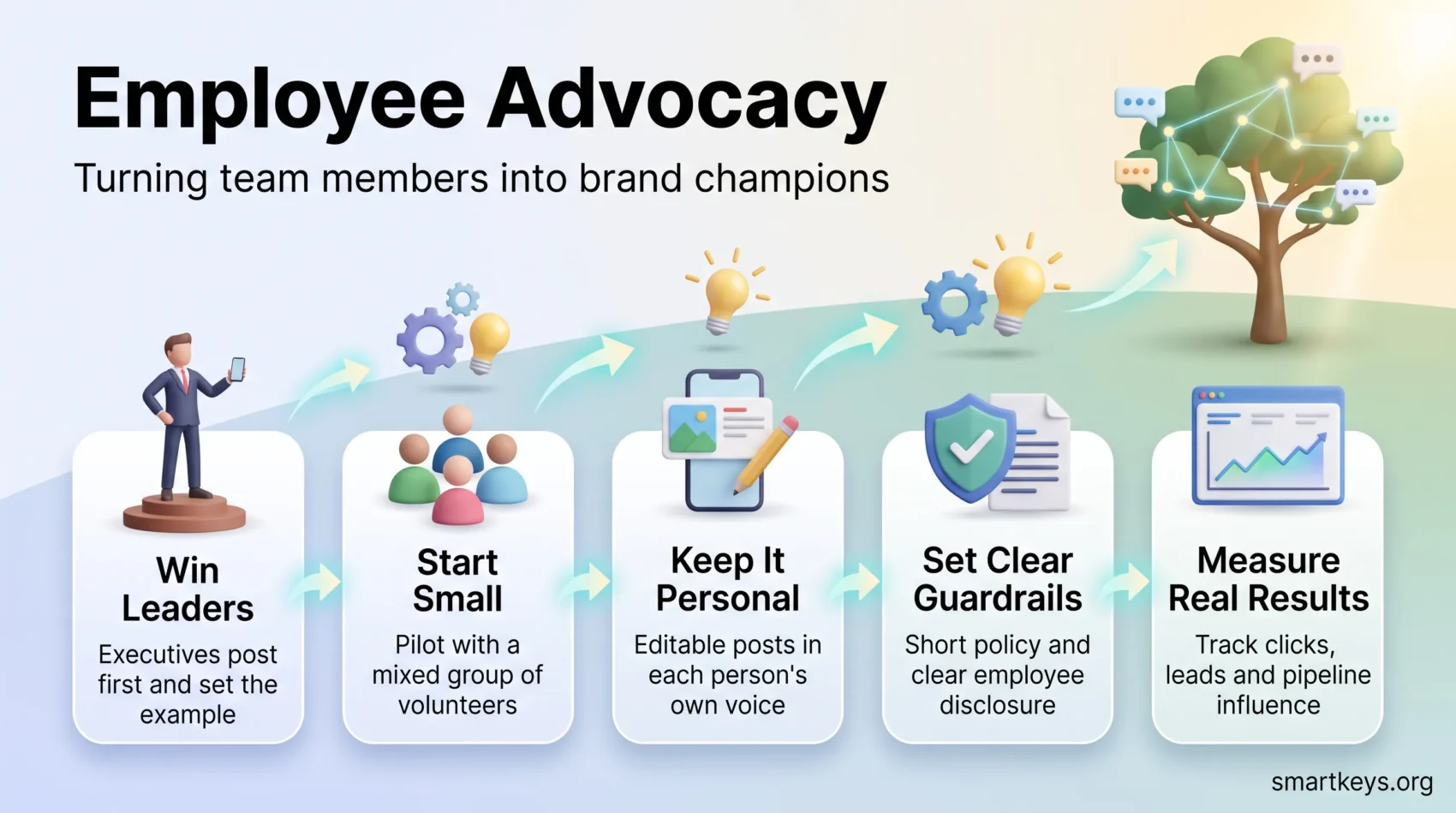
With the foundation in place, start with goals so every action maps to a business outcome. Define KPIs for marketing (reach, traffic, leads), sales (pipeline influence, win rate) and talent (referrals, applications). Track them from day one. Adding measurement later is how programs lose their budget.
1. Start with a small first group
Choose 15-30 interested people from several departments rather than one team. Give them short training, content templates and one tool. Structured training sessions are the most common format (43%), ahead of video tutorials (12%), onboarding integration (11%) and self-paced material (9%).
2. Set a content rhythm
Four fresh items a week is a workable benchmark. Mix company news, culture, industry commentary and leader posts. Always include a suggested caption and one sentence on why the item is worth sharing.
3. Make results visible
Report results internally every month. 64% of program managers plan to highlight success stories in 2026, because proof recruits new advocates better than reminders do.
4. Expand step by step
Open the program to one department at a time. Sales often shows measurable results first, while HR and communications build longer-term employer-brand value. If the rollout touches many teams, borrow from your change management playbook.
“Start small, measure results, and scale what moves the needle.”
Content That Performs: Authentic Posts and Curation
The best shares read like a conversation, not a press release.
Give people short, editable templates so they can post quickly, then invite them to personalize. One or two lines of real context turn a post people scroll past into one they reply to.
Templates vs. personal voice
Offer ready-made copy with optional variations, so people save time but still sound like themselves. AI drafting helps and hurts here at the same time. It removes the blank page, but generic AI text is easy to spot in a feed.
An editorial mix that works
Rotate company news, culture stories, industry insight and leader commentary that invites replies. Strong brand storytelling gives advocates something worth sharing. Many programs that stall have a content problem, not a people problem.
Avoid content overload
Choose relevance over volume. Keep the queue short and topical, and spread posts across platforms so the same message does not appear three times in one feed.
- Package each item with two or three caption options.
- Give leaders prompts, since their posts trigger everyone else’s.
- Use images, short video and documents, which usually earn more engagement than plain links.
Choosing an Employee Advocacy Platform
The right tool balances admin control with a fast, mobile-friendly experience for contributors. 67% of programs run on a dedicated platform, while 28% still manage everything manually. Manual works for a small pilot, but spreadsheets and email get hard to maintain as the group grows.
General social media tools can cover the early stage. Our comparisons of Buffer and Hootsuite and Sprout Social and Buffer show what scheduling suites cost, and some of them offer advocacy add-ons.
Admin essentials
Look for dashboards that show reach, engagement, clicks and earned media value (EMV), an estimate of what the same exposure would have cost as paid advertising. You also want content curation, approval flows and easy user management. Check what data the tool passes into your analytics and CRM, the customer relationship management system where sales tracks deals.
Contributor must-haves
A fast mobile app, a clean content feed, sharing to several accounts at once, and one-tap scheduling. Every extra click costs participation.
Integrations, gamification and AI
CRM and internal communication integrations put reporting in one place. Leaderboards create friendly competition. AI drafting gives people a starting point, but confirm the tool lets you enforce your own tone of voice.
- Admin checklist: analytics, curation, governance, user management, EMV reporting.
- User checklist: mobile app, multi-account sharing, fast personalization.
- Extras: CRM integration, leaderboards, tone-controlled AI suggestions.
Where Employee Advocacy Delivers Across the Organization
Each department gets something different from the same program.
Marketing: reach, traffic and lower paid spend
Marketing gains reach and better-quality traffic at a lower cost per click. Over time this reduces reliance on paid media, though it rarely replaces it.
Sales: social selling and pipeline
Reps engage buyers where they already research. Because sales is now the most active advocacy function, it is often where a program first justifies its cost. Shared metrics help here, which is why sales and marketing alignment matters before launch.
HR and recruiting: employer brand and referrals
Candidates research companies on social media before applying. Employee posts are one of the few employer-brand assets that are free, continuous and credible at once. Advocacy also tends to reflect wider employee engagement: people rarely promote a workplace they feel disconnected from.
Communications: information flow and culture
Advocacy shifts internal culture from top-down announcements toward shared ownership of the story. It pairs well with other human-voice channels. An internal podcast, for example, gives distributed teams the context they need before they can speak about the company with confidence. An employee experience platform can deliver advocacy content alongside other internal news.
The same dynamic drives community-led growth: people amplify things they feel part of.
How to Measure the Success of Your Program
Build the measurement plan before the first post goes out.
77% of teams track KPIs, but only 44% compare their results with peers. That is a blind spot, because raw reach numbers mean little without an outside reference point.
What to track
The most common method in 2026 is EMV or cost per click (67%). Next come social following growth (43%) and website traffic and conversions (43%). Engagement (36%), brand awareness (36%) and employee feedback (31%) follow.
Adoption and participation
Sign-ups are easy. Sustained sharing is the real health metric. In the survey, 68% of advocates share three or more times a week, and 21% post five or more times.
Attribution
Add UTM parameters, short tags on each link that tell your analytics tool where a visit came from. Set them up from day one so traffic, sign-ups and deals can be traced back to individual posts. Without this, advocacy stays a “nice to have” in every budget discussion.
Keep improving
Use the data to adjust content mix, posting rhythm and incentives. Then report business outcomes such as leads, influenced deals and saved ad spend, not just likes.
Common Mistakes to Avoid
- Making participation mandatory. Forced posts read as forced and damage the credibility you want to borrow.
- Sharing only promotional content. If every item is a product link, people stop opening the queue.
- Skipping training. Nearly a third of advocates still get none, and uncertainty is the top barrier.
- Letting AI write everything. Generic output is obvious and wastes the one advantage advocacy has.
- Forgetting disclosure. Posts about your products without a clear employment note can create legal risk.
- Measuring only shares. Share counts do not survive a budget review. Clicks, pipeline influence and EMV do.
- Launching without leaders. Without visible executives, participation rarely spreads beyond early volunteers.
Real-World Examples
The following published case studies come from Sprout Social, whose advocacy tool the companies used. They show how small, repeatable habits produce measurable reach.
A weekly digest that doubled shares
Medallia relaunched its program in 2022 with a weekly email digest of relevant, localized content. According to the company, employee shares roughly doubled from day one, and the team added leaderboards to keep momentum.
Advocacy built into a rebrand
Simpli.fi launched its advocacy program a few months before a 2023 rebrand. The three-month pilot produced about $90,000 in earned media value and a reported 7x return, so the public launch landed with awareness already building.
Contests and recognition
Ivanti used contests, CEO thank-yous and onboarding training to revive its program. Monthly shares grew from about 1,000 to 17,000 within the first quarter.
Conclusion
Employee advocacy is a simple idea: help the people who already know your company talk about it well.
It has left experimental territory. In the 2026 DSMN8 survey, 59% of program managers rate it as extremely or very important. The programs that succeed share a short list of traits: clear structure, real training, visible executives, the right tool and measurement beyond vanity metrics.
Start small. Run a first group, write guardrails people can remember, and connect posts to real conversions. Reward genuine effort and let people sound like themselves. Your brand champions are already on the payroll; most are just waiting for permission and something worth sharing.
Found this useful?
Make SmartKeys a preferred source on Google, and our articles will surface more often in your Top Stories, AI Overviews, and AI Mode.
Add as Preferred Source