Viktor is an AI employee that lives inside Slack and Microsoft Teams — and in 2026 it stopped being a curiosity and became a budget line for a lot of teams.
This Viktor review covers what the product actually does, what it costs after the mid-2026 pricing change, where the credit model gets expensive, and who should skip it.
One clarification first, because search results mix them up constantly: viktor.com — the subject of this review — is not viktor.ai. The latter is a low-code platform for civil and structural engineers who build Python apps. Same first name, completely different product.
Key Takeaways
- Viktor is a managed AI employee from Zeta Labs that works inside Slack and Microsoft Teams, so your team learns no new interface.
- It connects to 3,200+ business tools through OAuth and returns finished output: PDFs, spreadsheets, dashboards, deployed web apps and pull requests.
- Pricing is credit-based rather than per seat. The free tier gives up to $100 in non-expiring credits; the Team plan is listed at $100/month for 40,000 shared credits.
- Credits track real model usage, so a heavy month can cost several times the sticker price. Forecasting is the biggest weakness.
- A $75M Series A led by Accel in May 2026 removed most of the viability risk that hung over the product at launch.
- SmartKeys readers who are new to Viktor get $50 off their first purchase with the code FELIX50OFF6U.
What Viktor Actually Is
Most AI tools hand you text and leave the work to you. Viktor is built to finish the task.

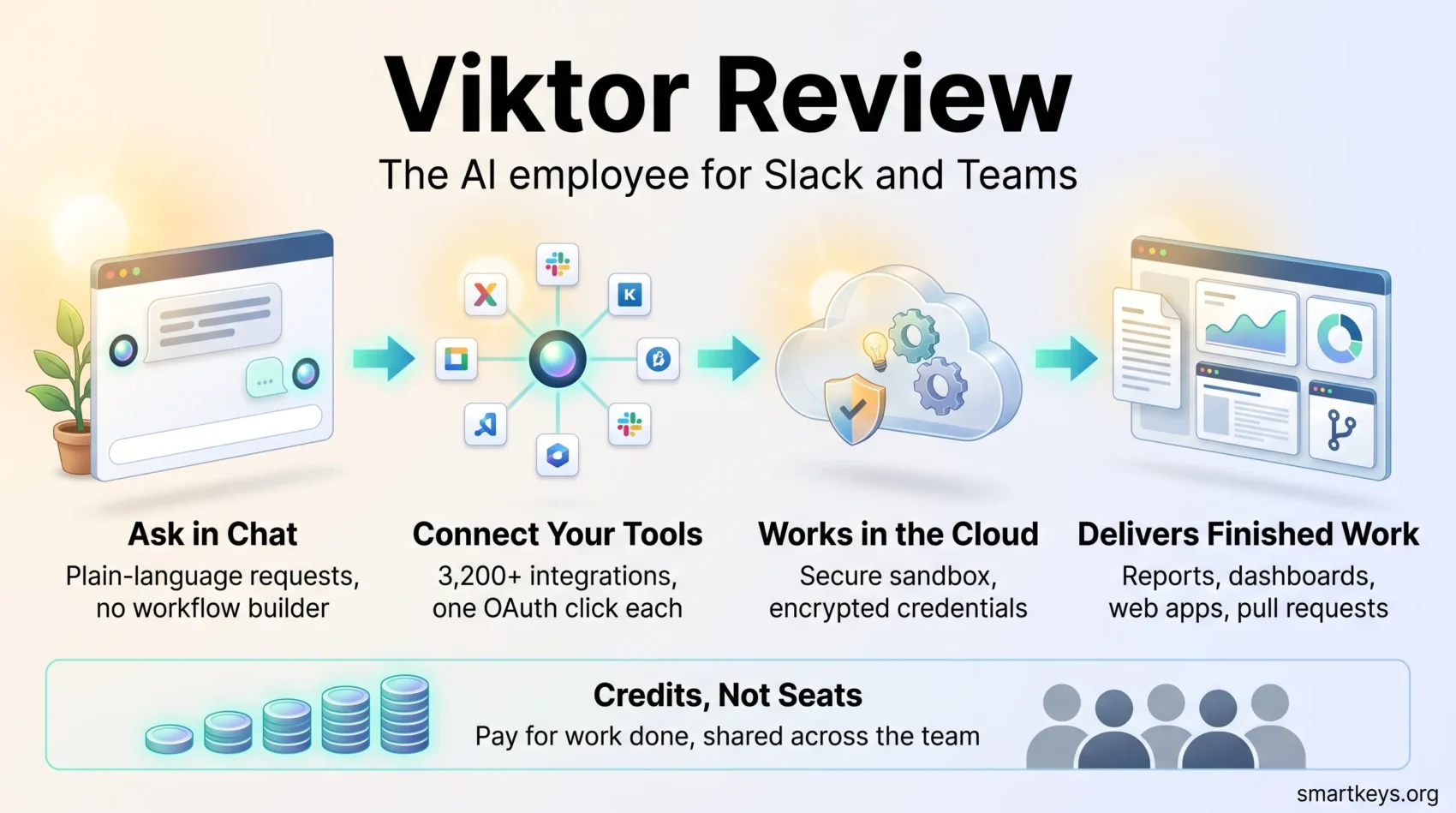
You add it to a Slack workspace or a Microsoft Teams tenant, connect your tools with one OAuth click each, and then message it the way you would message a colleague. It reads the request in plain language, works in a secure cloud sandbox, and posts the result back into the conversation.
There is no prompt engineering layer, no visual workflow builder and no agent configuration screen. That is the core design bet: the setup cost is close to zero, and the intelligence sits in the model rather than in a canvas you have to maintain.
Who is behind it
Viktor is built by Zeta Labs, the team that previously shipped the Jace AI email assistant. The company was founded in 2023 by Fryderyk Wiatrowski and Peter Albert, both formerly at Meta.
In May 2026, Zeta Labs raised a $75M Series A led by Accel, with Slack co-founders Stewart Butterfield and Cal Henderson among the angel investors. Viktor’s own site now claims more than 50,000 teams, up from roughly 12,000 workspaces reported in spring 2026.
The funding round matters for buyers: a credit-based tool you route daily operations through is only as durable as the company behind it.
Core Features and What They Produce
The feature list is broad, but it clusters into six things that matter day to day.
- Data and reporting: cross-references sources such as Stripe, HubSpot, PostHog and Google Ads, then delivers board-ready PDFs, Excel files or a short summary in chat.
- Proactive automation: a “heartbeat” system watches how your team works and proposes automations — morning revenue briefings, weekly ad audits, anomaly alerts. You approve once and it runs.
- Scheduled tasks: recurring standups, competitive scans and monthly reviews, with Viktor handling schedule, execution and delivery.
- Research: it browses real websites, reads documents and cross-references sources rather than producing a surface-level summary.
- App building: describe a tool and it ships a real web app with a database, auth and hosting, delivered as a link.
- Code and engineering: it reads a repository, creates branches, writes code, opens pull requests and runs tests.
Browser automation sits underneath several of these — filling forms, navigating multi-step flows, scraping and capturing screenshots when no API exists.
If you are still deciding which parts of your week are worth handing to a machine at all, our task automation playbook is a useful place to start before you spend a credit.
Viktor Review: Pricing and Credits Explained
This is where most buying decisions are actually made. Viktor charges for work done, not for seats — which is generous for large teams and unpredictable for busy ones.

| Plan | Price | Credits | Best for |
|---|---|---|---|
| Free | $0 | Up to $100 in credits, never expire | Evaluating without a sales call |
| Team | $100/month | 40,000 shared credits, roll over | Small and mid-sized workspaces |
| Enterprise | Custom | Volume pricing and discounts | Procurement, DPA and SLA requirements |
A caveat worth knowing: Viktor’s pricing has moved. Reviews published earlier in 2026 quote $50/month for 20,000 credits, and some CTAs on Viktor’s own site still repeat that figure. The live pricing table currently shows $100/month for 40,000 credits. Check the plan page before you budget.
How far do credits actually go?
Viktor publishes rough ranges, and they are honest ones:
- Quick tasks — 100 to 300 credits: summarise a Slack thread, draft a CRM follow-up.
- Complex workflows — 500 to 1,500 credits: update a live web page, run a multi-source audit.
- Full projects — 2,000 to 5,000 credits: build and deploy an internal app connected to two or three systems.
The arithmetic is unforgiving. Ten complex workflows a day will clear 40,000 credits well before month end. Viktor softens this with caching — repeated workflows reuse context and cost less than fresh model calls — plus rollover, on-demand top-ups and auto-top-ups with a monthly spend cap.
Still, this is usage billing, and it behaves like usage billing. If that model is new to you, the same dynamic shows up in our FullEnrich review, where credits burn at very different rates depending on what you ask for.
Check Viktor Pricing & Free CreditsBudget for the work you will actually delegate, not the work you imagine delegating in month one.
Integrations and Fit With Your Stack
An AI coworker is only as useful as the systems it can reach.
Viktor ships with more than 3,200 pre-built integrations, each authenticated through OAuth rather than pasted API keys. Commonly used connections include HubSpot, Stripe, GitHub, Linear, Notion, Google Drive, Google Ads, Meta Ads, PostHog and Cursor. When a tool is missing from the catalogue, Viktor can build a custom integration on the fly.
Because it operates inside the channels your team already uses, adoption tends to be the easy part. That is a genuine advantage over tools that add another tab — and it fits neatly with an asynchronous way of working, where written requests and delivered artefacts replace status meetings.
The trade-off is that Slack and Teams are the product surface. Viktor is not designed as a standalone workspace, so teams that live in email or in a project tool without a chat layer will feel the mismatch.
Security and Compliance
Credentials never touch a local machine. Everything is stored encrypted in transit and at rest in Viktor’s cloud, and every integration authenticates through OAuth.
Viktor’s site displays SOC 2, GDPR, CCPA and CASA Tier 3 badges. Independent reviews published in mid-2026 reported that the SOC 2 attestation was Type 1, with Type 2 and ISO 27001 still in progress and the report available under NDA.
If your procurement process requires a completed Type 2 or an ISO certificate, ask for the current status directly rather than relying on the badge row. A data processing agreement, an SLA and dedicated onboarding are Enterprise-plan items.
This is also a governance question, not just a security one. Handing an autonomous agent write access to your CRM and repository raises the same accountability issues we cover in our guide to explainable AI in business decisions.
- Encryption at rest and in transit
- OAuth for every integration, no stored passwords
- Isolated execution environment per workspace
- No model training on customer data
Where Viktor Falls Short
No review is useful without the parts the vendor page leaves out.
- Cost is hard to forecast. A credit pool that swings with usage is harder to defend in a budget meeting than a flat per-seat fee.
- It is team-shaped, not person-shaped. Solo operators get team pricing and a team-oriented experience for a personal problem.
- Visibility by default. Work happens in shared channels, which is great for transparency and awkward for anything sensitive.
- Enterprise gating. DPA, SLA and onboarding sit behind custom pricing.
- Autonomy needs supervision. An agent that opens pull requests and edits live pages needs review habits your team may not have yet.
Who Should Use Viktor — and Who Should Not
Viktor makes sense if your team already lives in Slack or Teams, runs recurring reporting across several SaaS tools, and has enough repetitive analytical work to justify usage-based spend. Marketing, revenue operations and small engineering teams get the fastest payback.
It is a poor fit for solo users, for teams with no chat platform, and for organisations whose compliance review will stall on a pending certification.
If you want an assistant that stays closer to research and drafting than to autonomous execution, our Cassidy AI review covers a more conservative alternative. Agencies weighing an all-in-one platform with its own AI Employee suite should also read the GoHighLevel review before committing.
Verdict
Viktor is the most convincing version of the “AI coworker” idea available in 2026 — provided you treat credits like a real operating cost.
The product does what the category has been promising for two years: it takes a plainly worded request and returns a finished artefact, without a workflow canvas in between. Adoption friction is genuinely low, the integration catalogue is deep, and the funding round settled the durability question.
What you are buying is capacity, not seats. That is the right model, and it is also the thing that will surprise your finance team. Start on the free credits, measure the burn rate on two or three real workflows, and only then pick a plan. When you do, the code FELIX50OFF6U takes $50 off your first purchase as a new user.
For the wider context on where this category is heading, see our overview of business automation trends for 2026 and the case for augmenting rather than replacing human work.
Start With Viktor's Free CreditsFound this useful?
Make SmartKeys a preferred source on Google, and our articles will surface more often in your Top Stories, AI Overviews, and AI Mode.
Add as Preferred SourceFAQ
What is Viktor?
Is viktor.com the same as viktor.ai?
How much does Viktor cost?
Is there a Viktor discount code?
Yes. New Viktor users get $50 off their first purchase with the code FELIX50OFF6U. The free plan needs no code, so the discount applies when you move from the free credits to your first paid purchase.