Climate tech is any technology whose main job is cutting greenhouse gas emissions or helping people cope with a warmer climate. That covers batteries and heat pumps, but also grid software, low-carbon cement, flood sensors and satellites that watch for wildfires. In 2026 the money behind all of it is moving in a direction almost nobody forecast two years ago.
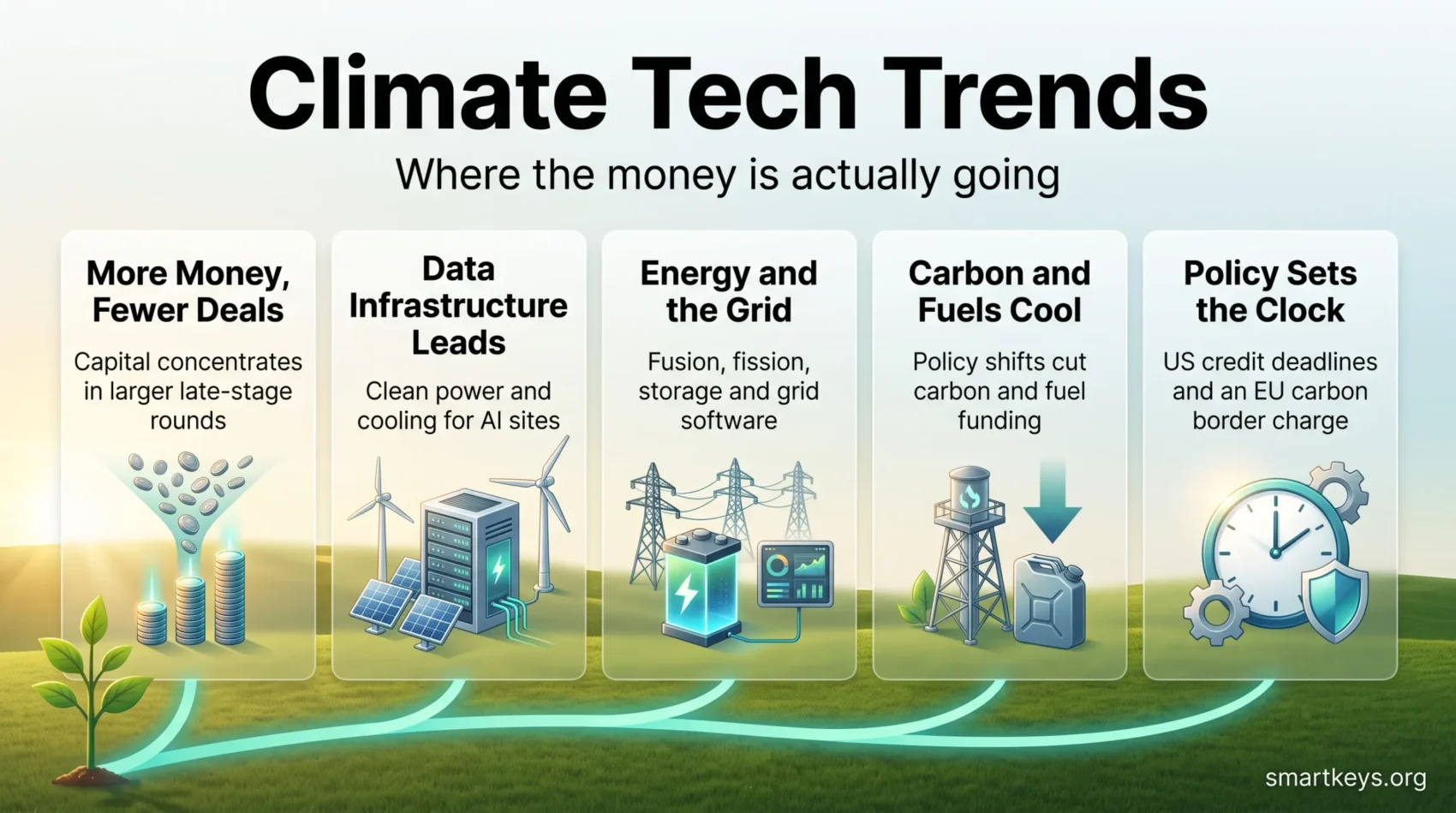
Global climate tech venture funding reached $26.1 billion in the first half of 2026, up 55% on the same period a year earlier, according to Sightline Climate’s CTVC data. Over the same six months the number of deals fell 25%, to a five-year low. More money, fewer companies: that one contrast explains most of what follows.
This guide covers where the capital actually went, which categories lost ground, what the 2026 US tax changes and the EU’s new carbon border charge mean in practice, and how to read funding numbers like these without being misled by them.
Key Takeaways
- Funding is rising while deal counts fall, so capital is concentrating in fewer, much larger rounds.
- Data centre infrastructure became the single largest climate tech category in the first half of 2026.
- Energy is still the anchor sector, with fusion, fission and storage taking most of it.
- Carbon and low-carbon fuel startups lost more than half their funding as subsidies and policy shifted.
- US clean energy tax credits now run on construction-start deadlines, so project timing decides the economics.
- The EU carbon border charge started applying on 1 January 2026 and reaches importers of steel, cement and aluminium.
Where climate tech funding stands in 2026
Two numbers define the market. Funding is up. Deal count is down.
Sightline Climate counted $26.1 billion of climate tech venture investment in the first half of 2026, a 55% jump year on year. In the same window, the number of individual deals dropped 25% to the lowest level in five years. Investors are writing bigger cheques to a shorter list of companies.
The full-year 2025 picture sets the baseline: $40.5 billion invested across 1,545 deals, up 8% in dollars but down 18% in deal count. The pattern was already visible then. It simply accelerated.
Why fewer deals can still mean more money
Late-stage rounds did the heavy lifting. Series C funding, which is usually the round a company raises once it has paying customers and wants to scale, hit a record $10.5 billion in the first half of 2026. That was roughly 40% of all climate tech investment and close to four times the prior year.
Series A funding also rose 55%, to $4.5 billion. Growth-stage capital, by contrast, fell 18% to $3.6 billion. So the money is clustering at two points: early bets on a small number of credible teams, and large cheques for companies that can already point to revenue.
For founders, the practical read is simple. The bar for a first institutional round is higher, and the reward for clearing it is larger. Our guide to startup funding trends in 2026 covers how that same concentration is playing out across venture capital generally, and scaling strategies for startups looks at what has to be true before a growth round makes sense.
Data centres became the biggest climate tech category
The largest single shift of 2026 was not in solar or hydrogen. It was in buildings and the power that runs them.
Funding for built environment companies rose by more than 800% and now accounts for 34% of all climate tech investment, overtaking energy as the biggest vertical. Almost all of that comes from data centres. Two deals illustrate the scale: DayOne raised $4.5 billion and NScale raised $2 billion, both at Series C.
Why a data centre counts as climate tech at all
It sounds like a contradiction. Data centres consume enormous amounts of electricity, so how do they belong in a climate category?
The answer is that the buyers are paying for the low-carbon part. AI workloads need firm, round-the-clock power, and the operators competing for that business are the ones signing contracts for nuclear, geothermal and long-duration storage. They also fund the cooling, waste-heat recovery and grid connections that make a site viable at all. The investment is classified by what it builds, not by how much power the finished building draws.
That does not settle the underlying argument about total energy demand. We cover both sides in more detail in our piece on AI data centre energy use.
Energy: fusion, fission and the grid
Energy was the largest vertical until data centres overtook it, and it remains the deepest pool of capital in the sector.
In 2025, energy startups raised $14.4 billion, about 36% of the year’s total and up 31% on 2024. The internal split is striking. Fusion and fission together took 44% of that energy funding. Distributed energy resources, meaning small generation and storage assets sitting close to where power is used, plus grid-scale storage, took another 24%.
Grid technology had its strongest half on record
Grid software and hardware posted their best first half ever in 2026. The reason is unglamorous and structural. Wind and solar produce power when the weather allows, not when demand peaks, so the grid needs two things: storage that can hold energy for hours or days, and software that shifts demand to match supply.
Long-duration storage is where the hardware answer sits. Iron-air and vanadium flow batteries are built for multi-hour and multi-day discharge rather than the short bursts lithium handles well. On the software side, utilities pay for forecasting, dispatch control and demand response, which is the practice of paying customers to shift or pause consumption when the grid is tight.
Buyers in this market do not buy promising technology. They buy systems with performance guarantees, warranties and an interconnection agreement already in hand. Permitting and grid connection queues remain the slowest part of any deployment, which is why connected sensing and control systems and predictive maintenance have become standard parts of the commercial pitch: they make an asset’s output measurable and its downtime predictable.
The categories that lost ground
Not every part of climate tech grew. Two categories contracted sharply in the first half of 2026.
Carbon funding, which covers capture, removal and carbon accounting startups, fell 61% to its weakest half since 2020. Low-carbon fuels fell 56%, as subsidy changes and policy delays made project economics harder to underwrite.
Transportation, by contrast, rose 52%, and climate management software rose 6%, helped by cheaper satellite capacity.
The carbon drop deserves care in interpretation. Less venture funding is not the same as less activity. Corporate buyers are still signing removal contracts, and the tooling side of the market keeps growing. If your interest is measuring and reporting your own emissions rather than investing in the sector, carbon accounting software and our guide to carbon neutrality claims are the more useful starting points.
Hard-to-abate industry is still underfunded
Steel, cement, chemicals and the built environment together produce roughly a third of global greenhouse gas emissions. They attract nothing close to a third of climate tech funding.
The reasons are practical rather than ideological:
- Capital intensity. A new cement kiln or steel process costs hundreds of millions before it produces anything.
- Operational risk. Changing a production line means downtime, recertification and a quality risk on every tonne shipped.
- Payback framing. Plant managers buy energy savings, yield improvements and compliance. “Lower carbon” on its own does not clear an investment committee.
The near-term pathways that are actually moving are narrower than the headlines suggest: electrifying process heat where temperatures allow, capturing emissions at the point they are produced at gas-intensive sites, and substituting cement binders that cut embodied carbon without changing how concrete is poured.
What helps is demand-side pressure rather than technology alone. When a buyer specifies low-carbon steel in a contract, the supplier has a reason to invest. That is why green supply chain requirements, circular manufacturing models and wider supply chain shifts matter more to industrial decarbonisation than any single breakthrough. Digital twins, meaning live simulated copies of a physical plant, and private networks on the factory floor are how many sites find the savings that pay for the rest.
AI in climate tech: useful, and expensive to run
AI shows up in climate tech in two opposite roles. It is a tool that makes energy and land use more efficient, and it is a source of electricity demand that makes the grid problem harder.
On the useful side, the applications are specific rather than general. Forecasting models tell a grid operator how much wind will arrive tomorrow. Computer vision spots a wildfire from a satellite image before a person reports it. Yield models tell a farm where to irrigate. The common thread is that the model is tied to proprietary data and to a measurable outcome, not to a generic chatbot.
Earth observation funding tripled in the first half of 2026, and satellite operator ICEYE raised $521 million. That money buys the input layer these models depend on.
The honest limits are worth stating. Measurement, reporting and verification, usually shortened to MRV, is the process of proving an emissions reduction actually happened. It is still the weak point. Data sources are fragmented, standards differ by jurisdiction, and a claim that cannot be verified cannot be financed. If you are deploying AI against your own operations, data governance is the unglamorous prerequisite, and in Europe the EU AI Act now adds documentation duties on top.
Adaptation moves from niche to budget line
Adaptation means reducing the damage from climate effects that are already happening: flooding, heat, drought, wildfire. For years it was treated as a policy topic rather than a market. That changed.
Adaptation deals are numerous but individually small. They cluster in crop resilience, wildfire detection, flood monitoring and insurance technology, and the buyers are the parties carrying the loss: insurers, utilities, food companies and municipalities.
The structural problem is the exit. No adaptation company has produced a billion-dollar exit yet. Corporate acquirers are the most likely route, because they can fold a monitoring product into an existing procurement relationship and price the avoided loss. Until that happens, founders in this category should plan for shorter, milestone-driven rounds blending grant money, pilot revenue and corporate partnerships rather than a single large raise.
Policy in 2026: US credits on a clock, EU charge live
Policy changed more than technology did over the past year, and it changed in opposite directions on either side of the Atlantic.
What the 2026 US tax rules mean for project timing
The Inflation Reduction Act’s clean energy credits were substantially rewritten by the One Big Beautiful Bill Act. The effect is not a simple repeal. It is a set of deadlines that make timing the deciding variable.
The core changes:
- Wind and solar (credits 45Y and 48E): construction must begin by 4 July 2026. Projects starting after that date must be placed in service by 31 December 2027 to qualify.
- Clean hydrogen (credit 45V): construction must begin before 1 January 2028.
- Manufacturing (credit 45X): wind components produced and sold after 31 December 2027 are no longer eligible.
- Transferability survives. Developers can still sell credits to third parties, but not to entities on the prohibited foreign entity list, and new content thresholds apply: 40% non-restricted content in 2026, rising to 60% by 2030.
For anyone underwriting a US project, the practical consequence is that safe-harbour documentation, supply chain origin and construction-start evidence now sit alongside the technology in due diligence. Geothermal, nuclear and hydrogen have longer runways, with phase-outs beginning in 2034.
The EU carbon border charge started in January 2026
The EU’s Carbon Border Adjustment Mechanism, or CBAM, entered its definitive phase on 1 January 2026. In plain terms, it puts a carbon price on certain imports so that goods made outside the EU do not undercut goods made inside it under EU carbon rules.
It applies to imports of cement, iron and steel, aluminium, fertilisers, electricity and hydrogen. Importers bringing in more than 50 tonnes of covered goods a year must register as authorised declarants, then buy and surrender certificates matching the emissions embedded in what they import. Carbon costs already paid in the country of production can be deducted.
If you buy steel or aluminium into the EU, this is now a line in your landed cost, not a reporting exercise. It also gives European industrial decarbonisation projects a demand signal that US projects currently lack. Our guides to building an ESG framework and ESG reporting duties for software companies cover the disclosure side of the same shift.
What to do with this if you are raising or buying
For founders raising capital:
- Size your milestones for a late-stage bar. Investors want revenue evidence, not a technology roadmap.
- Show meter-level results. A verified saving at one site beats a modelled saving across a market.
- Line up a corporate pilot early. Corporate backers bring distribution and procurement, not just money.
- Map the policy window into your funding plan, especially construction-start dates in the US.
For companies buying climate technology:
- Ask for performance guarantees and warranties in writing. Bankability, not novelty, predicts whether a vendor survives.
- Check permitting and interconnection status before you check the specification sheet.
- Separate the emissions claim from the cost claim. Both can be true, and only one usually gets audited.
If sustainability sits inside a broader strategy rather than a single procurement decision, aligning sustainability with commercial goals and sustainable business innovation are the wider frames. For the investment side, green finance trends tracks where the capital comes from, and green technology trends covers adjacent innovation outside the venture-funded core. On the people side, demand for climate skills is covered in green jobs and sustainable work and in our overview of future job skills.
How to read climate tech funding numbers
Funding trackers disagree with each other, and the disagreement is usually about definitions rather than arithmetic.
Three questions decide most of the gap:
- What counts as climate tech? Most trackers require a demonstrable emissions or adaptation benefit. That is why some widely covered companies never appear in the totals, and why data centres now do.
- What counts as funding? Venture and growth equity plus grants is the common basis. Debt, project finance, asset purchases and IPOs are usually excluded, which understates capital-intensive sectors badly.
- When was it counted? Trackers restate history when they change their taxonomy, so a 2024 figure quoted in 2026 may not match the same figure quoted in 2024.
A single megadeal can also swing a quarterly total by double digits. When you see a dramatic percentage change, check the deal count alongside it. If dollars rose and deals fell, as they did in the first half of 2026, the story is concentration rather than a broad recovery. That distinction matters more than the headline number, and it is the same trap that shows up across startup trend reporting generally.
Conclusion
Climate tech in 2026 is not in a boom or a bust. It is consolidating.
Capital is flowing to fewer companies at larger cheque sizes, with data centre infrastructure now the biggest single destination and energy close behind. Carbon and low-carbon fuels lost ground for policy reasons rather than technical ones. Adaptation is growing in deal count while it waits for its first large exit.
Policy is now the variable that moves project economics most. In the US, credits survive but run on construction-start deadlines that reward companies ready to break ground. In the EU, the carbon border charge turns embedded emissions into a cost line for importers of steel, cement and aluminium.
If you take one practical rule from this: judge any climate technology on whether it has a paying customer, a verifiable result and a policy path that does not expire before the project does. That test explains most of who got funded this year, and most of who did not.
Found this useful?
Make SmartKeys a preferred source on Google, and our articles will surface more often in your Top Stories, AI Overviews, and AI Mode.
Add as Preferred Source