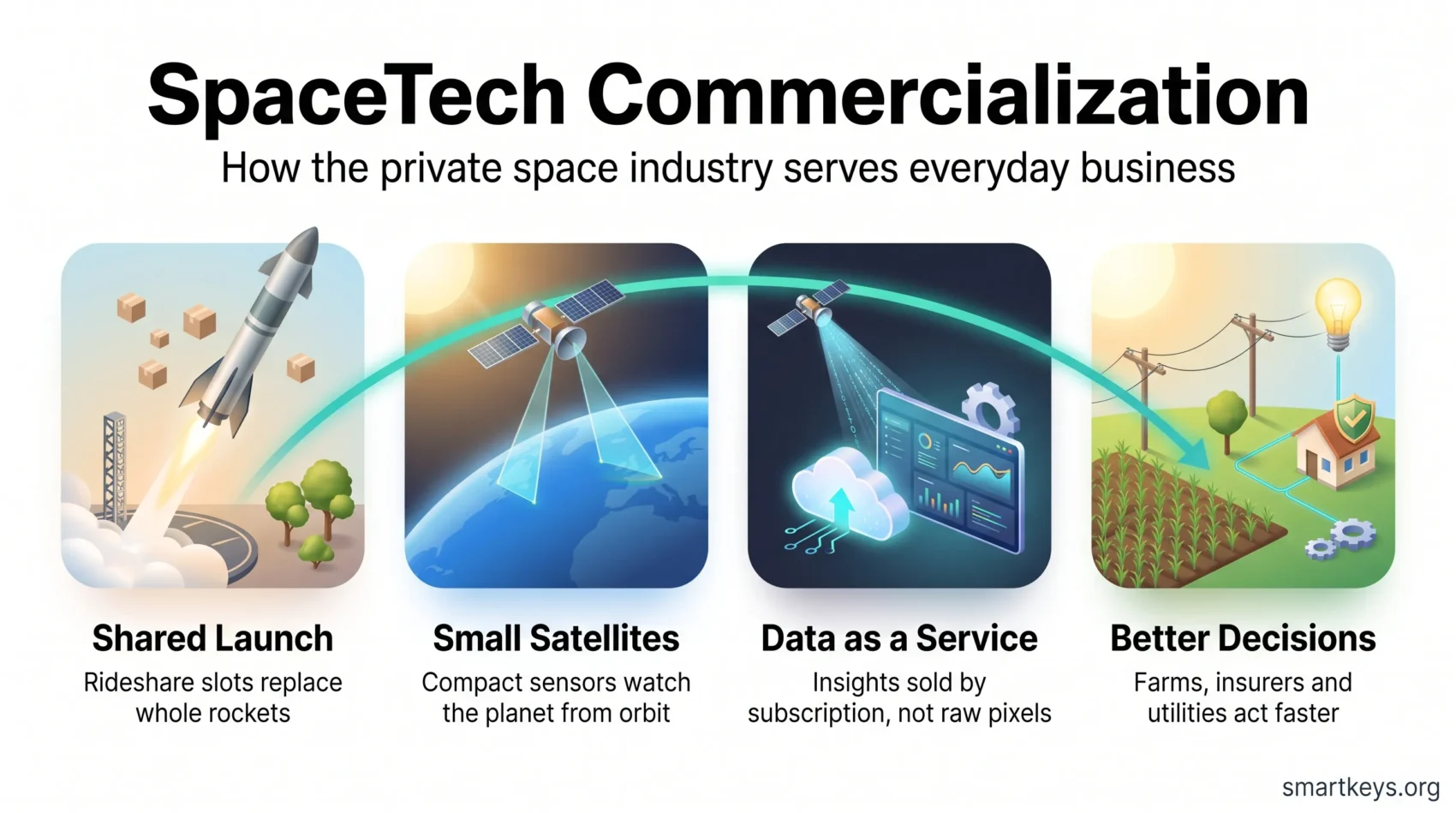
Space stopped being a government programme and became a supply chain. Rockets fly weekly, a satellite can cost less than a delivery van, and the data those satellites produce is sold by subscription like any other software service.
That change matters for ordinary companies, not just aerospace firms. A farm co-operative, an insurer or a utility can now buy orbital data the way it buys cloud storage. Nobody has to build a rocket.
This guide explains what the commercial space industry actually sells in 2026 and where the money is going. It also shows how a business can use it without owning a single piece of hardware. Every figure below is sourced. The parts that are still uncertain are flagged as such.
Key Takeaways
- The global space economy reached $686 billion in 2025, and roughly four fifths of it is now commercial rather than government spending (Space Foundation).
- Most of the value has moved downstream, to data, connectivity and analytics rather than to hardware.
- Cheap rideshare launches let you test a space-enabled product for the price of a mid-size marketing campaign.
- Investors now fund fewer, larger companies with real contracts, and 2026 has already beaten 2025 on capital raised.
- The fastest route to value for most firms is buying satellite data as a service, not launching anything.
Where the commercial space economy stands in 2026
The Space Foundation is a US non-profit that has tracked industry revenue for two decades. It put the global space economy at $686 billion in 2025. That is a 12% rise on 2024 and the second double-digit year of the past decade. Commercial activity accounted for $544.3 billion, or about 79%. Government budgets made up the rest.
The often-quoted long-range figure comes from the World Economic Forum and McKinsey, who projected in April 2024 that the space economy could reach $1.8 trillion by 2035. Treat that as a scenario rather than a forecast. It is useful mainly because it shows where analysts expect the growth to sit: in downstream applications such as communications, navigation and Earth observation, not in launch itself.
Two events in 2026 marked how far the sector has moved into mainstream finance. SpaceX listed on Nasdaq on 12 June 2026 under the ticker SPCX, raising about $86 billion at a valuation near $1.77 trillion. A year earlier, Voyager Technologies had raised roughly $383 million in a smaller listing. Space companies are now assets that pension funds hold.
What the numbers mean for a normal business
You do not need to care about launch cadence. You need to care about three things that follow from it.
First, orbital data is getting cheaper and more frequent. Second, connectivity now reaches places that had none. Third, both are sold through ordinary commercial contracts with service levels, not through space agencies. That is the whole shift, in one paragraph.
From one-off missions to repeatable infrastructure
For fifty years, a space project was a single expensive event. You built one spacecraft, launched it, and hoped. Reusable rockets broke that pattern by making launch a scheduled service instead of a milestone.
The knock-on effect is that companies can now treat space projects like product cycles. Build small, launch on a shared rocket, learn, and iterate. It is the logic of software product development, applied to hardware that happens to sit in orbit. For a wider view of that pattern, see our overview of current startup trends.
Miniaturisation did the rest. A modern low Earth orbit satellite can weigh a few dozen kilograms and be built from commercial components. Low Earth orbit, usually shortened to LEO, is the band roughly 300 to 1,000 kilometres up where most commercial satellites operate. Cheaper spacecraft mean shorter refresh cycles and faster feedback, much like the shift toward staged, evidence-led scaling in other industries.
The commercial space stack: who does what
It helps to think of the industry as four layers. Most companies only ever buy from the top layer.
Launch and rideshare
Rideshare is the space equivalent of a shared shipping container. Instead of buying a whole rocket, you buy a slot on one. SpaceX publishes rideshare pricing that starts at $300,000 for 50 kilograms to sun-synchronous orbit, a polar path that crosses each point on Earth at the same local time every day. That predictability is why imaging satellites use it.
A dedicated Falcon 9 flight is listed at about $74 million for up to 22,800 kilograms to LEO. Divide that out and you get roughly $3,000 per kilogram, against the Space Shuttle era figure of tens of thousands. SpaceX’s Starship is aiming far lower still, but its long-term cost per kilogram is a company target rather than a published price, so plan on today’s numbers.
Satellites, sensors and Earth observation
Earth observation, or EO, means imaging the planet from orbit. Modern constellations combine several sensor types. Optical cameras see what a photograph would show. Radar sees through cloud and at night. Thermal sensors detect heat, which is how gas flares and building heat loss get spotted. Hyperspectral sensors split light into narrow bands, which reveals crop stress or mineral content that the eye cannot see.
The European Space Agency counted about 11,000 active satellites in orbit at the end of 2024, and the number has kept climbing since, driven mostly by broadband constellations. More satellites means shorter revisit times, which is the gap between two looks at the same field, port or pipeline.
Connectivity and ground infrastructure
Satellite broadband now competes with terrestrial networks in rural areas and at sea. Ground stations have followed the same path as launch and become a service you rent by the pass rather than a facility you build. For distributed operations, this sits alongside the same connectivity questions raised by industrial IoT deployments and edge computing.
In-orbit servicing, manufacturing and return
The newest layer treats orbit as a place where work happens, not just a place things sit. Refuelling and servicing extend satellite life. On-orbit assembly allows structures too large to launch in one piece. Return capsules bring materials back.
Varda Space Industries is the clearest commercial example. It has flown six spacecraft. Each carries a capsule that re-enters and lands in the Australian outback. In May 2026 it announced work with United Therapeutics to grow drug crystals in microgravity. The company calls this the first commercial path to products made in space. No space-made drug has been sold yet, so treat it as a real business with an unproven market.
The economics of access
Falling launch prices changed the maths behind every mission. When a launch slot costs less than a trade show stand, the decision stops being a board-level capital question and becomes a project budget.
Three cost curves moved at once. Launch became a shared, repeatable service. Satellite buses, meaning the standard body a payload is bolted into, became mass produced. Ground and processing costs fell as operators moved to cloud delivery.
The last of those is easy to overlook and often matters most. Older EO contracts delivered enormous raw image files that a customer had to store and process. Modern providers deliver analysis-ready products or plain alerts. You get “this field is water stressed” rather than 40 gigabytes of pixels, which changes both the cost and the skills you need in-house. This is the same move from raw data to packaged insight seen in data-as-a-service models and real-time data platforms generally.
Where the investment money is going
Funding patterns tell you which parts of the sector investors think are real.
According to PitchBook, space tech startups raised $10.1 billion across 433 deals in 2025. In the first half of 2026 alone they raised $11.3 billion across 244 deals, already beating the whole of the previous year. The median round size more than doubled, from $7 million to $14.5 million.
Read that carefully. Deal count fell while capital rose. Investors are not spreading money across more experiments. They are concentrating it in fewer companies that already have customers, usually government or defence customers. If you are raising money in this sector, signed contracts matter more than technical novelty. That mirrors the wider shift in startup funding conditions.
Government demand underpins much of this. Defence and civil space budgets have grown in the US, Europe and Asia, and several countries have loosened foreign investment rules to attract satellite manufacturing. For suppliers, that means procurement rules, export controls and fixed-price contracts are part of the business model, not an afterthought.
Turning orbital data into business decisions
This is where most companies will actually touch the space industry. The pattern is simple: a satellite sees something, software turns it into a number, and that number changes a decision someone was already making.
Agriculture
Growers use imagery to spot water stress, disease and uneven growth before it is visible from a tractor. Combined with drone and ground sensors, it guides where to irrigate or spray. Our guide to commercial drones covers the low-altitude half of the same picture.
Energy and utilities
Methane sensing finds leaks that would otherwise go unreported for months. Thermal and radar imaging track pipeline right-of-way encroachment, vegetation near power lines and flood risk to substations. This feeds directly into predictive maintenance programmes.
Finance and insurance
Insurers use imagery to assess damage after a storm without sending an assessor first, which shortens claims. Lenders and investors use activity signals, such as counting vehicles or measuring storage tank levels, as an independent check on reported figures. The technique overlaps with the broader field of geospatial analytics and with insurtech more widely.
Logistics and supply chain
Vessel tracking, port congestion monitoring and weather routing all draw on satellite feeds. For companies rebuilding their networks after several disrupted years, it is one more input into supply chain resilience planning.
Climate and environmental reporting
Regulators and buyers increasingly want measured emissions rather than estimates. Satellite monitoring provides an independent record, which links this market to climate tech and carbon accounting tools.
Adoption is still early in all of these. That is the opportunity and the risk: the tools work, but few organisations have built the workflows that turn an alert into an action.
Risks, regulation and building for resilience
Space businesses carry a set of constraints that software businesses do not. Plan for them before you scale.
Licensing and spectrum. Radio frequencies are allocated nationally and internationally. Coordination takes months and can shape your system design. Budget the legal work up front.
Export controls. Space hardware and some software fall under regimes such as ITAR and EAR in the US. These restrict who you can hire, where you can ship and which partners you can work with. Screen partners early and document the reviews.
Rules still in motion. The EU Space Act, which would create a single European framework for licensing, debris and cybersecurity, was still a draft as of the Council’s progress report in May 2026. Member States were still arguing over scope and how non-EU operators would be treated. If you sell into Europe, track it rather than assume today’s rules will hold. It is the same planning problem companies face with AI regulation and data privacy law.
Collision risk and traffic. With thousands of active satellites and far more debris, collision avoidance is now routine operational work. Automated screening tools reduce the manual burden and the number of false alarms.
Cyber exposure. A satellite service is a network service. Ground segments, command links and supply chains are all attack surfaces, and the same principles apply as in any enterprise security programme. Encryption choices deserve particular attention, since long-lived assets outlast today’s algorithms, which is the argument behind quantum-safe encryption planning.
How to start without building a rocket
For most companies, the sensible entry point is a paid pilot with an existing data provider. A practical sequence looks like this.
1. Pick one decision. Not a theme. One recurring decision that currently relies on a site visit, a phone call or a guess.
2. Find the provider who already serves your sector. Vertical specialists usually beat general imagery vendors, because they have done the interpretation work already. This is the same argument as for vertical AI tools.
3. Run a bounded pilot. Three to six months, one region, one clear success metric such as claims processed per week or leaks found per quarter.
4. Check the integration cost. An alert nobody sees is worthless. Confirm the data lands in the system your team already uses.
5. Only then consider owning capacity. Hosted payloads and dedicated constellations make sense when volume is proven and the data is a competitive advantage rather than a convenience. That is a partnership decision as much as a technical one.
Conclusion
The commercial space industry has quietly become a normal supplier. Launch is a scheduled service, satellites are manufactured products, and orbital data is sold by subscription with service levels attached.
For most businesses, the practical opportunity is not building hardware. It is buying better information about physical assets, land or logistics, and acting on it faster than competitors who still send someone to look.
Start with one decision that would improve if you could see it from orbit. Run a small paid pilot. Measure whether it changed the outcome. The technology is ready; the workflows around it are what most organisations still have to build.
Found this useful?
Make SmartKeys a preferred source on Google, and our articles will surface more often in your Top Stories, AI Overviews, and AI Mode.
Add as Preferred Source