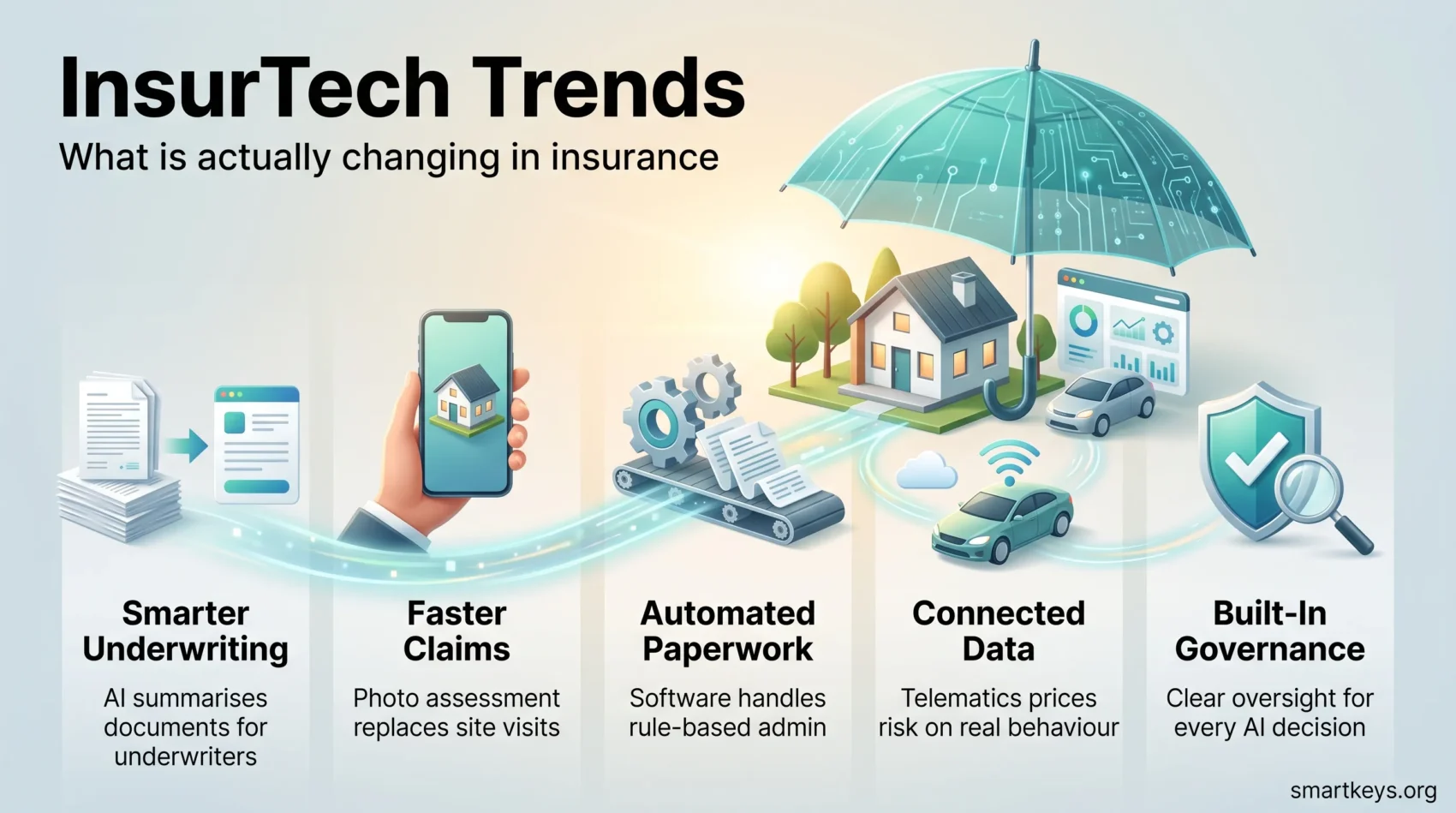
InsurTech is the use of technology to change how insurance is priced, sold, and paid out. The word covers both the startups selling software to insurers and the modernisation work insurers run themselves: automated underwriting, AI assistants for claims handlers, connected devices that measure risk, and the platforms that join them up.
For most of the last decade the story was about funding rounds. In 2026 it is about what reached production. This guide covers what insurers actually do with AI and automation, where the money is going, what the new rules require, and how to judge whether a project deserves funding. It is written for people who work with or buy from insurers, not for data scientists.
Key Takeaways
- Around two thirds of European insurers now use generative AI, mostly in back-office work rather than customer-facing chat, according to EIOPA’s February 2026 survey.
- In the US, most auto and health insurers already use machine learning models or plan to, and more than 20 states have adopted the NAIC’s AI governance bulletin.
- Investors have concentrated almost entirely on AI: 99.1% of second-quarter 2026 InsurTech funding went to AI-focused companies, per Gallagher Re.
- Telematics is mainstream in US auto insurance, with more than 21 million policyholders sharing driving data.
- Regulation is now a design input: EU transparency duties for chatbots applied from August 2026, and life and health pricing models face high-risk rules from December 2027.
- Projects that pay off fix one expensive handoff. The ones that fail are platform replacements with no measurable owner.
Where insurance technology actually stands in 2026
The useful question is no longer whether insurers use AI, but where they use it and whether anyone can show the result.
The clearest evidence comes from Europe. EIOPA, the EU insurance supervisor, surveyed 347 insurance undertakings across 25 countries and published the results on 2 February 2026. Close to two thirds said they actively use generative AI. Just under half had written a dedicated AI policy, up from a quarter in 2023.
The detail matters more than the headline. About 64% of those applications sit in the back office: pulling data out of invoices, audio recordings and medical reports, drafting emails and contracts, and assisting underwriters. Only 36% touch the customer, mostly as voice bots and chatbots. The technology is being used to remove typing, not to replace judgment. Insurers named hallucinations, meaning confident but wrong output, as their biggest worry.
The picture in the United States
US regulators collect similar data through the NAIC, which asked insurers whether they use, plan to use, or plan to explore AI and machine learning models. The answers were high across every line: 88% in auto, 92% in health, 70% in homeowners and 58% in life. Auto and health have the cleanest, most repetitive data, so they automate first. Life insurance involves slower decisions and longer-tailed risk, so adoption lags.
Where the money is going
Investment has narrowed sharply. Gallagher Re’s Global InsurTech Report put second-quarter 2026 funding at USD 2.44 billion, the highest quarterly total since 2022. But 99.1% of it went to companies built around AI, and early-stage funding fell by half from the previous quarter. For a buyer that is a warning as much as a signal: a thinner early-stage pipeline today means fewer independent vendors in three years. The same concentration shows up across the wider startup funding landscape and in adjacent fintech trends.
The technologies doing the work
Four groups of technology account for most of what insurers have put into production. None is exotic. What changed is that they now handle messy documents well enough to be trusted with volume.
Generative AI in underwriting, claims and service
The reliable uses are narrow and dull, which is why they work. A model reads a 40-page submission and produces a structured summary for the underwriter. It extracts the date of loss, the parties and the damage description from a first notice of loss, so the claim is routed correctly on the first attempt. It drafts the customer letter an adjuster then edits. Each removes minutes from a step that happens thousands of times a month. That is the usual shape of a return in AI in business operations: many small savings on a high-volume task, not one dramatic replacement.
The constraint is accountability. If a model influences a coverage decision, someone must be able to explain that decision to a customer and a regulator, which is why explainable AI matters more here than elsewhere.
Robotic process automation for the paperwork layer
Robotic process automation, usually shortened to RPA, is software that clicks through an existing system the way a person would. It suits work that is rule-based and stable: rekeying endorsements between two systems, reconciling premium payments, closing out renewals. It is the cheapest way to connect old software with no usable interface. Stitching several such automations into an end-to-end process is what vendors mean by hyperautomation, and it belongs in any serious business automation plan.
Treat published return figures with care, since vendor case studies measure different things. The honest way to size an RPA project is to count the hours the task consumes today and price them.
Connected data and telematics
Telematics means measuring behaviour directly instead of inferring it from proxies such as age or postcode. In US auto insurance it is no longer a pilot. Research from the IoT Insurance Observatory found more than 21 million US policyholders sharing telematics data with their insurer in 2024, growing at roughly 28% a year since 2018. A survey of 2,059 US auto policyholders by Arity and the same institute found 53% expressed high trust in how insurers handle personal data, placing insurers second only to banks.
That trust is the asset, and it is easy to spend. Customers accept behaviour-based pricing when they can see what is measured and what it earns them. The same logic is spreading to commercial lines through sensors on buildings and machinery, the practical end of IoT in business.
Chatbots, low-code and cloud
Chatbots handle policy lookups, document requests and simple claim intake well, and ambiguity badly. The design decision that matters is the escalation path: how quickly a frustrated customer reaches a person, and whether that person can see the conversation so far. Done well, automated service protects customer retention; done badly it is the fastest way to lose it.
Behind the front end, low-code tools let product and operations staff assemble workflows and forms themselves, shortening the loop between an idea and a testable version, while cloud infrastructure supplies the elasticity underneath.
The rules you now have to design around
Until recently, AI governance in insurance was a slide in a strategy deck. It is now a written requirement in two large markets.
United States: the NAIC model bulletin
The National Association of Insurance Commissioners adopted a model bulletin on insurers’ use of AI in December 2023. It bans nothing. It confirms that existing duties on unfair discrimination and market conduct apply to AI-driven decisions, and that regulators expect a written AI governance programme, documented testing and oversight of third-party models. By April 2026 more than 20 states and jurisdictions had adopted it.
The practical effect is inventory. You cannot demonstrate oversight of models you never listed, which makes a data governance strategy the first deliverable rather than the last.
European Union: the AI Act timetable
Two dates matter. Transparency duties under Article 50 applied from 2 August 2026: if a customer is talking to a bot, they must be told. Systems already on the market were given until 2 December 2026 to comply. Separately, Annex III classifies AI used for risk assessment and pricing in life and health insurance as high risk. Those obligations apply from 2 December 2027 and are substantial: risk management, evidence of data quality, technical documentation, logging and human oversight.
Our guide to EU AI Act compliance sets out what that means in practice, and RegTech tools can carry part of the evidence burden. Privacy law sits underneath all of it: behaviour-based pricing multiplies the personal data you hold, so a privacy compliance framework is part of the product rather than an afterthought.
Claims and risk: where the loop gets shorter
Claims is where customers judge you, and where technology has the most visible effect.
Two patterns are worth copying. The first is remote assessment. Tools such as HOVER build measurable 3-D property models from ordinary smartphone photos, so a straightforward property claim can be scoped without an adjuster climbing a roof. That removes a site visit and a safety risk at once.
The second is turning footage you already record into risk information. Video analytics platforms such as BriefCam index surveillance video so it can be searched by object, time and movement. For a commercial insurer running loss control, that converts hours of unwatched video into a short list of places where incidents cluster: a blind corner, a loading bay, a stretch of pavement that ices over.
Neither tool is the point. The loop is: measure what goes wrong, change something physical, then measure again to see whether claims actually fell. Without that step you have bought analytics, not risk reduction. Joining policy, claims and service records into one view is the job of a customer data platform.
How to run this as a capability rather than a pilot
The failure mode is familiar: a portfolio of interesting pilots, none owned by anyone with a budget. Four habits separate the programmes that survive.
Pick one expensive handoff. Not a platform, a handoff: the point where a file waits for a person, gets rekeyed, or bounces between teams. Those are measurable and the fix is provable.
Fund with exit criteria. Agree before the pilot which number must move, by how much and by when. Stop the ones that miss.
Treat vendors as co-developers. Agree the roadmap, the data handling and the escalation path in writing before you scale. A model you cannot audit is a model you cannot defend to a regulator.
Report in business terms. Cycle time, loss ratio, straight-through processing rate and customer effort are what leadership and rating agencies understand. Model accuracy alone is not a result. The pattern is the same one that shows up in every digital transformation programme.
Conclusion
InsurTech in 2026 is less exciting and more useful than it was five years ago.
What reached production is unglamorous: document extraction, routing, automated paperwork, behaviour-based pricing, and better search over data insurers already held. Regulation caught up, so governance is part of the build rather than a later cleanup, and investment narrowed to one theme, which means more pressure to prove returns.
So start with a single expensive handoff, agree what success looks like before you spend, and measure whether claims, cycle time or retention actually moved. That is a smaller ambition than a transformation programme, and considerably more likely to work.
Found this useful?
Make SmartKeys a preferred source on Google, and our articles will surface more often in your Top Stories, AI Overviews, and AI Mode.
Add as Preferred Source