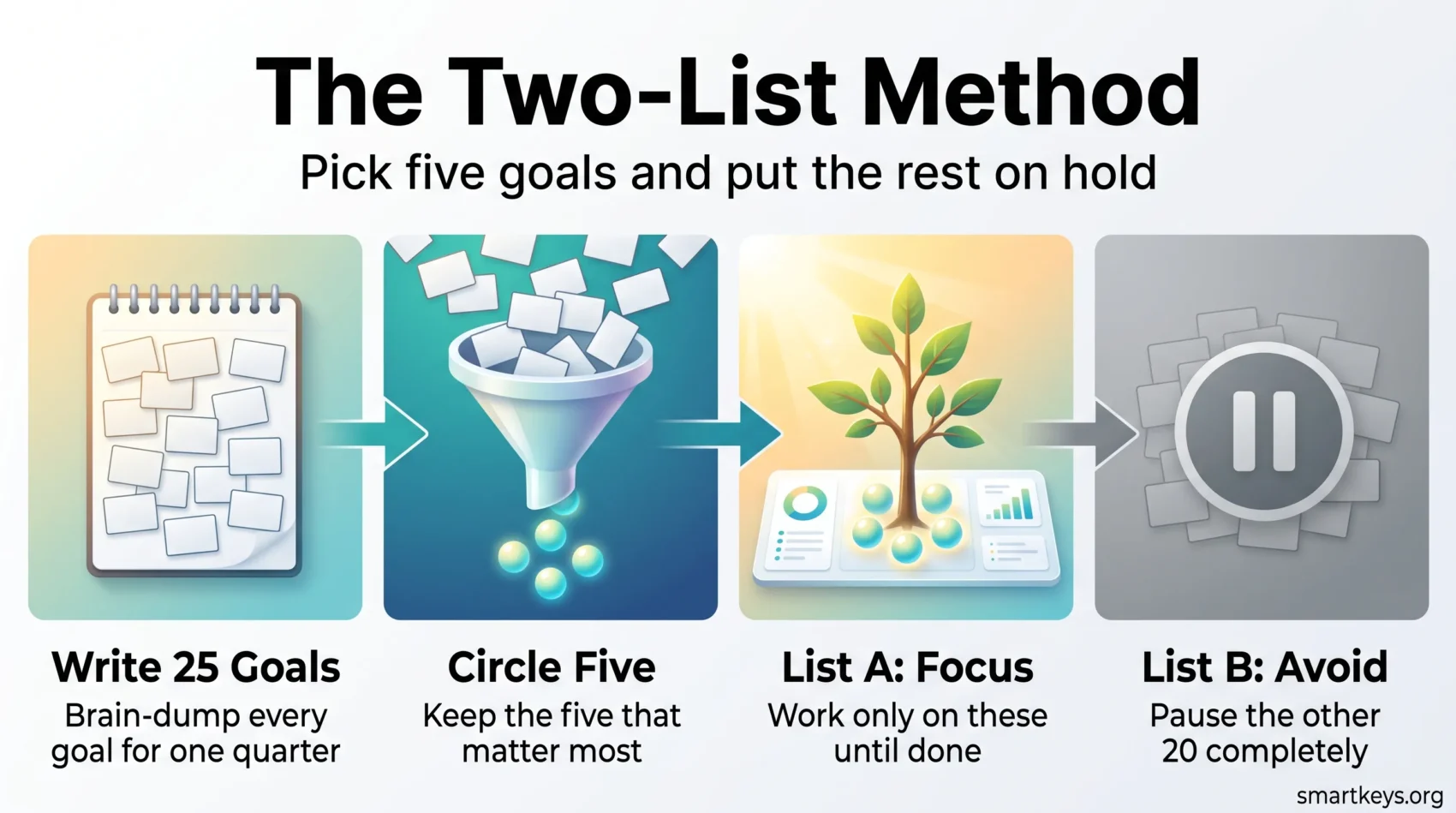
You can only finish a few things well at once. The two-list method is a simple way to decide which few. You write down every goal you are carrying, pick the small number that matter most, and treat everything else as off limits until those are done.
That second step is what makes the method unusual. Most planning systems rank your tasks, and our broader guide to prioritization covers the common ways to do that. This one asks you to actively refuse the ones that did not make the cut, even the genuinely good ones. The list of rejects has a name: the avoid list.
The method is usually told as a Warren Buffett story. That attribution does not hold up, as we explain below. The technique still works, for a reason unrelated to who invented it: committing to one goal makes competing goals easier to ignore.
Key Takeaways
- Write out roughly 25 goals, then circle the five you would keep if you could keep only five.
- The other 20 go on an avoid list. They are not a someday pile, they are a no until the top five are finished.
- The popular Warren Buffett origin story is not accurate. Buffett said publicly he cannot recall ever making such a list.
- Research on goal shielding explains why the method helps: a committed goal suppresses awareness of rival goals.
- The method fits self-directed work best. If most of your day is assigned to you, use it for the part you do control.
What the two-list method actually is
The method has four steps and takes under an hour.
You write down about 25 goals for a chosen time frame. You circle five. You copy those five onto List A. The remaining 20 go onto List B. Then you work only on List A until it is done.
List B is the part people get wrong. It is not a backlog you dip into on a slow afternoon. It is a list of things you have decided not to do yet, precisely because they are appealing enough to steal time from List A.
An example makes the difference clear. Say you run a small consultancy. Your List A holds “land three retainer clients,” “ship the client portal,” and “cut invoice chasing to under an hour a week.” Your List B holds “start a podcast,” “get certified in a new platform,” and “speak at two conferences.” None of those is a bad idea. Every one would make a quarter look productive. That is the problem: they compete with List A for the same hours, and they are easier to start.
Where the story comes from, and why the Buffett attribution fails
The usual version goes like this. Mike Flint, Warren Buffett’s personal pilot for ten years, listed his top 25 career goals. Buffett told him to circle five. Flint said he would start on the five and chip away at the other 20 in his spare time. Buffett corrected him: the other 20 are your “avoid at all cost” list, and you do not touch them until the top five are done.
It is a good story. The evidence for it is thin.
The anecdote appears to trace back to a 2013 blog post by Scott Dinsmore of Live Your Legend, who described hearing it secondhand from someone connected to one of Buffett’s pilots. No primary source has surfaced since. More importantly, Buffett was asked about the rule directly at the 2013 Berkshire Hathaway shareholders meeting by author Alex Banayan. Buffett’s answer, as Banayan reported it, was that he was curious how Banayan had come up with it, and that he could not recall making a list in his life.
So treat the origin story as folklore. The line most often attributed to Buffett is broader: really successful people say no to almost everything. Inc., Yahoo Finance and Money have all quoted it without giving an occasion, so even that is best read as a repeated maxim rather than a sourced quotation.
None of this makes the method worthless. It means you should adopt it because it works for you, not because a billionaire supposedly endorsed it. If you want a comparison of methods judged on their own merits, our overview of task prioritization frameworks sets several of them side by side.
Why cutting the list works: the evidence
There is real research behind the core idea, even if the Buffett wrapper is fiction.
Psychologists James Shah, Ron Friedman and Arie Kruglanski published a study in 2002 in the Journal of Personality and Social Psychology called “Forgetting All Else: On the Antecedents and Consequences of Goal Shielding.” They found that when people commit strongly to one goal, competing goals become measurably less accessible in memory. The mind quietly dims the alternatives. The effect was stronger in people who felt more committed to the focal goal.
In plain terms: choosing is not just an administrative act. Naming a small set of goals changes how loudly the other options call to you. A list of 25 open ambitions keeps all 25 partly live in your head. A list of five does not.
A second study helps explain why writing List B down beats simply trying to forget those items. Roy Baumeister and E. J. Masicampo showed in 2011, also in the Journal of Personality and Social Psychology, that unfinished goals keep intruding on thought until you make a specific plan for them. The plan, not the completion, is what quiets the intrusion. An avoid list is a plan of sorts: you have decided what happens to those 20 items, which is nothing, for now. Our guide to open loops covers that mechanism in more detail.
How to run it, step by step
1. Pick a time frame before you write anything
“Lifetime goals” sounds impressive and produces useless lists. A quarter or a year gives you goals concrete enough to act on this week. If you have never done this, start with a quarter.
2. Brain-dump about 25 goals
Set a timer for 20 to 40 minutes and write without editing. Mix work, career and personal items, because the trade-offs between them are the ones that actually bite. If a blank page stalls you, our brain dump technique walks through the capture step.
Twenty-five is a guideline. Eighteen honest goals beat 25 padded ones.
3. Circle five
Ask one question of each item: if this were finished and nothing else on the list were, would the quarter have been worth it? Five is the working number because it is small enough to force real trade-offs and large enough to cover more than one area of your life.
Write a done criterion next to each of the five. “Improve marketing” is not a goal you can finish. “Publish eight articles and get the email list to 500 subscribers” is.
4. Split into List A and List B, and defend the split
List A goes somewhere you see it daily. List B goes directly underneath it, visible, labelled as paused. Seeing the paused items is the point: it reminds you that saying no to them was a decision you made on purpose, not an oversight.
Then convert each List A goal into one next action you could start tomorrow. A goal you cannot start is a goal that will not move. The next action mindset covers how to phrase those so they are genuinely actionable.
Turning the lists into a working week
The lists do nothing on their own. What makes them stick is a weekly rhythm and protected time.
Book two blocks of at least 90 minutes each week for List A work, and treat them like meetings with a client. Time blocking is the mechanism; the deep work guide covers how to protect those blocks once they are in the calendar.
Schedule the hardest List A work in your best hours. Most people have a few hours a day when difficult thinking is genuinely easier, and spending those on inbox triage is expensive. Our piece on managing energy rather than time explains how to find yours.
Pick one List A item as the day’s daily highlight, so there is a single thing that has to happen even on a bad day.
End the week with a short weekly review: what moved on List A, what quietly crept in from List B, and what the coming week’s blocks are for. A monthly review is the right place to ask the bigger question of whether the five are still the right five.
Where the method fails
Being honest about the limits is what keeps you from abandoning the method in week three.
It assumes you control your calendar. If most of your work is assigned by someone else, a five-goal list for your whole job is fiction. Apply it to the slice you do control, which might be one afternoon a week, and accept that the rest is reactive. The distinction between proactive and reactive work is worth mapping before you start.
It handles goals, not daily tasks. The two lists tell you which projects deserve your quarter. They say nothing about what to do at 2pm on Tuesday. Pair them with a daily method: the Ivy Lee method or the 1-3-5 rule both work for that layer.
Five is arbitrary. There is no research showing that five is the correct number. If your goals are large, three may be all you can carry. The principle is “far fewer than you wrote down,” not “exactly five.”
A rigid avoid list can cost you. Circumstances change, and a genuinely time-limited opportunity may deserve to break the rule. The safeguard is a standing rule rather than improvisation: an item only leaves List B if you first move something off List A. That keeps the count honest and stops the sunk cost trap from holding a dead goal in place.
Common mistakes
Letting List B leak into the calendar. It rarely arrives as a grand new project. It arrives as a 30-minute “quick look” that becomes a Thursday. The defence is a single test before anything gets scheduled: does this move a List A goal? If not, it does not get a slot. Our guide to saying no has language you can reuse when the request comes from a colleague.
Naming too many top goals. Eight priorities is not a priority list, it is your original list with a haircut. If you cannot cut to five, your goals are probably too big; break them down first using the approach in tackling big projects.
Moving the goalposts. Writing the done criterion before you start is what stops a goal from quietly expanding until it can never be finished.
Rewriting the lists instead of working on them. Reorganising feels like progress and is not. Set the lists once, review them weekly, and leave them alone in between. That failure mode gets its own treatment in productivity pitfalls.
Ignoring the boundaries the lists imply. A five-goal quarter only works if other people can predict what you will and will not take on, which is a question of setting boundaries rather than willpower.
Conclusion
The two-list method is one decision repeated: pick a few goals, write down what you are giving up to pursue them, and hold the line for a fixed period.
Its value is not that Warren Buffett used it, because the evidence says he did not. Its value is that naming a small set of commitments makes the alternatives genuinely quieter, which is what the goal shielding research describes, and that an explicit avoid list turns vague good intentions into a decision you can point at when something tempting shows up.
Start this week. Pick a quarter, write your goals, circle a handful, and put the rest somewhere you can see them. Then look at your calendar and find the first block. If you want to build the surrounding habits, our goal setting guide and our guide to using to-do lists effectively cover the layers underneath.
Found this useful?
Make SmartKeys a preferred source on Google, and our articles will surface more often in your Top Stories, AI Overviews, and AI Mode.
Add as Preferred Source