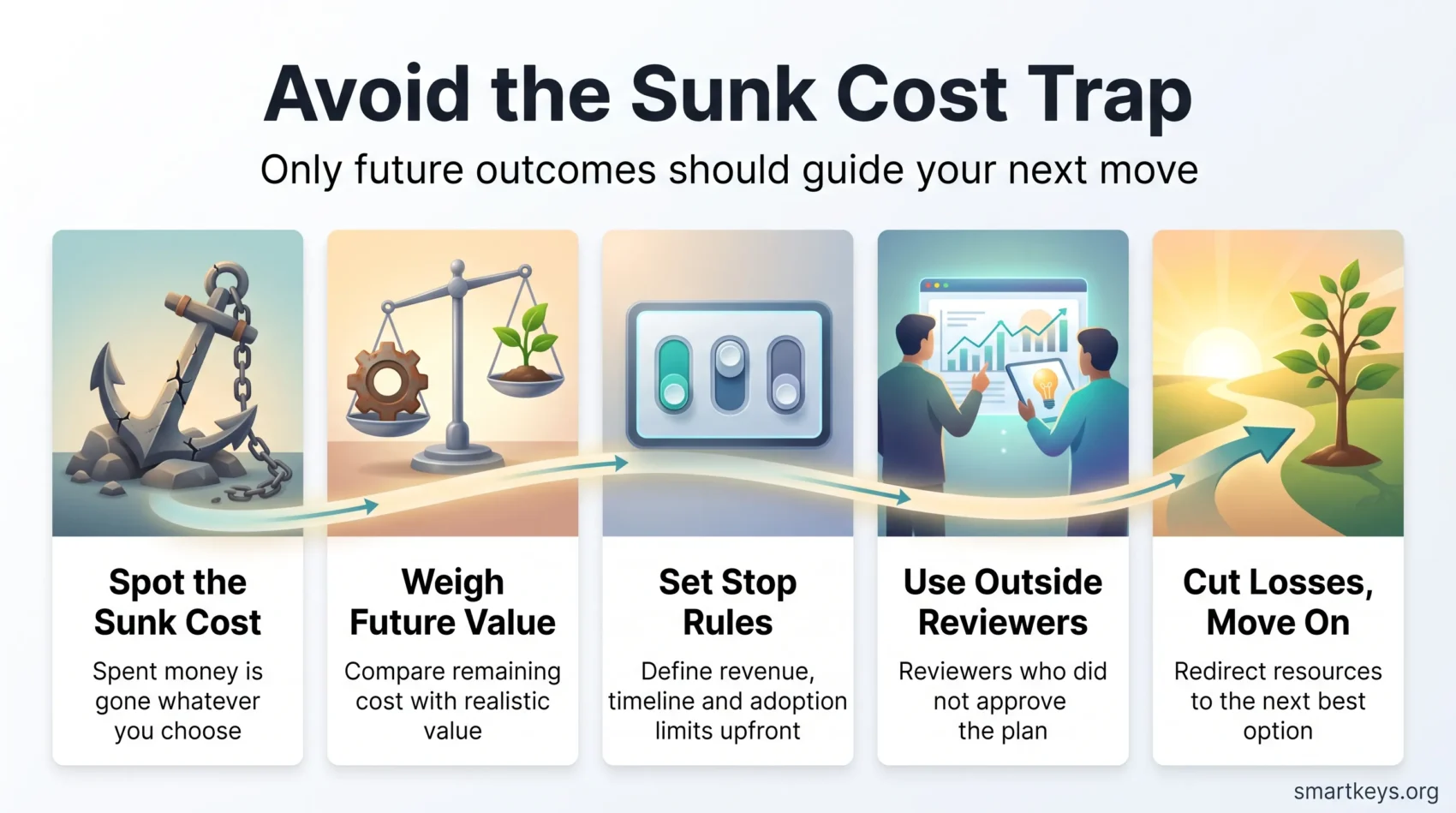
You don’t have to keep throwing good resources after bad. In economics, a sunk cost is money, time, or effort you have already spent and cannot get back. Because it is gone whatever you decide next, it should not shape your next move. Economists call that the bygones principle: only future outcomes count.
Picture a project that has already absorbed $30 million. A fresh forecast now shows the finished result is worth less than the money still needed to complete it. The rational choice is to stop, uncomfortable as that feels. The same logic runs through ordinary life, where tickets, subscriptions, and courses all tempt you to stay put. A short guide on delegating work frees up the focus that good decisions need.
Key Takeaways
- Judge every option by what it delivers from now on, not by what it already cost.
- Stop when projected value falls below the remaining cost to finish.
- The trap shows up in factories, software budgets, and careers alike.
- Escalation is predictable: responsibility, framing, and stress all make it worse.
- Written stop rules and outside reviewers beat willpower every time.
What Is a Sunk Cost? The Bygones Principle and Rational Decision Making
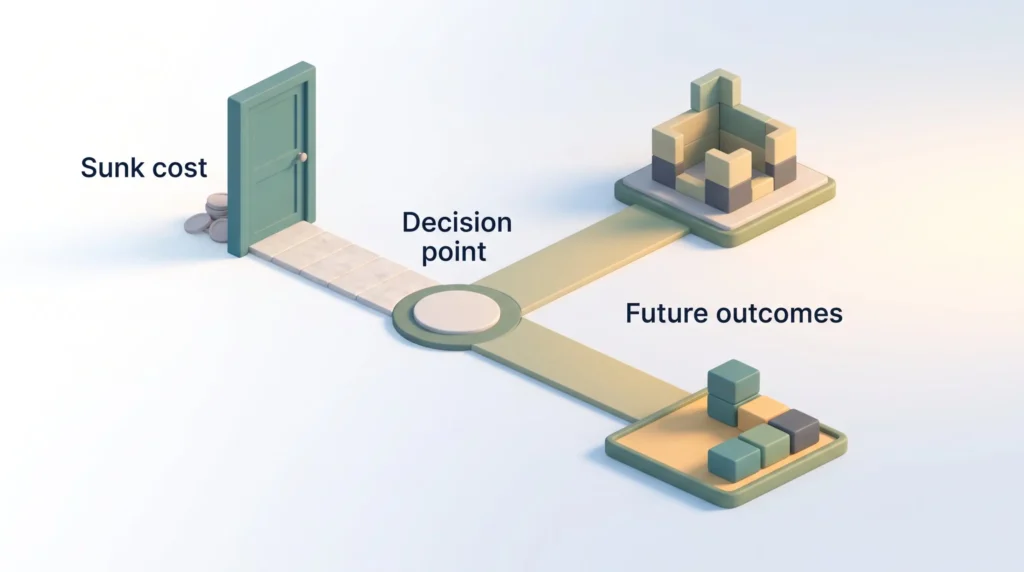
Think of past spending as a closed door. Your choices concern only the rooms you can still walk into.
Definition: why past expenditures are irrelevant to future choices
A sunk cost is an outlay you cannot recover, whatever you decide next. It is the same number under every option in front of you. Something identical on both sides of a comparison cannot make one side better, so it cannot decide anything. That is the whole argument, and it holds however large the number is.
The bygones principle and separability in decision trees
A decision tree simply maps the choices ahead of you, one branching point at a time. Separability means that the choice at each branching point depends only on what lies ahead of it, never on the path that brought you there. If your reasoning needs the history to justify the next step, the history is doing work it has not earned.
“Choose based on what lies ahead, not what has already occurred.”
Prospective vs. retrospective costs in business and life
Prospective costs are the ones you can still avoid. Retrospective costs are already gone. Say demand drops after you have built a factory. Compare the money still to be spent against the updated value of what the plant will produce, then add whatever selling or repurposing the building would recover. Clean cash flow management makes that comparison easier to run honestly.
Fixed, variable, and why sunk costs belong in their own column
Unrecoverable outlays behave differently from fixed and variable items, so keep them apart. A custom installation no buyer wants is largely sunk. A service contract is fixed but often cancellable. Energy use falls the moment you switch the line off. Once you know which licences and capacity you can actually recover, cloud cost optimization becomes a decision problem rather than a haggling exercise, and finance automation gives you current numbers fast enough to act on.
The Sunk Cost Fallacy: How Smart People Get Stuck
A small, sensible investment can harden into an obligation once past spending drives the choices. You end up defending what you already did instead of weighing what you would gain next.
From escalation to entrenchment
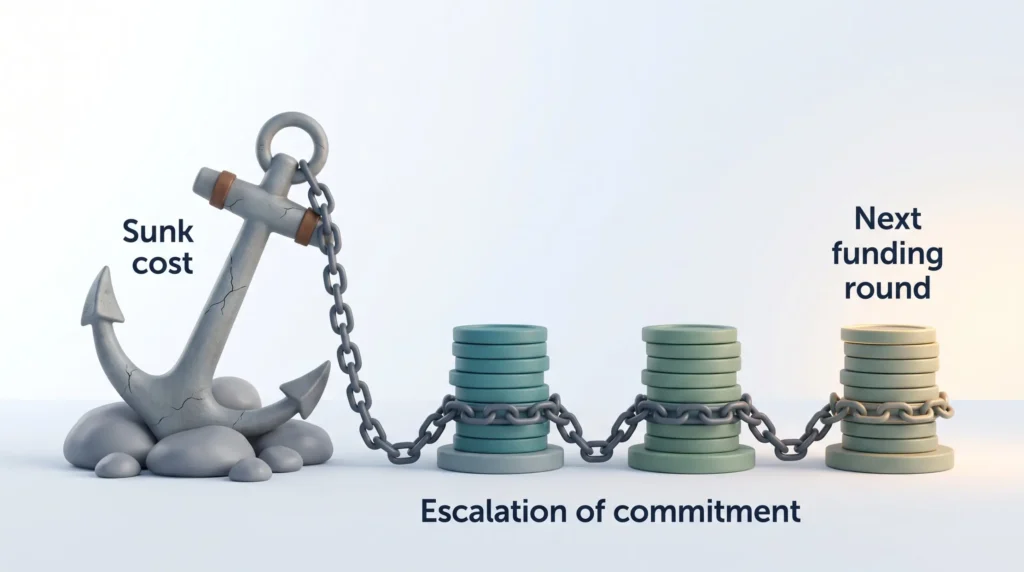
The sunk cost fallacy is the habit of letting money already spent decide what you do next. It usually arrives as escalation of commitment, the pattern where each new round of funding is justified by the rounds before it. You keep going because stopping feels like failure, not because the numbers support it. A documented risk management framework helps the way a checklist helps a pilot. It puts the reassessment on the calendar before anyone’s pride is involved.
Concorde as the textbook example
The Concorde fallacy is named after the Anglo-French supersonic airliner that Britain and France kept funding long after the commercial case had collapsed. It flew scheduled services from 1976 until 2003 and never came close to repaying its development cost.
Why cutting losses is hard
Admitting a bad bet hurts. You may fear blame, or want to look steadfast in front of people whose opinion you value. Organisations amplify this, because the person who approved the plan is often the one asked whether it should continue. Regular one-on-one check-ins give people a lower-stakes place to voice doubts before they harden into silence.
“Escalation happens when defending the past outweighs choosing the best future option.”
- Watch for the moment the argument shifts from future benefits to past spend.
- Compare remaining cost against a realistic forecast, not the original business case.
The Psychology Behind the Sunk Cost Effect
None of this is stupidity. Framing and emotion quietly nudge capable people toward staying the course, and researchers have measured how.
Framing effects: how gain and loss framing skew your decisions
Wording changes what people pick. Present the same facts as a certain gain and most people take the safe option. Frame them as a certain loss and those same people gamble. Once you have spent money, stopping reads as a loss and continuing reads as a chance to recover. That is what keeps the sunk cost effect alive.
Overoptimistic probability bias after you have invested
Confidence rises the moment you commit. Robert Knox and James Inkster interviewed racetrack bettors just before and just after they placed a wager. Bettors rated their horse’s chances higher once the ticket was in hand, with nothing about the race having changed (Journal of Personality and Social Psychology, 1968). The same shift inflates your odds on a project the day after you fund it.
Responsibility, emotion, and cognitive load
Feeling responsible makes you pour in more. In Barry Staw’s 1976 experiment, students played a company’s financial officer and decided on follow-up research funding. They allocated an average of $11.08 million to a division they had backed themselves, against $8.89 million when a predecessor had made the original call (Organizational Behavior and Human Performance).
Stress and overload sharpen the effect. Cognitive load is simply the mental effort a decision demands, and when your bandwidth is gone the familiar option wins, because reassessing costs energy you do not have. Setting instant messaging boundaries, running a brain dump before a big call, and building your attention span all leave more room for the judgement itself.
Cross-species evidence
The pattern is not a quirk of corporate life. In a 2018 Science study, Brian Sweis and colleagues found that mice, rats, and humans all showed sensitivity to sunk costs in comparable waiting tasks. That places the effect in decision systems far older than spreadsheets.
“Let future outcomes guide your choice, not what you’ve already done.”
For related reading on how automation reshapes what people value at work, see automation and jobs.
Related Biases That Keep You on the Wrong Path
Sunk costs rarely act alone. Pressure and habit make sticking to the first plan easy, even after the evidence changes.
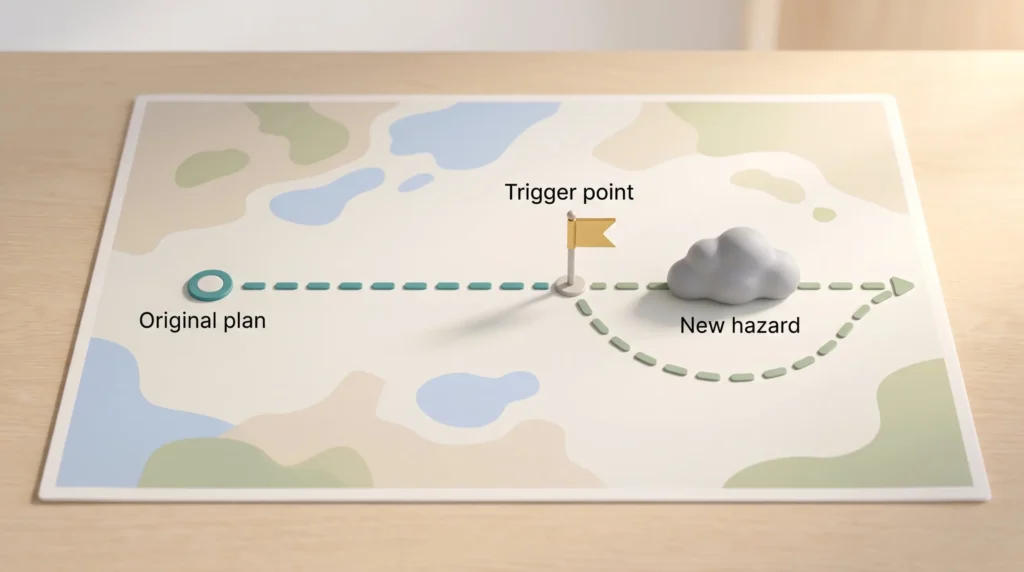
Plan continuation bias is the pull toward finishing the plan you started despite new hazards. Aviation has studied it most closely. A NASA review of 19 major airline accidents by Ben Berman and Key Dismukes found the bias apparent in at least nine of them. A Flight Safety Foundation task force reported that “press-on-itis” featured in 42% of the approach-and-landing accidents and incidents it reviewed.
Plan continuation in high-stakes contexts
The bias grows from two roots: optimistic success estimates and personal ownership of the plan. Under time pressure, teams freeze on the original intention instead of rebuilding their assessment from what they can see now. The fix is structural. Decide in advance what evidence would change the plan, and who is allowed to call it.
Planning fallacy, groupthink, and loss aversion
Three further biases usually travel with sunk costs. The planning fallacy, first described by Daniel Kahneman and Amos Tversky, produces timelines and budgets that quietly assume nothing will go wrong. Groupthink, the tendency of a group to converge on one view rather than risk friction, then suppresses the dissent that would correct them. Loss aversion, our habit of feeling a loss more sharply than an equivalent gain, makes admitting the earlier estimate was wrong hurt more than quietly spending more. Watch for the milder cousin too: productive procrastination, where a team stays busy around a doomed project instead of confronting it.
Practical prompt: before you press on, ask what new evidence would make you change course. If nobody can name it, build that trigger into the review process.
Real-World Examples: Business, Money, and Everyday Decisions
Everyday choices and large business moves share one trap: feeling tied to what you already put in. The test never changes. Does the next dollar, or the next hour, earn more here than anywhere else?
Factory shutdowns and corporate write-offs
Weigh future cash flows against liquidation or repurposing value, not the original build cost. If the line cannot earn its remaining costs, the write-off is the price of information, not a fresh loss. Firms that treat it that way tend to be capable of real business model innovation, because they can free capital from what is no longer working.
Software licences, subscriptions, and stalled pilots
This is where the trap shows up most often now. A team buys an annual licence, builds workflows around it, then defends the tool for the rest of the term because of what it paid. Stalled pilots work the same way. The prototype cost is gone either way, so the only question is whether the next phase deserves funding. Judge an AI augmentation pilot on measured results rather than its budget, and lean on explainable AI practices, because a system nobody can interrogate is hard to evaluate honestly.
Tickets, memberships, and the clean plate
If rain ruins the game, leaving early is rational when your evening is worth more than the remaining innings. A prepaid gym membership is the same. The payment is gone, so go when the workout is worth the trip, not to justify the fee.
Career pivots and emotional anchors
Years of study and the money behind them can make leaving a field feel like waste. Yet that spending is done either way, and what remains is the working life ahead of you. Shorter, targeted credentials have made these moves cheaper, which is part of why micro-credentials in hiring have gained ground with employers.
“Focus on what the next dollar delivers, not what you’ve already handed over.”
Sunk Cost: A Practical System to Cut Losses and Move Forward
A repeatable routine stops emotional attachment from turning small bets into long-term drains. The aim is a process that makes the future-value comparison automatic, so nobody has to be brave in the moment.
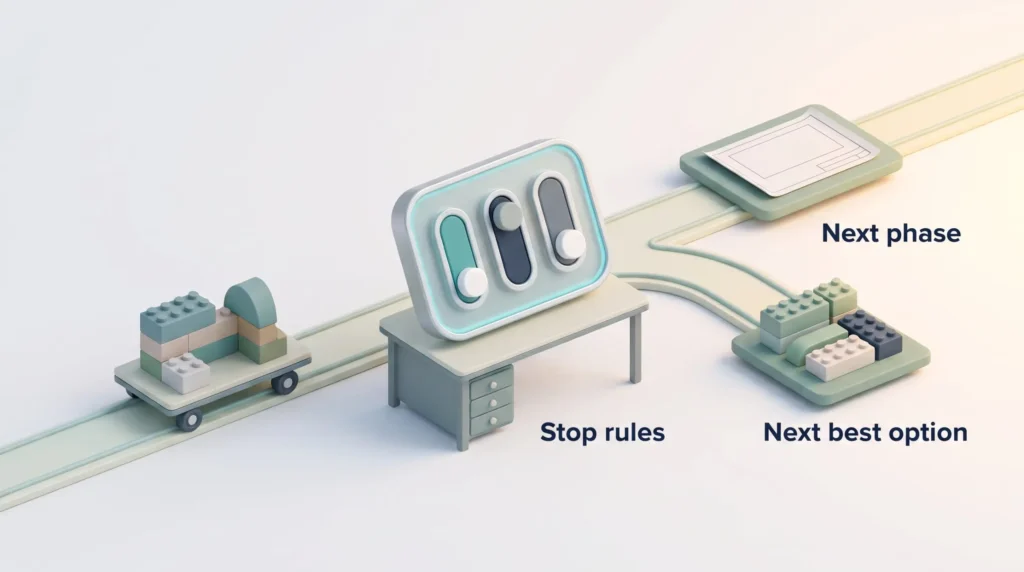
Focus on future value only: marginal analysis you can run today
Marginal analysis just means judging the next step on its own merits. At each checkpoint, compare the remaining cost to complete against a realistic estimate of what completion is worth, and against the best alternative use of the same resources. If the remaining cost is higher, accept the loss and stop. Writing the comparison down matters more than the precision of the numbers, because it forces the assumptions into the open.
Precommitment checklists and decision trees that enforce separability
Give every review point a short checklist that asks reviewers to ignore prior spend and re-enter current inputs. Simple decision trees help, because each branching point then stands on its own. Framing the review as a fresh problem, the way design thinking reframes a brief, keeps the conversation on the decision rather than the decider.
Designing stop rules and kill criteria before you start
Set objective thresholds in advance: a revenue floor, a timeline slip, an adoption rate. Write the rule down, record who owns the call, and hold to it. Tying thresholds to explicit targets, as a personal OKR framework does for goals, keeps them honest. And workforce contingency planning answers the question that stops most shutdowns cold: where do the people go next?
Delegating to data and outside reviews to reduce bias
Hand periodic reviews to dashboards, auditors, or reviewers who did not approve the original plan. The research on personal responsibility predicts the benefit: the further a reviewer sits from the original decision, the cleaner the call. Rotate reviewers, keep the ritual light, and consider outsourcing low-value work so your own reviews land on decisions that matter.
- Compare remaining cost against expected value and the next-best option.
- Use precommitment checklists and written stop rules to enforce separability.
- Keep documentation light and the decision calendar fixed.
Conclusion
Good judgment asks one simple question: what will this choice give me from here on out?
Marginal analysis, written stop rules, and reviews owned by someone other than the sponsor keep decisions tied to future value. Together they take the emotional charge out of the sunk cost fallacy. That makes changing course possible on a normal Tuesday rather than only in a crisis.
Final tip: document the rule you used, then act. Over time you waste less money and less time, and your team makes calmer, sharper calls.
Found this useful?
Make SmartKeys a preferred source on Google, and our articles will surface more often in your Top Stories, AI Overviews, and AI Mode.
Add as Preferred Source