You have a product that works and customers who pay for it. The question now is how to serve ten times as many without your costs, your team or your service quality falling apart.
Scaling means increasing what your business can deliver without increasing costs at the same rate. If doubling revenue means doubling headcount, you are growing. If it means adding one server and two support agents, you are scaling.
An MVP (minimum viable product, the smallest version of a product real customers will use) proves someone wants what you built. Scaling proves you can deliver it repeatedly, profitably and without the founders in every decision. This guide covers when to scale, what usually breaks first, how to design systems and teams that hold up, and how to pay for it without locking yourself into costs you cannot reverse. If you want the wider context first, our overview of the startup trends reshaping business in 2026 covers formation, funding and sector data.
Key Takeaways
- Scaling means serving more demand without a matching rise in costs. Growth alone does not qualify.
- Let measured signals trigger capacity changes: backlog, response times, error rates, not gut feeling.
- Keep spending variable as long as you can. Fixed costs are hard to unwind if demand shifts.
- Most failures trace back to cash and weak product-market fit, so protect both before you expand.
- A few strong hires and clear ownership add more capacity than a larger average team.
Why moving from MVP to market leader needs a different mindset
Early on, speed wins. Later, repeatability wins. In the first phase you are searching: changing the product weekly, talking to every customer, deciding things in a group chat. That works while the company is small enough for everyone to hold the whole picture in their head.
Once demand grows, the same habits become the bottleneck. Nobody knows who owns a decision. The same customer question gets three different answers. Work waits for a founder in another meeting.
Harvard Business School’s Jeffrey Rayport describes company building in three stages: exploration, where you look for product-market fit; extrapolation, where you scale what works; and exploitation, where the business turns durably profitable. In his HBR interview on the subject, he stresses that leaders who scale successfully put unusually heavy weight on cultural questions, not just on go-to-market and capital. That matches what founders report: the technical problems are solvable, the human ones decide the outcome.
Technical debt shifts too. It is the shortcuts you took to ship fast, which now cost extra time on every change. A quick fix is cheap when three people touch the code and expensive when thirty do. Pay some of it down as you build, and favour components that can be replaced or scaled one at a time.
“You move from founder heroics to enabling your team to repeat success without you in every decision.”
For the leadership habits that support this shift, see our guide to future leadership skills.
Scaling vs. growing: how to tell you are actually ready
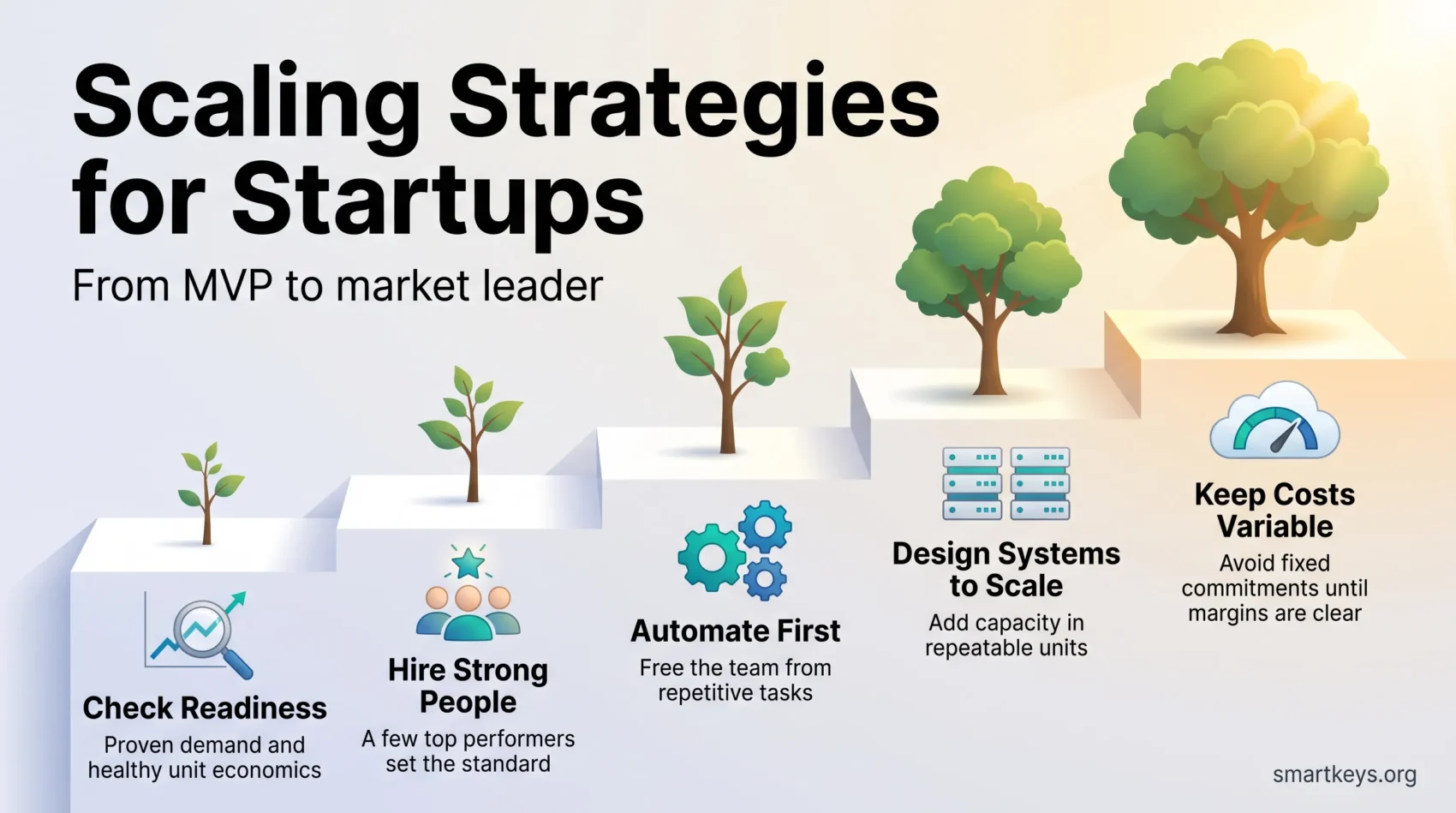
Before you add people or servers, check that more output does not automatically mean proportionally more cost. That check separates real scale from expensive growth.
Unit economics is the phrase for this: what one customer costs to win and serve, against what they pay you over time. If that gap is negative, more customers make the problem bigger.
Readiness signals worth trusting
Use evidence rather than a rule of thumb. Good signs: revenue that has held its trend across several quarters rather than one strong month, onboarding that runs the same way every time, and a support load growing more slowly than your customer count.
Pressure signals are just as telling: a pipeline you cannot work through, delivery dates you keep missing, a team permanently at capacity. Those mean demand has outrun throughput, and hiring alone will not close the gap fast enough.
What the failure data actually shows
CB Insights reviewed 431 venture-backed companies that shut down from 2023 onward. Running out of capital was cited in 70% of cases and weak product-market fit in 43%, with bad timing at 29% and unsustainable unit economics at 19%. The report makes an important point about the first figure: running out of money is usually the last event, not the root cause. Something else went wrong first, and the funding stopped because of it.
The practical reading is simple: do not treat scaling as the fix for a product people are lukewarm about. It multiplies whatever you already have, weaknesses included.
Two ways to add capacity, with different trade-offs
- Hiring more people: covers a market faster, but adds fixed cost and months of onboarding before the new hires are productive.
- Automating or buying tools: keeps cost variable and lifts output from the same team, but only where the task is repetitive and well defined.
- Vertical scaling: giving one machine more power. Quick, and limited by the largest machine you can buy.
- Horizontal scaling: adding machines that share the work. More effort up front, but it removes the ceiling and survives one machine failing.
“Size the gap between demand and your team’s throughput, then choose the mix of people and tech that protects margins.”
People, processes and culture: building a core that holds
Invest in people and habits now, so the company absorbs more work later without constant firefighting.
Raise the hiring bar early. McKinsey’s research on talent found high performers are roughly 400% more productive than average ones, and in highly complex roles such as management and software development the gap widens to around 800%. A small group of strong hires sets the standard for everyone who follows, and tends to attract others like them.
Make culture concrete
Write down the behaviours you expect, not slogans. “We answer customer emails within one working day” is a behaviour. “Customer obsession” is a poster. Behaviours can be taught, referenced in feedback and noticed when they slip.
For distributed teams this matters more, because none of it is absorbed by sitting near each other. Our guide to remote onboarding and training covers how to transfer context deliberately.
Structure and delegation
Specialised roles and clear ownership move work faster than a team where everyone does a bit of everything. Name the person who decides, not just the person who does. Founders who struggle here usually need practice more than permission, which is what our guide to delegation is for.
Keep feedback short and frequent rather than annual. Continuous performance management catches misalignment while it is cheap to fix and makes retention problems visible early; our overview of talent retention strategies covers what moves the needle beyond pay. If you are considering software to screen candidates, read our guide to AI hiring tools first, because several jurisdictions now regulate how these systems may be used.
Speed with discipline
Track technical debt in the open. Keep a short register, give each item an owner, and clear the worst of it alongside feature work. Debt nobody has written down does not get paid, it just gets more expensive.
“A few exceptional hires multiply impact; structure and processes let that impact scale without founder bottlenecks.”
Systems and data: technology that keeps up with demand
Start with measurable load signals and clear boundaries between the parts of your system. Vertical scaling suits components that cannot be split. Horizontal scaling suits services that can run as several copies, which also makes them more resilient.
Two design habits do most of the work. The first is keeping services stateless: no single server holds information only it knows, so session data lives in a shared cache or database and any copy can answer any request. The second is loose coupling, where parts communicate through queues rather than calling each other directly, so a slow component creates a backlog instead of a cascade of failures.
If you are choosing an architecture now rather than inheriting one, our explainer on cloud-native architecture covers the trade-offs, and our overview of cloud computing trends sets out where the platforms are heading.
Autoscaling, with guardrails
Autoscaling means the platform adds or removes capacity automatically based on a signal you choose. It works well when that signal reflects real pressure, and badly when it does not.
- Pick a metric that tracks the queue of work: pending requests, message backlog, response time. CPU alone reacts too late.
- Set an upper and lower bound, so a runaway loop cannot spend your budget overnight.
- Delay scaling back down, so capacity does not flip on and off during a normal traffic wobble.
- Group resources that grow together into repeatable units, then add whole units rather than tuning pieces.
Microsoft’s Azure Architecture Center documents these patterns in detail, including deployment stamps and competing consumers for background work. The principles apply on any major cloud.
Capacity that scales automatically also bills automatically, which is how cloud invoices surprise people. Our guide to cloud cost optimization covers the controls worth setting up early, and business intelligence tools turn data spread across several systems into something a weekly review can act on.
“Design for small, measurable steps, then grow capacity in repeatable chunks.”
Scope: choosing which growth opportunity to take next
Pick one direction at a time. Companies rarely fail because they chose the wrong expansion. They fail because they chose three at once and did none properly.
Extend what exists, or build something new
Extend first when a new region or a new type of customer is asking for the product you already have. Delivery model, support material and pricing mostly carry over, so the cost of trying is low. Our framework for expanding into new markets covers what usually needs adapting anyway, and our go-to-market strategy playbook covers how to launch it.
Build something new when existing customers keep asking for an adjacent capability and would pay for it. Pilot it with a handful of accounts before committing engineering quarters. If growth comes mainly through the product rather than a sales team, our product-led growth playbook covers expansion in that model.
Balance speed and scope
Schedule short debt-reduction blocks around each launch, so fragile parts of the system stop capping growth without halting progress for a quarter.
Rank opportunities with real numbers: how many customers asked, what they would pay, what serving them costs. Avoid large fixed commitments, such as your own warehousing or long leases, until demand and margins are clear.
Funding and cost structure in 2026
Tie every funding decision to a constraint you can name. If you cannot say which bottleneck the money removes, the round is buying time rather than capacity.
The current funding picture is easy to misread. Crunchbase recorded a record $510 billion in global venture funding in the first half of 2026, but more than 70% of second-quarter capital went to AI companies, and two of them, OpenAI and Anthropic, took $217 billion, or 43% of the half-year total. Headline abundance and your own prospects are different things: for most founders, growth still has to be funded largely by their own economics. Our review of startup funding trends covers where access has narrowed, and our piece on the shift away from growth at all costs covers what investors now expect to see.
Keep costs variable for as long as you can
Prefer variable spending over fixed until the unit economics are proven. Cloud services, contractors and third-party providers can be scaled back in a month. A signed lease, an owned facility or a large permanent team cannot.
That is why cash discipline matters more during a growth phase than it feels like it should, and why cash flow management deserves the same attention as revenue. Where you need capacity without permanent headcount, an on-demand workforce of freelancers and contractors is often the cheaper way to test whether a role is really needed.
- Buy or build: decide in advance what evidence would justify turning a variable cost into a fixed one.
- Spend on the real constraint: fund the bottleneck that is actually limiting output, not the loudest request.
- Hold a buffer: keep enough cash that you can slow down deliberately rather than being forced to.
“Use capital to enable proven capacity, not to subsidize experiments that hide weaknesses.”
Customer experience and operating cadence
Map every handoff from first enquiry to renewal, then check which ones break under volume. Quality usually slips at the joins, not inside the individual steps.
Write down the path a customer travels: enquiry, sale, onboarding, support, renewal. Give each stage an owner and a target. That makes bottlenecks visible and stops the same question getting different answers. Since keeping an existing customer is almost always cheaper than winning a new one, our guide to customer retention is worth reading before you spend more on acquisition.
Test capacity before you need it
Run load tests ahead of known peaks rather than discovering the ceiling during one. Move heavy work such as report generation, exports and image processing into background jobs, so a slow task never blocks the page a customer is waiting on.
Set a rhythm for spotting problems early
Give the operating calendar three layers: a weekly look at what is stuck, a monthly review against targets, and a quarterly decision point for anything architectural. Attach thresholds to your dashboards, so a metric crossing a line starts a conversation instead of being noticed three weeks later.
Scaling steps you can apply this month
Start with the work that frees your team. Automating routine tasks in HR, finance and sales support adds capacity without adding cost.
Automate the repetitive layer first
Automated payroll, invoicing that flows into bookkeeping and templated onboarding remove hours of manual handoffs weekly. Our overview of hyperautomation covers how to sequence this beyond single-task tools.
Where a workflow needs building rather than buying, low-code platforms let operations staff assemble it without engineering time. Past a handful of systems, an iPaaS integration layer, a service that keeps data in sync between applications, saves more effort than another point-to-point connection.
Plan with scenarios rather than a single forecast
Model what happens at your current demand, at double it and at half of it. For each service, note where it breaks and what raising that limit would cost. This turns a surprise outage into a planned decision.
Set a small number of KPIs that connect the parts
Pick a handful and review them weekly: time to hire, onboarding time for a new customer, gross margin per customer, and retention. Four numbers people actually look at beat twenty on a dashboard nobody opens.
- Quick win: automate one HR task and one finance task this month.
- Plan with data: run a scenario test for a threefold demand spike.
- Pilot, then extend: move one service to a managed platform, and outsource one back-office function in parallel.
Conclusion
Scaling works when your people, your systems and your cost structure move together. Each one can cap the other two.
Let the stage you are actually in decide what to work on. If product-market fit is still uncertain, more capacity makes the problem more expensive rather than smaller. If it is solid, the constraint is usually throughput, and the fix is a mix of automation, clearer ownership and architecture that grows in repeatable steps.
Pick one market or one new capability at a time, test demand cheaply, and expand only when the numbers justify it. Keep spending variable, keep the customer path documented, and keep a small set of metrics everyone reviews. That is what lets a company handle far more demand without the experience, the margins or the team quietly degrading.
Found this useful?
Make SmartKeys a preferred source on Google, and our articles will surface more often in your Top Stories, AI Overviews, and AI Mode.
Add as Preferred Source