An on-demand workforce strategy is a written plan for which work you keep on the payroll and which work you buy in from freelancers, contractors and agencies when you need it. It is the difference between hiring a specialist because a project is stuck, and knowing in advance which projects will need one.
Most companies already use external talent. Far fewer have decided the rules for it. Budgets get approved by whoever happens to sign, contracts vary by department, and nobody can say afterwards whether the money bought speed or headcount by another name.
ManpowerGroup’s 2026 US Talent Shortage Survey, based on responses from more than 6,000 US employers collected in October 2025, found 69% reporting difficulty finding skilled talent, down slightly from 71% a year earlier but still close to record levels. On the other side of the market, MBO Partners counted 72.9 million independent workers in the US in its 2025 State of Independence report, with 5.6 million of them earning more than $100,000 a year and around 80% intending to stay independent. The specialists exist. The question is whether your company can reach them quickly and engage them legally.
This guide covers what the model looks like in practice, how to map your gaps before buying anything, how to source and onboard without adding weeks, what changed in worker classification law in 2026, and which numbers show whether it is working.
Key Takeaways
- Decide in advance which work stays in-house and which is bought in, instead of improvising per project.
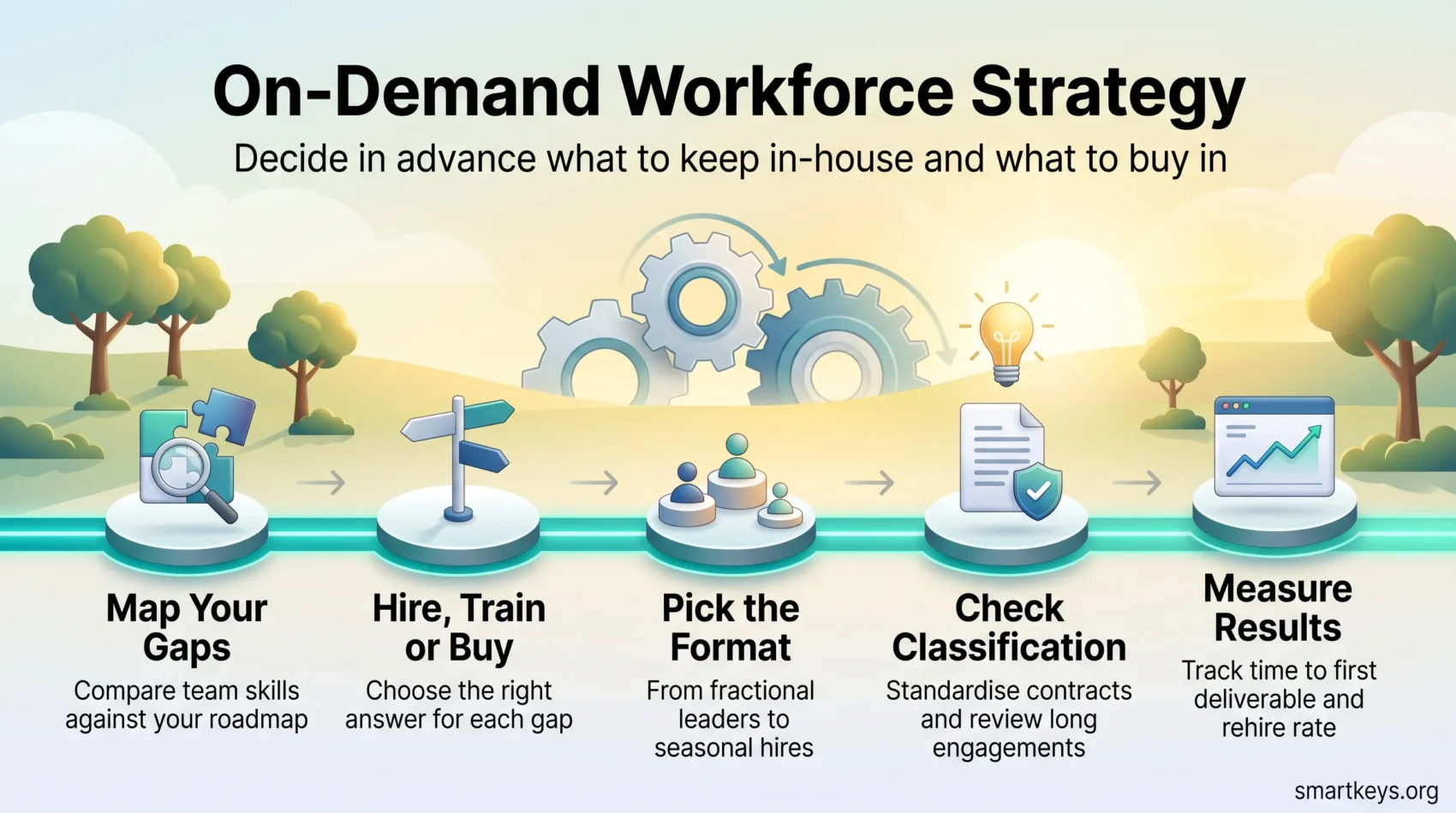
- Map internal skills against your roadmap first. The gap list tells you what to buy.
- Match the engagement format to the need: fractional leader, project specialist, delivery team or short-term hire.
- Worker classification rules moved in 2026 in both the US and the EU, so review contracts before you scale.
- Track time to first deliverable and rehire rate, not just time to hire.
What an on-demand workforce actually is
An on-demand workforce is the pool of people who do work for your company without being on the payroll. They are engaged for a defined scope, a fixed period or a set number of hours, and the relationship ends when the work does.
The label covers several formats that behave very differently. Treating them as one category is the most common planning mistake: a fractional finance chief and a freelance video editor need different contracts, onboarding and oversight.
The formats and what each one is for
- Fractional executives: an experienced CFO, CTO or CMO for one or two days a week. Useful when a company of forty needs senior judgment but cannot justify a full salary.
- Project consultants and freelance specialists: a named individual with a defined deliverable, such as migrating a billing system or producing a compliance report.
- Delivery teams: a small agency or pod that arrives with its own project manager. Right when you need output rather than extra hands to supervise.
- Interim managers: cover for a departure or parental leave, usually on a monthly retainer, so a function keeps running while you recruit.
- Short-term and seasonal hires: capacity for a known peak. Often the cheapest option, and often the one people forget to plan.
Our overview of how businesses hire on-demand talent in 2026 covers the wider market, and current freelancing trends looks at the same shift from the worker’s side.
Blended beats fully flexible for most companies
A fully flexible model, where almost nobody is permanent, works for a handful of project-based businesses and fails for everyone else.
The reason is institutional knowledge. Someone has to remember why the pricing model changed two years ago, or which customer contract carries an unusual clause. That is worth paying to keep.
The blended model keeps core work on staff and buys in what is specialised, temporary or unpredictable. A useful test: if the work will still exist in the same form in three years and needs context that takes months to build, hire for it. If it is a one-off, a peak, or a skill you need twice a year, buy it.
Start with a gap map, not a shopping list
Before you contact a single platform, write down what you have and what your plan requires. The step takes a week and prevents most of the waste that follows.
Supply is an inventory of the skills already in the building, including the ones people use outside their job title. Demand is your roadmap for the next two to four quarters, translated into capabilities rather than headcount. Comparing the two produces a short list of gaps, ranked by which threaten a delivery date. A structured digital skills gap analysis is the quickest way to run this, and workforce analytics tools help if your headcount data sits in several systems.
Decide what each gap deserves
Not every gap should be bought in. Three answers exist, and the wrong one is expensive.
- Hire: the gap is permanent, central to the product, and worth the recruitment cost.
- Train: someone internal is close to the skill and wants it. Measuring upskilling ROI tells you whether this route actually pays back.
- Buy: the gap is narrow, urgent or seasonal, and the skill would go stale between uses.
If the same gap appears three quarters running, that is not a peak. It is an unfilled role, and the rolling contract usually costs more than a salary would.
Get leaders and delivery teams onto one plan
The classic failure is a finance team that sees contractor spend as a cost line to squeeze and a delivery team that sees it as the only way to hit a date. Both are reacting to the absence of a shared rule.
Fix it with three written decisions: who can approve an external engagement, up to what value, and against which budget. Then name someone in each function to own intake locally, so the model does not become a procurement bottleneck. It sits naturally alongside workforce contingency planning, since both answer the same question: what do we do when capacity moves suddenly?
“Speed comes from agreeing the rules before you need them, not from approving faster once you do.”
Sourcing and onboarding without adding weeks
The advantage of external talent disappears if engaging someone takes as long as recruiting. The delay sits in two places: building a shortlist, and getting the person productive once they sign.
Where to look
Marketplaces are fastest for defined, portable work such as design, development, writing and data. Curated networks and specialist agencies cost more but pre-vet, which matters when a bad hire gets access to customer data. Our guide to freelance talent platforms compares what each type is good at.
Your own alumni are the underrated source. Former employees and contractors who already know your systems can start on day one rather than week three. Keep a simple list of people you would rehire, with what they worked on and when.
AI matching tools rank candidates by skill and availability rather than keyword, which shortens the shortlist step. They also carry legal duties in several jurisdictions, so read what AI hiring tools require before switching one on.
Make the first week short
Time to first deliverable is the number that matters, and it is usually lost to access requests. Prepare a standing kit: a scoped brief, the tool accounts the role needs, a named internal contact, and one page on how decisions get made.
Borrow from your remote onboarding process rather than inventing a second one. If your managers have never supervised contractors, a short briefing pays for itself: managing freelancers is a different skill, mostly because you are buying an outcome rather than directing a day.
Treat repeat contributors as a bench
People who enjoyed working with you come back faster and cheaper than a fresh search. Pay invoices on time, give feedback that is useful rather than polite, and tell people when the next project is likely. The logic behind talent retention applies to repeat contributors too, and where a contractor proves themselves in a role that turns out to be permanent, the contract-to-hire route is a low-risk way to convert.
Classification and compliance changed in 2026
This is where a cost saving turns into a liability, and both sides of the Atlantic moved this year.
United States: the rule is being rewritten again
The Department of Labor published a proposed independent contractor rule in the Federal Register on 27 February 2026, with the comment period closing on 28 April 2026. It rescinds the 2024 rule and returns to the earlier framework, leaning on two core factors: control over the work, and the worker’s opportunity for profit or loss. Three secondary factors, skill, permanence and integration, apply when the core two disagree.
Two practical points follow. First, the proposal stresses that actual practice matters more than what the contract permits, so a clause saying a contractor may set their own hours counts for little if you set them in reality. Second, this is federal wage and hour law only. State tests are stricter in places: California’s ABC test treats a worker as an employee unless the company proves all three of its conditions, and the IRS applies its own test for tax.
Europe: the Platform Work Directive lands in December
The EU Platform Work Directive entered into force on 1 December 2024, and member states must transpose it into national law by 2 December 2026. From that date it creates a rebuttable presumption that people working through digital labour platforms are employees rather than contractors, with each member state applying its own classification test. The presumption covers employment law only, not tax, criminal or social security proceedings.
If you engage people in the EU through a platform, budget for the possibility that some of those relationships get reclassified. Our guide to gig economy regulation tracks how individual countries are implementing it.
Practical guardrails
- Standardise contracts by engagement type so a project brief cannot accidentally read like a job description.
- Use an employer of record when you enter a new country rather than issuing a contractor agreement and hoping. Compare providers in our global payroll guide.
- Review long-running engagements annually. Duration is what regulators notice first.
- Give managers a one-page rule on what they may direct, and who to call before making an exception.
“The cheapest compliance work is the contract you write correctly the first time.”
Controlling cost while buying expertise
Compare the real total before you commit. A senior contractor at a high day rate can still beat a permanent hire once you count recruitment, benefits, equipment and the months before a new employee is productive. The same rate is poor value if the work is routine and continuous.
Set rate bands by role so negotiation does not restart each time, and reserve premium rates for work with a clear payoff. Pay differences across locations create their own tension, covered in our piece on global pay parity, and cross-border engagements add coordination costs that managing cross-border teams goes through.
Measuring whether it works
Time to hire is the wrong headline metric, because it measures your paperwork rather than the result. Four numbers tell you more.
- Time to first deliverable: signature to something usable. It exposes onboarding friction that time to hire hides.
- Rehire rate: the share of contributors you would engage again, and the share who accept. A falling rate is an early warning about how your company treats external staff.
- Cost per outcome: total engagement cost against what it delivered, next to what an internal team would have spent.
- Gap recurrence: how often the same skill gap reappears. Persistent recurrence is a hiring or training signal, not a sourcing one.
Review these quarterly. Most companies already run continuous performance management internally, and extending the cadence to external contributors costs almost nothing.
Segment the results. External talent usually beats internal hiring on specialised, time-boxed work and loses on anything needing deep product context. Knowing where that line sits in your own company is the point of measuring at all. For next steps on adapting roles and automation, see our guide to job automation and adaptation, and for a deeper look at evolving gig trends that affect cost and sourcing, see our short guide on gig economy trends.
Conclusion
An on-demand workforce strategy is mostly a set of decisions taken in advance. Which work stays in-house. Who approves an engagement and up to what value. Which contract template fits which format. What you measure afterwards.
Start narrow. Take the two gaps most likely to delay something this quarter, decide whether to hire, train or buy each one, and run those engagements through a written process. Track time to first deliverable and whether you would work with the person again.
Conditions favour the approach: skilled talent stays hard to hire, and a large pool of independent specialists is available to companies that can engage them properly. The constraint is rarely supply. It is whether your own process moves quickly without creating a classification problem you notice a year later.
Found this useful?
Make SmartKeys a preferred source on Google, and our articles will surface more often in your Top Stories, AI Overviews, and AI Mode.
Add as Preferred Source