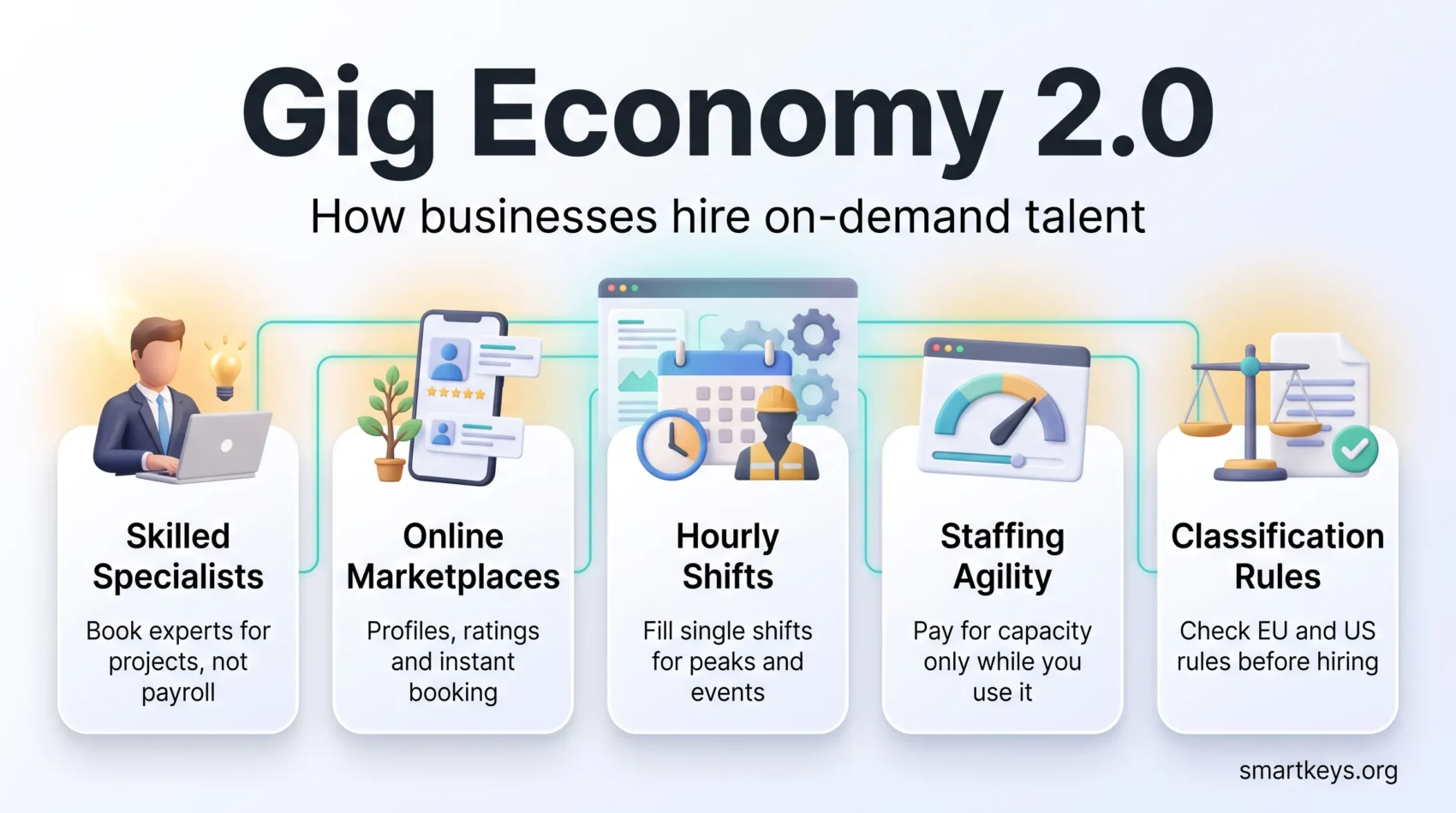
Gig Economy 2.0 is the second wave of on-demand work. The first wave ran on rideshare and delivery apps. The second runs on skilled independent contractors, hourly shift marketplaces and software that fills a job in hours instead of weeks.
For an employer, that changes one question. Which work needs a permanent hire, and which can you book only when you need it? A hotel staffing a banquet through a shift app is answering it. So is a marketing team hiring a freelance data analyst for six weeks.
This guide takes the buyer’s side: how large the independent workforce really is, how the platforms work, and which rules changed in 2026. For market size, drivers and the longer outlook, see our overview of the gig economy in 2030.
Key Takeaways
- MBO Partners counted 72.9 million American independent workers in 2025, of whom 27.6 million work independently full time.
- Almost half of independents who sell a service now find clients through an online marketplace, against 3% in 2012.
- Hourly shift platforms let you book single shifts, which suits hospitality, warehousing, events and healthcare.
- Skilled freelancing grows fastest where people pair domain knowledge with AI tools.
- Classification law tightened in the EU and loosened in the US during 2026, so the same worker may be treated differently in each market.
How Employers Find Gig Talent Today
Independent work is not new. What changed is how people find it. In 2012, only 3% of independents who sell a service found clients through an online talent marketplace. By 2025 that share had reached 49%, according to MBO Partners. Word of mouth gave way to searchable profiles, ratings and instant booking.

The total pool has barely grown. MBO Partners counted 72.9 million American independent workers in 2025, most of them occasional, and our gig economy data and outlook breaks that number down in full.
What matters for employers is the mix. The number of independents earning more than $100,000 a year rose from 4.7 million in 2024 to 5.6 million in 2025. Upwork’s 2026 Future Workforce Index, published in July 2026, found that more than a third of skilled US knowledge workers now freelance in some form, up from a quarter a year earlier.
The sector spread has widened too. Events, hospitality, warehousing and healthcare now book staff the way software teams have booked contractors for years. Where that supply sits is covered in our look at the global gig economy.
The Rise of Gig Economy 2.0
The first gig wave sold convenience to consumers. The second sells capacity to businesses. That shift explains why the work on offer looks so different now.
From Side Income to Specialist Supply
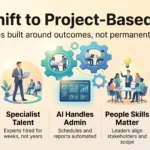
Early gig platforms mostly moved people and parcels. The same booking model now covers software development, design, financial analysis, clinical shifts and marketing. Upwork’s 2026 index describes a role it calls the AI orchestrator: a specialist who combines subject knowledge with AI tools and human judgment. Freelancers doing AI-related work on its marketplace earned 34% more per hour than those who did not.
That pattern cuts both ways. Simple generative work is being commoditised: contract volume for creative AI production grew 90% year over year, yet earnings per contract fell 13%. Complex, AI-augmented professional work moved the other way, with earnings up 45%. Our piece on freelancing trends covers the broader shift.
Why Employers Are Buying It
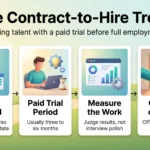
Three reasons come up repeatedly. Hiring cycles are slow, and a booked contractor starts in days. Some skills are too narrow to justify a salary, such as a compliance specialist you need twice a year. And demand is uneven, so a fixed headcount either sits idle or runs short. Many companies also use independent work as a trial period: the contract-to-hire model lets both sides test the fit first, and AI hiring tools now handle much of the screening.
Key Features of the Digital Gig Marketplace
A gig marketplace lists work, holds the payment and handles the paperwork between you and a self-employed worker.
Marketplaces such as Upwork, Fiverr and Toptal focus on project work. Shift platforms such as Instawork, Wonolo and Indeed Flex fill a specific block of hours. Both give you:
- A pool of pre-screened workers with ratings from previous clients.
- Escrow or automated payout, so you are not chasing invoices.
- Contract templates and tax forms handled by the platform.
- Matching software that shortlists candidates in minutes rather than days.
What you can buy spans creative services, technical work, operational shifts and professional advice. Our guide to freelance talent platforms compares the main options in detail.
The Worker’s Side of Gig Economy 2.0
Understanding the supply side makes you a better client.
Why People Choose Independent Work
People choose it mainly for control over when and where they work. That freedom is why the arrangement holds, and why many independents run several income streams at once, a habit described in our article on the polywork trend. Skilled independents also set their own rates and often charge more per hour than a comparable employee, because the rate covers unpaid time, insurance and equipment.
For you, the consequence is scheduling. A contractor is not on call. Agree response times and deadlines in writing, and treat them as any supplier commitment.
Income Instability and Missing Benefits
The lower half of the market tells a different story. Earnings swing with demand, a quiet quarter has no salary behind it, and many people take on more clients than they can serve well. That is where quality slips. Steady, recurring bookings cost you nothing extra and buy you reliability.
Independent contractors also have no employer-provided health insurance, sick pay or pension, and carry those costs themselves. This gap is now the main policy question in the sector, and several US states have started to answer it, as the section on 2026 rules below explains.
Benefits for Businesses in the Gig Economy 2.0
Used deliberately, on-demand talent gives you two things a fixed payroll cannot: reach and elasticity.
Access to a Global Talent Pool
You can hire a specialist wherever they live. A German manufacturer can book a Brazilian industrial designer for one product cycle without opening an office there. Paying that person legally across borders is the harder part, which is why global payroll solutions have grown alongside the platforms.
Cost Efficiency and Staffing Agility
The saving is not the hourly rate, which is usually higher. It is that you stop paying for capacity you are not using. You add people for a product launch or a seasonal peak, then scale back without a redundancy process. That only pays off if you plan it. Deciding in advance which roles stay permanent and which flex is the core of workforce contingency planning. A structured approach to sourcing, described in our guide to an on-demand workforce strategy, keeps the spending visible.
New Work Models Promoting Flexible Work
The most distinctive part of Gig Economy 2.0 is the shift platform. It does something freelance marketplaces never did: it sells a single shift.
How Hourly Shift Platforms Work
You post a shift with a date, a location, a role and a rate. Workers receive it as a notification and accept or decline from a phone. Matching software ranks candidates on past work, training and reliability.
Instawork, a larger US operator, reports a network of more than five million hourly professionals in North America and says it fills most shifts within a day. Treat vendor figures as claims, not audited data. The model is well established in hospitality, warehousing and events, and the same logic is moving into permanent teams, where intelligent shift scheduling matches employees to demand instead of a fixed rota.
Matching Workers with Local Opportunities
Shift work is local by nature. Someone has to be there, so platforms weight results by travel distance. That cuts commuting time for workers and means fewer no-shows for you. Not all frontline work needs to be on site, though. Remote monitoring and dispatch roles are growing, as our piece on remote blue-collar jobs explains.
What the 2026 Rules Require
Classification carries the real financial risk in gig hiring. The rules moved in opposite directions on each side of the Atlantic during 2026, so a single global policy no longer works. Our guide to gig economy regulation goes into the detail.
Europe: A Presumption of Employment
The EU Platform Work Directive entered into force on 1 December 2024. Member states must write it into national law by 2 December 2026. From that date, platform workers are presumed to be employees unless the platform shows otherwise. The presumption is rebuttable and defers to each country’s existing test, so the effect will vary by member state.
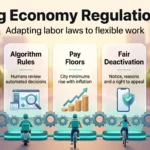
The directive also regulates automated decisions. Platforms must tell workers when AI is used, keep a human in charge of suspensions and terminations, and review those systems at least every two years. Those duties sit alongside the wider debate on algorithmic management.
United States: A Moving Target
Washington went the other way. On 27 February 2026 the Department of Labor proposed rescinding the 2024 independent contractor rule and restoring a modified version of the 2021 test, which gives more weight to control over the work and to the worker’s opportunity for profit or loss. The comment period closed on 28 April 2026.
Two points matter for planning. The proposal is not final. And the 2024 rule still applies in private lawsuits, even though the Department stopped enforcing it. State law can be stricter than federal law, so check both. Our overview of future of work legislation tracks how these threads connect.
Portable Benefits Without Reclassification
A third route is opening up. Portable benefits laws let a company pay into a worker’s own benefits account without that payment counting as evidence of employment. Utah passed the first such law in 2023. Alabama, Tennessee and Georgia followed with similar frameworks, and West Virginia’s version took effect in June 2026.
The accounts stay with the worker when they change clients. Contributions are voluntary, and the safe harbour covers only that one factor, so the rest of your classification analysis still has to hold up.
Preparing for the Future of Work in the Gig Economy 2.0
Companies that get value here treat contractors as part of the workforce plan, not an emergency measure.
Worker Training and Upskilling Initiatives
Skills move quickly. MBO Partners found that 74% of independents used generative AI in their work in 2025, up from 65% a year earlier. If your contractors are ahead of your employees on the tools, the gap shows up in your output.
Two steps help. Extend product training to long-term contractors, which many legal frameworks allow when it relates to the product rather than to how the work is performed; confirm this with counsel in your jurisdiction. And use verifiable evidence of skill when you hire, since micro-credentials are easier to check than a claimed specialism.
Internally, the discipline is managing a mixed team well. Our guide to managing freelancers covers the day-to-day mechanics, and the wider skills picture sits in our articles on upskilling and future work trends.
Found this useful?
Make SmartKeys a preferred source on Google, and our articles will surface more often in your Top Stories, AI Overviews, and AI Mode.
Add as Preferred SourceFAQ
What is Gig Economy 2.0?
Gig Economy 2.0 is the business-facing stage of on-demand work. The first wave was consumer apps for rides and delivery. The second uses the same booking mechanics to supply companies with skilled independent professionals and with staff for single shifts. The difference is who the customer is. In the first wave a person ordered a service. In the second, an employer books capacity: a warehouse fills a Saturday shift, or a finance team hires an analyst for one reporting cycle. The platforms also do more, matching candidates automatically and handling contracts, payment and tax paperwork.
How big is the US independent talent pool employers can hire from?
MBO Partners counted 72.9 million American independent workers in 2025, up slightly from 72.7 million in 2024. That total covers very different situations, so the split matters. Around 37.4 million work independently only occasionally, often alongside a job. The full-time group is 27.6 million and has been roughly flat for two years. Within it, 5.6 million earned more than $100,000 in 2025, against 4.7 million the year before.
What are hourly shift platforms and when should a business use one?
An hourly shift platform is an app where a business posts a single block of work and self-employed workers accept it from their phone. Instawork, Wonolo and Indeed Flex are examples. Matching software ranks candidates by past shifts, training and reliability, so a shift can be filled in hours. Use one when demand is uneven and the work needs someone on site: a banquet, a warehouse peak, a trade fair, a short-staffed care shift. It is a poor fit for work needing deep company knowledge, because the same person may not return.
Does hiring gig workers actually save money?
Not on the hourly rate. An independent usually charges more per hour than an employee costs, because the rate covers unpaid time, insurance, equipment and self-employment tax. The saving comes from elasticity: you pay for capacity only while you use it, and you skip recruiting for a role you need for six weeks. Platform fees, onboarding time and management effort eat into that gain, so the model pays off when demand is variable rather than steady.
What changes for European employers on 2 December 2026?
That is the deadline for EU member states to transpose the Platform Work Directive into national law. From then, people working through a digital labour platform are presumed to be employees unless the platform shows otherwise. The presumption can be rebutted and runs through each country’s existing employment test, so the effect differs by member state. The directive also covers automated management: platforms must disclose when AI is used, keep human decision-making over suspensions and terminations, and review those systems every two years. Check the national implementing law wherever you operate.
Where does US contractor classification stand in 2026?
It is unsettled. On 27 February 2026 the Department of Labor proposed rescinding the 2024 independent contractor rule and restoring a modified 2021 test, which weights control over the work and the opportunity for profit or loss more heavily. The comment period ran to 28 April 2026, and the proposal is not final. Meanwhile the 2024 rule still governs private lawsuits, even though the Department has stopped enforcing it. State tests can be stricter, so a worker treated as a contractor federally may not be under state law.
Can a company give gig workers benefits without making them employees?
In a growing number of US states, yes. Portable benefits laws create a safe harbour: a company can contribute to a worker’s own benefits account, covering health coverage or retirement savings, and that contribution does not count as evidence of an employment relationship. Utah passed the first version in 2023, Alabama, Tennessee and Georgia adopted similar frameworks, and West Virginia’s law took effect in June 2026. The account travels with the worker between clients. Contributions stay voluntary, and the protection covers only that one factor, so the rest of your classification analysis still has to stand on its own.