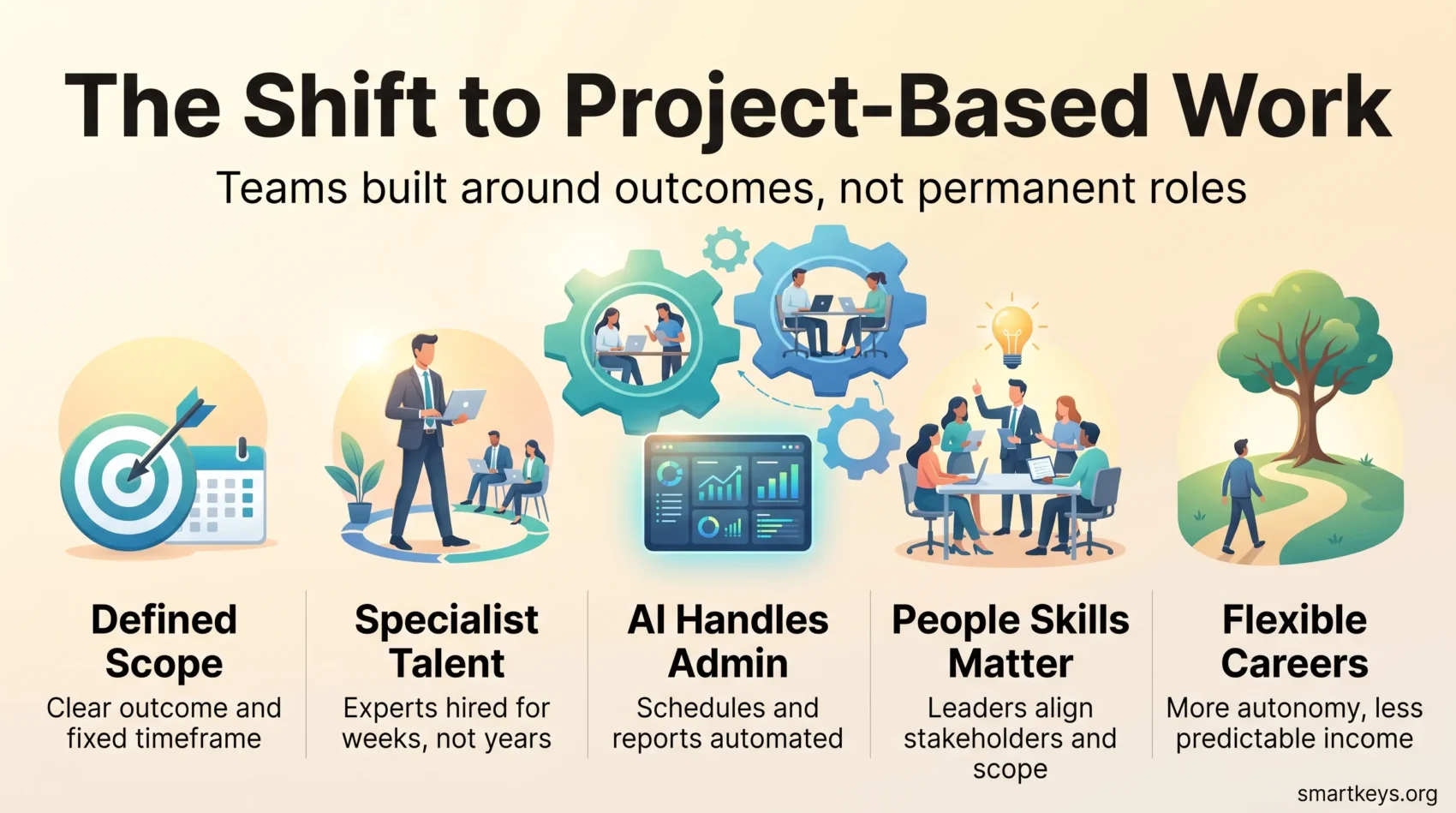
The employment landscape keeps shifting toward project-based work: defined scopes, fixed timeframes and teams assembled for a specific outcome rather than a permanent seat on an org chart. The shift shows up on both sides of the labour market. Companies want the ability to staff a capability for six months without hiring for ten years, and a growing share of skilled professionals want the autonomy that contract assignments and freelance projects provide.
The numbers behind it are no longer marginal. Upwork’s Future Workforce Index reports that 39% of US workers did some freelance work in the past year, up roughly four percentage points on the year before, and that freelancers earned $1.5 trillion in 2024. MBO Partners counted more than 72 million Americans working independently in its 2025 State of Independence study. Meanwhile the Project Management Institute puts the global project workforce at 39.6 million people and expects demand for project talent to grow by 64% between 2025 and 2035.
Key Takeaways
- Independent and project-based work has moved from the margins to the mainstream, with 39% of US workers freelancing in some form (Upwork, 2026).
- AI is now standard in project delivery: 70% of project professionals say their organisation uses it, up from 36% in 2023 (APM, 2025).
- Employers use contract assignments to reach specialized talent quickly and to keep headcount flexible.
- PMI expects demand for project talent to grow 64% by 2035, with a possible shortfall of nearly 30 million qualified professionals.
- Project-based careers trade benefits and predictable income for autonomy, variety and, for established freelancers, a slightly higher median income.
Understanding the Shift to Project-Based Work
Project-based work organises labour around outcomes rather than roles. A scope is defined, a team is assembled from inside and outside the company, the work is delivered, and the team disbands or re-forms around the next problem. It sits between traditional employment and pure freelancing, and most organisations run a blend of both. Our guide to outcome-based work models covers how the contracts and success measures differ from hourly arrangements.
Three things made the model workable that were not in place a decade ago: distributed collaboration tools, talent platforms that surface a specialist in days rather than months, and AI that absorbs enough coordination overhead for small teams to run projects which once needed a programme office.
The scale of demand is easy to underestimate. PMI’s May 2025 Global Project Management Talent Gap report puts the current global project workforce at 39.6 million and warns of a shortfall of up to 29.8 million qualified project professionals by 2035, driven by capital investment in construction, healthcare and industrial transformation. That is a structural shortage, not a cyclical one, and it explains why organisations increasingly reach for contract talent rather than waiting out a hiring process.
The Role of Technology in Project-Based Work
Technology made short-cycle project delivery practical at scale. The interesting question in 2026 is not whether teams use AI, but which parts of the work it has actually absorbed.
What Automation Actually Handles in Project Work
The Association for Project Management surveyed 1,000 project professionals with Censuswide in September 2025. Seventy percent said their organisation was using AI, up from 36% in the same survey two years earlier, with a further 29% planning to adopt it. The functions where respondents saw the most benefit were task and schedule automation (50%), resource allocation (50%), risk analysis and forecasting (50%), reporting and dashboarding (49%) and stakeholder communications (43%).
That list is telling. It is dominated by the administrative layer of project management: status collection, schedule maintenance, resource levelling and report production. What has not moved is the judgement work, namely negotiating scope, resolving conflict between stakeholders and deciding what to cut when the deadline will not move.
Generative AI in Day-to-Day Project Work
Generative AI has become routine among independent workers in particular. MBO Partners found that 74% of independents use it to improve their productivity and output, a higher adoption rate than most permanent workforces report. For a solo contractor, drafting a scope document, summarising a client call or producing a first-pass risk register is time that comes straight off billable capacity.
The same APM survey found 82% of project professionals using AI more often than they expected to five years earlier. The practical effect is that a two-person team can now produce the documentation trail that used to require an analyst. Our overview of AI collaboration tools for distributed teams covers what the major platforms charge for these features.
Benefits of Project-Based Work for Employers
Project-based staffing solves two problems at once: it matches capacity to demand, and it buys access to skills the company does not need permanently.
Increased Flexibility and Agility
A company that staffs a capability on contract can start it, scale it and stop it without a hiring or redundancy cycle. That matters most where demand is uneven: a product launch, a compliance deadline, a migration, a market entry. It also lowers the cost of being wrong, because an initiative that does not work out ends when the contract ends. The trade-off is planning discipline, since contract capacity has to be forecast and budgeted like any other input.
Access to Specialized Talent
The stronger argument is access. A mid-sized company will never justify a full-time specialist in a niche it touches twice a year, but it can hire one for eight weeks. This is where freelance talent platforms changed the economics: MBO Partners found that 42% of independents now rely on online platforms as their primary route to work, which means the supply side is genuinely searchable.
At senior level the same logic produced fractional executive roles, where a company buys one or two days a week of experience it could not otherwise afford. Many companies also look inward first, using an internal talent marketplace to staff projects from existing employees before going to market.
Employee Demand and the Shift to Independent Work
Supply has moved as much as demand. Independent work is now a deliberate career choice for a large share of skilled professionals rather than a gap-filler between jobs.
Career Preferences Towards Freelance Projects
Upwork’s Future Workforce Index puts freelance participation at 39% of US workers, and its 2025 study found that 28% of US skilled knowledge workers work independently. MBO Partners adds a generational detail: Gen Z accounted for 28% of the independent workforce in its 2025 study, which suggests this is an entry route rather than a late-career move.
Not everyone treats it as an either-or choice. Many people run independent projects alongside a salaried role, a pattern covered in our piece on the polywork trend. Others use contract work as a route into a permanent job, which is the logic behind the contract-to-hire model.
Short-Term Assignments and Financial Security
The income picture is better than the stereotype suggests, but it is uneven. Upwork’s 2025 study found that people earning exclusively through freelance work reported a median income of $85,000 against $80,000 for comparable full-time employees. MBO Partners counted a record 5.6 million independent professionals earning more than $100,000 a year, up 19% on 2024.
Those are medians and upper tiers, not guarantees. Independent income arrives irregularly, benefits are self-funded, and tax obligations land in lump sums. Several income streams reduce the risk of any single client disappearing, which is why experienced contractors rarely rely on one account. Cross-border arrangements add another layer, since payment, classification and social contributions all have to be handled correctly; our overview of gig economy regulation covers what changes when client and contractor sit in different countries.
Project-Based Work and Remote Employment
Project work and remote work reinforce each other. Once a role is defined by a deliverable rather than a desk, location stops being a selection criterion.
Growing Popularity of Remote Project Work
Remote arrangements settled rather than disappeared after the pandemic, and that stability is what makes distributed project staffing something you can plan around. Our analysis of how remote work actually settled covers the current picture. For employers, the practical consequence is a much larger candidate pool for any given project, which matters most for narrow specialisms.
Managing Remote Teams Effectively
Managing remote teams on a fixed timeline needs more structure than managing a permanent team, because there is no long runway for people to learn how each other work. The practices that hold up:
- Clear communication: Name the channel for each type of message, and put decisions in writing where the whole team can retrieve them later.
- Shared tooling: One place for the plan, one for the work, one for files. Contractors joining for six weeks cannot learn four overlapping systems.
- Regular check-ins: Short, scheduled and focused on blockers rather than status, which the tooling already reports.
- Explicit onboarding: Access, context and a named contact on day one. This is the single biggest source of lost time on short engagements.
Managers running a mixed team of employees and contractors need a specific skill set, covered in our guides to remote leadership and managing freelancers. Teams spread across jurisdictions face further coordination and compliance questions, which our piece on cross-border remote teams addresses.

The Influence of Economic Factors on Project-Based Work
Economic factors shape how much project-based work companies buy, and in which direction.
What the Pandemic Changed, and What Stuck
The pandemic is now a historical cause rather than a current one. What it left behind is durable: distributed collaboration as a default competence, normalised contracting relationships, and finance functions comfortable with variable labour cost. Companies that had never engaged a remote contractor before 2020 now do so routinely.
Market Demand for Flexible Contract Assignments
Demand for contract capacity tends to rise when hiring is cautious but work still has to be delivered, which describes most of the current market. Rather than a permanent headcount increase, companies commission a defined piece of work with a defined end. Building that into a resourcing model instead of treating each engagement as an exception is the subject of our guide to on-demand workforce strategy, and the longer view sits in our analysis of where contract work is heading.
For a wider view of how independent work fits into the labour market, see our coverage of emerging workforce trends.
The Shift in Organizational Structure
Sustained project-based delivery changes the shape of the organisation itself. Deep functional hierarchies are poor at assembling a team across four departments in a week, so structures flatten around the work.
Cross-Functional Teams and Collaboration
Cross-functional teams put the people who hold the relevant knowledge on the same team for the duration of the project, which removes most handover delay. The gain is speed and better decisions. The cost is contention for people, since the same specialists are wanted by several projects at once. That contention is a resourcing problem, not a personality problem, and it is solved by prioritising projects explicitly rather than by asking people to work harder.
Emphasis on Short-Term Projects for Business Goals
Shorter projects with narrower scopes have become the default, because they surface bad assumptions earlier. A six-week deliverable that fails costs six weeks; a two-year programme that fails costs the programme. Breaking larger ambitions into sequenced projects with real decision points is what makes flexible staffing worth having, since it creates natural moments to stop, redirect or scale up.
Project-Based Work as a Solution for Workforce Challenges
Project-based work also answers staffing problems that permanent hiring handles badly: uneven demand, skills the company needs occasionally, and turnover in roles that offer little variety.
Addressing Employee Turnover with Temporary Job Projects
Variety is part of why people stay. Internal project assignments let employees work on something different without leaving the company, which is one reason internal marketplaces and secondments have spread. They also expose people to other parts of the business, which makes them harder to replace and more likely to see a future there. Our guide to talent retention covers how this sits alongside pay and progression.
Strategies for Retaining Top Talent in a Project-Based World
Retention in a project-based organisation depends on things that are easy to neglect when teams keep re-forming. Contribution has to be recognised when it happens, not at an annual review that lands after the team has dissolved. Progression has to be legible when there is no straight functional ladder. And the same applies to trusted contractors: people who deliver well come back if the engagement was run well, and do not if it was not. Senior structures have shifted too, with newer leadership functions owning capability and workforce design; our piece on emerging C-suite roles covers where these sit.
Key Trends Shaping the Future of Project-Based Work
Two trends matter more than the rest for anyone building a project-based career or workforce.
Continuous Learning and Skill Development
The World Economic Forum’s Future of Jobs Report 2025 estimates that 39% of workers’ core skills will change by 2030. In project-based work that pressure is sharper, because each engagement is won on current, demonstrable capability rather than tenure. Employers cannot rely on people absorbing new skills through long internal projects, and independents have to fund and schedule their own development. Cross-training gives permanent staff the breadth to be useful across several projects.
Demand for Emotionally Intelligent Leadership
As AI absorbs scheduling, reporting and resource levelling, what remains of project leadership is the part that involves people: aligning stakeholders who want different things, holding a team together when scope changes, and giving feedback to someone who will not be on the team next quarter. Those demands are heavier in project settings precisely because relationships are short and there is no time to recover from a bad start. Our overview of the soft skills that hold their value covers which ones employers actually assess.
Project-Based Work versus Traditional Employment
Neither model is better in the abstract. The comparison only becomes useful against your own financial position, risk tolerance and career stage.
Benefits and Drawbacks of Each Approach
- What project-based work offers:
- Control over which projects you take and, within limits, when you work.
- Exposure to several industries and problem types in a short period, which builds range quickly.
- Rates set against specialised skills rather than an internal salary band, plus the option to run more than one engagement.
- What it costs:
- Irregular income, self-funded benefits and self-managed tax and pension arrangements.
- Unpaid time spent finding the next engagement, which is real work that never appears on an invoice.
- No employer-funded training, and limited access to internal progression.
- What traditional employment offers: predictable income, employer benefits, funded development and a defined progression path, in exchange for less control over what you work on.
The income evidence is encouraging but narrow. Upwork’s 2025 figures show exclusive freelancers reporting a median $85,000 against $80,000 for full-time employees, and MBO Partners counted 5.6 million independents above $100,000. Both describe established professionals with a client base, not people in their first year.
Choosing the Right Path for Your Career
Three questions do most of the work:
- How much income variability can you absorb? Count fixed monthly obligations and how many months of runway you hold.
- What do benefits actually cost to replace? Health cover, pension contributions and paid leave have a real price that comes off the headline rate.
- Do you want range or depth? Project work builds breadth fast. Deep specialisation inside one organisation is usually easier to build as an employee.
A common middle path is to start contracting alongside employment, build two or three repeat clients, and only then leave. It is slower, and it removes most of the risk that makes the decision hard.
The Future of Project-Based Jobs
The direction is set by two forces pulling the same way: a structural shortage of project talent, and a workforce that increasingly prefers flexible arrangements.
Trends in Contract Work Opportunities
PMI’s projection of 64% growth in demand for project talent between 2025 and 2035, against a possible shortfall of 29.8 million qualified professionals, is the clearest signal available. Shortages of that size are not filled by permanent hiring alone. Expect more blended teams, more contract capacity treated as a standing part of the resourcing model, and more competition for people who can run a project to completion.
Emerging Industries and Sectors for Project-Based Work
PMI points to construction, healthcare and industrial transformation as the sectors driving demand growth, alongside capital investment in emerging economies. In knowledge work, technology, SaaS, marketing and design have the deepest contractor markets, largely because the work is already deliverable-shaped and the tooling is remote by default. Roles that combine technical and commercial skills are in the strongest position.
Conclusion
Project-based work is now a standard part of how organisations staff themselves, not an alternative to it. The evidence is consistent: 39% of US workers freelanced in some form last year, more than 72 million Americans work independently, and PMI expects demand for project talent to grow by nearly two thirds over the next decade while the supply of qualified people falls short.
For employers, the advantage lies in matching capacity to real demand and reaching specialists they could not justify hiring. That advantage only materialises with the operational work behind it: clear scopes, fast onboarding, honest prioritisation and managers who can run a mixed team.
For individuals, the trade is autonomy and variety against predictability. The income data is more favourable than the stereotype, but it describes people with an established client base. If you are considering the move, build that base before you need it. For the wider context, see our analysis of future work trends.
Found this useful?
Make SmartKeys a preferred source on Google, and our articles will surface more often in your Top Stories, AI Overviews, and AI Mode.
Add as Preferred Source