Cloud-native architecture is now the default way new business software gets built. The CNCF Annual Cloud Native Survey published in January 2026 found that 98% of surveyed organizations use cloud-native techniques in some form, and that 82% of container users run Kubernetes in production, up from 66% in 2023. The open question in 2026 is not whether to adopt it, but which parts pay for themselves and what they cost in money, skills and complexity.
Key Takeaways
- Cloud-Native Architecture leverages microservices for flexibility and resilience.
- Containers provide portability and resource efficiency for applications.
- Kubernetes automates the orchestration of numerous containers.
- Adopting cloud-native practices supports faster deployment cycles.
- Cost efficiency depends on active management, not the architecture alone.
Understanding Cloud-Native Architecture
Cloud-native architecture describes applications designed for cloud environments from the start, rather than lifted onto them later. The distinction matters: moving a monolith into a virtual machine gives you someone else’s hardware, while a cloud-native design gives you elasticity, independent releases and automated recovery. It is one of the few cloud computing trends that changes how teams work, not just where software runs.
Definition and Key Features
Cloud-native designs emphasize scalability, resilience and rapid iteration. They use microservices to split applications into independently deployable parts, and containers to make those parts behave the same everywhere. That consistency makes frequent deployment safe rather than risky.
Key features include:
- Resiliency against failures, enabling quick recovery from issues.
- Automation to streamline workflows and operational tasks.
- Component-based system design that promotes modularity and reuse.
- Infrastructure as code for efficient resource management and deployment.
- Observability to monitor application performance and reliability.
Core Components of Cloud-Native Architecture
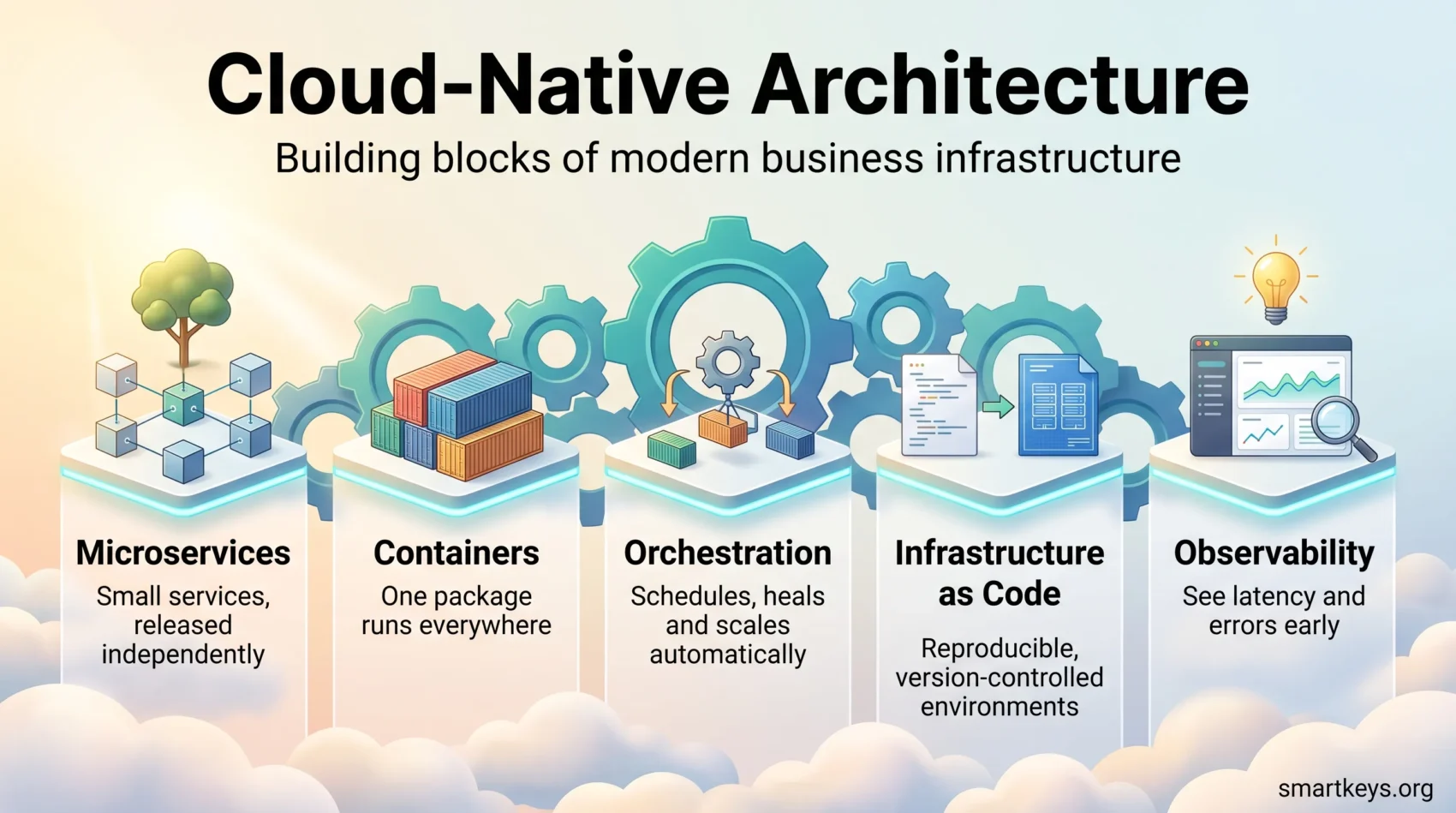
The core components form a stack. Microservices are the building blocks. Containers package each service with its dependencies so it runs identically on a laptop, in test and in production. Orchestration tools such as Kubernetes schedule those containers, restart the ones that fail and scale the ones under load.
Two supporting layers decide whether the rest works. Infrastructure as code makes environments reproducible instead of hand-tuned, and observability turns a distributed system into something you can debug. Without instrumentation, teams cannot answer basic questions about latency and errors, which is why real-time data pipelines arrive with the first microservice rollout.

Cloud-Native Adoption in 2026
The same CNCF survey found that 59% of organizations describe much or nearly all of their development and deployment as cloud native, while roughly one in ten is still at an early stage. Container platforms have also become the substrate for machine learning: 66% of organizations hosting generative AI models use Kubernetes for some or all inference workloads.
That connects to spending. Gartner forecast worldwide IT spending of $6.31 trillion in 2026, a 13.5% rise, with data center systems growing 55.8% to $787.99 billion as AI workloads scale. The platform decisions behind AI in business operations and AI features inside SaaS products are cloud-native decisions.
Benefits of Cloud-Native Applications
The advantages are real but conditional: elasticity only helps if your workload varies, and independent deployment only helps if your teams are organized to use it.
Scalability and Flexibility
The scalability of cloud-native applications lets resources be added or released automatically as demand moves. For a retailer facing a seasonal peak, that removes the need to buy worst-case capacity and leave it idle all year. The same elasticity underpins edge computing deployments, where workloads scale per location.
Cost Efficiency Is a Practice, Not a Guarantee
Pay-as-you-go pricing lowers the barrier to entry, but it does not lower the bill by itself. Flexera’s 2026 State of the Cloud Report, based on more than 750 cloud decision-makers, found managing cloud spend to be the top challenge for 85% of respondents and recorded a rise in wasted cloud spend for the first time in five years, driven largely by AI workloads.
Organizations that keep costs down treat this as an ongoing discipline: 63% now run an established FinOps team. Budget for cloud cost optimization and a real FinOps practice alongside the migration, not after it. Flexera also found 73% running hybrid environments, which makes a deliberate hybrid cloud strategy more useful than a pure public-cloud plan.
How Microservices Enable Business Agility
Microservices change how companies build, and with it how quickly they respond. Teams own a service end to end, shortening the path from decision to release. The trade-off is that you swap one complicated application for many simple ones plus a complicated network between them.
Decoupling Services for Enhanced Reliability
Splitting an application into specialized services limits the blast radius of a failure. If the recommendation service goes down, checkout keeps running. This only holds if services are genuinely independent; shared databases and synchronous call chains quietly rebuild the monolith. Clean contracts are what make the API economy work inside a company as well as between companies.
Faster Deployment of Features
Independent teams can release their own services without waiting for a coordinated launch, so fixes reach customers sooner. The gain is reduced coordination cost, not raw coding speed, and it disappears when integration becomes the bottleneck. Once a business runs dozens of services plus third-party SaaS, an integration layer is what keeps release cycles short.
The Role of Containerization in Cloud-Native Solutions
Containerization packages an application with its dependencies, ensuring portability across platforms. It removes a whole category of deployment failure: code that worked in testing and broke in production because the environment differed.
Understanding Containers
Containers encapsulate everything needed to run an application, so developers can focus on the software rather than environment drift. They share the host operating system kernel instead of virtualizing hardware, which is why they start in seconds and pack densely.
Benefits of Using Containers for Applications
Containers are now the standard unit of deployment for application management:
- Portability: containers run in public cloud, private cloud or on-premises without repackaging.
- Efficiency: they use fewer resources than virtual machines, fitting more workloads on the same hardware.
- Scalability: individual services scale up or down rather than the whole application.
- Rapid deployment: image-based releases and rollbacks take seconds, not scheduled downtime.
- Consistent environments: the same image runs in test and production.

The cost is a new layer to secure and maintain. Images need patching, registries need access control, and someone has to own the base images. Containers move operational work; they do not remove it.
Kubernetes: The Orchestrator of Cloud-Native Architecture
Kubernetes is the scheduling layer that makes containers manageable at scale, and production use among container users reached 82% in the 2026 CNCF survey. It runs on AWS, Google Cloud and Azure as well as on-premises, which is much of its appeal.
Managing Containers Effectively
Kubernetes handles the work that becomes impossible by hand past a few dozen containers:
- Declarative configuration in YAML or JSON, so the desired state is version-controlled.
- Self-healing that restarts or replaces failed containers automatically.
- Pods that group related containers with their storage and network resources.
- Horizontal autoscaling that adds or removes replicas as traffic changes.
The same properties are why Kubernetes has spread into IoT and connected device estates, where fleets of small workloads need consistent management.
Automating Deployment and Scaling
Rolling updates replace containers gradually, so releases avoid downtime and failed rollouts can be reverted. Kubernetes also monitors nodes, pods and services, giving operations teams one control plane instead of several. The honest caveat is complexity: 34% of CNCF respondents named it a barrier to adoption, and a managed service removes some of that burden but not the need for people who understand what the cluster is doing.
The Transformation of DevOps Through Cloud-Native Practices
Cloud-native practices reshaped DevOps by making infrastructure programmable. Once environments are defined in code and deployments are automated, the handover between development and operations stops being a scheduled event.
Integration of Development and Operations
Teams that own both the code and its operation get faster feedback and fewer handover defects, and removing the queue between silos is often the biggest source of speed. Many organizations extend the logic to business users through low-code platforms, which push simple internal applications out of the engineering backlog.
What AI Changed in the Delivery Pipeline
The 2025 DORA report found that 90% of technology professionals now use AI at work and more than 80% believe it has increased their productivity. It also found a tension worth planning for: higher AI adoption was associated with an increase in both delivery throughput and delivery instability. DORA’s reading is that AI amplifies whatever platform it lands on. Strong internal platforms, clear APIs and solid automated testing turn AI assistance into leverage; fragmented tooling and fragile infrastructure turn it into technical debt produced faster.
Cloud-Native Architecture and Business Digital Transformation
Digital transformation stalls when IT systems cannot change as fast as the business plans to. Cloud-native architecture is one of the few structural answers, which is why it sits inside most serious digital transformation programmes rather than beside them as a standalone IT project.
Aligning IT with Business Objectives
The alignment is practical. Elastic capacity lets finance match spend to demand. Independent services let product teams run experiments without a release train. Reproducible environments let compliance verify what is running. Vendors have packaged this by sector, and industry cloud solutions now bundle compliance controls and data models on the same foundations.
Real-World Applications Across Industries
In retail, elastic scaling absorbs promotional peaks that would otherwise need year-round capacity. In financial services, independent deployment shortens the cycle for fraud and risk models. In healthcare, containerized services let providers modernize patient-facing systems without replacing core records in one step. Manufacturing shows the limits: cloud-native services support predictive maintenance well, but plant-floor control still runs on-premises for latency and safety reasons, which is why hybrid deployments dominate.

Challenges in Adopting Cloud-Native Architecture
The CNCF survey ranks the obstacles: 47% cited cultural change within development teams, 36% lack of training, 36% security concerns and 34% complexity. Only one is a technology problem.
Security Concerns and Solutions
A distributed architecture widens the attack surface. Every service is a network endpoint, every image a supply-chain dependency, every cluster credential a possible path inward. The practical response is to assume no implicit trust between services, the core of the zero trust security model, and to combine image scanning, secrets management, workload identity and continuous monitoring. Knowing which service holds which data becomes a prerequisite, so a working data governance approach belongs before the migration.
Skills Gap in Cloud Technologies
The scarce skill is rarely writing services. It is running them: cluster operations, cost management, security and incident response in a distributed system. With 36% of CNCF respondents naming lack of training as an obstacle, it is the constraint most likely to slow a rollout. Closing a digital skills gap is usually cheaper internally than on the hiring market, and structured upskilling and reskilling gives existing engineers the platform knowledge the architecture needs.
Found this useful?
Make SmartKeys a preferred source on Google, and our articles will surface more often in your Top Stories, AI Overviews, and AI Mode.
Add as Preferred Source