The name on the box changed years ago, but the question has not: is Google’s productivity suite the right foundation for your team? G Suite was retired as a brand in October 2020 and everything it contained now ships as Google Workspace. This review covers what the suite includes in 2026, what the four business plans cost after Google folded Gemini into the base price, how it compares with Microsoft 365, and where it still frustrates people. If you are shopping for productivity apps for your team, this is the detail that decides the bill.
Key Takeaways
- G Suite no longer exists as a product name — it became Google Workspace in 2020.
- Business plans list at $7, $14 and $22 per user per month on an annual commitment, or $8.40, $16.80 and $26.40 billed flexibly.
- Gemini is bundled into paid plans rather than sold as an add-on — the biggest change since 2024.
- Business Starter, Standard and Plus are capped at 300 users; past that you need Enterprise.
- Headline prices now match Microsoft 365 almost exactly; the difference is what each vendor includes.
From G Suite to Google Workspace
If you are still searching for “G Suite,” you are searching for a brand Google discontinued. The suite was renamed Google Workspace in October 2020, and in 2022 the legacy free G Suite edition for small businesses was wound down. The apps stayed; the packaging, plan names and pricing all changed.
What you buy today is a cloud-first bundle: Gmail on your own domain, Drive, Docs, Sheets, Slides, Meet, Chat, Calendar, Forms, Sites, Keep and Vids, plus an admin console that governs all of it. Google reports more than three billion people use Workspace apps, though that figure counts consumer Gmail and Drive accounts alongside paying business seats — the paid installed base is far smaller.
The practical consequence is that the tools are no longer separate products stitched together. Meet sits inside Gmail and Calendar, Chat spaces carry Drive files, and since 2025 Gemini reaches across all of them. Treat Workspace as one platform with one admin surface, and its pricing logic starts to make sense.
What Google Workspace Includes in 2026
The core proposition has not changed in a decade: browser-based documents several people can edit at once, with no file versions emailed back and forth. What has changed is everything layered on top.
The Core Apps and the Admin Console
Docs, Sheets and Slides remain the centre of gravity. Drive handles storage and sharing, with shared drives — team-owned rather than person-owned — available from Business Standard upward. That distinction matters: on Business Starter, files belong to individual accounts, so an employee leaving means an ownership transfer.
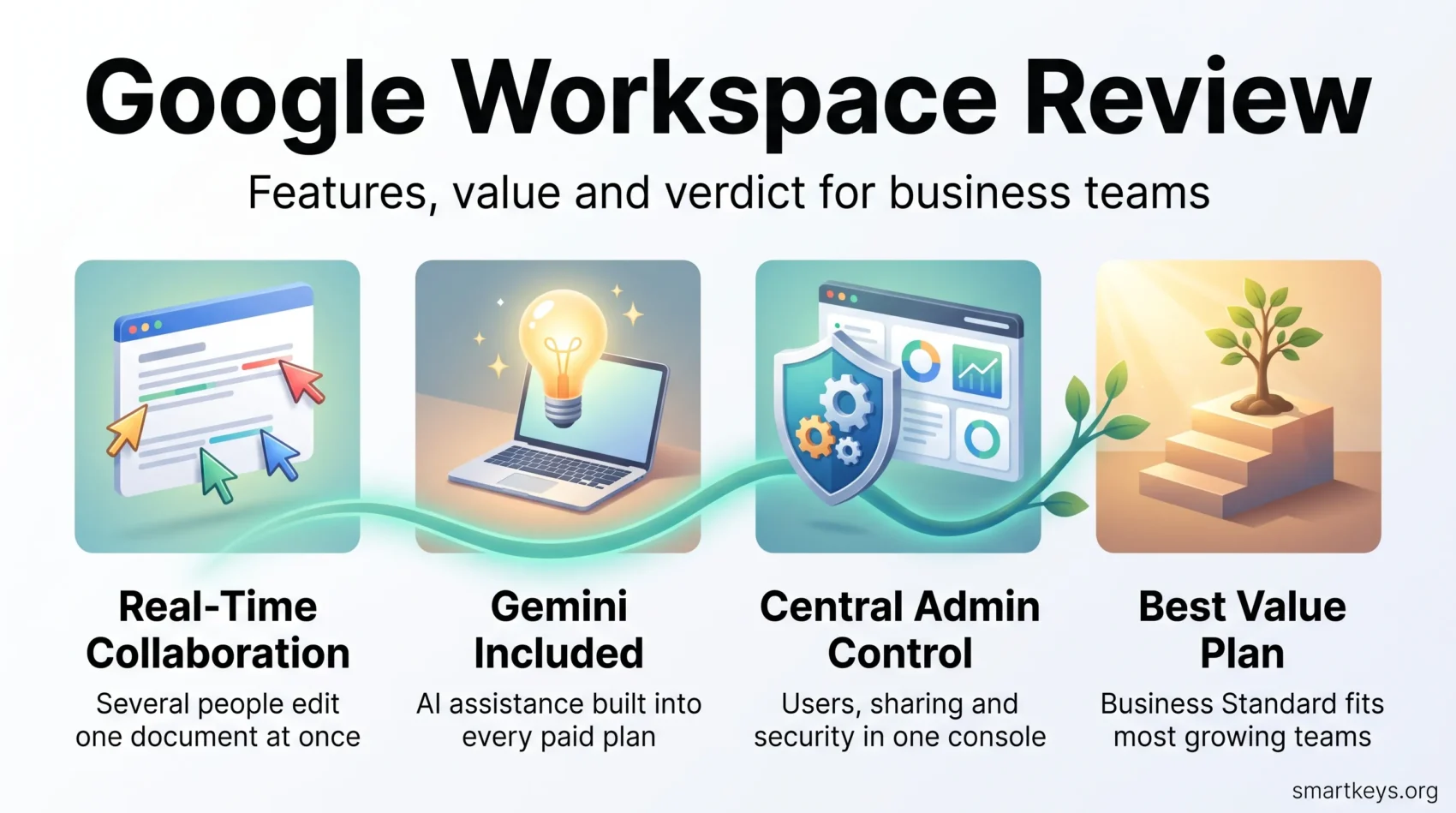
The Admin Console is where Workspace earns its keep for IT. You manage users, groups, app access, sharing rules and security policies in one place. Endpoint Management enrols devices, enforces screen locks and wipes work profiles remotely. Google Vault, from Business Plus, covers retention, legal hold and eDiscovery.
Note-taking is the obvious gap. Google Keep is deliberately lightweight, and teams that want structured knowledge management usually pair Workspace with something else — our comparison of Evernote and OneNote covers the usual replacements.
Gemini, Workspace Studio and the Agent Layer
In January 2025 Google stopped selling Gemini as a separate add-on and folded it into Workspace Business and Enterprise plans, raising base prices instead. Google’s own example: a Business Standard customer paying roughly $32 per user per month for the plan plus the Gemini Business add-on now pays $14. If you were already buying the add-on, that was a large cut. If you were not, it was a price rise you did not ask for.
What you get depends on the tier. Business Starter includes Gemini in Gmail and Vids plus the Gemini app. Business Standard and above extend it across Docs, Sheets, Slides, Drive, Meet and Chat, and add NotebookLM.
The more interesting 2026 addition is Google Workspace Studio, generally available across all release domains since 19 March 2026. It lets non-developers describe an automation in plain language and have Gemini build an agent that runs it — triaging requests, summarising documents, generating drafts — using context from Gmail, Drive and Sheets, with connectors into systems such as Salesforce, Jira and Mailchimp. At Cloud Next 2026 Google added reusable “skills” for these agents, interactive dashboards inside Sheets, and a Workspace MCP server so external AI applications can reach Workspace data through a standard interface.
Meet’s note-taking also grew up: “Take notes for me” now produces summaries and action items for meetings held in person or on other platforms, narrowing the gap to dedicated AI meeting-notes tools.
How Workspace Handles Team Collaboration
Collaboration is why most teams pick Workspace, and it holds up. The suite is built around several people touching the same object at once, not around files that get checked out and returned.
Real-Time Document Collaboration
Multiple people can edit a Doc or Sheet simultaneously, cursors visible and changes saved continuously. Comments, suggestions and version history make review cycles traceable, and you can restore any earlier state. There is no merge step and no “final_v3” problem.
The limitation is offline work. Docs, Sheets and Slides support offline editing in Chrome once enabled, but it is a fallback rather than a first-class mode, and it remains the most common complaint from people moving off desktop Office.
Communication: Meet, Chat and the Rest
Meet participant caps scale with the plan: 100 on Business Starter, 150 on Standard, 500 on Plus and 1,000 on Enterprise, all with a 24-hour limit. Recording, noise cancellation and attendance tracking sit on higher tiers. Competitive, but not category-leading — if video is your primary workload, compare it against Zoom and Microsoft Teams first.
Google Chat covers messaging and spaces at no extra cost, but it is no rival to a dedicated platform; teams that live in chat usually still run Slack alongside Workspace. Meet’s live translated captions have improved, though coverage is limited to a handful of languages compared with specialised translation tools.

Who Google Workspace Fits
Workspace suits organisations that want a single vendor for email, files, documents and meetings without running infrastructure. It scales cleanly from a two-person consultancy to a few hundred seats.
Small Teams and Growing Companies
For a small business, everything arrives configured. Point your domain at Google, create accounts, and email, calendars, storage and video calls work the same day — no server, no patching, no licence-tracking spreadsheet.
The catch is that Business Starter is thinner than its price suggests. Thirty gigabytes per user fills fast once Gmail attachments accumulate, there are no shared drives, and Gemini access is limited. Most teams end up on Business Standard within a year.
Scaling Beyond 300 Seats
All three Business plans are capped at 300 users. Cross that line and you move to Enterprise, which is quote-only and adds data-loss prevention, client-side encryption, enhanced Meet controls and stronger sovereignty options. Plan that step early: it is a pricing conversation, not a checkbox. Teams coordinating many seats usually add a dedicated tracker — our guides to task management, ClickUp and Monday.com versus Trello cover the candidates.
Google Workspace Pricing in 2026
Pricing is where the old G Suite advice has aged worst. The $6 Basic plan people still quote has not existed for years.
The Free Trial
Google offers a 14-day free trial covering the paid features on the plan you select, so you can test shared drives, admin controls and Gemini before paying. Fourteen days is short for a domain migration, so treat it as a functional evaluation rather than a full pilot and run it alongside your existing mail.
The Four Business Plans
Prices below are list prices per user per month in the United States.
- Business Starter: $7 on an annual commitment, $8.40 billed flexibly. Custom email, 30 GB pooled storage per user, Meet for 100 participants, Gemini in Gmail and Vids.
- Business Standard: $14 annual, $16.80 flexible. 2 TB per user, Meet for 150 with recording and noise cancellation, shared drives, and Gemini across the core apps plus NotebookLM.
- Business Plus: $22 annual, $26.40 flexible. 5 TB per user, Meet for 500 with attendance tracking, Vault, and advanced endpoint management.
- Enterprise: quote only. 5 TB per user with more available on request, Meet for 1,000 plus domain livestreaming, DLP, client-side encryption and data-region controls.
Two details catch people out. First, the annual commitment is a commitment: you pay for the seats you reserved for twelve months, even if headcount drops. Flexible billing costs 20 percent more precisely because it lets you scale down. Second, storage is pooled across the organisation rather than locked to individuals.
Where the Bill Actually Grows
The base price is rarely the final number. Marketplace add-ons, extra storage, Google Voice licences and higher AI tiers bill separately, and seat counts drift upward as contractors and shared mailboxes accumulate. Review the user list quarterly. The discipline behind cloud cost management applies here too: unused seats are the largest source of SaaS waste.
Google Workspace vs Microsoft 365 in 2026
This is the comparison that matters, and in 2026 it got close.
Feature Comparison
Workspace is browser-native: everything runs in a tab, collaboration is a document’s default state, and the mobile apps match the desktop experience. Microsoft 365 pairs cloud services with installed desktop applications, and Excel remains more capable than Sheets for heavy modelling.
- Collaboration: Workspace was designed for simultaneous editing; Microsoft added it to a file-based model and it shows in edge cases.
- Storage: Workspace ranges from 30 GB to 5 TB per user by tier; Microsoft 365 Business plans include 1 TB of OneDrive storage across the board.
- Offline: Microsoft wins outright. Desktop Word, Excel and Outlook work without a connection in a way Google’s offline mode does not match.
- Meetings: Teams is more deeply embedded in Microsoft’s stack than Meet is in Google’s, and carries telephony features Meet handles through separate Google Voice licences.
Pricing and Value
As of July 2026, Microsoft 365 Business Basic lists at $7 per user per month, Business Standard at $14 and Business Premium at $22 on annual commitment — the same three headline numbers as Workspace Starter, Standard and Plus. The difference is AI. Google includes Gemini in those prices. Microsoft sells Copilot separately: the bundled Business Standard with Copilot lists at $23.50 and Business Premium with Copilot at $32.
For a team that wants AI assistance across its documents and mail, Workspace is currently the cheaper route by a wide margin. For a team that does not, the two are priced identically and the decision comes down to Excel, offline work and which ecosystem you already run. Google has also shortened the switching path: its data import service now moves mail, files and conversations off Microsoft 365 several times faster than before. If a suite change is part of a wider digital transformation programme, that migration cost belongs in the business case.
Security, Privacy and Compliance
Workspace’s security is strong at the platform level and dependent on configuration at the tenant level. Google secures the infrastructure; you own the sharing settings, and defaults are more permissive than most compliance teams expect.
Data Protection Controls
- Two-step verification and security keys can be enforced organisation-wide, with passkeys supported for phishing-resistant sign-in.
- Data Loss Prevention scans Drive and Gmail against your rules and blocks or warns on external sharing. It sits on Enterprise plans.
- Encryption protects data in transit and at rest by default; client-side encryption on Enterprise lets you hold the keys.
- Google Vault handles retention, legal hold and export from Business Plus upward.
- Endpoint Management enforces device policies and remote wipe of work profiles.
Agent governance is the newer concern. With Workspace Studio agents reaching real data, Google shipped controls in 2026 to monitor and audit agent access, aimed at prompt-injection and data-exfiltration risk. If you enable agents, review those logs — the thinking behind a cybersecurity mesh architecture applies inside the suite too.
Compliance and Data Residency
Google Cloud, which underpins Workspace, holds ISO/IEC 27001, 27017, 27018 and 27701 certifications and publishes SOC 2 and SOC 3 reports. Workspace provides the data processing terms, access controls and export tooling needed to support GDPR obligations, though compliance stays a shared responsibility rather than something a certificate confers on you.
Where residency matters, Google now offers controls that pin data processing to specific regions — the US and EU today, with Germany and India announced — alongside client-side encryption that can exclude Google itself. Those are Enterprise-tier features, worth knowing before procurement assumes they come with Business Plus.

What Users Praise and What They Complain About
Reviews of Workspace are consistent enough that the pattern says more than any rating.
What Works Well
- Real-time collaboration in Docs and Sheets, which almost nobody gives up once they have it.
- Low administrative overhead — onboarding is a few clicks, and there is nothing to patch.
- Search across Gmail, Drive and Chat is faster than the alternatives, and Gemini now summarises what it finds.
Where It Falls Short
- Offline capability lags installed desktop applications — the most cited reason teams stay on Microsoft.
- Sheets hits limits Excel does not, on very large datasets and complex financial models.
- Support on Business tiers is widely rated slow, with generic answers until you escalate.
- Admin complexity grows quickly. Sharing defaults and OU-level policy inheritance catch out teams without an IT function.
- Chat is an also-ran. Most teams pay for a second messaging tool, which erodes the “one bundle” argument — a reason to audit your messaging habits and boundaries first.
Extending Workspace with the Marketplace
The Google Workspace Marketplace is where the suite gets specialised. Applications install against your domain, respect your admin policies and appear inside Gmail, Drive or Docs, saving a context switch to yet another tab.
Common examples include time trackers such as Clockify, scheduling tools such as Calendly, and document-signing add-ons. Help desks connect through Zendesk, marketing teams through HubSpot, and engineering teams through Jira. Teams who want a structured document workspace rather than plain Docs often add a tool from the Notion and Coda category.
Two rules keep this from becoming a mess: restrict which add-ons users can install, and review installed applications and their OAuth scopes on a schedule. An app with broad Drive access is an exposure, not a convenience.
Verdict: Who Should Choose Google Workspace
Google Workspace is the strongest choice for teams that work in a browser, collaborate on documents constantly and want AI assistance without a second invoice. At $14 per user per month with Gemini included, Business Standard is the most defensible plan in the lineup. Business Starter is a false economy beyond a handful of users.
It is the wrong choice if your work depends on desktop Excel, if a meaningful share of your team works offline, or if you are already committed to Microsoft’s identity and device stack. There, price parity does not compensate for the friction. Teams choosing primarily on storage and file sharing should read our Dropbox versus Google Workspace comparison first.
Run the 14-day trial on Business Standard, migrate one team rather than the whole company, and check storage and seat count after 60 days. That is enough to know whether it fits.
Found this useful?
Make SmartKeys a preferred source on Google, and our articles will surface more often in your Top Stories, AI Overviews, and AI Mode.
Add as Preferred Source