Choosing the right productivity tool shapes how much of your week you actually get back. This comparison covers Notion and the platform most people still call Coda – which its owner renamed Superhuman Docs on 8 July 2026. Both blend documents, databases and AI in one place, but they charge for them in completely different ways. By the end you will know which one fits your team, your data and your budget.
Key Takeaways
- Coda is now Superhuman Docs. The change took effect on 8 July 2026, and existing coda.io doc links redirect to docs.superhuman.com.
- Superhuman states the rebrand did not change pricing: existing subscribers keep their plans and their rates.
- Notion charges for every member – $10 per member per month on Plus and $20 on Business, with up to 20% off for yearly billing.
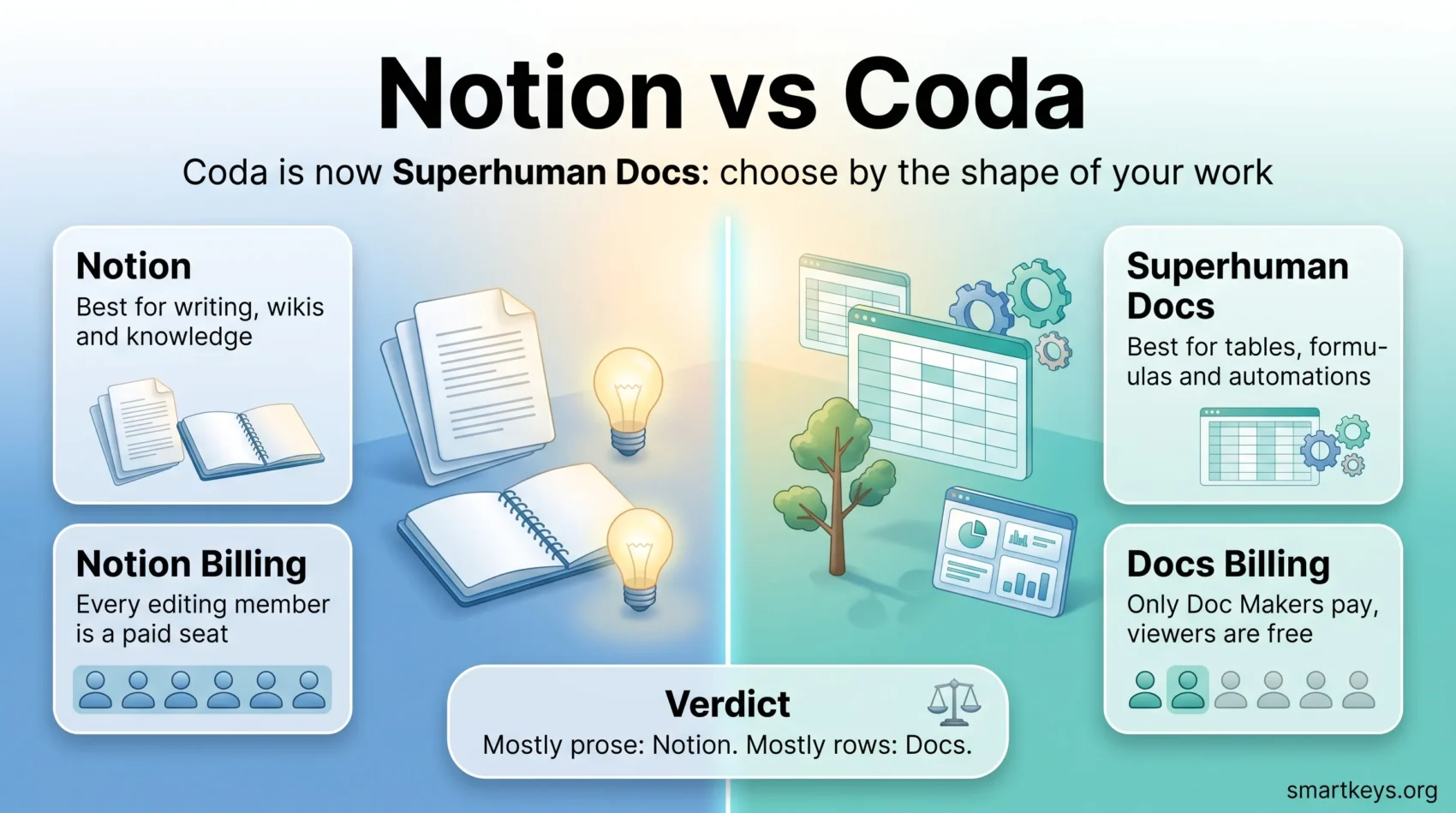
- Superhuman Docs bills only Doc Makers. Editors and viewers are free, which keeps large read-and-comment teams cheap.
- Notion meters custom agents separately at $10 per 1,000 monthly Notion credits; Docs AI, AI columns and the Docs MCP connector are included in existing Docs plans.
Introduction to Productivity Tools
Hybrid tools have collapsed the old split between a document app, a spreadsheet and a project tracker. Notion and Superhuman Docs both sit in that category: a single page can hold prose, a database, several views and an automation at once.
Notion leans towards writing, wikis and knowledge management. Docs leans towards structured data, formulas and small internal apps. The overlap is real, which is why the decision usually comes down to how much of your work is prose and how much is rows.
If you want a wider survey first, our guide to the productivity apps worth using in 2026 covers the broader field, and the Monday.com and Trello comparison shows how board-first tools differ from document-first ones.

What Changed in 2026: Coda Is Now Superhuman Docs
Grammarly renamed itself Superhuman in late 2025, after acquiring both Coda and the Superhuman email client. On 8 July 2026 the Coda product itself became Superhuman Docs.
For existing users the move is mostly cosmetic, but a few things matter in practice. The product now lives at docs.superhuman.com, and Superhuman says existing coda.io doc links redirect automatically. API endpoints keep working. If your company runs data-loss-prevention tooling or restricts embeds, the new domain needs allowlisting, and the Slack integration – now Superhuman Docs for Slack – may need reconnecting.
The release also shipped real new capability: table pages, which give a single table a full page of its own; AI columns and blocks; a Docs AI chat that reads your workspace context; and a Docs MCP connector so assistants such as Claude, ChatGPT or Cursor can work against your docs while Docs stays the source of truth. AI Views and Superhuman Databases – the latter aimed at up to one million rows – launched in closed beta. A Mac desktop app arrived with the rebrand, with Windows promised later in 2026.
Crucially, Superhuman stated that pricing is not changing and that everything announced is included in existing plans. That is unusual for this kind of SaaS consolidation, where acquisitions are often followed by repackaging.
Understanding Notion: A Comprehensive Overview
Notion began as a block-based note-taking app and grew into a workspace that carries wikis, projects and lightweight databases. The block editor is still the core idea: every paragraph, table and embed is an object you can move.
Key Features of Notion
- Block editor: mix text, tables, boards, callouts and embeds on one page.
- Databases and views: table, board, calendar, timeline and gallery views over the same records, with formulas and relations.
- Collaboration: shared teamspaces, comments, page history and granular permissions.
- Templates: a large public gallery plus duplicable community setups, which removes most of the blank-page problem.
- AI: writing and autofill assistance, plus AI Meeting Notes and Enterprise Search on higher plans.
Notion is a common home for a second brain. If you are still deciding how to capture information at all, our guide to digital note-taking is a better starting point than any single app.
Notion Pricing in 2026
Notion publishes four tiers:
- Free: $0 per member, with unlimited pages for individuals, block limits once you add members, and up to 10 guests.
- Plus: $10 per member per month, with unlimited guests.
- Business: $20 per member per month, adding AI Meeting Notes and Enterprise Search (beta).
- Enterprise: custom pricing, adding zero data retention with LLM providers.
Notion advertises up to 20% off for yearly billing. The important structural point is that every collaborator who needs edit access is a paid member. Custom agents are metered on top – free to try, then $10 per 1,000 monthly Notion credits – so treat AI as a variable line item rather than a flat seat cost.
Superhuman Docs (Formerly Coda): An In-Depth Look
Docs merges the document and the spreadsheet more aggressively than Notion does. A page can behave like an internal app: tables with real formulas, buttons that write rows, and automations that fire on a schedule or on a change.
Main Features of Superhuman Docs
- Tables and formulas: a formula language closer to a spreadsheet than to Notion’s property formulas.
- Automations: time-based and change-based triggers that move data between tables and notify people.
- Packs: the extension framework that connects external services and adds custom formulas; Packs can also be published and sold.
- Docs AI and AI columns: AI applied per column or block against live data, not only in a side chat.
- Docs MCP: an official connector so external AI clients can read and write your docs.
That app-like behaviour puts Docs closer to the integration layer than most document tools, and it is one reason the platform keeps appearing in discussions of AI in SaaS.
Pricing Options for Superhuman Docs
Docs keeps four tiers – Free, Pro, Business (previously called Team) and Enterprise. Superhuman does not publish the per-seat rates in its help centre, so check the official pricing page before you budget, and treat figures quoted elsewhere with caution.
What is documented is the billing model, and that is the real differentiator. Only Doc Makers are billable: people who can create docs and pages and use Docs AI. Workspace admins count as Doc Makers. Editors, who can update existing pages but cannot create new ones, and viewers are free.
The free tier is documented precisely. Personal, unshared docs carry no object or row limits. Shared docs are capped at 50 objects – pages, tables, views, controls, buttons and canvas formulas – plus 1,000 rows across all tables, 1 GB of media per doc and 10 MB per file. Exceed a limit and you get 14 days to upgrade or trim before the doc becomes read-only.
Notion vs Superhuman Docs: A Feature Comparison
Core Features Compared
Docs wins on data. Its formula language, automations and buttons let one page replace a small internal tool, and the closed-beta Superhuman Databases target row counts that would make a Notion database sluggish. Notion wins on writing and structure: long-form pages, nested wikis and search across a large workspace all feel better there, and the block editor is faster for assembling a document than Docs’ canvas.
For project tracking specifically, both are more flexible and less opinionated than a dedicated tool. If you want firmer rails, compare a ClickUp setup, the Asana and Trello pairing or Trello against Jira before you build a system from blank pages. There is also a direct Monday.com versus Notion comparison if a board-first tool is the alternative you are weighing.
Integrations, Packs and MCP
Both platforms publish an open API and a gallery of connectors, and both now ship an official MCP server. Notion MCP is a remote server: after you authorise it with OAuth, a client such as Claude Code or Cursor can search, read, create and update Notion content, including pages and databases. Docs MCP does the same job for Superhuman Docs.
The difference is philosophy. Docs’ Packs add custom formulas and two-way synced tables, which suits data-centric work. Notion’s ecosystem is broader in everyday office terms and slots more naturally next to Google Workspace and Slack. Neither replaces a dedicated integration platform once you have more than a handful of systems to keep in sync.
Ease of Use: Which Tool is More User-Friendly?
Learning Curve for Notion
Notion is the easier start. The block editor behaves like a document, the template gallery removes most blank-page anxiety, and a new user can be productive within an hour. The difficulty arrives later, when a workspace grows and nobody agreed on structure. Notion will not stop you building a mess.
Learning Curve for Superhuman Docs
Docs asks more of you upfront. Formulas, controls and automations are genuinely powerful, but the payoff only shows once you build something that would otherwise need a spreadsheet plus a script. If nobody on the team enjoys that kind of tinkering, the power stays unused. Matching a tool to how you actually work matters more than raw capability, and our guide to finding your productivity style is a useful check before you commit.
Collaboration Capabilities and Seat Maths
This is where the two pricing models diverge sharply. In Notion, everyone who edits is a paid member; guests are free but limited, and the Free plan caps them at 10. In Docs, only creators pay, so a team of five makers and forty commenters costs five seats.
Turn it round and Notion looks better. A team where everyone writes pays for everyone either way, and a flat per-member price is simpler to forecast than tracking who qualifies as a maker. Model your own split of writers to readers before you commit – at 50 people the difference is large.
Both handle real-time editing, comments and version history well enough that collaboration quality rarely decides the choice. What does decide it is the surrounding workflow: if most of your friction is meetings rather than documents, an AI meeting notes workflow will save more time than switching document tools.
Databases and Automation: Strengths of Each Tool
Data Management in Notion
Notion databases are approachable. Properties, relations, rollups and views cover most internal tracking, and the interface stays legible for people who do not think in tables. Automations exist but are simpler, and very large databases are not Notion’s strength.
This makes Notion a good fit for individuals and small teams looking to centralize their information without maintaining a system that only one person understands.
Data Management in Superhuman Docs
Docs is built for this. Tables carry a spreadsheet-grade formula language, automations chain steps together, and two-way sync through Packs keeps external systems aligned. AI columns push it further by generating or classifying values row by row. If your document is really a data product, Docs is the better host.
Which Tool is Best for You? Use Cases Explained
- Individuals and writers: Notion. The free plan is generous for solo use and the editor is the nicer place to think.
- Small teams doing documentation: Notion. Wikis, teamspaces and search scale well for prose.
- Teams with many read-only collaborators: Superhuman Docs. Free editors and viewers change the maths entirely.
- Data-heavy or app-like workflows: Superhuman Docs. Formulas, automations and AI columns do work Notion cannot.
- Teams standardising on a task tool: neither, necessarily. Read our task management guide and how to use to-do lists effectively first, because the method usually matters more than the app.
If price is part of the decision, remember that both vendors run a freemium model: the free tier is designed to stay pleasant right up to the point where your team outgrows it.
Conclusion
Notion and Superhuman Docs have drifted further apart, not closer. Notion is the better writing and knowledge tool, with a simple per-member price and AI features that are partly metered by credits. Docs – under a new name, with a refreshed AI layer and unchanged pricing – is the better data tool, and its Doc Maker billing is dramatically cheaper for teams where only a few people build.
Pick on the shape of your work rather than the feature list. If your pages are mostly prose, take Notion. If your pages are mostly rows, take Docs. And if you are still weighing note-first options, our Evernote versus OneNote comparison covers the ground either tool would have to beat.
Found this useful?
Make SmartKeys a preferred source on Google, and our articles will surface more often in your Top Stories, AI Overviews, and AI Mode.
Add as Preferred Source