Work culture changed less dramatically than the headlines of 2020 suggested, and more permanently. Hybrid schedules settled at a level neither side of the argument predicted, artificial intelligence moved from pilot projects into daily tasks, and the questions that decide whether a workplace functions have shifted from “where do people sit” to “how do people work together, and who checks what the machine produced.”
The numbers describing this settlement are unglamorous. In May 2026, about 25% of paid full days in the United States were worked from home, a share that has barely moved for three years, according to the Survey of Working Arrangements and Attitudes. Global employee engagement sat at 20% in 2025, and manager engagement at 22%, its lowest point in a decade, Gallup reports. Neither figure looks like a revolution. Both describe a workplace that is still unfinished.
This guide covers what the evidence actually supports about the future of work culture in 2026: how much remote work is left, what AI is doing to daily work, where wellbeing and inclusion programmes stand, and which rules employers now have to follow.
Key Takeaways
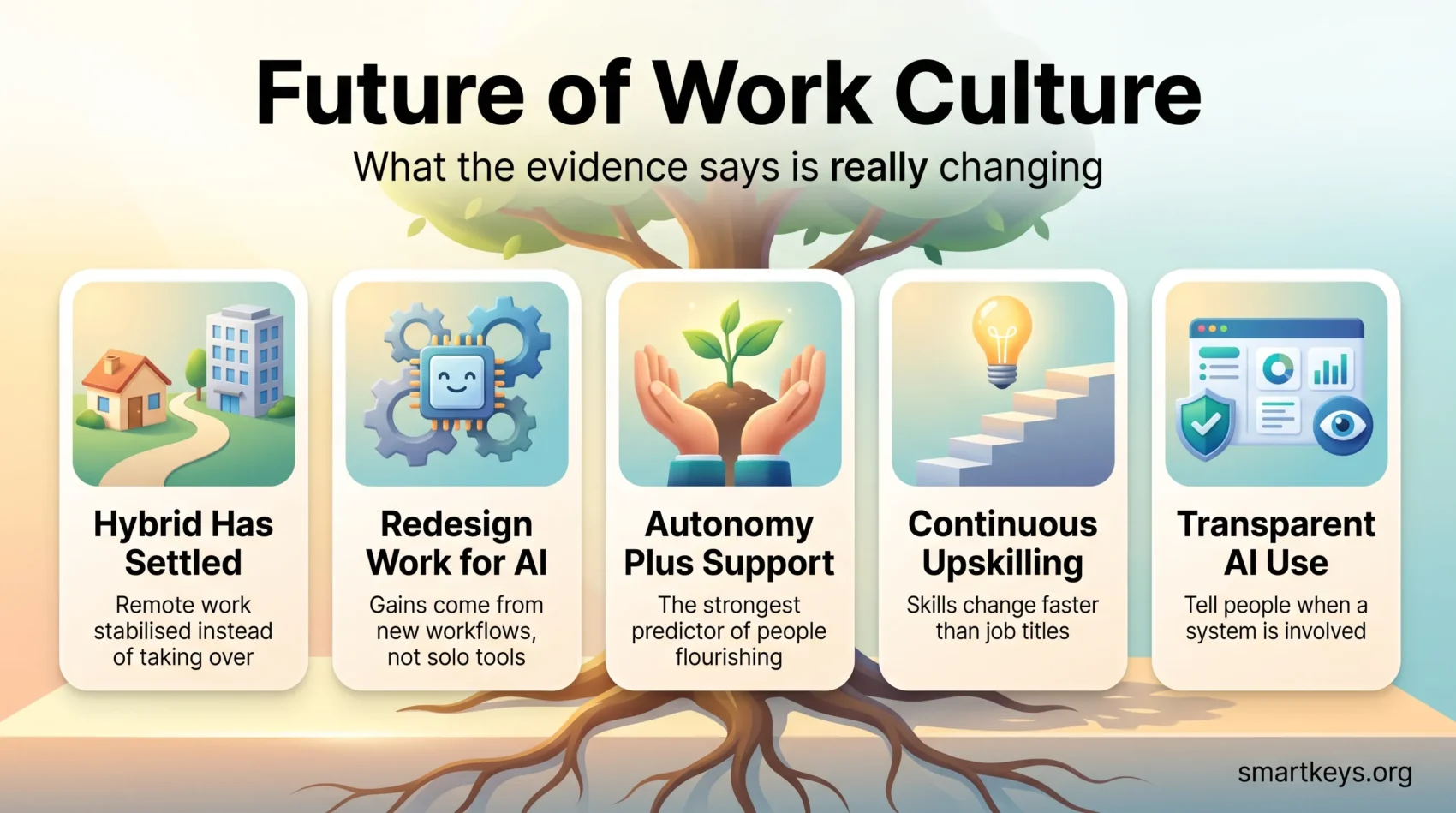
- Remote work has stabilised near a quarter of US paid days rather than continuing to grow.
- Engagement is the weak point of most work cultures, and manager engagement is weaker still.
- AI adoption pays off mainly where the organisation redesigns work around it, not where individuals experiment alone.
- Autonomy plus support is the strongest observable predictor of whether people flourish at work.
- Skills change faster than job titles do, which makes continuous skills development a structural requirement.
- EU transparency rules for AI systems have applied since August 2026 and reach ordinary employers.
Understanding the Shift in Work Culture
The modern workplace is not simply more digital than it was five years ago. It is more distributed, more automated, and considerably harder to hold together. Tools changed first; expectations followed; culture is still catching up.
The clearest sign of that gap is engagement. Gallup’s State of the Global Workplace 2026 puts global employee engagement at 20% for 2025, with thriving up a single point to 34%. Manager engagement fell to 22%, down nine points since 2022. Managers are the layer that translates strategy into daily work, so a decade low there is not a soft metric. It is a structural problem that shows up later as turnover, missed handovers and quiet disengagement.
The picture inside organisations is similar. The 2026 Workplace Wellbeing Report from the Gies College of Business at the University of Illinois, based on a nationally representative sample of 2,000 US workers, found 61% languishing at work and 39% flourishing. The same study found the sharpest split not by industry or seniority, but by working conditions: 68% of people in high-autonomy, high-support teams were flourishing, against 10% in low-autonomy, low-support teams.
That contrast is the most useful finding in the current literature on work culture. Culture is not what a company writes on its careers page. It is the amount of discretion people have over their work and the amount of backing they get when they use it. For distributed teams, our guide on how remote companies build a strong culture turns that idea into daily habits. For a wider view of how these pressures play out across the HR function, see our overview of human resource management trends.
The Role of Technology in Future Work Culture
Technology is no longer the interesting variable on its own. Almost every knowledge worker now has access to capable tools. What separates organisations is whether the work around those tools has been redesigned.
Microsoft’s 2026 Work Trend Index makes that point with unusual precision. Among AI users, 66% report spending more time on high-value work and 58% say they are producing work that was previously out of reach. Yet only 26% say leadership is clearly aligned on an AI strategy, and organisational factors account for roughly twice the measured AI impact of individual effort. Active agents grew fifteenfold year on year. Capability is not the bottleneck. Coordination is.

The same survey shows what the human half of the job is becoming. Half of respondents named quality control of AI output as an increasingly important skill, 46% named critical thinking, and 86% said they treat AI output as a starting point rather than a finished answer. That is a meaningful cultural shift: reviewing, challenging and correcting machine work is now a core competence rather than a specialist task. Our analysis of AI and automation at work covers the returns question in more detail.
There is a cost to all of this. In the same data, 65% of workers fear falling behind if they do not adapt, while only 13% say they are rewarded for reinventing how they work regardless of the outcome. Pressure without permission is a reliable way to produce cautious teams. Employers that want experimentation have to make it safe to try something that does not work, and that means saying so explicitly rather than hoping people infer it.
Embracing Remote Work and Flexible Schedules
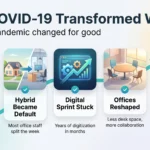
Remote work stopped being a trend and became an arrangement. The argument now is about degree, not direction, and the data has been stable long enough to plan around.
Where Remote Work Actually Settled
The Survey of Working Arrangements and Attitudes put work-from-home at about 25% of paid full days in the United States in May 2026. Between June 2025 and May 2026, full-time employees split roughly 62% fully onsite, 26% hybrid and 12% fully remote. Employer plans have hovered around 1.3 to 1.5 remote days per week since mid-2022, which is close to what people actually do.
Two things follow. First, fully remote work is a minority arrangement, not the default. Second, hybrid is not a transitional state waiting to resolve itself, since employers and employees have converged on almost the same number. Our piece on how remote work changed the workplace traces how that equilibrium formed.

Balancing Flexibility with Productivity
Flexibility is popular, and popularity is not proof of output. The most defensible position is narrower than either camp usually argues: hybrid schedules reliably improve retention and satisfaction, and their productivity effects depend heavily on how the work is coordinated rather than on the number of office days.
What does travel well is the practice around the schedule. Written decisions instead of hallway agreements. Meeting-light days protected in the calendar. Explicit rules on response times so that availability does not silently expand to fill the evening. Teams that do this get most of the benefit of flexibility; teams that simply moved the same meeting load online usually do not. Our guide to flexible work schedules sets out the implementation detail, and remote employee engagement covers what holds distributed teams together.
Flexibility also raises the stakes on security, because company data now sits on home networks and personal devices. The practices worth insisting on are covered in our guide to cybersecurity in remote work. For benefits that match how people actually work, see future employee benefits.
Hybrid Work Environments: The Best of Both Worlds
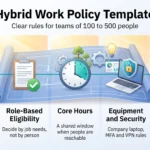
Hybrid is now the standard arrangement for remote-capable roles, which means the interesting question is no longer whether to adopt it but how to run it without creating two classes of employee.
Benefits of a Hybrid Work Approach
The advantages that hold up in practice are practical rather than visionary:
- A wider hiring radius, because candidates are not restricted to commuting distance.
- Individual control over when deep work happens, which suits people whose peak hours differ.
- Lower property costs where office footprints are genuinely reduced rather than merely reorganised.
- Better retention, which is the most consistently reported effect of flexible arrangements.
Some organisations go further and drop the fixed office entirely, using a registered address and on-demand meeting space instead. Our look at virtual offices in a hybrid workforce covers when that model works.
Challenges and Solutions in Hybrid Setups
The recurring failure in hybrid setups is proximity bias: information and opportunity concentrate around whoever happens to be in the room. It rarely announces itself. It shows up as remote colleagues hearing decisions late, or being overlooked for the visible projects that lead to promotion.
Four practices reduce it. Default to written decisions in a shared place. Run meetings as if everyone were remote when anyone is. Rotate the anchor days so the same people are not always co-located. Review promotion and stretch-assignment data by work arrangement, because the gap is measurable if anyone looks. The wellbeing side of the same problem is covered in hybrid workspaces and employee wellbeing.

Fostering Employee Well-Being in a Digital Age
Wellbeing programmes have a credibility problem, and it is largely self-inflicted. App subscriptions and resilience workshops are cheap; changing workload and autonomy is not. The Gies data points squarely at the expensive option, since the flourishing gap between high-autonomy, high-support teams and low-autonomy, low-support teams was 68% against 10%.
That does not make the smaller measures useless. It makes them secondary. The sequence that matters is workload first, control second, support third, and perks last. Concretely, that means realistic capacity planning, genuine discretion over how work gets done, managers with enough time to manage, and only then the wellbeing budget.
Boundaries deserve specific attention, because digital work erodes them by default. Clear expectations on out-of-hours contact, calendars that protect uninterrupted blocks, and leaders who visibly stop working at a reasonable hour do more than any application. Several European countries have codified a right to disconnect, and the direction of travel elsewhere is similar.
Clear goals and expectations also matter for reducing workplace stress, because ambiguity is itself a stressor. For the specific pressures of distributed teams, see remote work and mental health.

Diversity and Inclusion: Cornerstones of Future Work Culture
The politics around diversity work changed sharply after 2024, and the practice changed less than the vocabulary did. Research by Catalyst and NYU’s Meltzer Center, conducted in early 2025, found 78% of organisations rebranding this work under labels such as belonging, workplace culture or fairness rather than abandoning it. A Resume.org survey of nearly 1,000 US employers in July 2025 found about one in five had eliminated their programmes after the 2024 election and one in ten had reduced investment.
The employee side of that ledger is worth knowing before deciding. In the Catalyst research, 76% of employees said they were more likely to stay with an employer that supports inclusion, and 43% said they would leave one that stopped. Those are stated intentions rather than observed behaviour, so treat them as a signal of sentiment rather than a forecast of turnover.
What survives the relabelling is the part that was always operational: structured interviews rather than gut feel, pay and promotion data reviewed by group, meeting practices that do not reward whoever interrupts most, and accommodation processes that work without a fight. None of it depends on what the programme is called. Investing in diversity enriches workplace culture, and current leadership trends show how much of this now sits with line managers.
The Importance of Skills Development and Upskilling
Skills are shifting faster than job titles, which is why “learn a new role” is worse advice than “keep updating the role you have.”
The World Economic Forum’s Future of Jobs Report 2025 estimates that 39% of workers’ key skills will change by 2030, with roughly 170 million new roles created and 92 million displaced, a net gain of about 78 million. Displacement and creation are not evenly distributed, which is exactly why organisational training matters more than individual initiative.
Emerging Skills for the Digital Workforce
Three clusters are visibly growing in demand:
- Working with data: reading, questioning and presenting quantitative evidence, which is now expected far outside analyst roles.
- Supervising AI output: judging quality, spotting fabrication and knowing when a result needs a human decision, named by half of AI users in the Microsoft data as increasingly important.
- Security awareness: the everyday practices that keep distributed work from becoming an open door.
Alongside these sit the durable human skills that automation does not touch: negotiating, explaining, deciding under uncertainty and managing conflict. Our guide to upskilling and reskilling covers how to prioritise, and education and future jobs looks at which credentials still hold value.
Upskilling Initiatives by Organizations
Training programmes fail for predictable reasons: no protected time, no connection to real work, and no route from a completed course to a different assignment. The ones that work share three features. Learning happens inside working hours rather than on top of them. Practice uses actual company problems rather than generic exercises. Completion leads somewhere visible, whether that is a new responsibility, a pay band or an internal move.
The last point is the one most often skipped. If nothing changes after training, participation collapses in the second year, and the programme is judged a failure when the design was the problem.
Work-Life Balance in a Digital Workspace
Working from home removed the commute and the boundary at the same time. Without a physical transition, the working day tends to expand quietly, and the effect is easiest to see in evening message volume.

A few habits reliably help:
- Set a defined finish time and a short ritual that marks it, such as a walk or shutting the laptop in a drawer.
- Keep work out of the room you relax in where the space allows it.
- Agree response-time expectations in writing, so nobody guesses at the norm.
- Take real breaks away from the screen rather than switching tabs.
Balance is easier to protect when the workspace itself is set up properly. For more on transforming your workspace, explore this resource.
Ethics and Rules for Workplace Technology
Workplace technology ethics stopped being a discussion topic and became a compliance question. Employers now sit on the deployer side of concrete legal duties.
In the European Union, the AI Act’s transparency obligations under Article 50 have applied since 2 August 2026, irrespective of an AI system’s risk classification. People must be told when they are interacting with an AI system, synthetic media must be machine-readable marked, and deployers of emotion recognition or biometric categorisation systems must disclose that those systems are operating. Systems already in service before that date have until 2 December 2026 to meet the technical marking requirements. Under the Digital Omnibus package, the bulk of the high-risk obligations covering areas such as recruitment and worker management moved to 2 December 2027, with product-embedded high-risk systems following on 2 August 2028. The AI literacy duty was softened rather than deferred: organisations must take measures to support AI literacy rather than guarantee a level of it.
Emotion recognition and biometric categorisation deserve particular caution in an employment context, and monitoring tools raise the same questions even where they are lawful. Our overview of AI in employee monitoring covers where those lines currently sit.
The practical response is unexciting and effective: keep an inventory of every AI system in use and what it decides, tell people plainly when a system is involved, keep a human accountable for consequential decisions, and document why the system was chosen. That work is described in our guides to AI governance and data privacy at work.
Future Work Culture: Adapting to Continuous Change
Adaptability is the most requested and least specified quality in current job descriptions. It becomes concrete once you ask what an organisation actually does when conditions change.
The Microsoft data suggests where most fall short. With 65% of workers worried about falling behind and only 13% rewarded for reinventing how they work irrespective of the result, the incentive points at looking busy rather than changing anything. Adaptability is not a personality trait to hire for. It is a set of conditions: permission to stop doing something, time to learn during working hours, and a manager who is not punished when an experiment fails.
Three habits distinguish organisations that keep up. They retire work as deliberately as they add it, because capacity is finite. They decide in the open, so that a change in direction can be explained rather than merely announced. And they measure whether a change worked, which is what separates adaptation from churn. Where these conditions are missing, resistance to change is usually a rational response to how change has gone before. Our look at future work trends sets out the longer-term picture.
Conclusion
The shape of work culture in 2026 is clearer than the debate suggests. Remote work settled at about a quarter of US paid days. Hybrid is the normal arrangement for remote-capable roles, and employer plans and employee behaviour have converged. AI is widely used and unevenly effective, with the difference coming from organisational design rather than individual skill. Engagement is low, manager engagement lower, and the strongest predictor of whether people flourish is the combination of autonomy and support.
None of that is solved by a values statement. It is solved by decisions about workload, discretion, management capacity and who is accountable when a system makes a call. Those decisions are unglamorous, they are visible in the data, and they are what a work culture actually consists of.
Found this useful?
Make SmartKeys a preferred source on Google, and our articles will surface more often in your Top Stories, AI Overviews, and AI Mode.
Add as Preferred Source