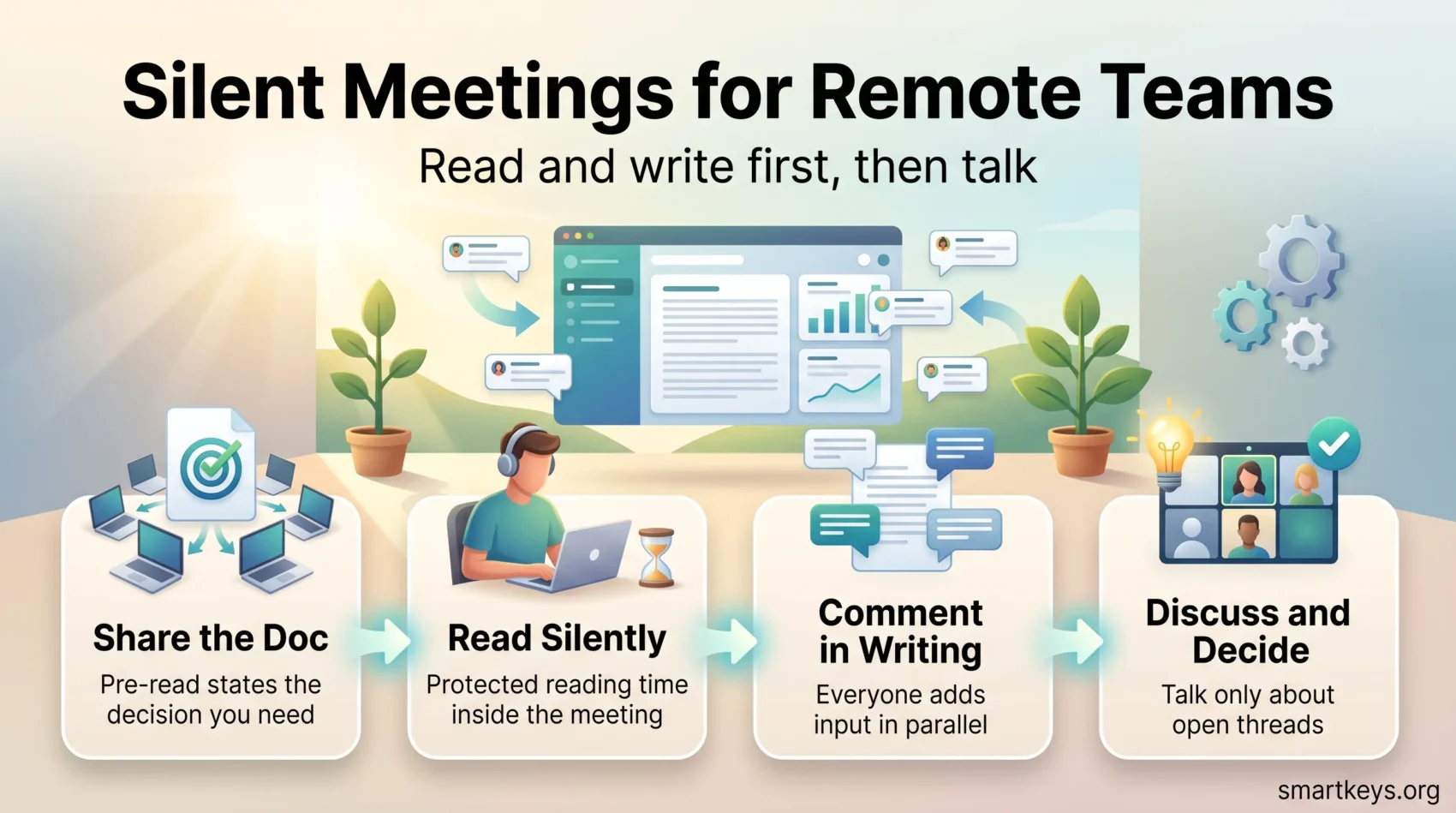
Silent meetings replace most of the talking with structured reading and written input. Participants work through a shared document, add their comments in writing, and only open their microphones once everyone has had the same chance to think. For remote teams that removes two things which quietly wreck video calls: the person who speaks first setting the frame for everyone else, and the person on a lagging connection never finding a gap to talk.
The format is not an experiment. Amazon has run meetings this way for years, opening with a six-page narrative memo that everyone reads in silence before any discussion starts. Jeff Bezos described the practice as “the smartest thing we ever did” in a 2019 CNBC interview. The reasoning is simple: a written argument can be examined, while a confident presentation mostly gets applauded. This guide shows how silent meetings work for remote teams, when to use them, and how to run a silent meeting step by step.
Key Takeaways
- A silent meeting spends most of its scheduled time on reading and written comment, not on speaking.
- Idea-generation research points to production blocking, the loss that happens when only one person can speak at a time and ideas are forgotten while people wait their turn. Written input avoids that queue.
- The format fits pre-reads, written proposals, complex decisions and early idea generation. It fits team building and urgent troubleshooting badly.
- Writing first levels the field for non-native speakers, quieter colleagues and anyone on a weak connection.
- Silent meetings only work with a real agenda, a document circulated in advance and someone facilitating the discussion that follows.
Understanding Silent Meetings
A silent meeting is a working session, not a reading break. The document is the agenda, the comments are the discussion, and the spoken part exists to resolve what writing could not. It is one practical piece of asynchronous work: most of the thinking happens in writing, and live time is kept for what writing cannot settle.
What Defines a Silent Meeting?
The defining feature is proportion: more than half the scheduled time goes to individual reading and written contribution. Participants open a shared document, read it at their own pace, and leave comments, questions and objections in the margin. Only then does anyone speak, and the conversation starts from what people actually wrote rather than from whoever unmutes first.
That shift matters most for distributed teams. Remote attendees, non-native speakers and introverts all lose ground in a fast verbal exchange. In writing, everyone gets the same amount of airtime by default.
Key Components of a Silent Meeting
Four elements separate a silent meeting from a call where nobody talks:
- A document circulated in advance: the pre-read carries the argument, the data and the decision being asked for. A meeting built on a thin document produces thin comments.
- Protected reading time: allocate it inside the meeting rather than assuming people prepared. In a 30-minute session, roughly the first 10 minutes is a workable split.
- A facilitator: someone keeps time, groups the comment threads and decides which ones are worth discussing out loud.
- A tool everyone can use: a shared document with comment threads is usually enough. Anything that needs a tutorial will cost you more than it saves.
If you are already reviewing how your team spends its calendar, a meeting audit is a sensible place to work out which recurring sessions would survive the switch.
How Silent Meetings Work for Remote Teams
Running the format across time zones takes more preparation than a standing call, and less improvisation.
Running the Format in a Distributed Team
The facilitator shares the document early enough that people in other regions can read it during their own working hours. Comments accumulate asynchronously. The live session then covers only the threads that could not be closed in writing, which is often a fraction of the original agenda.
This is close to how asynchronous communication tools are meant to be used, and it pairs naturally with the constraints of teams spread across time zones. Microsoft’s Work Trend Index reported that nearly a third of meetings now span multiple time zones, up 35% since 2021. The more that is true of your team, the more a written first pass is worth.
Technology Requirements for Silent Meetings
You need less tooling than most teams assume:
- A shared document with threaded comments and version history.
- A place where decisions land afterwards, so the thread does not become the only record. A reusable meeting notes template handles this well.
- Digital whiteboards when the topic is visual rather than textual; the Miro and Lucidspark comparison covers the practical differences.
Resist the urge to add another platform for this. Tool sprawl is a real cost, and a silent meeting held in a document your team already uses will get adopted far faster than one that needs a new login.
The Advantages of Silent Meetings
The benefits are not about enforced quiet. They come from changing who gets heard and when.
Encouraging Diversity of Thought
Group idea generation has a well-documented weakness. Because only one person can speak at a time, the others wait. While waiting, they rehearse or forget what they wanted to say. Diehl and Stroebe’s work on production blocking traced much of the productivity loss in brainstorming groups to exactly this bottleneck, and reviews since have consistently found that people generating ideas individually before pooling them produce more distinct ideas than a freely interacting group.
Writing removes the queue. Ten people can comment on the same paragraph simultaneously, and the loudest voice no longer sets the frame for everyone who follows. Written input also travels: a good comment stays readable a week later, which is what makes it useful for organizational memory.
Leveling the Playing Field
In a normal call, participation is unevenly distributed and usually predictable: senior people, native speakers and extroverts take most of the floor. A written round gives every participant the same starting position, at their own pace, without having to interrupt anyone to be heard. That is also the practical foundation of a transparency culture: the reasoning is visible to everyone, not just to the people who were quick enough to say it out loud.
Improving Productivity with Silent Meetings
Silent meetings are usually shorter than the discussion they replace, because the slow part happens in parallel rather than in sequence.
Time Efficiency and Structure
A clear split (read, comment, discuss, decide) means nobody spends the first ten minutes working out what the meeting is for. Complex decisions in particular benefit: people can re-read the tricky paragraph instead of asking someone to repeat it.
The structure also exposes meetings that should never have been scheduled. If the document answers every question and the comments agree, you can cancel the call and keep the decision.
Reducing Meeting Noise and Distraction
Side conversations, tech interruptions and the running commentary of a large call all eat into a productive meeting environment. Microsoft’s Work Trend Index found that 57% of meetings are ad hoc calls with no calendar invite at all, and that workers are interrupted roughly every two minutes during core hours. A silent meeting is the opposite of that pattern: scheduled, documented and quiet by design. Applying the same discipline to chat keeps the gains from leaking away between sessions; our guide to instant messaging boundaries shows how.

Fostering Inclusivity in Remote Teams
Inclusion in a virtual setting is mostly a question of who can realistically speak. Silent meetings change that mechanically rather than by encouragement.
Effective Communication for Non-Native Speakers
A rapid discussion in a second language is exhausting and easy to fall behind in. Reading and writing let people process at their own speed, look up a term, and edit before they commit. Where language gaps are wide, real-time translation tools can carry the live portion, but the written round is usually the bigger win: text can be translated, re-read and quoted accurately in a way that a fast verbal exchange cannot.
Engaging Quieter Team Members
Colleagues who rarely interrupt are not colleagues without opinions. A written round gives them a route in that does not require competing for the floor, which is one reason the format is often recommended for teams thinking seriously about neurodivergent colleagues. Regular one-on-one check-ins are still needed alongside it. Silence in a document is not the same as psychological safety.
When to Implement Silent Meetings
The format is a tool, not a policy. Applying it everywhere is the fastest way to make your team resent it.
Best Scenarios for Silent Meetings
Silent meetings work best where thinking matters more than reacting:
- Idea generation, where parallel written input beats taking turns.
- Complex or contested decisions that need a written argument on the table.
- Design and document reviews, where comments anchor to specific lines.
- Smaller groups, and any session where participants span several time zones.
Limitations of Silent Meetings
The format is a poor fit for:
- Team building and relationship work, where the point is the interaction itself.
- Incidents and anything needing immediate back-and-forth.
- Groups that do not yet trust each other enough to write down a disagreement.
- Sensitive personal conversations, which belong in a call.
Used in the wrong place, a silent meeting reads as coldness rather than focus. Match the format to the work.
Planning and Organizing Silent Meetings
Most failed silent meetings fail before they start, because the document was not ready or the purpose was not clear.
Creating an Effective Agenda
- State the decision: say what you want to leave the meeting having agreed.
- Allocate the time: reading, commenting, discussion and close, in minutes.
- Send it early: late enough to be current, early enough for other time zones.
Building in time for individual thought is the point of the exercise, not a courtesy. Deciding in advance whether a topic even needs a live session is a question of choosing between email, chat and a meeting.
Facilitators and Roles
- Facilitator: keeps time, clusters the comments and picks what gets discussed aloud.
- Note taker: records decisions and owners, not the conversation. AI meeting notes can cover the live portion.
- Timekeeper: protects the reading block from being cut short.
On a small team one person can hold two of these roles. What does not work is nobody holding them.
Best Practices for Silent Meetings
Using Technology Effectively
Use the document tool your team already lives in, and set comment permissions so everyone can write rather than only suggest. Keep one canonical version. A silent meeting run across three copies of the same file produces three separate conversations. Where people take their own notes alongside the shared document, a consistent digital note-taking habit makes the follow-up much easier.
Encouraging Participation and Feedback
Explain the format before the first session, and say plainly that reading time is working time. People who have never done this often feel guilty about the silence. Close by summarising decisions and owners in the document itself, and ask afterwards whether the format helped. Teams that treat it as an experiment they can adjust stick with it; teams that have it imposed usually drift back to talking. The connection to remote employee engagement is direct: people stay engaged with meetings where their contribution visibly changed the outcome.
Challenges of Silent Meetings for Remote Teams
Potential Issues with Engagement
Silence can read as disengagement, and it genuinely hides it. Someone who skims the document and writes nothing is invisible in a way they would not be on a call. The counter is a short spoken round at the end, and a facilitator who notices who has not contributed twice in a row rather than once.
The format also suppresses the spontaneous tangent that occasionally produces the best idea in the room. Keep some sessions conversational on purpose.
Accessibility Considerations
A written-first meeting shifts the accessibility burden rather than removing it. Screen reader users depend on the document being properly structured, with real headings and described images. Colleagues with dyslexia may need the pre-read further in advance, not the same ten minutes as everyone else. Anyone on a slow connection needs a document that loads without a live collaboration session. Check these before you standardise the format, not after someone quietly stops attending.
Conclusion
Silent meetings are a narrow tool with a specific effect: they change who gets heard, and they force an argument to survive in writing before it survives in a room. In distributed teams, airtime depends on connection quality, language and time zone as much as on seniority. That makes the effect worth more than it sounds.
Start with one recurring meeting that already has a document attached to it. Run it silent for a month, ask the team, and keep what works. For the wider context of how distributed work has settled, see our overview of the state of remote work.
Found this useful?
Make SmartKeys a preferred source on Google, and our articles will surface more often in your Top Stories, AI Overviews, and AI Mode.
Add as Preferred Source