The blank page is rarely a speed problem. It is a decision problem. When you sit down without knowing what the first paragraph has to do, the session goes on choosing rather than writing.
This guide is about writing faster by making fewer decisions while you type. It works the same for a proposal, a team update or a blog post. The method has two halves: settle what the piece needs before you draft it, then draft without stopping to judge the result.
One number sets the expectation. Researchers at Aalto University and the University of Cambridge analysed the typing of 168,000 volunteers and found an average of 52 words per minute. At that pace, a 1,000 word draft is about 20 minutes of typing. If it takes three hours, the extra time went into deciding.
Key Takeaways
- The blank page is a decision problem, not a typing problem. At 52 words per minute, 1,000 words take about 20 minutes to type.
- Write a complete rough draft before you fix any part of it. The draft’s only job is to exist.
- A three-point outline helps most on unfamiliar topics. On subjects you know well, the gain is small.
- Draft in one pass: no deleting, no looking things up. Type TK where a fact is missing and keep going.
- Leave the draft overnight before editing, so you come back as a reader instead of the author.
Why a Draft-First Approach Works
A draft-first approach means producing a complete rough version before improving any part of it. The draft is allowed to be bad. Its only job is to exist, so you have something to react to.
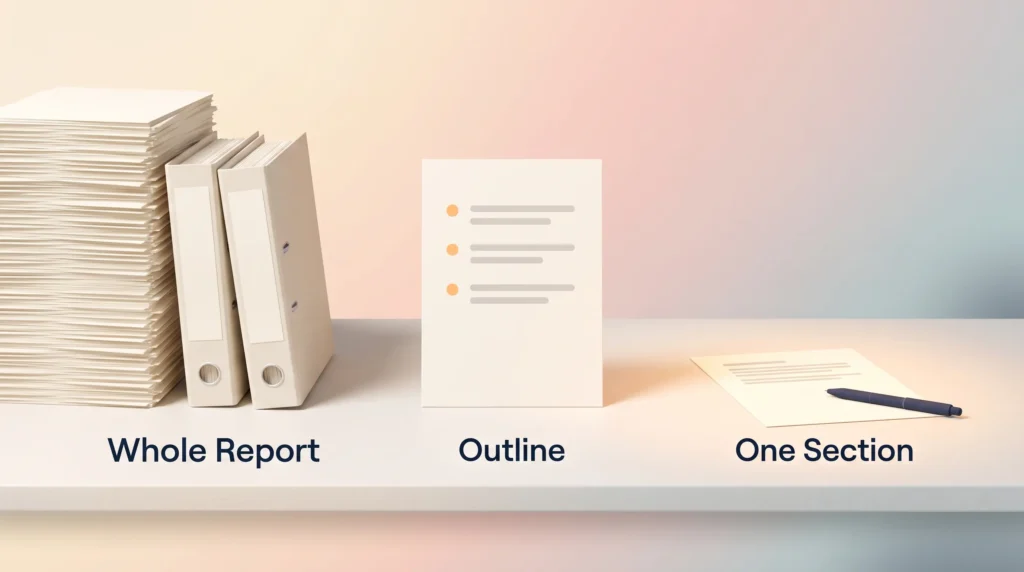
There is research behind the habit. The psychologist Ronald Kellogg studied what happens when writers sketch a structure before drafting. An outline lets a writer spend more of the session generating sentences, because the shape of the text is already settled. Kellogg also names the limit: the gain shrinks when you already know the topic well. Outlining pays off most on unfamiliar material, where blank pages happen.
The second half of the method is size. Instead of “write the report”, pick a unit you can finish in one sitting: one section, one argument, one worked example. Shawn Coyne’s Story Grid method does this for fiction with a one page planning sheet called the Foolscap. Name the next unit precisely and the session starts itself, the same logic behind the daily highlight technique, where you commit to one meaningful task per day.
Proven Strategies for Writing Faster
Four habits do most of the work. Each removes a decision from the moment you are least able to make it.
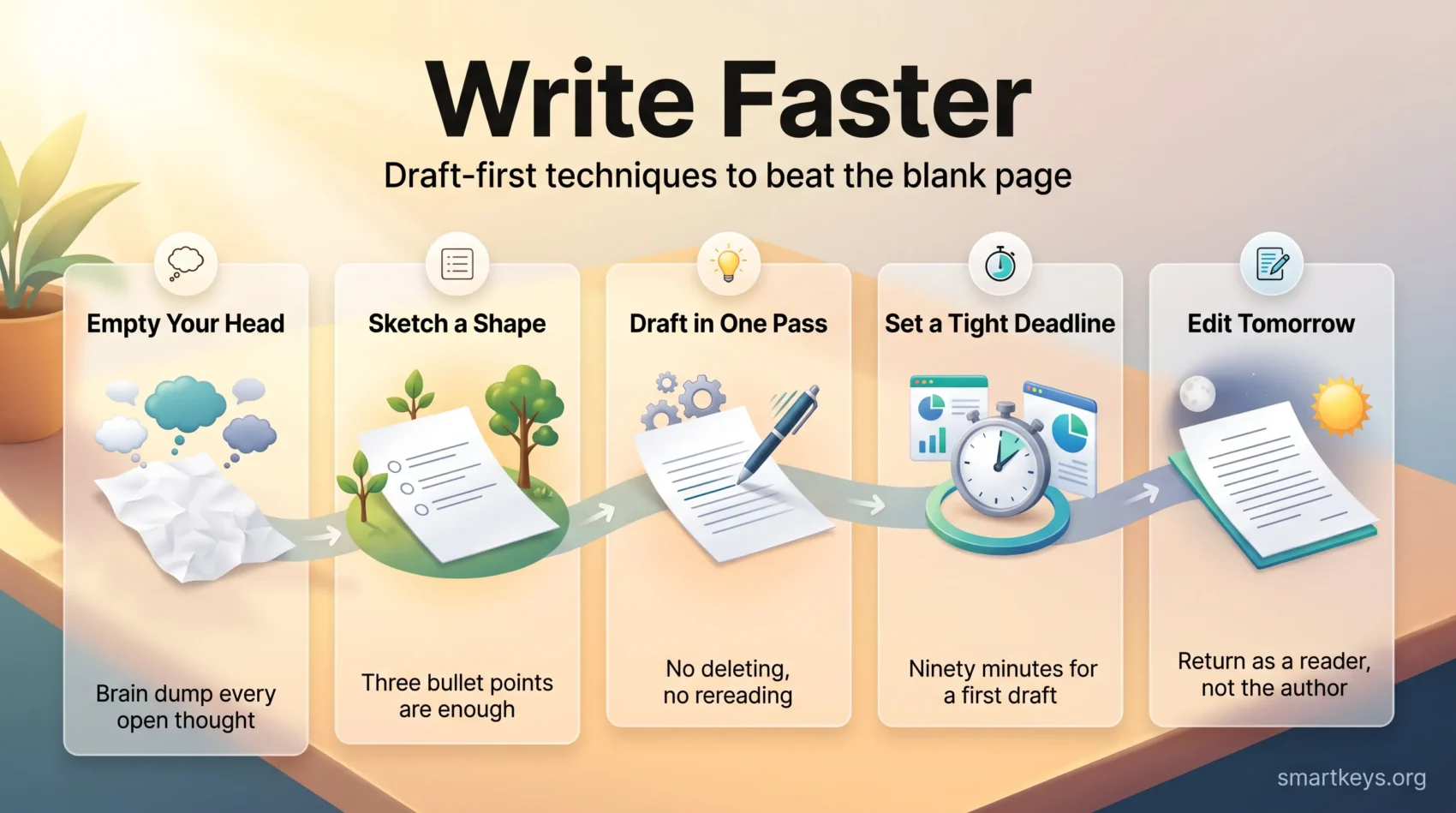
Empty your head, then sketch a shape. A brain dump, writing every open thought down in one pass, takes five minutes and turns a vague topic into raw material. The outline that follows can be three bullet points. If a list does not fit, sketch it: mind mapping breaks a complex idea into parts, and visual thinking shows how those parts connect.
Draft in one pass. No deleting, no rereading, no looking up the exact figure. Mark gaps with a placeholder such as TK and keep going. This is single-tasking, doing one thing at a time instead of switching, and it is the biggest speed gain most writers have available.
Set a deadline that is slightly too short. Work stretches to fill the time you give it, which is why shorter deadlines often produce the same output. Ninety minutes for a first draft is uncomfortable, and that is the point.
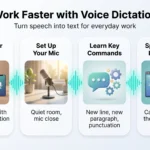
Say it before you write it. Most people speak faster than they type, and more plainly. Voice dictation turns speech into a rough draft, and a messy transcript is easier to edit than an empty document.
Tools That Support a Draft-First Process
Tools cannot decide what you want to say. They remove setup work, which matters when writing time comes in small pieces.
Digital Outlines and AI Assistance
Generative writing tools are good at the part people dread: the first shape. Jasper sells a Blog Post Agent that drafts a structure from a topic and a goal, and Byword generates long-form drafts from a keyword or brief. Treat the output as an outline you argue with. Generated prose is generic and can state things that are not true.
Templates and Snippets
If you write the same thing every week, never start from zero. A stored skeleton for a status update or a proposal answers half your structural questions. For phrases you retype constantly, text expansion turns a few keystrokes into whole blocks of text.
Timers and Cleanup
A timer converts an open-ended task into a bounded one. The Pomodoro Technique, developed by Francesco Cirillo, uses 25 minutes of uninterrupted work then a five minute break. Any fixed block works if you defend it. For the editing pass, the Hemingway Editor flags long sentences and hard-to-read paragraphs. Use it after the draft, never during. Keep sources findable with a digital note-taking system.
Optimizing Your Writing Sessions
A method survives only if it has a slot in the week. Three things decide whether that slot holds.
Book it like a meeting. “I will write more this month” produces nothing. Pick a day, a start time and one named unit of work. Weekly planning gives each priority a place before the week fills up. Long unbroken blocks matter more for writing than for most work, the argument behind the maker versus manager schedule.
Write when your attention is available. Most people get a few hours a day when hard thinking is cheap. Protect those for drafting and push admin elsewhere. That is the practical meaning of managing your energy rather than only your time.
Cut interruptions before they arrive. A drafting session cannot survive constant pings. Set up a focus profile on your phone, agree response-time expectations for chat, and let website blockers remove tempting sites. Deciding which notifications deserve to reach you is a one-time job with a long payoff.
Why Drafting and Editing Do Not Mix
Drafting and editing pull in opposite directions. Drafting wants volume and forward motion. Editing wants judgment and cutting. Doing both at once means you write a sentence, delete it, write it again, and end the hour with one polished paragraph and no article.
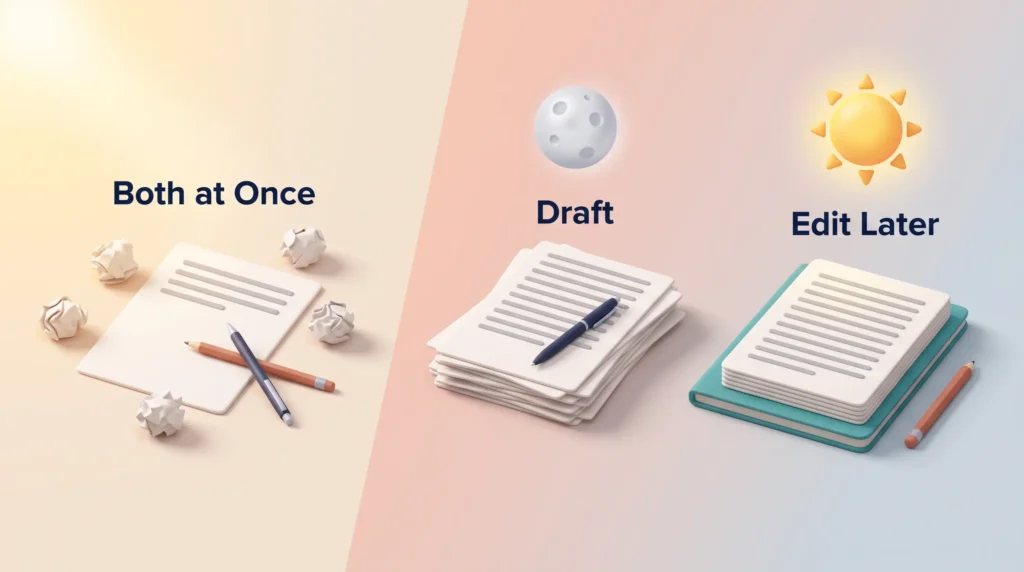
The fix is a gap. Draft, then leave the text alone for a few hours, ideally overnight. You come back as a reader rather than the author, and the weak parts become visible. If you cannot wait, print it or read it aloud.
Perfectionism is the usual reason people refuse the gap, and it is often procrastination in a respectable coat. Polishing paragraph one for the fifth time feels like work while postponing paragraph two. Staying with one text for a full hour is its own skill, and training your attention span plus a few focus tools beats any writing app.
Conclusion
Writing faster is not typing faster. At 52 words per minute, typing was never the constraint. The time goes into decisions, and a draft-first process moves them out of the drafting hour.
Start small: empty your head, sketch three bullet points, set a timer, and write one section without deleting anything. Name the next unit before you close the file, so tomorrow starts with a task instead of a question.
Found this useful?
Make SmartKeys a preferred source on Google, and our articles will surface more often in your Top Stories, AI Overviews, and AI Mode.
Add as Preferred Source