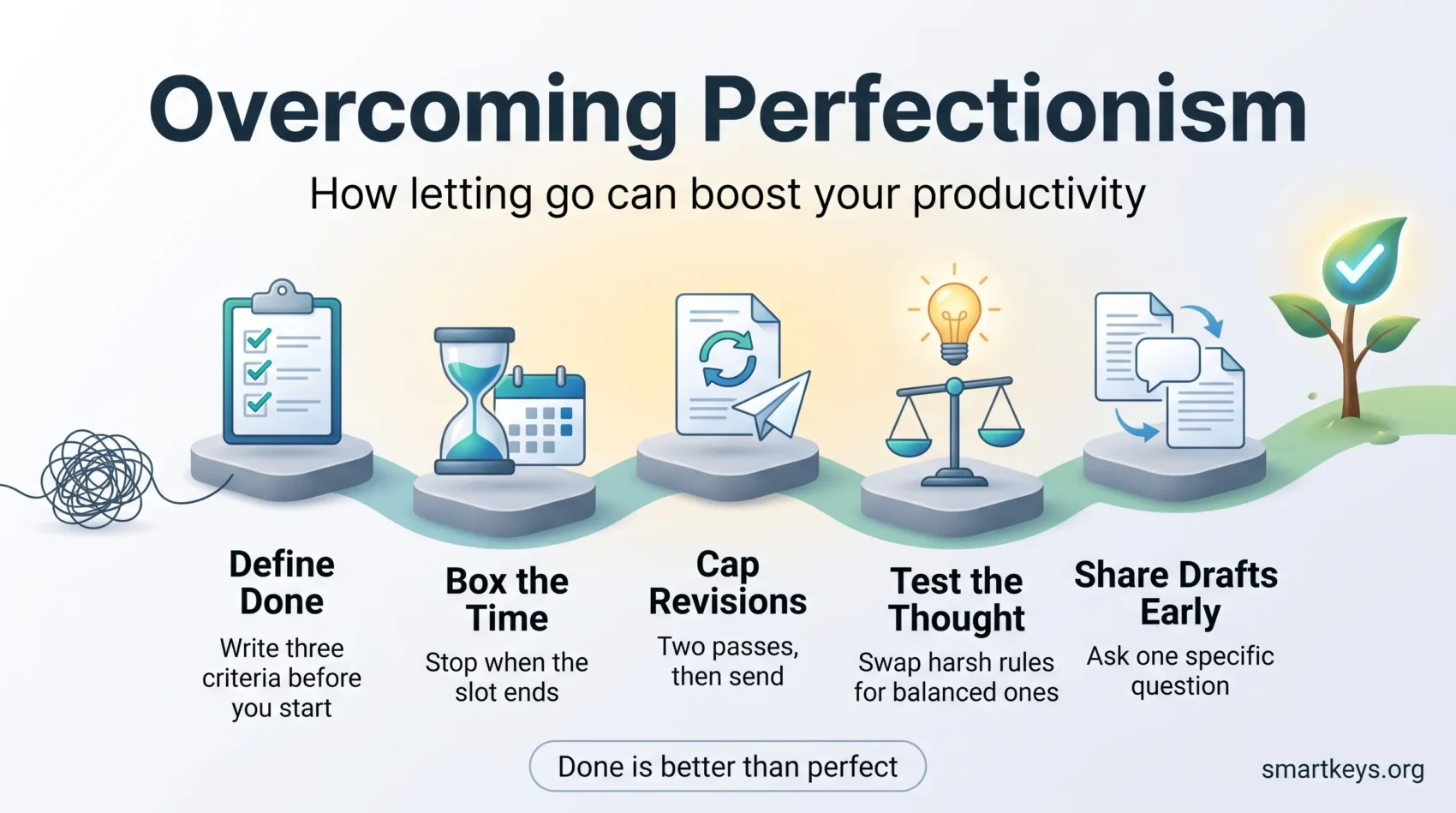
Perfectionism ties your sense of worth to flawless output. So you put off starting, over-edit what you have, and hold back work that is already good enough.
That habit is expensive. Research links it to more stress, more anxiety and lower well-being. Newer workplace research adds a blunter finding: perfectionists put in longer hours, and those extra hours do not show up as better results.
This guide explains the difference between high standards and perfectionism. It shows what the pattern costs you at work, where it comes from, and which habits loosen its grip.
Key Takeaways
- Perfectionism is not the same as high standards. It is high standards plus harsh self-judgment when you fall short.
- Researchers split it in two: perfectionistic strivings (setting demanding goals) and perfectionistic concerns (fearing mistakes and judgment). The second one does the damage.
- A 2025 meta-analysis of 26 studies found perfectionist employees work longer hours without performing better.
- Fear of falling short predicts procrastination. Having high goals does not.
- The fixes are small and practical: define “done” before you start, box the time, and cap your revisions.
Perfectionism versus high standards
Wanting to do good work is not a problem. The problem starts when anything short of flawless feels like failure.
Psychologists measure two separate things here. Perfectionistic strivings means setting demanding goals for yourself. Perfectionistic concerns means fearing mistakes and criticism, and reading a near miss as proof that you are not good enough.
Strivings on their own are fairly harmless. Concerns are the part that costs you time, sleep and confidence. Most of what people call perfectionism is really the second one.
The same standard, a very different cost
A high achiever finishes a report, notes two things to do better next time, and sends it.
A perfectionist finishes the same report, rereads it four times, rewrites one heading twice, and sends it two days late still convinced it is weak.
Both wanted good work. Only one of them paid two days for it. If you want the wider picture of how beliefs about ability shape output, our guide to building a growth mindset at work covers the research on effort and improvement.
What perfectionism actually costs you at work
The case against perfectionism is not that it makes you lazy. It is that it makes you slow, tired and no better off.
Longer hours, no better results
This is the finding that should change how you think about it. A 2025 meta-analysis by Bellam and Curran in the Journal of Occupational and Organizational Psychology pooled 26 studies covering close to 10,000 workers. Perfectionist employees consistently worked longer hours. Those hours did not turn into better performance.
The two dimensions behaved differently. Perfectionistic strivings showed a modest positive link to performance, including task completion and creative output. Perfectionistic concerns showed no performance benefit at all, while still adding stress and hours.
An earlier review reached a similar verdict. Harari and colleagues, writing in the Journal of Applied Psychology in 2018, found that perfectionism has sizable and consistent relationships with many workplace factors but an equivocal relationship with job performance. Put plainly: it changes a great deal about how work feels, and very little about how well it turns out.
The procrastination loop
Perfectionism and delay feed each other. You avoid starting because a rough first version would feel like evidence against you. The delay makes the task loom larger, which makes starting harder still.
The evidence points at the fear, not the ambition. A 2017 meta-analysis by Sirois and colleagues in the European Journal of Personality found that procrastination rose alongside perfectionistic concerns (r = .23 across 43 studies). It fell slightly as perfectionistic strivings rose (r = -.22 across 38 studies).
Worth reading twice. High goals do not make you procrastinate. Fear of falling short does. Our guide to overcoming procrastination goes deeper into the triggers and the ways out.
Burnout
Hill and Curran pooled 43 studies for a meta-analysis in Personality and Social Psychology Review. Perfectionistic concerns predicted burnout in school, in sport and at work. The link was strongest in workplaces, where recognition and support tend to be thinnest. Perfectionistic strivings had a small protective effect.
If you already feel close to empty, start with recovery rather than technique. Our guides to managing stress at work and using short breaks to restore focus are the better first step.
Why more people run into this now
Curran and Hill analysed responses from 41,641 college students in the United States, Canada and the United Kingdom, collected between 1989 and 2016. Their 2019 paper in Psychological Bulletin reported that self-oriented perfectionism rose by 10 percent and other-oriented perfectionism by 16 percent over that period.
Socially prescribed perfectionism rose by 33 percent. That is the belief that other people demand perfection from you. It is also the dimension most closely tied to anxiety and low mood. If the pressure feels external, that is not only your imagination.
Where the habit comes from
Perfectionism is learned, which is the good news. It is a pattern, not a fixed trait.
Many people trace it to conditional approval. As a child, praise arrived for results rather than for effort. Over time that teaches a simple rule: I am acceptable when my output is flawless. The rule outlives the situation that created it.
Overcontrolling adults can have the same effect. Their control feels like safety at first. Later it becomes an internal voice that supervises everything you produce.
The thinking traps that keep it running
Four common distortions do most of the work:
- All-or-nothing thinking: anything less than perfect counts as failure.
- Mental filtering: you scan a page of praise and see only the one critical line.
- Labeling: a mistake makes you careless rather than someone who made a mistake.
- Should statements: rules you never agreed to, applied without exception.
Naming the distortion is most of the cure. Once you can say “that is mental filtering,” the thought loses some of its authority.
How to loosen the grip
None of these steps require you to lower your standards. They change when you stop, not how well you aim.
1. Define “done” before you start
Write three criteria that make the task finished. For a client email: answers the question, names the next step, fits on one screen. Decide this before you write, while you are still calm.
Vague standards are what create endless editing. You cannot hit a target you never described. Our guide to breaking large goals into achievable steps covers how to set markers you can actually reach.
2. Put the work in a box
Give the task a fixed slot and stop when it ends. A 25 minute Pomodoro interval works well for small pieces. For bigger ones, time blocking or a team-wide focus time policy protects the block from interruptions.
A time box does something subtle. It moves the decision from “is this perfect yet” to “has the slot ended,” and only the second question has a clear answer.
3. Cap your revisions
Two passes, then send. First pass for structure, second for clarity. Anything you notice after that goes on a list for next time.
This single rule saves more hours than any app. It also protects the deep, uninterrupted stretches that hard work needs, which our guide to deep work explains in more detail.
4. Test the thought
Cognitive behavioural therapy, a structured approach to changing unhelpful thinking patterns, offers a simple check you can run alone.
Write the thought down. Ask what evidence supports it and what contradicts it. Then write a balanced version. “If it is not perfect, I failed” becomes “this meets the brief, and feedback will make the next one better.”
Doing this on paper matters. A short work journal makes the pattern visible over weeks rather than minutes.
5. Dare to be average on low-stakes work
Pick tasks where the cost of a small flaw is genuinely low. Internal notes, first drafts, routine updates. Deliberately do them to a solid but unpolished standard for 30 days.
You are gathering evidence. Almost nobody notices, and the time you save is real. That evidence is what changes the belief, not willpower.
Make the evidence visible. Keep a short log of what you sent on time, and give yourself a small reward for finishing rather than for polishing: a proper break, a walk, an early end to the day. This is positive reinforcement, rewarding the behaviour you want more of so it becomes the easier default.
Every extra hour spent polishing an internal note is an hour taken from work that actually moves something forward. Economists call this opportunity cost: the value of what you give up when you choose one use of your time over another. The 80/20 rule is a quick way to spot the few tasks where extra care really pays off.
Deciding which work deserves polish in the first place is a prioritization question, and treating every task as equally important is the fastest route back into the trap.
6. Show the draft early
Send an unfinished version with one specific question attached. “Is this the right structure?” beats “any thoughts?” by a wide margin.
Early feedback prevents hours of polishing in the wrong direction. It also breaks the isolation that lets a harsh internal standard go unchallenged. If one trusted colleague knows you are working on this habit, they can act as an accountability partner and ask “did you send it?” instead of “is it perfect?” Treating each round as one improvement rather than a verdict is the habit our guide to continuous improvement describes.
When your standards become other people’s problem
Other-oriented perfectionism is the version you apply to colleagues. It strains relationships and slows teams, usually without producing better work.
Three things help. Agree on what “done” means together, before the work starts, so nobody is guessing at your private bar. Replace global judgments with specific requests: “the summary needs the numbers” lands better than “this is sloppy.” And hand over whole tasks rather than fragments, which our guide to effective delegation covers in practice.
Protecting your own limits matters too. Setting clear boundaries and learning to say no without damaging the relationship reduce the overload that makes perfectionism worse.
When to consider professional help
Self-help tactics have limits. Consider talking to a professional if self-criticism is persistent, if it stops you functioning at work or at home, or if you avoid tasks because nothing ever feels good enough. Ongoing low mood, sleep problems and intrusive standards are all reasons to seek support, as are changes in eating driven by the same pressure.
The good news is that this responds well to treatment. Galloway and colleagues reviewed 15 randomised controlled trials in Cognitive Behaviour Therapy in 2021. Cognitive behavioural therapy aimed specifically at perfectionism produced medium to large reductions in perfectionism itself, along with medium reductions in depression symptoms and smaller reductions in anxiety.
Bringing two or three concrete examples to a first session helps. Note the situation, the thought and what you did.
Conclusion
Perfectionism is not high standards. It is the fear that attaches itself to them, and the evidence says that fear buys you longer hours rather than better work.
Start with one change today. Write three criteria for “done” on your next task, set a timer, and stop when it rings. That single experiment does more than any amount of resolve, because it produces evidence you can see.
Keep one line handy: done is better than perfect. For the wider set of habits that make an ordinary week work, our guides to self-management, staying motivated through the workday and the productivity advice that does not hold up are good next reads.
Found this useful?
Make SmartKeys a preferred source on Google, and our articles will surface more often in your Top Stories, AI Overviews, and AI Mode.
Add as Preferred Source