Staying motivated through a full workday is less about willpower than most advice suggests. It depends on how your day is structured, how often you are interrupted, and whether the work in front of you feels like it is going somewhere. Gallup’s State of the Global Workplace 2026 report put global employee engagement at 20% in 2025, down from 21% the year before and from a 23% peak in 2022 and 2023. Most people are not fighting a personal motivation problem. They are working inside conditions that quietly drain it.
A lot of what drains motivation does sit inside your own control: the size of the tasks you set, when you schedule the hard ones, and whether anyone else knows what you are working on. This guide covers the practices that hold up, at home or in an office, and the evidence behind them.
Key Takeaways
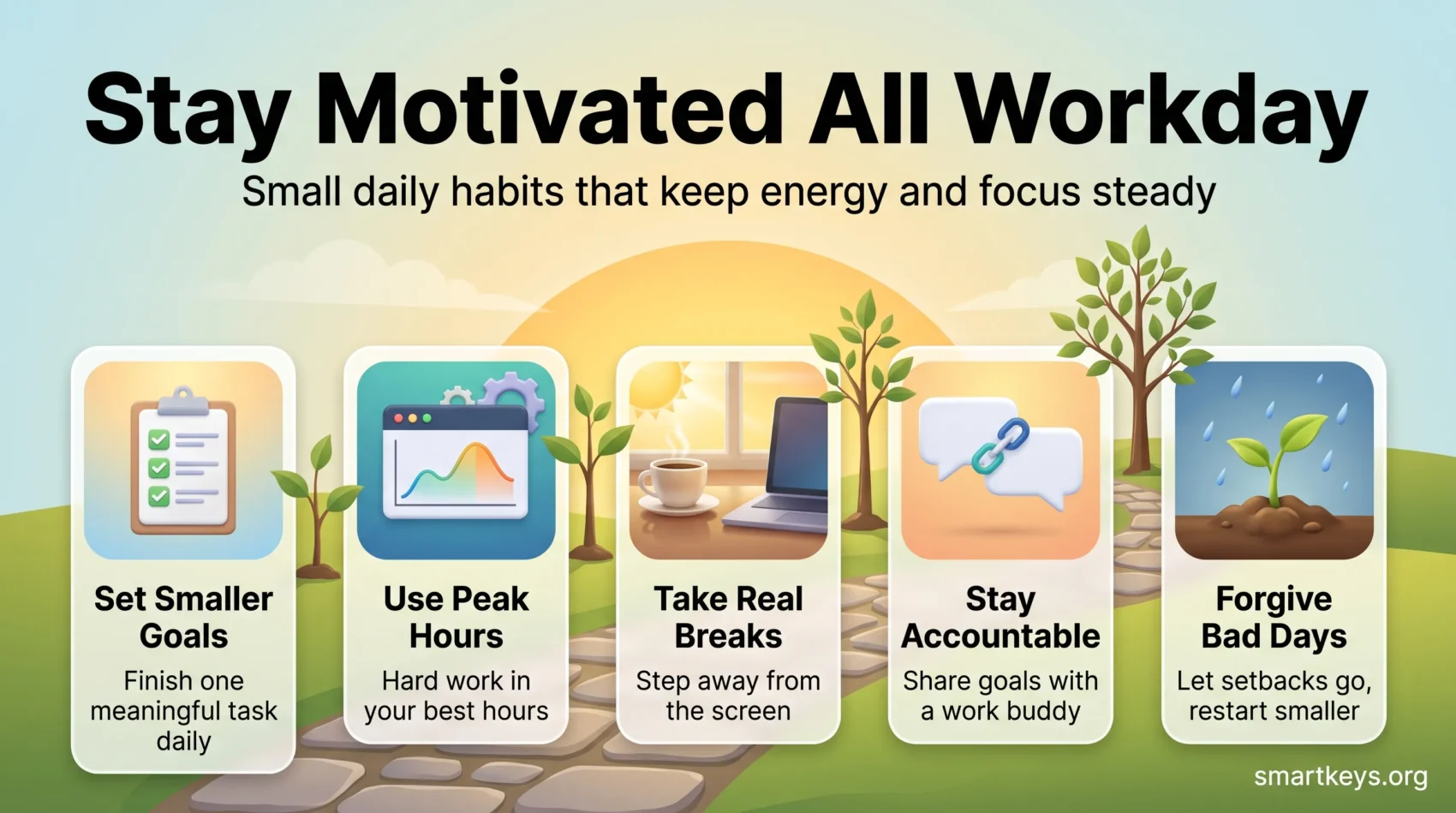
- Break large projects into tasks small enough to finish today; visible progress is the strongest daily motivator.
- Schedule demanding work during your own peak hours rather than fighting your energy curve.
- Take real breaks. The research supports them clearly for energy and fatigue, less so for raw output.
- Set up a workspace and work hours you can defend, especially at home.
- Tell someone what you are working on; accountability outperforms private intentions.
- Move during the day. Physical activity supports mood and alertness at doses most people can manage.
- Forgive yourself after a bad day. Self-criticism predicts more delay, not less.
Understanding the Importance of Staying Motivated
Motivation is not a mood that arrives on its own. It is the product of what you are working on, how much say you have over it, and whether you can see it moving. When it drops, the work starts to feel heavier than it is.
The most useful distinction is between extrinsic and intrinsic motivation. Extrinsic drivers such as pay, deadlines or praise work, but they tend to be short-lived and they fade when the reward stops. Intrinsic motivation comes from the work itself: interest in the problem, a sense of getting better at something, some control over how you do it. That second driver, the belief that effort makes you better at things, is the heart of building a growth mindset for productivity, and it is what keeps motivation from depending on outside rewards. Decades of research in self-determination theory, developed by Edward Deci and Richard Ryan, point to autonomy, competence and relatedness as the conditions under which it holds up.
You cannot always change what you are assigned, but you can often change how visible your progress is and who you do it alongside. Gallup’s data adds one more piece worth knowing: manager engagement fell from 31% in 2022 to 22% in 2025, a steeper drop than for individual contributors, who moved from 20% to 19% over the same period. If your manager seems disengaged, that is a documented pattern rather than a reflection on you, and a reason to build motivation practices that do not depend on someone else supplying them.
Set Smaller Goals for Daily Success
Large projects are demotivating for a simple reason: on any given day, you cannot finish one. Breaking a project into pieces you can complete today converts a vague obligation into a sequence of finishable tasks. This is the core of practical goal setting, and it is where most daily motivation is won or lost.
The Power of Bite-Sized Tasks
Edwin Locke and Gary Latham’s 2002 paper in American Psychologist, reviewing 35 years of goal-setting studies, found that specific and moderately difficult goals reliably produce better performance than vague encouragement to do your best. “Improve the onboarding flow” is not a goal. “Rewrite the three error messages in the signup form” is.
The practical test is whether you know what the first action is. If you do not, the task is still too big and needs breaking down into smaller steps before it goes on your list.
Feeling Accomplished with Smaller Objectives
Teresa Amabile and Steven Kramer’s work on the progress principle, drawn from diaries kept by knowledge workers and published in Harvard Business Review in 2011, found that nothing influenced people’s motivation and emotions at work more than making progress in meaningful work. The progress did not need to be dramatic. Small steps forward on work that mattered to the person were enough to change how the day felt.
That is a strong argument for structuring your list so something gets finished every day, rather than leaving three large items open for a week. Pick one task you intend to complete, and treat everything else as a bonus.

Take Regular Breaks to Recharge
Breaks matter for motivation mainly because of how they make you feel. A 2022 meta-analysis by Albulescu and colleagues in PLOS ONE, pooling 22 samples and 2,335 participants, found that micro-breaks gave small but reliable gains in vigour and less fatigue, while the effect on raw performance was not significant. Longer breaks helped output more, especially after draining cognitive work.
For staying motivated across a full day, the practical rules are simple: put breaks in the calendar so they actually happen, and leave the screen during them. A break spent answering messages is not recovery. How to design breaks that restore focus is covered in our guide to short breaks that sharpen focus, and movement breaks add the benefit of getting you out of the chair. If a fixed rhythm helps you start, the Pomodoro Technique or time blocking both build breaks into the plan.
Create a Workspace That Inspires You
Your environment does quiet work on your motivation. An uncomfortable chair, poor light or a permanently cluttered desk adds friction to every task, and friction is what motivation gets spent on. Two changes pay off fastest: a defined work zone, so sitting down there signals the start of work, and a desk you reset each evening so tomorrow starts clean. This matters most in a home office; the details of ergonomics, lighting and layout sit in our guide to workspace optimization.
Understand Your Productive Hours
Energy is not flat across a day, and treating it as if it were is a reliable way to waste your best hours. Most people have a window where demanding work is noticeably easier, and another where it is a grind.
Finding yours takes about two weeks of rough notes: rate your energy and focus a few times a day and look for the pattern. The rule is then simple. Put your hardest work in the peak window and defend it; email, admin and routine tasks belong in the trough.
For most people the trough lands after lunch, and there are practical ways to work with the afternoon slump rather than against it. A short walk, a change of task type, or a few minutes of meditation often does more than another coffee. Thinking in terms of energy management rather than time management changes how you build the day.
Focus on High-Impact Tasks
Motivation survives on the sense that your effort is going somewhere. A day spent entirely on small urgent things ends with the feeling of having been busy without moving.
Identifying What Matters Most
The distinction to make is between urgent and important. Urgent work announces itself; important work usually does not. Review your week and ask which tasks advanced a goal you care about, and which simply arrived loudly.
Prioritizing Tasks for Greater Motivation
Once you know which tasks carry the weight, order your list so they come first, before the day fills up. Doing the hardest important task early, sometimes called eating the frog, means the rest of the day runs downhill rather than uphill. Our guide to prioritization covers the frameworks in more depth.
Staying Motivated Through Accountability
Private intentions are easy to renegotiate. Once someone else expects an update, the calculation changes. Accountability is one of the few motivation levers that works even on days when you feel nothing.
Finding a Work Buddy
Pairing up with a colleague costs almost nothing and adds a light, regular obligation to say what you are working on. It also addresses the isolation of remote work, which Gallup links to lower wellbeing even among otherwise engaged remote staff. A weekly exchange of goals is enough; an accountability partner does not need to be a formal arrangement.
Setting Up Regular Check-ins
Regular check-ins keep the commitment alive and give you a place to adjust the plan before it fails quietly. Keep them short and specific: what you finished, what is blocked, what you are committing to next. Any shared task board works for making progress visible.
Invest in Your Daily Routine
A routine reduces the decisions you make before the real work starts. That is its main benefit: not discipline, but fewer negotiations with yourself first thing in the morning.
The Role of Morning Rituals
A morning ritual does not have to be elaborate. Something that wakes you up properly, something that sets the day’s intention, and a clear signal that work has started is enough. Journaling, a short walk or a few minutes of quiet all work; the specific practice matters less than doing the same thing consistently. Habit stacking, attaching a new habit to one you already do, is the most reliable way to make one stick.
Preparing Nourishing Meals and Snacks
Preparing food in advance removes a recurring midday decision and makes it likelier you eat something that carries you through the afternoon rather than flattening you. Heavy lunches and long gaps between meals both show up as a dip in focus hours later. Our guide to nutrition and productivity covers what the evidence supports and what it does not.

Get Moving: The Physical Activity Factor
Movement is one of the few habits that improves mood, alertness and sleep at the same time, and all three feed straight into how motivated you feel at your desk. Treat it as maintenance rather than a stimulant: one workout will not rescue a flat afternoon, but a regular routine makes flat afternoons rarer. The World Health Organization’s 2020 guidelines recommend 150 to 300 minutes of moderate activity a week for adults, roughly a brisk half-hour walk on most days. During the workday, standing up to stretch every hour or so is enough to break the stiffness of sitting. Our guide to exercise and productivity goes further into what the evidence supports.
Creating Clear Boundaries Between Work and Home
When work and home share the same space and the same hours, the day never really ends. Motivation erodes because there is no point at which you are finished. A fixed end time, work notifications switched off after it, and colleagues who know your hours are what create that finish line.

Boundaries only hold if other people know about them, so say them out loud rather than hoping they are inferred. More on setting boundaries that last for months, not weeks. If the boundary has already collapsed and the tiredness does not lift after rest, take it seriously as burnout rather than a motivation problem.
Recognize and Celebrate Small Wins
Marking completed work sounds sentimental until you consider the alternative: finishing something and immediately moving on, so the day registers only as what is still outstanding. That is how a productive week ends with you feeling behind.

Rewarding Yourself for Completed Tasks
The reward does not need to be large. Crossing something off, taking the break you earned, or keeping a short record of what you finished each day all serve the same purpose: making progress visible to yourself. Amabile and Kramer’s finding applies directly here, because progress only motivates if you notice it. A simple done-list, written alongside your to-do list, is often more useful than an elaborate reward system. If you want to design rewards more deliberately, these positive reinforcement techniques for work show which kinds of rewards keep motivation going and which backfire.
Building Momentum with Acknowledged Successes
Recognition works between people as well as within them. Telling a colleague specifically what they did well costs nothing, and Gallup’s research identifies recognition as a factor separating engaged teams from disengaged ones.
Be specific. “Thanks for rewriting that section, it reads much better” lands; “great work” does not.
Learning to Forgive Yourself
Every plan meets a bad week eventually. What you do next determines whether it stays a bad week.
Letting Go of Perfectionism
Perfectionism looks like high standards and functions like a brake. When the acceptable outcome is flawless, starting becomes risky and delay the safer option. Shifting the standard from flawless to finished gets work moving again, and our guide to overcoming perfectionism covers how to make that shift without dropping your standards entirely.
Building Mental Resilience
There is direct evidence for self-forgiveness here. A 2010 study by Michael Wohl, Timothy Pychyl and Shannon Bennett, published in Personality and Individual Differences, followed 119 students across two midterm exams. Among those who had procrastinated heavily before the first exam, students who forgave themselves for it procrastinated less before the second. Those who stayed self-critical were more likely to repeat the pattern, and reduced negative emotion appeared to explain part of the difference.
The practical implication runs against instinct: after a wasted day, the productive response is to let it go rather than to punish yourself for it. Treating setbacks as information rather than verdicts is what keeps a bad week from becoming a bad month, and it is a habit that positive thinking at work makes much easier to keep.

Conclusion
Motivation is not a resource you top up once and spend down. It is a by-product of conditions you can influence: tasks small enough to finish, hard work scheduled when you can actually do it, breaks that are real breaks, someone who knows what you committed to, and a finish time you respect.
None of these require unusual discipline, only deciding once and then defending the decision. And when a day goes badly, which it will, the evidence is clear that being hard on yourself makes the next day worse rather than better. Start with one change, and make it the one nobody wants to make: put your hardest task in your best hour and let the inbox wait.
Found this useful?
Make SmartKeys a preferred source on Google, and our articles will surface more often in your Top Stories, AI Overviews, and AI Mode.
Add as Preferred Source