Getting people to repeat their best work is mostly a question of what happens right after they do it. Positive reinforcement at work means adding something the person values immediately after a behavior you want to see again, so the behavior becomes more likely. Applied honestly, it is one of the few motivation techniques with a serious evidence base behind it.
The stakes are clear in 2026. Gallup put global employee engagement at 20% in 2025, a second straight annual decline, with manager engagement down to 22%. Recognition is among the cheapest levers available, and it is badly underused: 81% of managers told Gallup and Workhuman it is not a major strategic priority at their organization.
This guide covers what positive reinforcement actually is, what the research supports, how to build a reward system that survives a real workweek, and where the approach backfires, with practical workplace examples along the way. Reinforcement shapes specific behaviors; for the broader belief that skills can be built through effort and feedback, see our guide to developing a growth mindset at work. If your day is already too fragmented to reinforce anything, start with a clearer approach to task management and come back to this.
Key Takeaways
- Reinforcement is defined by its effect on behavior, not by how generous it feels to give.
- Timing matters more than size: earlier rewards raise intrinsic motivation more than delayed ones.
- Well-recognized employees are 45% less likely to have left two years later, according to Gallup and Workhuman.
- Specific praise tied to an observable behavior outperforms generic encouragement.
- Recognition that feels inauthentic or unevenly distributed does more harm than none at all.
What Positive Reinforcement Actually Means
Positive reinforcement is a term from behavioral psychology, not a synonym for being nice. “Positive” means something is added rather than removed. “Reinforcement” means the behavior that preceded it becomes more frequent. If the behavior does not increase, whatever you added was not a reinforcer, however well intended.
That distinction is the practical heart of the method. A manager who praises everyone every Friday is adding something but reinforcing nothing in particular. A manager who says “the way you flagged the data problem before the client saw it saved us a week” has tied a consequence to a specific action, and that action is more likely to recur.
The Behavioral Principle Behind It
The framework comes from operant conditioning, developed by B.F. Skinner in the 1930s and 1940s. His core finding was that behavior is shaped by its consequences: what follows an action changes how often it appears. Positive reinforcement adds a desirable consequence. Negative reinforcement removes an unpleasant one. Punishment suppresses behavior but teaches nothing about what to do instead, which is why reinforcement is the more useful workplace tool.

Three Conditions That Make It Work
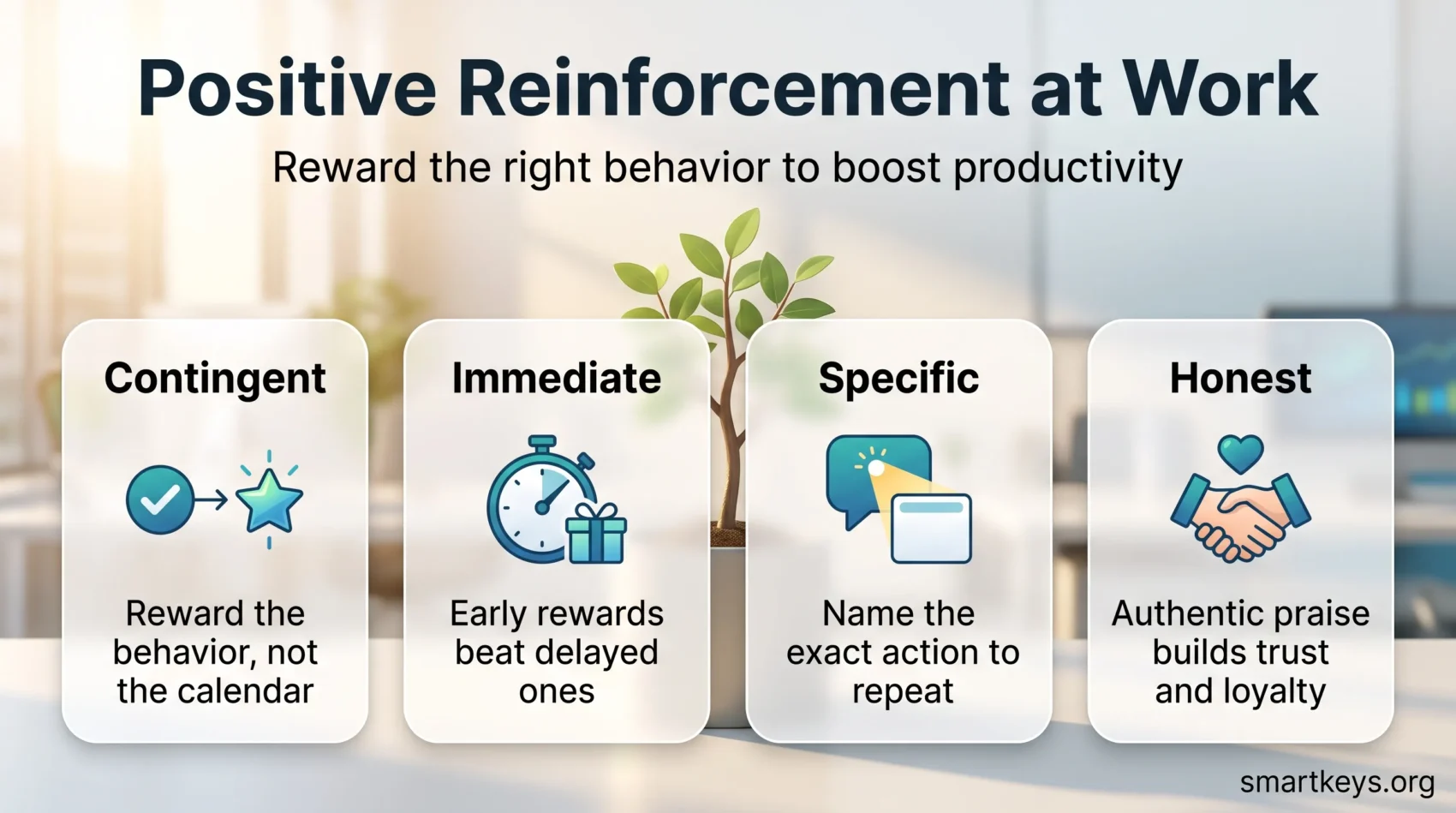
Decades of applied behavior analysis, much of it in classrooms, point to the same three conditions. Reinforcement should be contingent, following the target behavior rather than the calendar. It should be immediate, because a close consequence links clearly to the action. And it should be specific, naming the behavior rather than the person’s general worth.
Behavior-specific praise is the best studied example. Teachers who name the exact action they want repeated see more on-task behavior and fewer disruptions than those who rely on correction. The workplace version is identical and far rarer.
What the Evidence Supports at Work
Recognition has strong, repeatedly measured effects on retention, loyalty and engagement, and weaker effects on raw output. Treat precise productivity percentages with suspicion; treat the retention data as solid.
Retention and Loyalty
Gallup and Workhuman’s joint research found that well-recognized employees are 45% less likely to have turned over two years later, and estimated that an employer of 10,000 people saves more than $16 million a year in turnover costs by making recognition part of its culture. Employees who consider their recognition appropriate are three times as likely to feel loyal, at 77%. If retention is the real problem, recognition belongs in the same conversation as pay and talent retention strategy.
Engagement and Feedback
The same body of research found that employees who feel fulfilled by the recognition they receive are four times as likely to be engaged, and that people who strongly agree they get useful performance feedback from colleagues are five times as likely to be engaged. Distributed teams feel the absence most sharply, since informal acknowledgment does not survive the move to chat by default. Deliberate practice matters more there than in an office, which is why remote employee engagement tends to require explicit rituals.
Learning and Skill Development
Reinforcement is also how skills consolidate. Feedback that names what worked gives people something to repeat, which is why short feedback loops sit at the centre of most microlearning approaches. Gallup found that workers who strongly agree their employer supports skill development are 47% less likely to be job hunting. Linking recognition to progress rather than output also pairs naturally with a growth mindset.
The Recognition Gap
Most organizations believe they recognize people. The data says otherwise. Only about a third of employees strongly agree the recognition they receive feels authentic. Just 23% strongly agree their organization marks professional milestones such as promotions and work anniversaries, and only 15% say the same about personal life events. The most actionable number: only 20% have ever been asked how they prefer to be recognized.
That last gap is free to close. One question in a one-on-one meeting tells you whether someone wants public credit or a quiet note, and getting it wrong turns a reward into an ordeal for anyone who dislikes attention.
Set Goals Worth Reinforcing
You cannot reinforce a behavior you have not defined. Before designing rewards, get specific about what should happen more often.
Name the Behavior, Not the Outcome
Outcomes lag and often sit outside a person’s control. Behaviors do neither. “Close more deals” cannot be reinforced reliably; “log every call the same day” can. Start from your objectives, then work backwards to the daily actions that produce them. Practical goal setting strategies and the habit of breaking large goals into smaller steps exist for this reason.
Make Progress Visible
Reinforcement needs something to attach to. A habit tracker, a to-do list you actually close out, or a shared board all turn invisible effort into a moment worth acknowledging. Visible progress is its own reinforcer, which is why gamification works when it tracks something people already care about and fails when it does not.
Design a Reward System That Holds Up
Building a reward system is less about generosity than about structure. Three decisions do most of the work.
Intrinsic and Extrinsic Rewards
Intrinsic rewards come from the work itself: mastery, autonomy, the satisfaction of a finished piece. Extrinsic rewards come from outside it: bonuses, public credit, time off, a better project. Extrinsic rewards are easier to schedule and easier to overuse. Intrinsic ones are more durable but harder to engineer; you protect them by removing friction, not by adding incentives.
Timing Beats Size
The most useful finding here concerns timing. In research published in the Journal of Personality and Social Psychology in 2018, Kaitlin Woolley and Ayelet Fishbach showed that rewards delivered earlier, during an activity rather than after it, raised intrinsic motivation and persistence compared with identical rewards delivered later. A small acknowledgment on Tuesday usually does more than a larger one at the quarterly review. That is also why annual cycles reinforce so little, and why many companies have moved toward continuous performance management.
Match the Reward to the Person
Reinforcers are personal by definition. Public praise motivates some people and embarrasses others. Choice of project, protected focus time, or a genuine thank-you note can outperform a gift card at a fraction of the cost. Ask, then vary. Predictable rewards fade into salary; unpredictable acknowledgment of real work does not.
Track Without Turning It Into Surveillance
Any tracking system should answer one question: what happened that is worth reinforcing? Favour tools that surface completed work rather than activity. Simple beats sophisticated. A weekly review of what actually got finished is enough to run recognition on, and it doubles as an early warning when procrastination is stalling a project.
Be wary of metrics that measure presence instead of contribution. Keystroke counts and activity scores reinforce looking busy, which is exactly the behavior you did not want. Our overview of current HR trends covers where employer measurement is heading.
Techniques You Can Apply This Week
Build a Feedback-Rich Environment
Peer recognition scales in a way manager recognition cannot, and Gallup’s finding on colleague feedback suggests it carries similar weight. Make it easy and specific: a dedicated channel, a standing item in team meetings, or the plain expectation that people name each other’s contributions out loud. Even a walking meeting beats a formal review for the low-stakes, immediate feedback that actually reinforces behavior.
Reinforce Yourself Honestly
The same principles apply to solo work. Tie a small, immediate reward to finishing a defined block rather than to a vague sense of a productive day. The failure mode is drifting rewards: taking the break whether or not the block happened. At that point nothing is contingent and nothing is reinforced. If self-directed motivation is your harder problem, our guide on staying motivated through the workday goes deeper.
Where Positive Reinforcement Goes Wrong
Three failure modes are worth naming. The first is the overjustification effect: paying people for something they already enjoyed can shift their reason for doing it from interest to payment, and interest may not return when the payment stops. Reserve extrinsic rewards for work that needs the push.
The second is inauthenticity. Recognition that is scripted, distributed by policy, or obviously assembled to hit a quota reads as management theatre. Since only a third of employees find their recognition authentic, this is the common case, not the rare one.
The third is inequity. Gallup found meaningful differences in who feels recognized on par with equally performing peers, so an unexamined programme can quietly reinforce the wrong pattern. Check who is getting acknowledged before scaling anything up.
Positive reinforcement is not a personality trait or a management fashion. It is a mechanism, and it works when it is contingent, immediate, specific and honest. Pairing it with real investment in continued development is what turns a motivation bump into something durable.
Found this useful?
Make SmartKeys a preferred source on Google, and our articles will surface more often in your Top Stories, AI Overviews, and AI Mode.
Add as Preferred Source