Team productivity is rarely a question of effort. Most teams already work hard. What slows them down is the friction between what they intend to do and what actually reaches the finish line: unclear priorities, constant interruptions, rework, and meetings nobody needed.
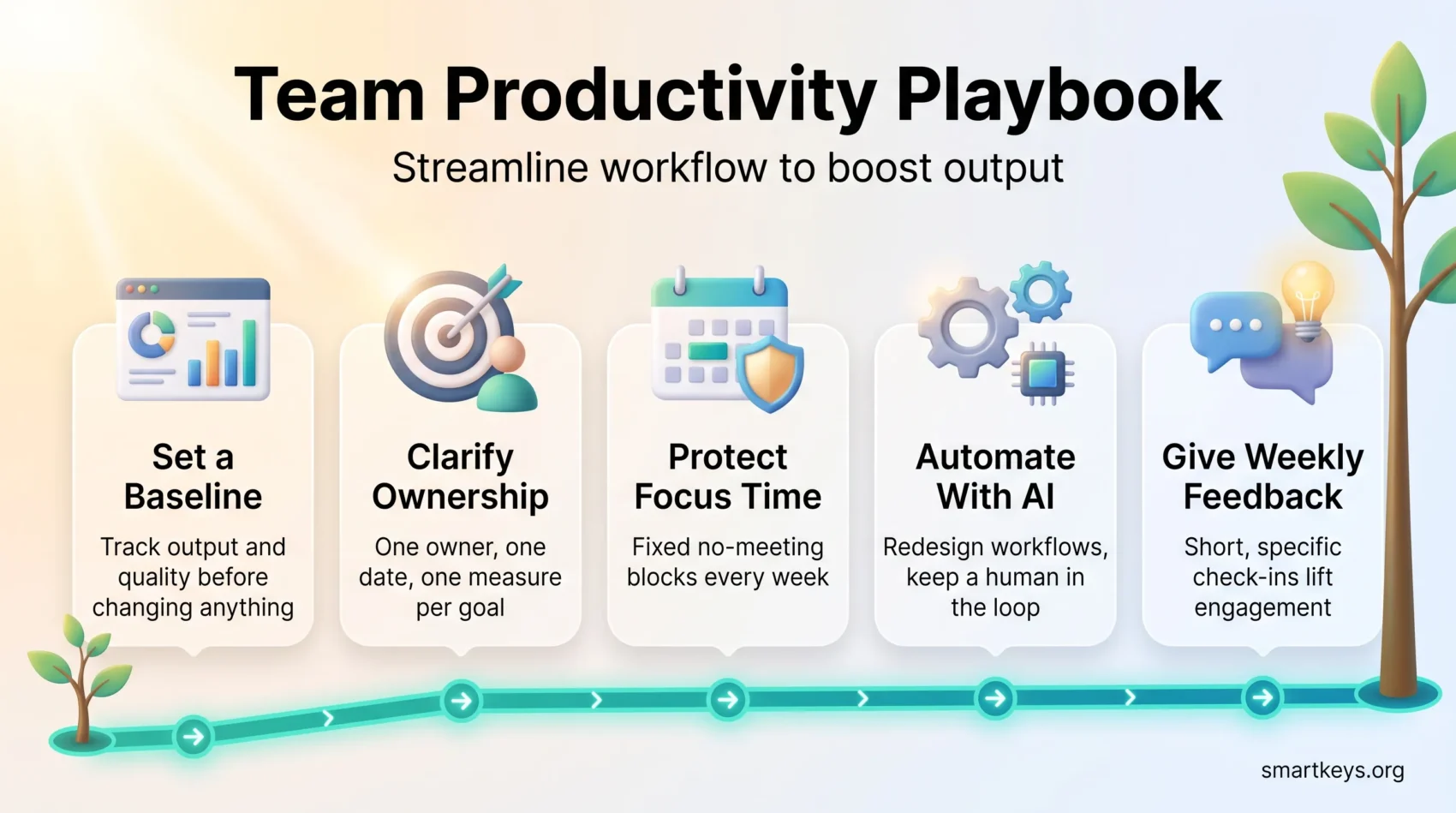
This playbook works through that loop in order. Set a baseline, tighten goals and ownership, put AI where it earns its keep, redesign how your team communicates, then adopt the leadership habits with real evidence behind them. Every figure below is attributed to a named source.
Key Takeaways
- Measure output and quality together, or you just move the cost somewhere less visible.
- Set a two to four week baseline before you change anything, so you can tell improvement from noise.
- Protect focus time deliberately. Microsoft data shows knowledge workers are interrupted roughly every two minutes during core hours.
- Use AI to redesign a workflow, not decorate an existing one. That is what separates companies seeing returns.
- Weekly, meaningful feedback from a manager is one of the strongest engagement levers available to you.
What Team Productivity Actually Means
Output is what your team delivers. Quality is how much of it is right the first time. A team that closes more tickets while generating more rework has not become more productive. It has shifted the cost somewhere harder to see.
Both feed two outcomes leaders care about. Customer experience is what customers notice: fewer errors, faster answers. Employee experience is what your team notices: clearer priorities and fewer evenings fixing avoidable mistakes. That second one is under real pressure. Gallup’s State of the Global Workplace 2026 put global employee engagement at 20% for 2025, its lowest level since 2020. Manager engagement fell to 22%, down nine points since 2022. Since managers set the rhythm for everyone reporting to them, a disengaged manager layer is a productivity problem before it is an HR one.
It also helps to retire assumptions about where work happens. The largest controlled test of hybrid work, a trial of 1,612 Trip.com employees published in Nature in 2024, found that hybrid working cut quit rates by roughly a third and raised job satisfaction, with no measurable effect on performance grades or promotions over the following two years. Location is not your lever. Clarity, focus and feedback are. It is worth separating evidence from folklore here, because plenty of productivity advice does not survive contact with data.
What this means for you
- Pick one output measure and one quality measure per team. Report them side by side, always.
- Treat engagement as a leading indicator, not a soft one. It moves before delivery does.
- Stop debating office days and start fixing the interruptions that follow people everywhere.
Where the bottleneck is workload rather than process, the fix is reassignment. Practical approaches to delegating work free senior time without letting quality slip.
Measure Before You Optimize
You cannot tell whether a change worked if you do not know what normal looked like. Spend two to four weeks capturing a baseline first. That window smooths out a bad Monday without losing the team’s attention.
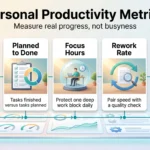
Keep the set small. Four numbers you review beat twenty you ignore.
- Delivery: completion rate, on-time delivery, and cycle time. Group tasks by type so you compare like with like.
- Quality: error rate and rework rate. Rework is the honest one, because it catches speed bought at the cost of accuracy.
- Service, for customer-facing teams: CSAT (the score customers give after an interaction), first reply time, and Customer Effort Score, which asks how hard the customer had to work to get their problem solved.
- Capacity: hours actually available for planned work once meetings are subtracted.
Numbers tell you where work stalls, rarely why. Pair every dashboard with a standing question in your one to ones: what slowed you down this week? A missed service level agreement, the response time you promised customers, usually has a cause no dashboard records. If you lead an operations team, this playbook for finding where process time and cost leak applies the same baseline thinking to margin.
Set targets at a cadence your team can act on. Weekly targets that roll up into a project view beat quarterly numbers nobody revisits. If you are starting from scratch, a structured approach to tracking goals and a practical guide to measuring productivity will save you a rebuild later.
Set Clear Goals, Roles, and Decision Rights
Most missed deadlines trace back to an unanswered question about who decides. Make priorities visible, then make ownership unambiguous.
Translate company objectives into team goals, then into individual outcomes. Each goal needs an owner, a date and a measure. “Improve onboarding” is not a goal. “Cut new-customer setup time from nine days to five by 31 March, owned by Priya” is one.
Use a lead measure, not just a target
The 4 Disciplines of Execution, a widely used execution framework, makes a useful distinction. A lag measure is the result you want, like reduced setup time. A lead measure is the behaviour that produces it and that your team controls this week, like completing every account handover within one working day. Track lead measures on a visible scoreboard, and hold a short weekly session where each owner reports what they committed to and what they delivered.
That beats a monthly status meeting because the loop is short enough to correct course. Deciding what belongs on the scoreboard is its own skill, and task prioritization frameworks give you a defensible way to choose.
Document the recurring work
A standard operating procedure is a written record of how a repeating task gets done and who hands it to whom. It sounds bureaucratic until you count the hours lost re-deciding solved problems. Write procedures for the five processes generating the most questions, and no more. A focused guide to building SOPs teams actually use is a good starting point. Once a process is written down, the next step is moving its handoffs and approvals into software, and this guide to choosing digital workflow software for your team covers what to look for.
Use AI Where It Pays, Not Everywhere
The gap between companies experimenting with AI and companies profiting from it is now the interesting story.
McKinsey’s State of AI global survey, fielded in May and June 2026, found nearly nine in ten organizations now use AI regularly in at least one business function. Only 37% could attribute any earnings impact to it, and just 6% qualified as high performers, crediting AI with 5% or more of EBIT. That share did not move year on year.
What separates the 6%? McKinsey’s answer is blunt: they redesign the workflow around AI instead of inserting AI into the one they already had. Bolting a summarisation tool onto a broken handover gives you a faster broken handover.
Start with tasks that are repetitive, low-judgement, and easy to check.
- Triage: routing tickets, tagging requests, flagging duplicates.
- Summarisation: condensing long threads, call notes or research so the next person starts informed.
- Drafting: first-pass replies to routine questions that a human then approves.
Keep a person in the loop wherever the output touches a customer or a decision. The goal is handing your team back the hours spent on retrieval and reformatting. To go beyond single-task automation, AI agent workflows cover how multi-step automation is actually being deployed.
Redesign How Your Team Communicates
Communication overhead is now the largest tax on knowledge work. The numbers are worse than most leaders assume.
Microsoft’s Work Trend Index analysis of anonymised Microsoft 365 signals found workers are interrupted roughly every two minutes during core hours, about 275 times a day. The average worker receives 117 emails and 153 Teams messages per weekday, and 48% say their work feels chaotic and fragmented. That is not a discipline problem but a system design problem. Two rules fix most of it.
Give every channel one job
Ambiguity about where a message belongs is what generates the duplicate ping. Write the rules down and keep them short.
- Chat: quick clarifications that expire within the day.
- Tickets or a work board: anything that is a request with an owner and a deadline.
- Documents: decisions and anything someone will need to find in six months.
- Meetings: disagreement, ambiguity and relationships. Not status.
This depends less on the tool than on how people write in it, so guidance on clear written communication is worth circulating once and then enforcing.
Default to asynchronous
The same Microsoft analysis found that 57% of meetings are ad hoc, called without a calendar invite, and that half of all meetings land in the two windows most people think best: 9 to 11am and 1 to 3pm. Every one of those is a focus block spent on coordination.
Write the update instead of convening for it. Asynchronous work is not slower; it moves the cost from everyone’s calendar to one person’s keyboard. Before cutting anything, run a meeting audit so you know what you are cancelling.
Protect Focus Time on Purpose
Focus time does not appear in the gaps. It has to be claimed.
Set a team-wide rule and defend it. A no-meeting block of two to three hours, on the same days each week, gives everyone a predictable window for work that needs a running start. Publish it, and let people decline invites landing inside it.
Two supporting habits matter as much as the block. Agree notification windows so nobody feels obliged to answer within seconds, and keep workload commitments achievable, because a team allocated at 130% will spend its focus block firefighting. Practical guidance on a team-wide focus time policy covers enforcement, which is usually the hard part.
The payoff is mechanical, not motivational. Every switch between tasks carries a resumption cost, and those compound across a day. Task switching is where a productive-looking week quietly disappears.
Make the Workplace Fit the Work
Whether people sit at home or in an office matters far less than whether the space suits the task.
Noise is the most consistent complaint about shared offices, and it lands hardest on work needing sustained concentration. An open floor needs real quiet zones, not a corner with a plant, plus huddle spaces so ad hoc conversation has somewhere to go that is not the desk row. Our guide to managing distraction in an open office covers the fixes that work.
For hybrid teams, equipment equity is most often neglected. If people in the room can hear each other and those at home cannot, remote participants stop contributing and you lose their input. Decent microphones and cameras are a productivity purchase, not an IT one. They also reduce proximity bias, the tendency to favour whoever is physically present when work is assigned or credited.
Then write the arrangement down. A hybrid work policy stating expectations plainly saves a hundred individual negotiations, and the evidence on hybrid workspaces and wellbeing is now solid enough to design against.
Leadership Habits That Move the Number
Of everything in this playbook, weekly feedback has the best evidence behind it.
Gallup is unusually direct here: 80% of employees who report receiving meaningful feedback in the past week are fully engaged, and that delivers roughly four times the engagement lift of getting office attendance right. Short conversations are enough. Gallup notes regular 15 to 30 minute check-ins beat longer, less frequent ones, because managers who skip weeks spend the time anyway catching up.
Three habits carry most of the weight.
- Be specific and current. One thing that went well, one thing to adjust, both from this week. Feedback about last quarter is a performance review, not coaching.
- Assign visible ownership. Every project and every metric gets one named owner. Shared ownership reliably becomes nobody’s.
- Treat misses as information. If missing a target triggers blame, your team stops giving you accurate forecasts, and you lose the early warning that made the metric useful.
Watch for signs a team is running too hot: rising absence, quieter meetings, slipping deadlines, drifting satisfaction scores. Catching those before someone resigns is far cheaper than replacing them, the practical case for burnout prevention. Distributed teams add their own demands, and remote leadership skills are worth developing explicitly.
A Four-Week Rollout
Trying all of this at once guarantees none of it sticks.
- Week 1: baseline. Pick one output metric, one quality metric, one service or engagement signal. Record them. Change nothing else.
- Week 2: ownership. Give every active project a named owner, a date and one lead measure, on a single visible board.
- Week 3: calendar. Introduce the no-meeting block and the channel rules. Cancel the recurring meetings your audit could not justify.
- Week 4: review. Compare against the baseline, ask the team what actually helped, and keep only what earned its place.
Then repeat. Judging by outcomes rather than activity stops this becoming another process that measures itself.
Conclusion
Team productivity improves through a few unglamorous decisions repeated consistently: know your baseline, name your owners, protect the hours where real work happens, automate what does not need judgement, and talk to your people every week. None of it needs a new platform or a reorganisation. It needs a decision about what your team will stop doing, held long enough to show up in the numbers you agreed to watch.
Found this useful?
Make SmartKeys a preferred source on Google, and our articles will surface more often in your Top Stories, AI Overviews, and AI Mode.
Add as Preferred Source