Conversational commerce means selling through a conversation instead of a form. A shopper asks a question in a chat window, a messaging app or an AI assistant, gets an answer, and buys without ever browsing a category page. The idea is not new. What changed by 2026 is that the conversation now happens in places the retailer does not own, and that it converts better than most other traffic. It is one of the clearest examples of AI changing business operations in a way customers actually notice.
This guide explains what conversational commerce covers, what the measured results actually look like, which channels are worth the effort, and what the new EU transparency rules require from August 2026.
Key Takeaways
- Conversational commerce is buying and selling through chat, messaging apps or voice, with a mix of automated and human replies.
- Traffic arriving at US retail sites from AI assistants grew several hundred percent year over year and converted better than other sources, according to Adobe Analytics.
- Agentic commerce goes one step further: the assistant completes the purchase inside the chat.
- The strongest returns come from answering pre-purchase questions and recovering abandoned carts, not from replacing your support team.
- From 2 August 2026, EU rules require that people are told when they are talking to an AI system.
- Start with one channel and a clear handover rule to a human. Most failures are handover failures.
What Conversational Commerce Actually Means
Conversational commerce, sometimes called chat commerce, is any sales or service interaction that happens as a back-and-forth exchange rather than through a static page. That covers four things:
- A chat widget on your own website or app.
- A business account in a messaging app such as WhatsApp, Facebook Messenger or Instagram, which overlaps closely with social commerce.
- Rich business messaging through the phone’s default text app.
- A voice assistant or an AI chat assistant such as ChatGPT, Gemini or Copilot.
The replies can come from a person, from software, or from both in turn. The commercial point is the same in every case: a question that would otherwise end in an abandoned session gets answered in the moment.
A concrete example makes the difference clear. A customer looking at a pair of running shoes wants to know whether they run small. On a product page, that person either digs through reviews or leaves. In a chat, they ask, get told the model runs half a size small, order the larger size, and the return never happens. The sale is the same sale. The path to it is shorter, and one common reason for a return has been removed.
Why It Matters Now: AI Assistants Became a Sales Channel
For years, conversational commerce meant a chat bubble in the corner of your own site. That is no longer where the growth is.
Adobe Analytics, which tracks more than one trillion visits to US retail sites, measured a 693% year-over-year increase in traffic arriving from generative AI sources during the 2025 holiday season. More importantly, that traffic behaved better than average. Year to date, AI referrals converted 31% more often than other sources. Visitors coming from AI assistants spent 45% more time on site, viewed 13% more pages, and were 33% less likely to bounce immediately.
Two things follow from that. First, a growing share of product research now happens inside a conversation with an assistant before anyone reaches your site. Second, people who arrive that way have already had their basic questions answered, which is why they convert. That makes how your product information reads to an AI assistant a commercial question, not just a technical one. It is closely related to optimising for AI search results and to the wider shift in how online retail is growing.
The numbers come off a small base, so the percentages look dramatic. AI referrals are still a minority of retail traffic. The direction and the conversion quality are what matter.
The Four Channels That Carry Conversational Commerce
Not every channel suits every business. Choosing badly is the most common way to waste money here.
Chat on Your Own Site
The easiest place to start, because you control it completely and the customer is already looking at your products. A site chat is most valuable on pages where people hesitate: sizing, compatibility, delivery times, returns. It is worth far less on a homepage, where visitors have no specific question yet. Most of that traffic now arrives on a phone, so test the chat the way mobile shoppers will actually see it.
Messaging Apps
WhatsApp, Messenger and Instagram put your business in the app people already keep open. The advantage is reach and re-contactability: once a customer messages you, you can follow up later within the platform’s rules. The cost is that you are operating on someone else’s platform, under their pricing and policies, and each one has its own rules about what you may send and when. This channel suits businesses with repeat purchases and a genuine reason to message again, which is also why it fits direct-to-consumer brands particularly well.
Rich Business Messaging in the Default Text App
RCS, short for Rich Communication Services, is the upgrade to SMS that adds images, buttons, verified sender names and read receipts inside the phone’s built-in messaging app. Apple’s support for RCS on iPhone opened the channel to a much larger audience. Juniper Research counted about 70 billion business RCS messages globally in 2025 and forecasts more than 200 billion by 2027, while noting that adoption is uneven between markets.
For retailers, this is mainly an operational channel: order confirmations, delivery updates and reorder prompts that people actually open, with a verified brand name instead of a random shortcode.
Voice Assistants
Voice remains useful for narrow, repeat tasks such as reordering a known product or checking an order status. It has not become a general shopping interface, largely because comparing options by ear is slow. Voice matters more for how people phrase searches than for how they check out, which is covered in more depth in our guide to voice search optimisation.

Agentic Commerce: When the Assistant Checks Out for You
The newest development is worth separating from the rest. In agentic commerce, the AI assistant does not just recommend a product. It completes the purchase.
Stripe and OpenAI launched Instant Checkout in ChatGPT on 29 September 2025, starting with US Etsy sellers and Shopify merchants. It runs on the Agentic Commerce Protocol, an open standard the two companies developed jointly, which lets a merchant accept orders from AI agents through a single integration while keeping control of pricing, branding and fulfilment. Payment moves through a shared payment token, so the assistant can trigger a charge without ever seeing the customer’s card details.
Gartner expects this pattern to spread fastest in business-to-business buying. Its October 2025 forecast puts 90% of B2B buying as AI agent intermediated by 2028, routing more than $15 trillion of spend through agent exchanges. That is a prediction, not a measurement, and predictions of this kind have a poor track record. Treat it as a signal about where large buyers are heading rather than as a number to plan against.
The practical question for a smaller retailer is simpler. If a customer’s assistant can place an order with your competitor and not with you, that is a lost sale you never see in your analytics.
Where Conversational Commerce Pays Off
Three use cases account for most of the measurable return.
Answering the Question That Blocks the Purchase
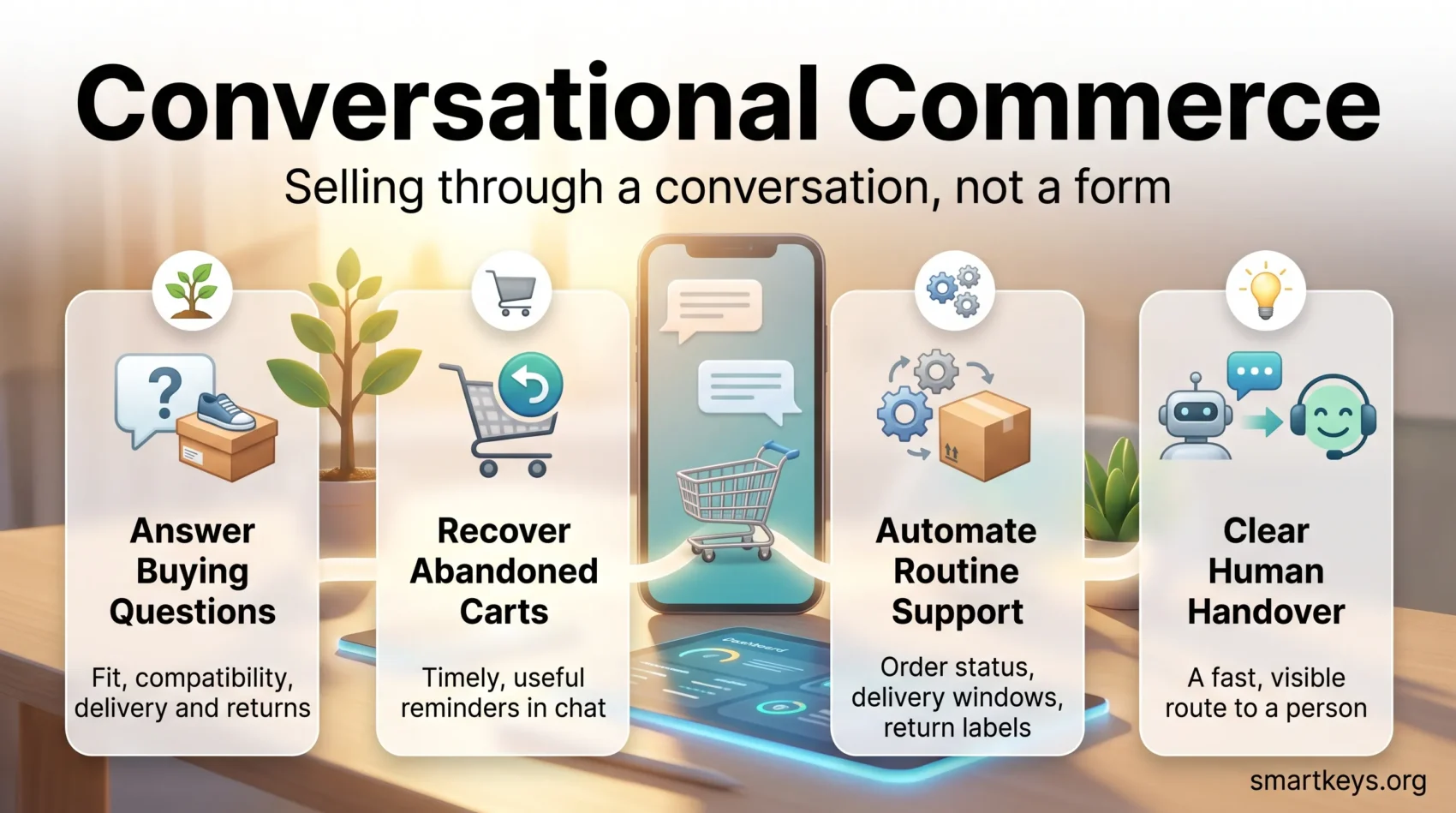
This is the strongest case and the easiest to justify. Every product category has three or four questions that stop people buying: will it fit, will it work with what I already own, when will it arrive, can I send it back. Answering them in the moment converts hesitation into orders. It also feeds your product pages, because the questions people ask reveal what the page failed to say.
Recovering Abandoned Carts
A message sent shortly after someone leaves a full cart is one of the few automated touches customers tolerate, provided it is useful rather than pushy. Chat and messaging channels are read far more reliably than email, which is why recovery messages perform well there. The gain comes from timing and relevance, not from the technology itself. A reminder that repeats what the customer already knows adds nothing. If your checkout offers instalments, note that buy now, pay later changes both conversion and margin, so measure the two together.
Cutting the Cost of Routine Support
Order status, delivery windows, return labels and password resets are repetitive and rule-based. Automating them frees your team for the conversations that need judgement, a pattern that runs through most current customer service trends. This is where most AI chatbots in customer service earn their keep, and the savings are real. They are also smaller than vendors suggest, because someone still has to build the flows, maintain them and handle everything the bot cannot.
What It Does Not Fix
Conversational commerce fails in predictable ways, and knowing them in advance saves money.
A bot that cannot hand over is the most common failure. Customers accept automation for simple questions and resent it the moment their problem is unusual. If there is no fast, obvious route to a person, the channel damages trust instead of building it, and it undoes the work behind every other customer experience improvement you have made. Define the handover rule before you launch: how many failed attempts, which topics always go straight to a human, and what the wait actually is.
Bad product data is the second failure. An assistant answering from an outdated stock feed or a thin product description will confidently give wrong answers. The conversation only ever surfaces what your systems already know, which is why a first-party data strategy tends to matter more than the chat tool itself.
The third is scope creep. Teams start with order status, then try to automate complaints, refunds and complex configuration. Each addition raises the failure rate and the maintenance burden. Keeping automation narrow and reliable beats making it broad and unpredictable.
Finally, personalisation has a limit. Customers welcome a chat that remembers their last order. They dislike one that seems to know things they never volunteered. Where that line sits is worth thinking through alongside your wider approach to e-commerce personalisation and data privacy.
The Rules You Have to Follow in 2026
One rule is new and applies to almost every business selling into the EU.
Article 50 of the EU AI Act takes effect on 2 August 2026. It requires that systems interacting directly with people make clear, from the start of the first interaction, that the person is dealing with an AI system. The disclosure has to be understandable without technical knowledge. There is a narrow exception where it is already obvious, but it is interpreted strictly, so relying on it is a poor bet. A separate grace period, until 2 December 2026, applies only to the marking of AI-generated content in systems placed on the market before August.
In practice this means one line at the top of the conversation. It is not a burden, and evidence suggests customers respond better to a bot that says what it is than to one that pretends otherwise. Our guides to EU AI Act compliance and wider AI regulation cover the surrounding obligations.
Beyond that, the usual rules still apply: consent for marketing messages, clear opt-out, and the platform policies of whichever messaging service you use. The same consent discipline underpins responsible AI in marketing generally. Messaging apps enforce their own limits on promotional content, and the penalty for ignoring them is losing the channel.
How to Start Without Overbuilding
A sensible sequence for a business that has not done this before:
- Pick the questions, not the tool. Pull your last few hundred support tickets and pre-sales emails. The four or five questions that dominate are your scope.
- Choose one channel. Site chat if most of your traffic already reaches your product pages. A messaging app if your customers buy repeatedly and you have a reason to follow up.
- Fix the data first. Stock levels, delivery estimates and specifications have to be accurate before automation touches them.
- Write the handover rule. Decide when a human takes over, and make the route visible in the conversation.
- Add the AI disclosure. One clear sentence at the start.
- Measure two things. Conversion rate for sessions that included a conversation, and the share of conversations that ended without resolution. The second number tells you where to improve.
Only after that is it worth looking at richer setups: proactive messages, AI-driven personalisation, or connecting chat to a broader omnichannel marketing plan.
The Practical Takeaway
Conversational commerce has stopped being a novelty feature and become a distribution question. Some of your customers now start their research inside an AI assistant, and a growing number will expect to finish the purchase there too. The businesses getting value from it are not the ones with the most sophisticated bots. They are the ones that picked a narrow set of questions, kept their product data clean, and made it easy to reach a human when the conversation stopped working. Done well, it becomes one of the cheaper ways to build customer loyalty.
That is unglamorous, and it is also why it works. The technology in this field improves every quarter. The reasons customers abandon a purchase have not changed in twenty years.
Found this useful?
Make SmartKeys a preferred source on Google, and our articles will surface more often in your Top Stories, AI Overviews, and AI Mode.
Add as Preferred Source