Recommerce is the buying and selling of goods that already had an owner: secondhand clothing, refurbished phones, used furniture, trading cards. The word is just shorthand for resale at scale.
What changed is not the behaviour but the infrastructure. Charity shops and classified ads always existed. What did not exist was a marketplace that photographs, prices, authenticates, ships and insures a used jacket as smoothly as a new one. That is what platforms built, and it moved resale from a weekend habit into a regular retail channel.
This guide covers what the current data actually shows: how big the resale market is, why people buy and sell used goods, which categories lead, how AI and social feeds changed discovery, and what the new textile rules in the EU and California mean if you sell clothing.
Key Takeaways
- Real scale: the global secondhand market is projected to reach $393 billion by 2030, roughly double the growth rate of apparel overall (ThredUp, 2026 Resale Report).
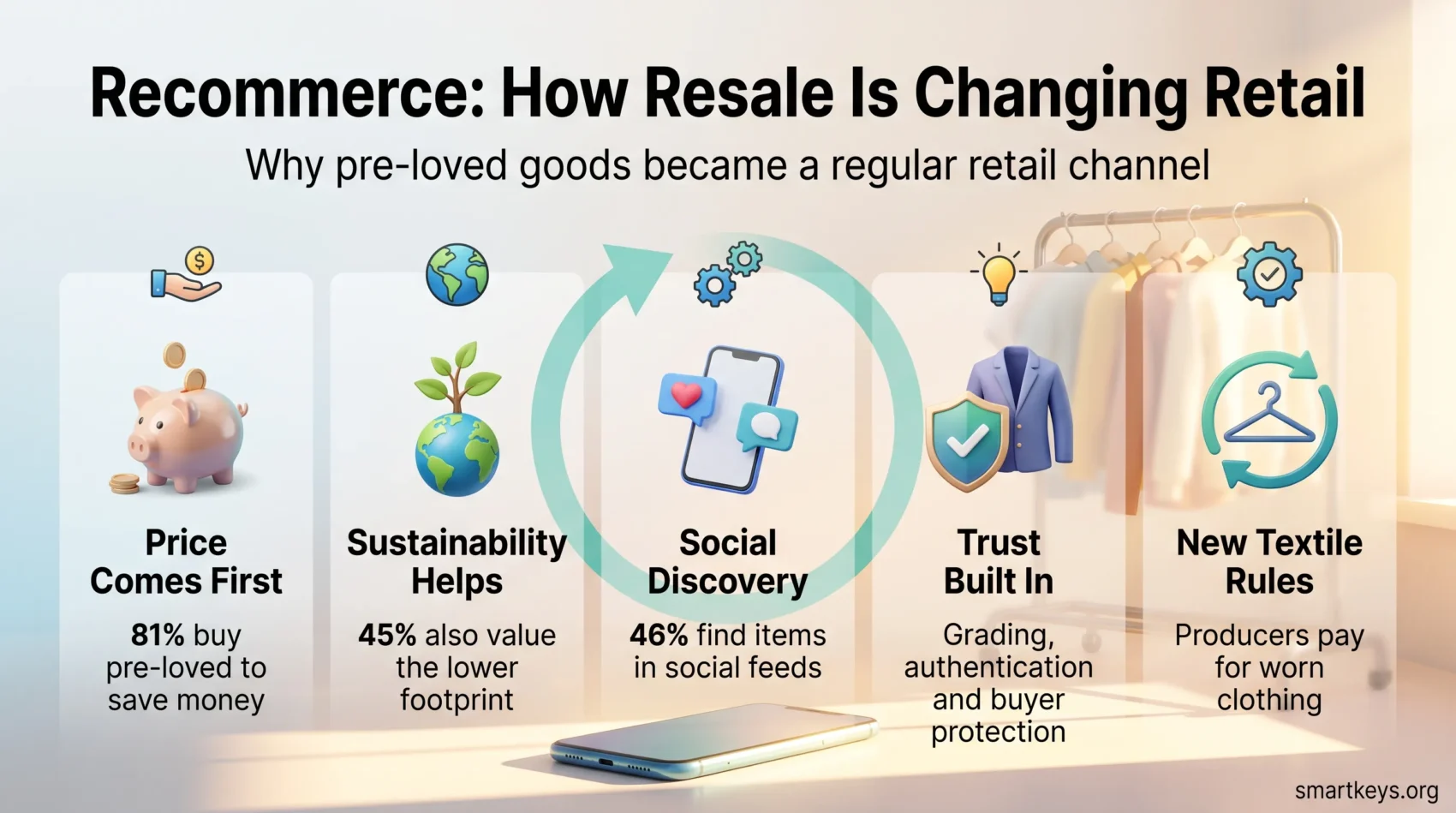
- Price leads: 81% of consumers name saving money as a reason to buy pre-loved; 45% name sustainability (eBay 2025 Recommerce Report).
- Young buyers drive growth: Gen Z and Millennials are expected to account for more than 70% of US resale growth through 2030.
- Discovery moved: 46% of resale shoppers find items through social feeds and creators rather than search.
- New rules: EU textile producer responsibility schemes and California’s SB 707 change who pays for collecting and reusing worn clothing.
Why the recommerce trend matters now
Buying used is no longer a niche choice. It sits inside the same apps people use for new goods, at the same moment of decision, and it competes on price, selection and delivery speed.
That matters in two directions. As a shopper, resale gives you access to items at lower prices, plus pieces that are no longer made. As someone running a business, resale is now a competitor for the same purchase, and increasingly a channel you can operate yourself.
The circular economy, in plain terms
The circular economy is the idea of keeping products in use for as long as possible instead of making, using and discarding them. Resale is the simplest version of it: one more owner for an item that already exists, and one fewer new item manufactured.
That is why resale keeps appearing in corporate sustainability plans. It is a measurable way to extend product life, which feeds directly into corporate responsibility reporting and into the emissions targets tracked by carbon accounting tools.
What actually removed the friction
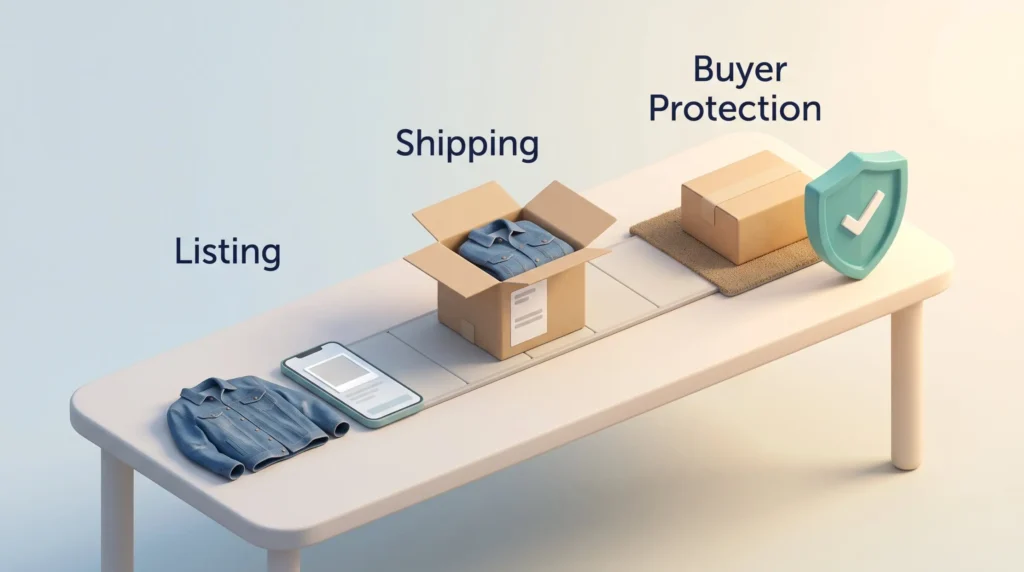
Three things made resale routine. Listing became fast enough to do from a phone in two minutes. Payment and shipping were absorbed into the platform, so neither side handles logistics. And buyer protection made the risk of a bad purchase small enough to ignore.
Once those three were solved, the same flywheel that powers any digital marketplace took over: more listings attract more buyers, more buyers attract more sellers, and the selection deepens on its own.
Market size: what the numbers show
Resale is growing faster than the retail it sits inside, from a base that is no longer small.
ThredUp’s 2026 Resale Report, produced with GlobalData and published in April 2026, projects the global secondhand market at $393 billion by 2030. Secondhand currently accounts for roughly 10% of global apparel spend, and the report expects it to grow at about twice the rate of the wider fashion market.
In the United States, the same report puts the resale market at $78.8 billion by 2030, an average growth rate near 7.3% a year. During 2025, US secondhand apparel grew close to four times faster than clothing retail as a whole.
Where the growth comes from
Two figures explain most of the trajectory. First, Gen Z and Millennials are expected to drive more than 70% of US resale growth through 2030. Second, resale is expected to outpace new clothing purchases at roughly two to one over the next five years.
That is a generational shift rather than a price blip. It has a lot in common with the broader e-commerce trends reshaping retail, and with the platform economics behind the sharing economy.
How one marketplace measures it
eBay reports that pre-loved and refurbished goods have made up more than 40% of its gross merchandise volume since 2024. For a marketplace of that size, resale is not a side category. It is most of the business.
Why shoppers buy pre-loved
The motivations are well documented, and they are not in the order most sustainability marketing assumes.
Price comes first
In eBay’s 2025 Recommerce Report, based on a survey of roughly 16,000 consumers across nine countries, 81% named saving money as a reason to buy pre-loved. That is the single largest driver, and it is stable across markets.
Resale is also how many people afford brands they otherwise would not buy. That undercuts the full-price tier of many direct-to-consumer brands, and it is one reason more of them now run their own resale programmes rather than cede the secondary market entirely.
Sustainability is a real but secondary driver
Forty-five percent of respondents named sustainability and environmental benefit as a reason to buy used. That is a substantial minority, not a majority, and it is worth being precise about: sustainability rarely wins a purchase on its own, but it removes hesitation once the price already works.
Companies that treat environmental benefit as the headline usually underperform companies that lead with price and treat the environmental case as confirmation. That pattern shows up across sustainability positioning in general.
Items you cannot buy new
Thirty-seven percent buy pre-loved because the item is no longer sold new, and 36% are after something unique or collectible. This is the part of resale that has no equivalent in normal retail. A discontinued camera lens, a specific 1990s jacket or a sealed trading card set cannot be ordered from a manufacturer at any price.
eBay also found that 65% of buyers enjoy what it calls the thrill of the hunt, and 56% use pre-loved purchases to express personal style. Both point at the same thing: for a large share of buyers, browsing resale is entertainment as well as shopping.
Why people sell
Most selling starts as decluttering and only sometimes turns into income.
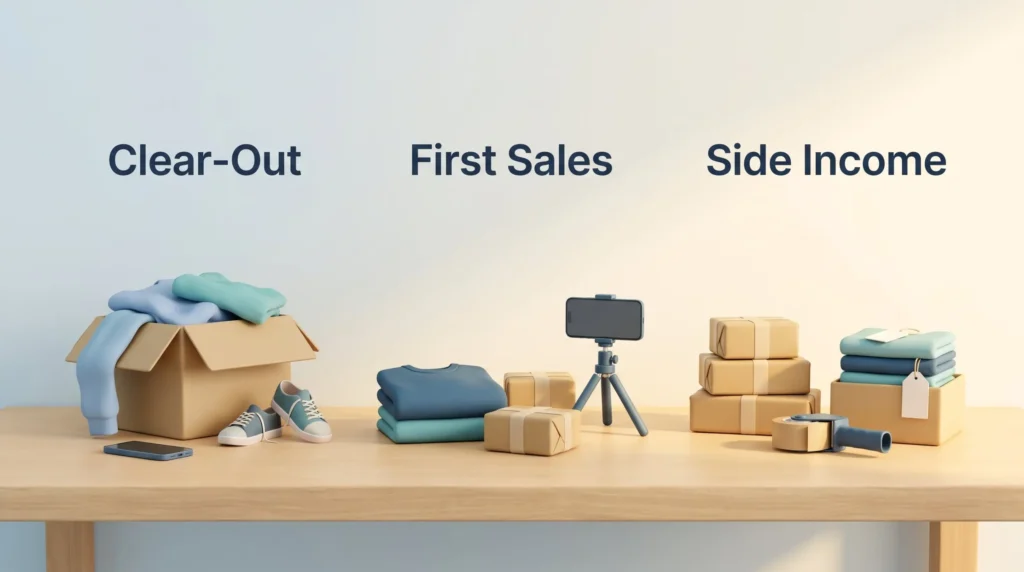
In eBay’s seller survey of just over 11,000 sellers, 86% said they source inventory from their own belongings rather than buying stock to resell. That is the ordinary case: a wardrobe clear-out, an upgraded phone, a hobby someone moved on from.
From clear-out to side income
A minority of those sellers keep going after the first few sales, and some build a genuine second income. What separates them is not luck but listing quality: accurate sizing, honest condition notes, clear photographs and predictable shipping. Those four things drive both conversion and the review scores that determine future visibility.
For anyone thinking about doing this seriously, the same practices apply as in any small online business, from pricing strategy to the customer service that produces repeat buyers.
Passion categories behave differently
Some categories are driven less by money than by interest. Among eBay sellers, 45% of trading card sellers, 37% of collectibles sellers and 35% of antiques sellers said sharing a passion was a main motivation. Watches and music came in at 31%, toys at 29%.
These sellers behave like specialists. They know their category, they price to the market rather than to clear space, and they are the reason authentication services exist.
Which categories lead
Clothing and shoes are the largest resale category by participation in most markets, followed by consumer electronics. National patterns vary more than people expect. In Japan, eBay recorded clothing at 42%, books at 40% and tech and electronics at 34% of buyer purchases. In Germany, 57% of sellers dealt in pre-loved technology and electronics.
The practical read for sellers is that category norms differ by country. If you sell across borders, the mix that works at home may not be the mix that works elsewhere.
Refurbished electronics
Refurbished devices sit slightly apart from the rest of resale. A refurbished phone or laptop is tested, repaired if needed, graded and usually sold with a warranty, which makes it closer to a new-goods transaction than a private sale.
That structure is what makes the category work at higher price points. Buyers accept a used device when someone has taken responsibility for its condition. Check three things before buying: the condition grade and what it means on that specific platform, the warranty length and who honours it, and the returns window.
Generational patterns worth acting on
The generations use resale differently, and messaging that ignores that tends to land badly.
Younger buyers are the growth engine. Fifty-nine percent of Gen Z and 56% of Millennials told eBay they planned to increase pre-loved spending, and close to 80% of both groups see themselves as part of a recommerce community. They respond to style, scarcity and social proof. The wider shifts in how Gen Z approaches work and spending point the same way.
Older buyers approach it more practically. The pull is value and clearing space, not identity. What convinces them is a precise condition description, good photographs and a returns policy they do not have to think about. That is also what builds the repeat purchases behind long-term customer loyalty.
How platforms build trust
Resale has an information problem that new retail does not: the buyer cannot verify what they are getting, and the seller is usually a stranger. Everything platforms have built on top of resale is an answer to that.
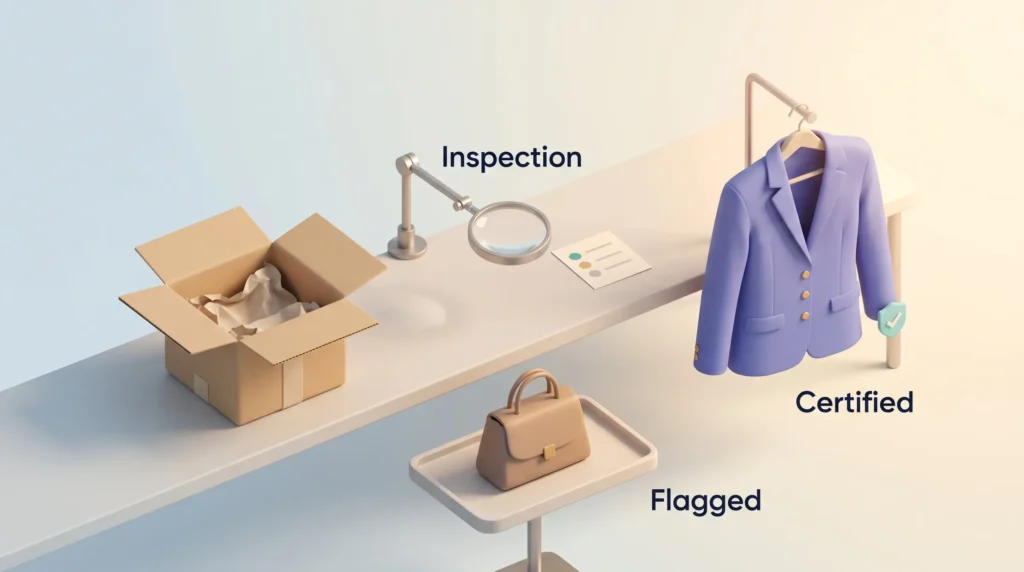
Authentication and grading
For high-value items, marketplaces now inspect goods in transit and certify them before delivery. For electronics, condition grading gives buyers a shared vocabulary. Neither is perfect, but both convert enough hesitant buyers to pay for themselves.
Provenance tracking sits at the far end of this. The same record-keeping ideas used in supply chains have been applied to luxury goods and collectibles, with mixed commercial results so far.
AI in search, pricing and fraud checks
AI is now doing routine work across resale. It writes listing descriptions from photographs, suggests prices from comparable completed sales, translates listings for cross-border buyers, and flags suspicious listings before they reach a feed.
It has also reached the buyer’s side. ThredUp found that 48% of resale shoppers used AI shopping tools somewhere in their journey. The underlying mechanics are the same as in AI-driven personalization elsewhere in retail, applied to inventory where every item is unique and appears exactly once.
Social discovery: where resale shopping now starts
The most consequential change of the last two years is not what people buy but where they start looking.
ThredUp found that 46% of resale shoppers discover items through social feeds and content creators rather than through search. Nearly half of demand now originates in a place the seller does not control and cannot optimise the way they would a product page.
This is social commerce applied to one-of-a-kind stock, and it changes the mechanics. Creators surface items; comment threads act as live reviews; direct messages replace product questions. Sellers who post their stock as content rather than only listing it see meaningfully more traffic. For the wider picture of how feeds and marketplaces have merged, see this guide on social commerce and e-commerce.
Adjacent technology is doing similar work. Virtual try-on and augmented reality in e-commerce reduce the sizing uncertainty that causes most resale returns, and flexible payment options such as buy now, pay later have spread into higher-value used goods.
New rules: who pays for worn clothing
The most significant recent development in resale is regulatory, and it is easy to miss because it targets producers rather than marketplaces.
The EU textile rules
The revised EU Waste Framework Directive entered into force on 16 October 2025. It requires every member state to set up extended producer responsibility schemes for textiles and footwear, meaning producers pay a fee for each item they put on the market to finance collection, sorting and treatment. Fees are eco-modulated, so more durable and more recyclable products cost their makers less.
Member states have 20 months from entry into force to transpose the directive and 30 months to have EPR schemes running. The directive also settles a long-running dispute by treating all separately collected textiles as waste, which is aimed at stopping unusable clothing being exported under a reuse label.
California’s SB 707
California’s Responsible Textile Recovery Act creates the first statewide textile EPR programme in the United States. Producers selling apparel and household textiles in California had to join the approved producer responsibility organisation by 1 July 2026. A statewide needs assessment is due by 1 March 2027, CalRecycle regulations take effect no earlier than 1 July 2028, and stewardship plans must be approved by 1 July 2030. The law covers clothing, footwear, handbags, towels, bedding and curtains, and excludes items such as protective equipment, mattresses and carpets.
Why this matters commercially
Both regimes push the cost of end-of-life handling back onto whoever put the product on the market. That makes durability and repairability cheaper for producers, and it gives brands a financial reason to run take-back and resale programmes they previously treated as marketing. Expect resale to appear more often as an operational answer to a compliance question, alongside changes in supply chain practice and circular manufacturing.
What to do with this
If you shop resale
Buy on platforms with buyer protection you have actually read. For anything expensive, prioritise sellers with long histories and specific condition notes over the lowest price. For electronics, treat the warranty as part of the price. And set saved searches rather than browsing: most good listings sell within hours, and alerts are the only reliable way to reach them first.
If you run a retail or e-commerce business
Start with trade-in rather than a full resale storefront. Trade-in converts a customer’s old item into store credit, which brings them back and gives you inventory without buying it. Grade honestly and publish the grading scale, because inconsistent grading destroys resale margins faster than pricing errors.
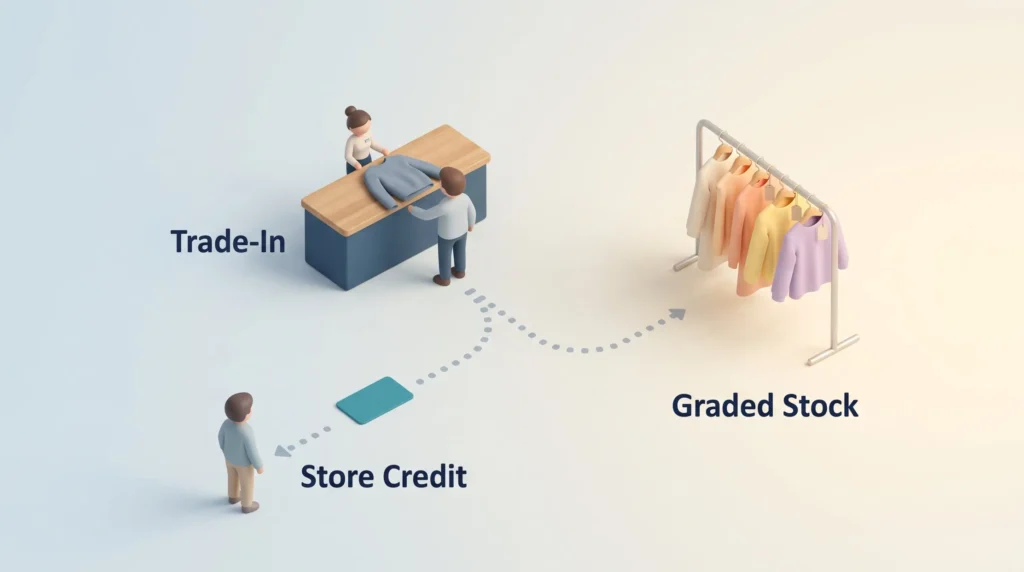
Then decide whether to operate resale yourself or partner with an existing marketplace. Running it in-house keeps the customer relationship and the data; partnering gets you liquidity immediately. Either way you will need a product page structure that handles single-unit inventory, which most storefronts, including standard Shopify setups, do not do well out of the box without configuration.
Finally, use the same personalization and merchandising discipline you use for new goods. The techniques behind e-commerce personalization apply, with the constraint that every item is unique, so recommendations have to work from attributes rather than repeat purchases. The retail technology shift visible in checkout-free and automated stores is running on a similar timeline.
Conclusion
Recommerce has stopped being a trend story and become a structural part of retail. The market is measurable, growing faster than the retail around it, and increasingly shaped by regulation rather than by consumer enthusiasm alone.
For shoppers, the practical gain is access: lower prices, and items that are no longer manufactured. For businesses, the question has moved from whether resale matters to whether you would rather run it or watch someone else run it on your products.
The parts worth watching next are authentication at scale, refurbished electronics as a mainstream category, and how far social discovery goes in replacing search. Each of those changes how a used item finds its next owner, which is the only thing resale has ever really been about.
Found this useful?
Make SmartKeys a preferred source on Google, and our articles will surface more often in your Top Stories, AI Overviews, and AI Mode.
Add as Preferred Source