
Managing up means working with your manager on purpose instead of by accident. You find out what they are measured on. You tell them what they need to know before they have to ask, and you flag problems while there is still time to fix them. It is not flattery. It is the difference between a manager who trusts your judgment and one who checks on you twice a day.
The idea was popularized by John Gabarro and John Kotter. Their Harvard Business Review article Managing Your Boss, first published in 1980, argued that the relationship is a shared responsibility, not something handed down from above.
Two numbers explain why this matters more in 2026 than it used to. Gallup’s mid-year data shows that 49 percent of employees strongly agree they know what is expected of them at work. Roughly half the workforce is guessing. Gartner surveyed 2,947 employees and managers in late 2025. It found that 47 percent of managers say more is expected of them than a year ago. Managers also spend an average of nine hours a week on their team’s personal and emotional concerns. That is more than a fifth of their working time.
So your manager has less attention to spend, and the odds that you share the same picture of your work are about even. A short written update, sent on a predictable rhythm, closes both gaps.
Key Takeaways
- Managing up is a working method, not flattery: clarify priorities, then report against them.
- Ask your manager directly what they are measured on this quarter.
- A useful update names what moved, what it produced, what is at risk, and what you need decided.
- Send bad news early, with a recommendation attached.
- Keep one-on-ones for decisions and feedback, not for reading out a status list.
What Managing Up Actually Means
Managing up is often misread as sucking up. Flattery is about how your manager feels. Managing up is about what your manager knows, and about removing the guesswork that slows decisions down.
Gabarro and Kotter described it as understanding your manager’s goals, pressures and blind spots, being honest about your own, then building a way of working that fits both. Three things follow.
- You share responsibility for the relationship. A manager who has never asked how you prefer to work is unlikely to start. You can.
- You give information before it is requested. Every question your manager has to ask is a cost you could have removed.
- You disagree in a usable form. “This is the wrong priority” is a complaint. “This pushes the launch by two weeks, here are the two options” is something a manager can act on.
None of this requires a good manager. The written record it produces protects you when you do not have one.
Find Out What Your Manager Is Measured On
You cannot align with a target you have not seen. Most people guess at their manager’s priorities from meeting agendas and tone of voice. That is how two people end up working hard in different directions.
Ask directly: “What are the two or three things you are being judged on this quarter?” Most managers answer, partly because being asked is a relief. The answer tells you which of your tasks carry weight and which are merely on your list.
Then check that it still holds. Priorities move when budgets, customers or leadership move, so repeat the question each quarter. If your company runs formal objectives, tie yours to your manager’s. A personal OKR framework (OKR stands for Objectives and Key Results) pairs each objective with measurable results; ordinary goal setting methods do the same with less ceremony.
One habit is worth adding. When a request arrives in a hurry, repeat it back: “So you want the pricing comparison by Thursday, covering the three enterprise plans only.” Thirty seconds there saves a day of work aimed at the wrong thing.
Match the Format to How Your Manager Reads
The same update lands differently depending on how it arrives. Some managers want the conclusion in the first line and nothing else. Others want the reasoning, because they will have to defend it upstairs. You cannot deduce which from a job title.
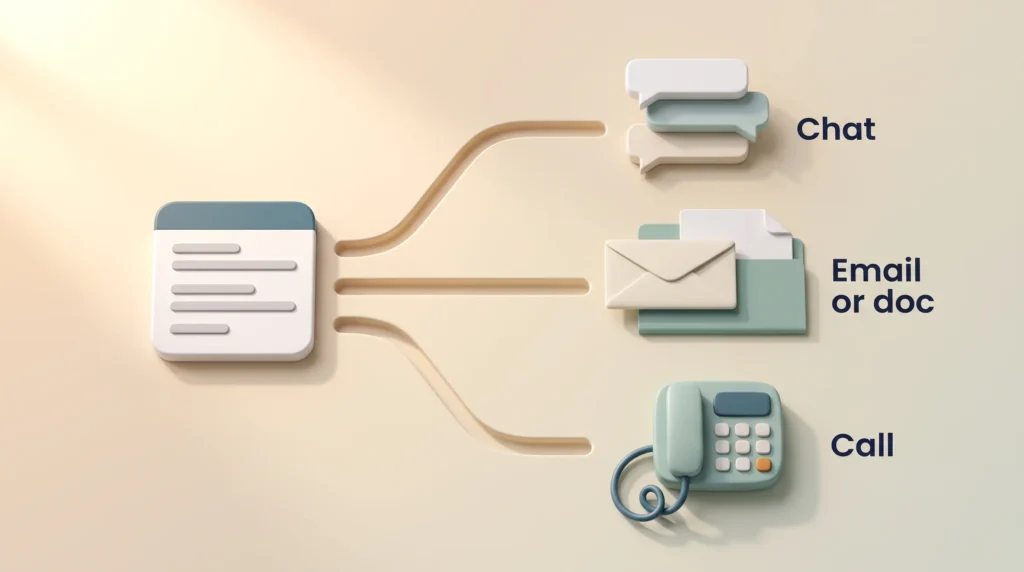
So ask. Three questions cover it: how often do you want to hear from me, how much detail is useful, and what counts as urgent enough to interrupt you?
Then match the channel to the content. Chat is for progress that needs no reply. Email or a shared document is for anything you may need to point at later: a decision, a budget number, a date. A call is for the tangled problem where three messages would turn into thirty.
Written updates travel better across time zones, which is why teams working in an asynchronous way default to them. They also respect your manager’s day. If their calendar is cut into meeting-shaped blocks, the maker versus manager schedule explains why a message they read at 6 p.m. beats a call at 11 a.m. Agreeing what counts as urgent is the other half of workable instant messaging boundaries.
The Five Parts of a Status Update That Works
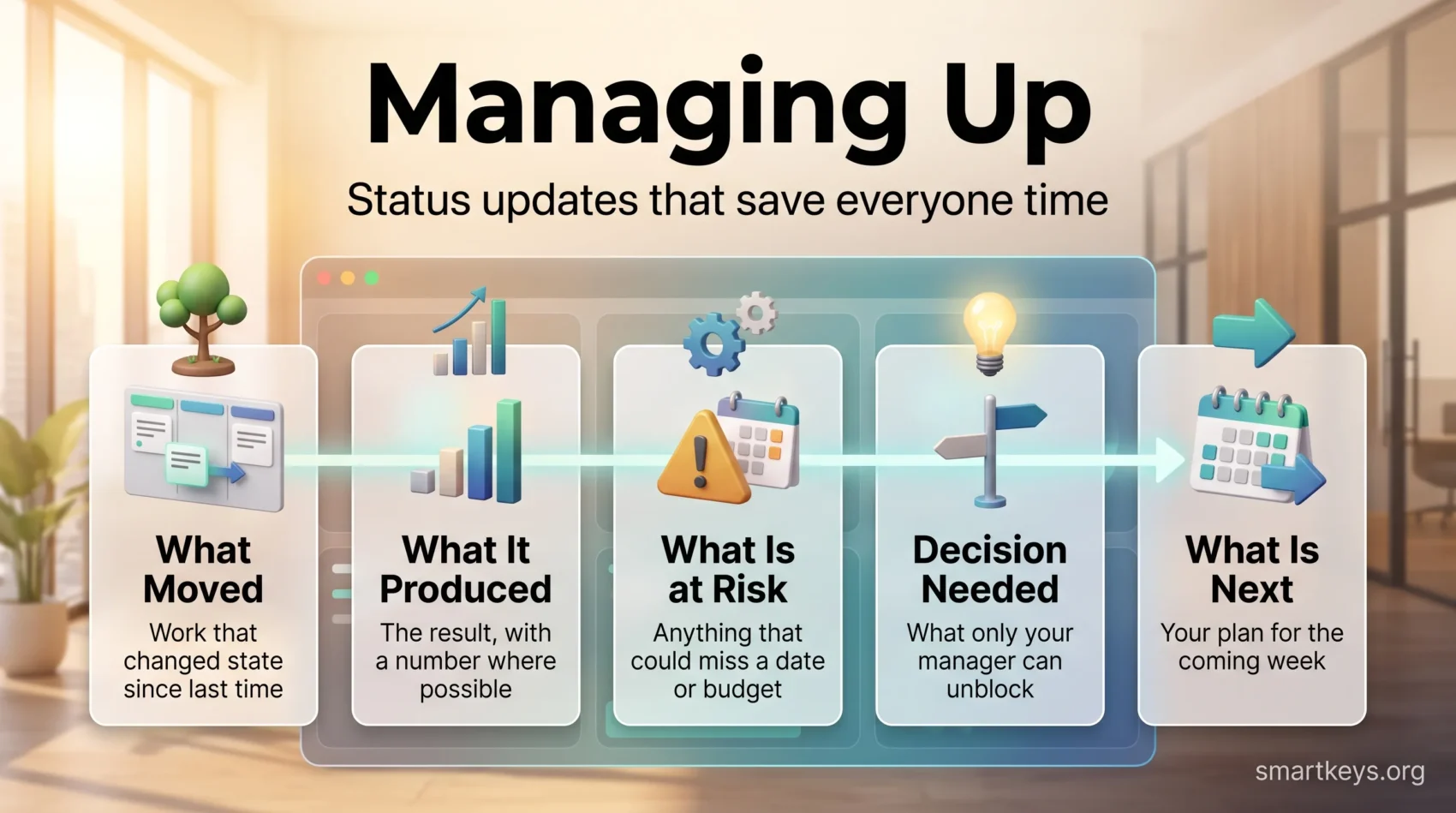
A good update answers five questions in order. Anything else is padding.
- What moved. The work that changed state since last time, not everything you touched.
- What it produced. The result, with a number where one exists. “The onboarding checklist is live” tells your manager nothing. “New hires reach first login in two days instead of five” tells them whether it was worth doing.
- What is at risk. Anything that could miss a date, cost more than planned, or fail quality checks.
- What you need decided. The one or two things only your manager can unblock, each with your recommendation.
- What is next. Your plan for the coming week, so they can correct it cheaply if it is wrong.
Inventing numbers is worse than leaving them out. If you have no measure yet, agree on one before you start the work. A short set of personal productivity metrics gives you something honest to report against instead of adjectives.
A Template You Can Reuse
Keep it to a screen. Five headings, two or three lines under each:
- Done: Migrated the reporting script. The monthly report now takes 20 minutes, not half a day.
- In progress: Supplier comparison, roughly 60 percent through, on track for Friday.
- Risks: The finance export is three days late. If it slips past Wednesday, Friday moves.
- Decision needed: Two suppliers fit the budget. I recommend the second, because delivery is two weeks faster. Your call by Thursday.
- Next week: Finish the comparison, start the rollout plan.
Send it the same day each week. Predictability is most of the value: a manager who knows your update lands on Friday morning stops chasing you on Wednesday. Writing it doubles as your own review, much like a weekly planning session, and a monthly review of those notes gives the longer view. If a blank page slows you down, empty your head onto it first, the way a brain dump works.
Raise Problems Early, and Bring a Recommendation
Bad news does not improve with age. A slipped date you mention on Monday is a scheduling problem. The same date on Friday afternoon is a crisis your manager has to explain to someone else with no warning.
People delay out of hope that it resolves itself, or fear of looking incompetent. Both cost more than the admission would have. Managers rarely remember who reported a delay; they remember who let one surprise them.
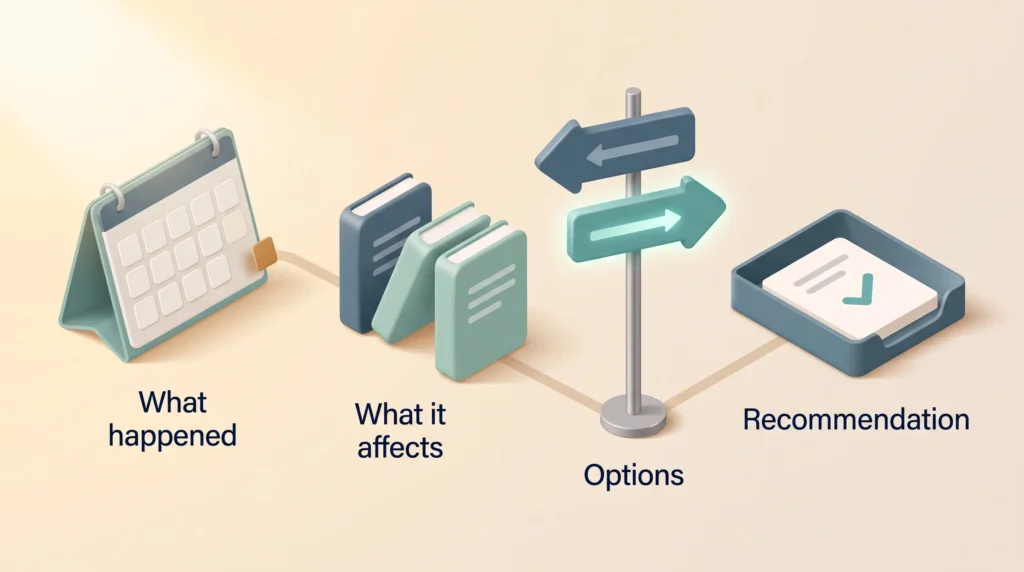
What makes an early warning easy to receive is its shape: what happened, what it affects, the options you see, and which one you would pick. That turns an interruption into a decision your manager can make in a minute.
The same structure works when the problem is your own workload. “I cannot do all three by Friday, which two matter most?” beats silence followed by a miss. If all three matter, that is a resourcing conversation, and delegation or moving low-value work elsewhere is the honest next step. Absorbing it quietly is how capable people reach the early stages of burnout.
Giving Your Manager Feedback Without Friction
Upward feedback is the part most people skip, and it is where trust is actually built. A structure helps more than courage does.
The Center for Creative Leadership teaches a model called SBI, short for Situation, Behavior and Impact. You name the moment, describe what was said or done without interpreting it, then state the effect you observed. That keeps the conversation on evidence instead of motives.
In practice: “In Tuesday’s planning call, you moved on about ten seconds after asking for input. Two people with questions told me afterwards they did not get to raise them.” Compare that with “you do not really want our opinions,” which invites a defense and settles nothing.
Check three conditions before you speak. Is it a pattern rather than a one-off? Does it affect the work? Do you have enough context to be right? If all three hold, ask permission: “Can I share something I noticed in the call?” That sentence changes the temperature of the conversation.
Timing helps too. A project debrief is a natural setting, because everyone expects to examine what happened. Organizations using continuous performance management, where feedback is ongoing rather than annual, make this routine. Predictable behavior is also what builds trust in a distributed team, where nobody can read the room.
Make Your One-on-Ones Worth the Time
A one-on-one spent reading out your status list wastes both calendars. If the update is written and already sent, the meeting is free for what writing cannot do: decisions, disagreements and career conversations.
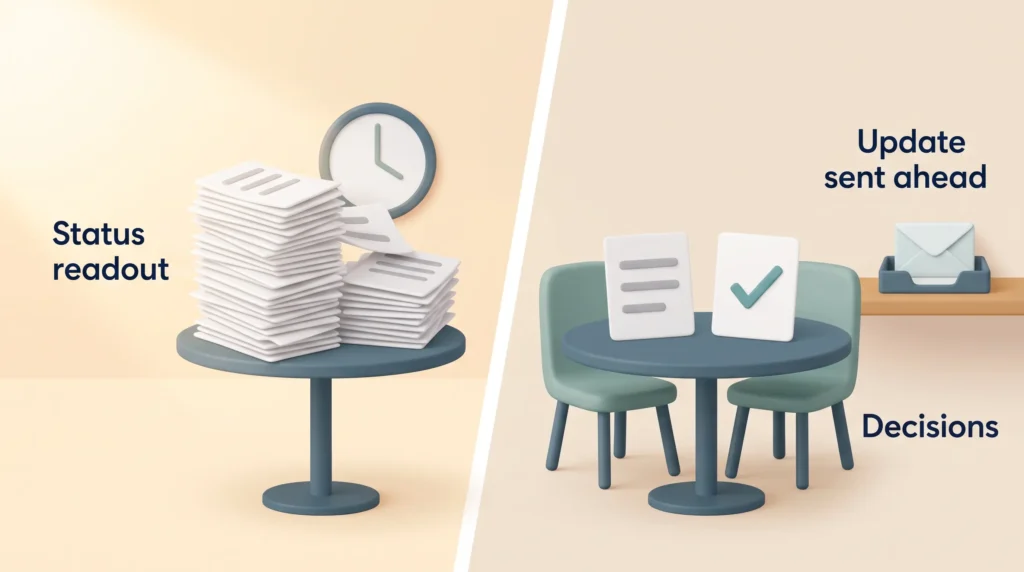
Bring a short agenda, even three bullets sent an hour before: what you finished, what you need from them, and one thing you want to get better at. Ending on that last point turns a status check into a development conversation.
Active listening, which means summarizing what the other person said before you respond, catches misunderstandings while they are still cheap. For a fuller structure, our one-on-one meeting template sets out the sections in order.
Close every session the same way: who does what, by when. Write it down straight after, using a meeting notes template or, for recorded calls, an AI meeting notes workflow. Ask before you record. That record does double duty when you work remotely. Your manager can point to it in a room you are not in, which is much of how visibility from a distance works.
When the Relationship Is Difficult
Not every manager relationship responds to good habits. Two problems come up often enough to plan for.
Micromanagement usually comes from a manager who cannot see progress, not one who thinks you are lazy. New managers do it most, and so do managers under pressure from above. The counter is visibility: send the update before it is asked for, show work in progress, and confirm what “done” means at the start. Most oversight fades once the anxiety behind it has nothing left to feed on.
Disagreement belongs on the ground of priorities and consequences, not intentions. Ask what rather than why. “What would we drop to make room for this?” opens a discussion. “Why do you always change the plan?” closes one.
There is also the situation no technique fixes. If the pattern is unfair treatment rather than a mismatch in working style, write down what happens and use whatever internal route exists, such as HR. Then take the possibility of leaving seriously. Manager quality is one of the strongest drivers of whether people stay, which is why it sits at the center of most talent retention strategies.
Conclusion
Managing up comes down to a few repeatable moves. Ask what your manager is measured on. Find out how they want information. Send a short update on a fixed day covering what moved, what it produced, what is at risk, what needs deciding and what comes next. Raise problems while they are small, with a recommendation attached.
Then use the meeting time you freed up for what needs a conversation: feedback in both directions, decisions, and where you want to be in a year. With half of employees unclear on what is expected of them, the person who removes that uncertainty is doing visible work.
Found this useful?
Make SmartKeys a preferred source on Google, and our articles will surface more often in your Top Stories, AI Overviews, and AI Mode.
Add as Preferred SourceFAQ
What does managing up actually mean?
Managing up means taking deliberate responsibility for the working relationship with your manager instead of leaving it to chance. It covers three things: finding out what your manager is measured on, giving them information in the form and rhythm they can use, and raising problems early enough to be fixed. The idea was popularized by John Gabarro and John Kotter in Harvard Business Review. It is not flattery. Done properly, it often means disagreeing in a form your manager can act on.
What should a status update to my manager contain?
Five things: what moved since the last update, what it produced, what is at risk, what you need decided, and what you plan next. Put a number on the result wherever an honest one exists, because “the checklist is live” says less than “new hires reach first login in two days instead of five.” Keep it to one screen. Anything longer competes for attention your manager does not have, and the parts that matter get skimmed with the rest.
How often should I send updates?
Weekly suits most roles, on the same day each week so your manager knows when to expect it. Predictability is much of the value: a manager who knows Friday morning brings your update stops checking in on Wednesday. Send an immediate message whenever something breaks or a date slips, because those cannot wait. On long projects with little weekly change, an update every two weeks plus fast reporting of exceptions works as well.
How do I report a problem without looking incompetent?
Tell them early and bring a recommendation. Four lines cover it: what happened, what it affects, the options you can see, and which one you would choose. That turns an interruption into a decision your manager can make quickly, and shows you have done the thinking. Delay is what damages credibility. A missed date raised on Monday is a scheduling problem; the same date on Friday afternoon is a crisis nobody saw coming.
Can I give my own manager feedback?
Yes, if you check three conditions first: it is a pattern rather than a single incident, it affects the work, and you have enough context to be right. Then use the SBI structure from the Center for Creative Leadership. Name the situation, describe the behavior without interpreting it, and state the impact you observed. Ask permission first, with something as simple as “can I share something I noticed?” A project debrief or your one-on-one beats a group meeting.
What should I do if my manager micromanages me?
Make your progress visible before your manager has to ask for it. Micromanagement usually comes from a manager who cannot see how the work is going, often because they are new to the role or under pressure from above. Send your update before it is requested, share work in progress instead of only finished results, and agree at the start what “done” looks like. If the close checking continues, ask directly what information would let them step back. Most managers relax once the gap they worry about is closed.