The work landscape keeps shifting, and companies increasingly look to crowdsourcing talent when they need skills faster than a hiring process can deliver them. What started as a way to gather ideas has become a working part of how projects get staffed, tested and shipped.
This article explains what crowdsourcing talent actually delivers in 2026: where it creates real flexibility, what it costs, where quality breaks down, and which rules now apply to the people doing the work. With the right talent acquisition strategies, a crowdsourced layer can sit alongside your permanent team instead of competing with it.
Key Takeaways
- Crowdsourcing improves workforce flexibility by giving you access to skills you do not employ full time.
- More than 72 million Americans now work independently, and 42% of them find work primarily through online platforms (MBO Partners, 2025).
- The distributed micro-task model and the contest model solve different problems, so pick deliberately.
- Quality depends on screening, clear briefs and reputation data, not on the size of the crowd.
- From 2 December 2026, EU member states must apply the Platform Work Directive, which changes how platform work is classified and managed.
Understanding Crowdsourcing and Its Evolution
Talent crowdsourcing means mobilising a community, usually online, to take on a defined task or challenge. The model began as a way to collect ideas. It now delivers finished work: code, designs, translations, labelled training data, research and campaign assets.
Modern crowdsourcing runs on two primary models. The distributed micro-task model splits a large job into small pieces so many contributors can work in parallel. It suits volume work with clear acceptance criteria, such as data labelling or content moderation. The contest model asks individuals or teams to compete, and you pay for the entry you choose. It suits open-ended creative and engineering problems where you cannot specify the answer in advance, and it underpins much of open innovation practice.
The idea is old. The British Longitude Act of 1714 offered up to 20,000 Pounds to anyone who could determine longitude at sea, and the clockmaker John Harrison eventually claimed the bulk of the reward with his marine timekeepers. The mechanism was the same one platforms use today: publish the problem, let anyone attempt it, pay for the solution that works.
What changed is the infrastructure. Marketplaces such as Upwork and Fiverr, specialist freelance talent platforms and industry-specific communities now handle discovery, contracting, escrow and dispute resolution. That removes most of the administrative friction that once made distributed work impractical for anything but small experiments.

The Role of Crowdsourcing Talent in Workforce Flexibility
Crowdsourcing talent gives you a way to add capacity without adding headcount. You reach into a global talent pool, buy the specific skill a project needs, and release it when the project ends. That is the core of optimizing talent pool spend: paying for capability by the task rather than by the year.
Speed is the other advantage. A conventional hire takes weeks of sourcing, interviewing and notice periods. A crowdsourced brief can be live within a day and returning work within a week. For teams facing seasonal peaks, a launch deadline or a skill gap they did not plan for, that difference decides whether the work happens at all. It also pairs naturally with on-demand workforce planning, where a small permanent core is supported by contingent capacity.
The evidence that this is now mainstream is in the numbers. MBO Partners reported in its 2025 State of Independence study that more than 72 million Americans work independently, that 42% rely on online platforms as their primary route to work, and that 74% use generative AI to improve their output. A supply pool that large and that digitally organised is a genuine sourcing channel, not a stopgap.
Crowdsourcing also reaches inward. Offering employees paid or recognised work on projects outside their own team is a form of internal talent marketplace, and it tends to raise employee engagement rather than dilute it.
Access to a Global Talent Pool
Hiring within commuting distance limits you to whoever happens to live nearby. Crowdsourcing removes that constraint, which matters most for skills that are scarce everywhere.
Breaking Geographic Barriers
Once work is briefed, delivered and reviewed online, location stops being a filter. You can commission a Rust developer, a Japanese localiser and a medical illustrator in the same week without opening an office anywhere. The constraints move elsewhere: overlapping working hours, payment rails and contract law. Cross-border payment and compliance are handled through global payroll and contractor platforms rather than by your finance team improvising.
Leveraging Diverse Skill Sets
A wider pool brings diverse skill sets and, with them, different assumptions about the problem. That is the main reason crowdsourced creative and engineering work often produces options an internal team would not have proposed. It is also why briefs need to be tighter: contributors have none of the context your staff carry in their heads.
Enhancing Innovation through Crowd Talent Solutions
Organisations looking to broaden their range of options often turn to crowd talent solutions. The value is not that crowds are wiser than experts. It is that a crowd generates a larger and more varied set of candidate solutions, and you only pay for the ones you keep.
The Power of Collective Intelligence
Collective approaches work best when the problem can be stated precisely, contributions can be evaluated independently, and the evaluation itself is cheap. Where those conditions hold, running a contest or an open call is an efficient way to search a solution space. Where they do not, for example on work requiring deep institutional context or confidential data, a crowd is the wrong instrument.
Case Studies of Successful Crowdsourcing Innovations
LEGO Ideas is the clearest working example. Fans submit product concepts, other users vote, and a submission that reaches 10,000 supporters enters a formal LEGO review that can lead to a commercially released set with a royalty for the designer. The programme has produced dozens of retail products and gives LEGO a continuous read on what its most engaged customers want.
Innocent Drinks built the same habit into its marketing, inviting customers into naming and campaign decisions. The pattern in both cases matters: the crowd contributes ideas and signal, while the company keeps the decision, the quality bar and the commercial risk. That balance separates durable crowdsourced innovation programmes from one-off publicity campaigns.

Crowdsourcing Talent: A Modern Approach to Recruitment
Crowdsourcing sits alongside conventional staffing rather than replacing it. It is strongest where the need is specific, time-boxed and specialised.
Transitioning from Traditional Staffing Models
Conventional hiring is expensive. SHRM puts the average cost per hire at close to $4,700, and that figure covers only the direct costs, not the manager hours consumed by interviewing or the output lost while a role sits empty. For a three-week piece of specialist work, that maths rarely justifies a permanent hire.
Adding a crowdsourced layer to your plan lets you:
- Match the commitment to the work, so short engagements do not carry permanent cost.
- Test a working relationship before extending it, which is the logic behind the contract-to-hire model.
- Respond to demand changes within days rather than quarters.
Engaging with Niche Talent
Reaching niche talent is where crowdsourcing earns its place. Platforms index skills at a granularity no job board matches, and specialist communities concentrate people who would never respond to a recruiter. The same channels support longer-term relationships: repeat contributors who know your product become a bench you can call on, which is the practical version of building a talent pipeline.
Treat those relationships as ongoing. Guidance on managing freelancers applies directly: consistent briefs, prompt payment and honest feedback are what keep good contributors available the next time you need them.
Benefits of Utilizing Crowdsourcing for Talent Acquisition
The benefits are real, but they are specific rather than universal. It helps to be precise about which ones apply to your situation.
Cost-Effectiveness in Hiring
The saving comes from matching cost to need, not from cheap labour. You avoid recruitment fees on short engagements, you do not carry benefits or idle time, and you do not pay for capability during the months you are not using it. Skilled independents on established platforms are not cheap by the hour, and treating rate as the main selection criterion is the fastest route to rework.
Improving Project Scalability
Crowdsourcing improves project scalability because capacity can move in both directions. Ten contributors can become thirty for a fortnight and back to ten, without redundancy processes. That elasticity is the point, and it is worth measuring: workforce analytics tools let you see how much of your delivery actually runs on contingent capacity before you depend on it.
Encouraging Employee Engagement
Internal crowdsourcing gives employees access to projects outside their job description. That tends to improve retention and skills breadth at the same time, and it is one of the more reliable levers in current employee engagement practice. Referral programmes work on the same principle: your staff already know qualified people you cannot reach.
Technology Behind Talent Sourcing Platforms
Talent sourcing platforms are the operating layer of crowdsourced work. They handle matching, contracting, milestone payments, escrow, IP assignment and dispute resolution, which is most of what used to make distributed work administratively painful.
Matching is increasingly automated. Platforms score profiles against briefs, rank candidates and surface people who never applied. That saves time, and it introduces risk: an opaque ranking model can systematically disadvantage groups of applicants. The issues covered in work on bias in AI hiring apply to platform matching as much as to corporate applicant tracking systems, and the sensible response is to audit outcomes rather than trust the ranking.
What these platforms reliably give you is:
- Reach into skills you cannot source locally
- Reputation and work history you can inspect before committing
- Structured contracting and payment protection on both sides
- Faster shortlisting through automated matching
- Access to people who are not actively job hunting
If you are also using AI to screen or rank candidates in your own process, the practical questions are covered in more depth in our guide to AI hiring tools.
Challenges of Crowdsourcing Workforce Solutions
Crowdsourcing fails in predictable ways. Knowing the failure modes is more useful than a list of benefits.
Quality Control Concerns
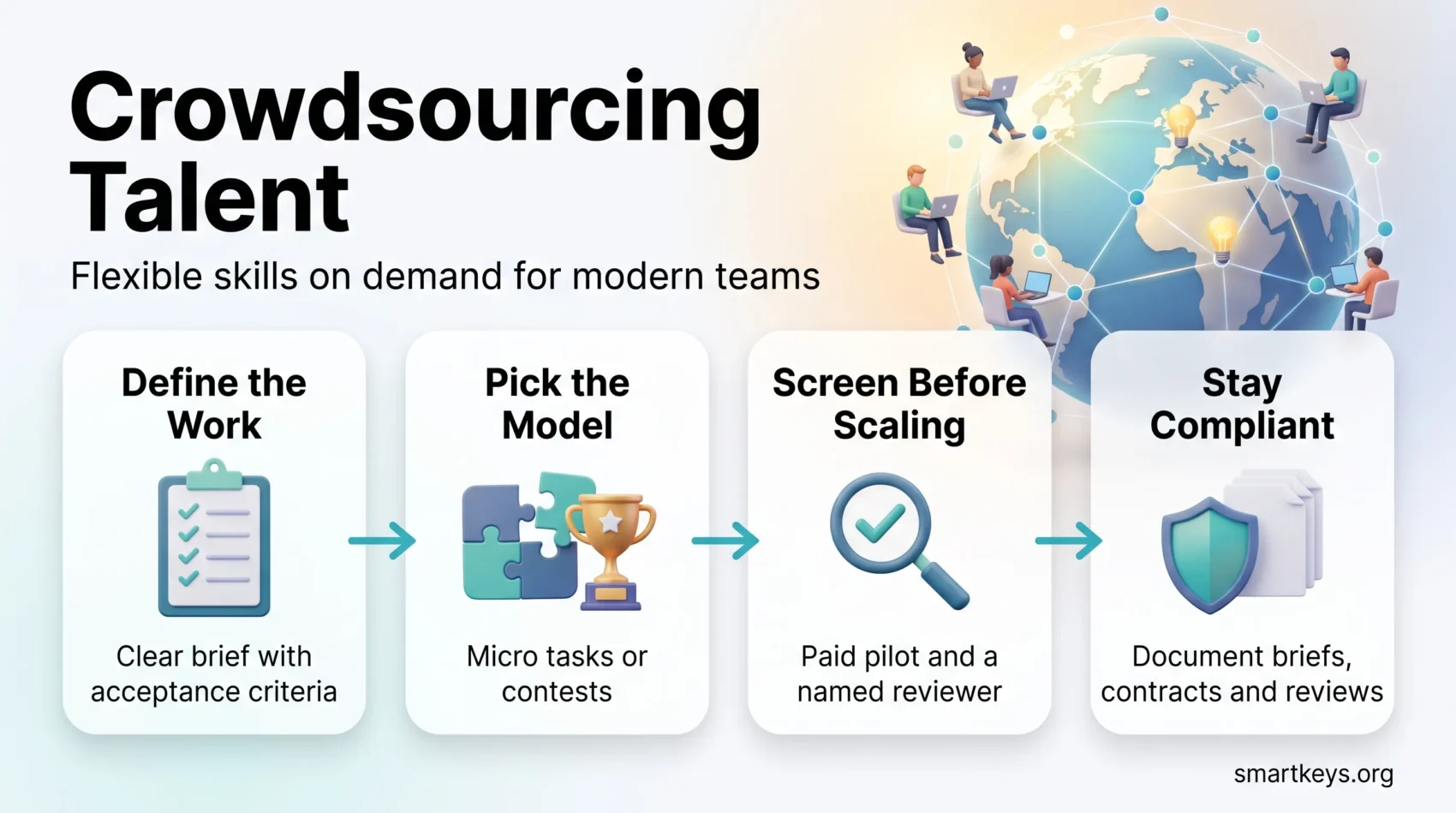
Weak submissions usually trace back to a weak brief rather than a weak contributor. Someone with no exposure to your product cannot infer your standards. What works: a written brief with explicit acceptance criteria, a small paid trial task before a large commitment, reputation data from comparable work, and a named internal reviewer who owns the accept or reject decision. Without that last role, quality drifts because nobody is accountable for holding the line.
Management of Diverse Teams
Coordination costs rise with the number of contributors. Time zones, language, tooling and differing assumptions about what “done” means all add friction. Distributed contributors need more written context than colleagues do, not less. Budget for that coordination work explicitly, or it silently consumes the time you thought you were saving.
Classification and Compliance in 2026
This is the part of crowdsourcing that changed most recently, and it is easy to get wrong.
The EU Platform Work Directive (EU) 2024/2831 must be transposed into national law by 2 December 2026. It introduces a legal presumption of employment where the facts indicate that a platform directs and controls the work, shifting the burden onto the platform to prove otherwise. It also imposes transparency duties on algorithmic management, including how automated systems allocate tasks, rate performance and restrict accounts, and it requires human oversight of significant automated decisions. Member states are implementing it in different ways, so if you commission platform work in the EU, check the national rules rather than the directive alone. Our overview of gig economy regulation tracks how these obligations are landing.
Separately, the EU AI Act treats AI used in recruitment, selection, task allocation and performance monitoring as high risk. Those obligations were originally due to apply from 2 August 2026, but the Council’s Omnibus VII package, approved in June 2026, postponed them to 2 December 2027 for standalone systems and 2 August 2028 for AI embedded in products. This is a delay, not a repeal, and the transparency duties that already apply to AI systems interacting with people are unaffected. Our EU AI Act compliance guide covers the timeline in detail.
Two consequences follow. Classification is a live risk in the EU, so document how work is briefed, supervised and accepted. And if a platform’s algorithm allocates or rates the people doing your work, understand how it does that before you build a delivery model on top of it.
Implementing Talent Acquisition Strategies through Crowdsourcing
A crowdsourced layer works when it is designed, not improvised.
Creating an Effective Crowdsourcing Model
Start with the work, not the platform. Write down what “finished” looks like, what the reviewer will check, what the budget is and what happens if the first attempt misses. Choose the model to match: micro-tasks for volume work with objective criteria, contests for open-ended problems, direct engagement for anything requiring context or confidentiality. Then pick a platform that fits that shape, rather than fitting your work to whichever platform you already have an account with.
Best Practices for Businesses
- Run a small paid pilot before committing a full project to a new contributor.
- Keep briefs written and versioned, so contributors and reviewers work from the same document.
- Settle IP assignment and confidentiality in the contract, before work starts.
- Build a bench of repeat contributors instead of re-sourcing every time.
- Encourage employee referrals, which consistently produce strong candidates at low cost.
- Track cost, cycle time and rework rate so you can tell whether crowdsourcing is actually helping.
Larger contingent programmes are worth planning at the same level as permanent headcount. That is the subject of workforce contingency planning, and it is what turns ad hoc freelancing into a capability you can rely on.
The Future Outlook of Crowdsourcing Talent
Three shifts look durable.
The independent workforce keeps growing and professionalising. MBO Partners recorded 5.6 million US independents earning more than $100,000 a year in 2025, a 19% rise on 2024, and Gen Z now makes up 28% of the independent workforce. This is not a residual category of people between jobs. Broader freelancing trends point the same way, as does the expanding global gig economy.
AI is changing what a crowd is for. When 74% of independents already use generative AI in their work, the value of a contributor moves away from producing volume and towards judgment, taste and domain knowledge. Routine micro-task work is exactly what automation absorbs first, so the crowdsourcing that survives will skew towards harder problems. That shift maps onto wider expectations about future job skills.
Regulation is catching up. The Platform Work Directive, national implementations and the delayed EU AI Act obligations together make crowdsourced work more governed than it was. Companies that already document briefs, contracts and review decisions will find this straightforward. Those that treated platform work as a way to avoid employment obligations will not. The same forces are reshaping contract work more broadly and the shape of remote work itself.
Conclusion
Crowdsourcing talent is a practical answer to a specific problem: needing a skill you do not employ, for less time than a hire would justify. Used that way, it adds real workforce flexibility, shortens the path from need to delivery, and gives you access to expertise your local market does not hold.
It is not a cheaper substitute for hiring, and it does not remove management work. The organisations that get value from it write clearer briefs, screen before they scale, keep a named reviewer accountable for quality, and treat classification and IP as contract questions to settle upfront rather than problems to discover later.
Get those foundations right and a crowdsourced layer becomes a permanent part of how you staff work.
Found this useful?
Make SmartKeys a preferred source on Google, and our articles will surface more often in your Top Stories, AI Overviews, and AI Mode.
Add as Preferred SourceFAQ
What is crowdsourcing talent?
Crowdsourcing talent means opening a defined piece of work to a community, usually through an online platform, instead of assigning it to an employee or a single contractor. The work can be split into small parallel tasks, run as a competition where you pay for the entry you choose, or commissioned directly from a specialist you found on a marketplace. The point is access rather than volume: you reach skills you do not employ, for the length of time the work actually takes. It suits well-specified, time-boxed projects far better than it suits open-ended roles that depend on institutional context.
How does crowdsourcing improve workforce flexibility?
It lets capacity move in both directions without redundancy processes. A conventional hire takes weeks of sourcing, interviewing and notice periods, and the cost continues whether or not the work does. A crowdsourced brief can be live within a day, and the commitment ends when the project does. That makes it useful for seasonal peaks, launch deadlines and skill gaps you did not plan for. The supply side supports it: MBO Partners found in 2025 that more than 72 million Americans work independently and that 42% find work primarily through online platforms.
What are the main crowdsourcing models?
There are two. The distributed micro-task model breaks a large job into small pieces so many contributors work in parallel, which suits high-volume work with objective acceptance criteria such as data labelling, transcription or moderation. The contest model asks individuals or teams to compete and you pay for the submission you select, which suits open-ended creative and engineering problems where you cannot specify the answer in advance. Direct engagement, hiring a specialist you found through a platform, sits between the two. Choose based on whether you can define the output precisely, not on which model sounds more modern.
Does crowdsourcing actually reduce hiring costs?
It reduces the cost of getting specific work done, which is not the same as cheap labour. SHRM puts the average cost per hire at close to $4,700 in direct costs alone, before manager time and the output lost while a role sits vacant. For a short specialist engagement, that maths rarely justifies a permanent hire, and crowdsourcing avoids recruitment fees, benefits and idle capacity. But skilled independents on established platforms charge accordingly, and choosing on hourly rate is the most common route to rework. Budget for coordination and review time as well, because both are real.
How do you keep quality consistent in crowdsourced work?
Weak submissions usually come from weak briefs. Someone with no exposure to your product cannot infer your standards, so write them down: what finished looks like, what the reviewer will check, and what happens if the first attempt misses. Beyond that, four things do most of the work. Run a small paid trial task before a large commitment. Use platform reputation and work history from comparable projects, not overall star ratings. Keep briefs versioned so everyone reads the same document. Most importantly, name one internal reviewer who owns the accept or reject decision, because quality drifts whenever nobody is accountable for holding the line.
What rules apply to platform and crowdsourced workers in the EU?
The EU Platform Work Directive (EU) 2024/2831 must be transposed into national law by 2 December 2026. It creates a legal presumption of employment where the facts show the platform directs and controls the work, putting the burden on the platform to prove otherwise. It also requires transparency about algorithmic management, covering how automated systems allocate tasks, rate performance and restrict accounts, plus human oversight of significant automated decisions. Member states are implementing it differently, so check national rules rather than the directive alone. If you commission platform work in the EU, document how each engagement is briefed, supervised and accepted.
What role does AI play in talent sourcing platforms?
Platforms use automated matching to score profiles against briefs, rank candidates and surface people who never applied, which shortens shortlisting considerably. The trade-off is opacity: a ranking model you cannot inspect can systematically disadvantage groups of applicants, and the same concerns raised about AI in corporate hiring apply here. Audit outcomes rather than trusting the ranking. On the supply side, MBO Partners found that 74% of independents already use generative AI in their work, which is shifting the value of a contributor away from producing volume and towards judgment and domain knowledge.
When is crowdsourcing the wrong approach?
Avoid it when the work depends on institutional context that takes months to acquire, when it involves confidential data or systems you cannot safely expose, or when the output cannot be evaluated cheaply and independently. Crowdsourcing also fits badly where the requirement is continuous rather than project-shaped, because you end up re-sourcing constantly and lose the accumulated knowledge each time. Coordination cost is the quiet failure mode: past a certain number of contributors, managing time zones, tooling and differing assumptions about what finished means consumes the time you expected to save.