Globalization did not end, and it did not stand still. It changed shape. World merchandise trade volume grew 4.6% in 2025, then the WTO cut its 2026 forecast to 1.9% as tariffs, frontloaded imports and regional conflict worked their way through the system. Over the same period the average effective US tariff rate climbed from 2.3% in January 2025 to 7.1% by June 2026, and in February 2026 the Supreme Court struck down one of the main legal bases for those tariffs.
For anyone running a business across borders, that combination matters far more than any sweeping claim about a flat or a fragmented world. Trade is still growing. The rules under which it grows are being rewritten faster than at any point since the 1990s. This guide covers what actually changed, what it means for sourcing, market entry and pricing, and which globalization business trends are worth planning around now.
Key Takeaways
- The WTO puts 2025 merchandise trade volume growth at 4.6% and forecasts 1.9% for 2026, with 2.6% penciled in for 2027.
- The US average effective tariff rate rose from 2.3% in January 2025 to 7.1% in June 2026, according to the Penn Wharton Budget Model.
- The Supreme Court invalidated the IEEPA tariffs on 20 February 2026, but Section 232 duties on steel, aluminum, autos and trucks remain.
- The USMCA joint review on 1 July 2026 ended without a 16-year extension, so annual reviews now run through to 2036.
- Global foreign direct investment rose 6% to $1.6 trillion in 2025, but the top 20 host economies took over 80% of it.
- The US $800 de minimis exemption is suspended, which changes the economics of low-value cross-border parcels.
- EU due diligence duties were narrowed in February 2026 to companies above 5,000 employees and EUR 1.5 billion turnover.
Understanding Globalization
Globalization is the deepening of links between economies: goods, services, capital, data and people crossing borders, plus the rules that govern that movement. For a company, it shows up as a sourcing decision, a hiring decision or a compliance obligation long before it shows up as a headline.
The long-run record is one of the strongest arguments for open exchange. World Bank figures show extreme poverty falling from roughly 2.3 billion people in 1990 to about 831 million today, measured against a $3 a day poverty line. The Bank is equally clear that progress has slowed sharply over the past decade under weak growth, debt, conflict and climate shocks.
Decoupling between the United States and China is real in specific sectors such as semiconductors and critical minerals, but a clean split into rival blocs has not happened. What geopolitical pressure has done is raise the value of adaptable strategies, a theme running through how globalization is reshaping work itself.
The practical hurdles are unglamorous: finding talent in an unfamiliar labor market, meeting local compliance standards, adapting a product to local expectations. Companies with a mature global footprint, Nestle and PepsiCo among them, tend to solve this the same way, by keeping strategy central and letting execution be local.
How Globalization Got Here
Cross-border exchange is ancient. Roman trade routes and the Silk Road moved goods, money and ideas across continents long before anyone used the word globalization. The industrial revolution changed the scale, as steam power and cheaper shipping turned regional commerce into intercontinental commerce.
The modern phase dates from the institutions built after the Second World War, which lowered tariffs and made cross-border investment predictable. Containerization then collapsed freight costs and the internet collapsed coordination costs. The G20’s formation in 1999 marked the point where large emerging economies became part of the conversation rather than its subject.
Two lessons carry forward. Integration is not a one-way ratchet; it has stalled and reversed before. And each wave was driven by a technology that made distance cheaper, which is worth remembering when assessing what AI in business operations will do to services trade.
Globalization Business Trends in 2026
The picture in 2026 is not deglobalization. It is slower, more politically managed integration, with far more attention paid to where things are made and who checks the paperwork.
Trade Keeps Growing, but the Curve Has Flattened
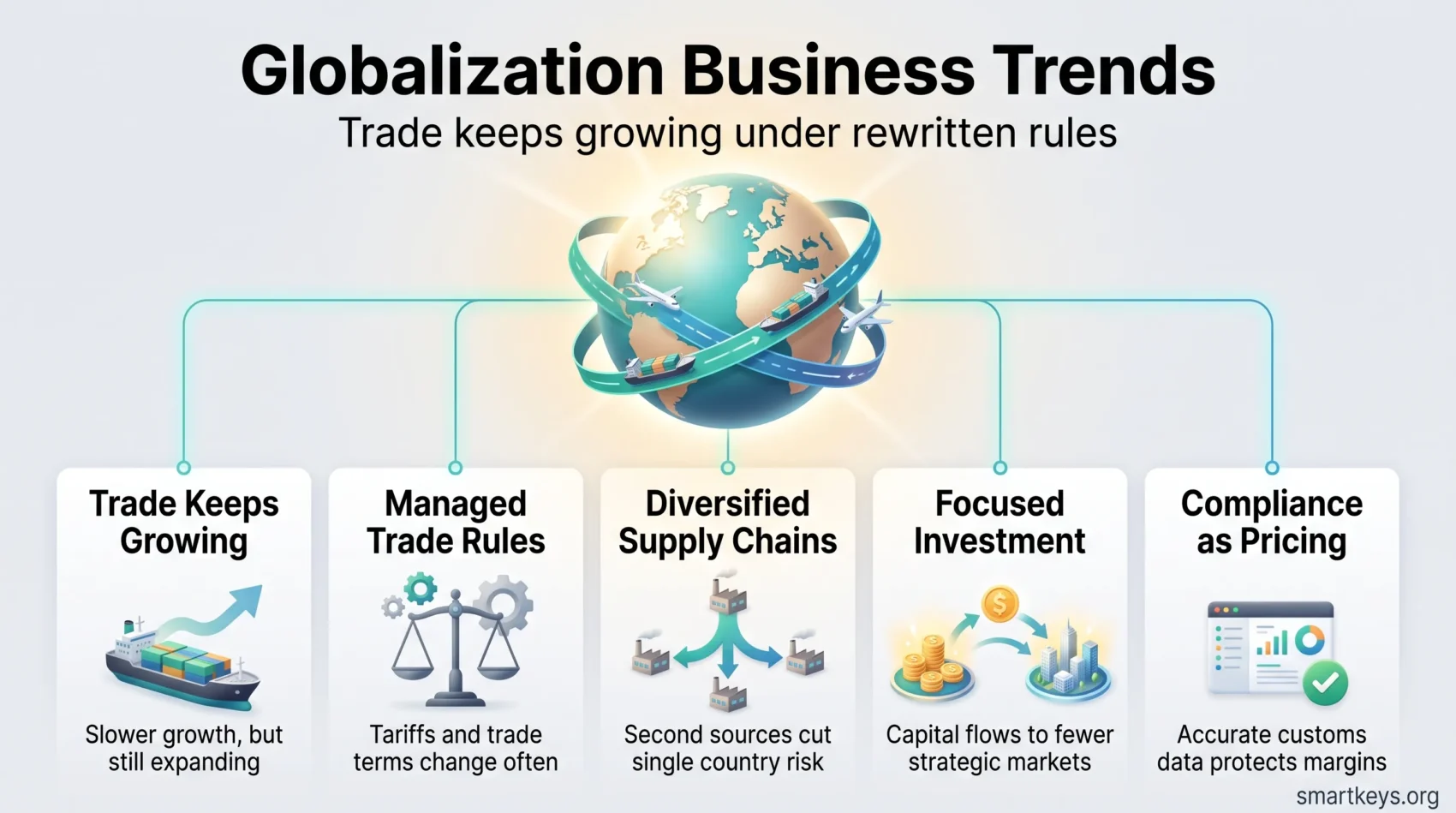
The WTO recorded 4.6% growth in merchandise trade volume in 2025, helped by a surge in AI-related goods and by importers pulling shipments forward ahead of new tariffs. Both of those are one-off effects, which is why the forecast for 2026 drops to 1.9%, with 2.6% expected in 2027. Services trade is holding up better, forecast at 4.8% growth in 2026 after 5.3% in 2025.
The operational consequence is that 2025 inventory decisions were distorted. Companies that read frontloaded demand as structural demand are carrying stock they do not need, exactly the failure mode supply chain resilience planning should catch.
Who Holds Power in Global Markets
Large corporations headquartered in developed economies still hold most of the capital, but the growth is elsewhere. UNCTAD put global FDI at $1.6 trillion in 2025, up 6%, with developing economies taking $901 billion of it. Concentration is the striking part: the top 20 host economies attracted more than 80% of the total, and strategic sectors such as AI infrastructure, semiconductors and critical minerals accounted for 44% of greenfield project value, up from 16% in 2020.
Capital is globalizing and concentrating at the same time. Trade also remains politically contested in the United States and in Europe, where subsidy disputes over electric vehicles show how quickly an industrial policy question becomes a trade question.
Consumer Preferences Across Borders
Global brands still travel well, and platform distribution has made a uniform product easier to sell in thirty countries than it once was in three. The interesting movement runs the other way too: resale, refurbishment and local sourcing now carry real weight with buyers, a shift covered in our look at the recommerce trend.
Remote work has also changed spending geography. When part of the workforce stops commuting, demand moves out of city centers into homes and secondary towns, and the rise of digital nomads extends that effect across borders.

The Role of Technology in Globalization
Technology is what makes distance affordable. Every serious expansion in cross-border business has followed a drop in the cost of moving goods, money or information.
Communication and Collaboration
Video calls, shared documents and instant messaging removed most of the friction from running a team across time zones. What remains is organizational: handover discipline, written decisions, clear ownership. Companies that get this right hire where the skills are rather than where the office is, and cross-border payroll platforms have made paying those people far less painful.
The infrastructure underneath is now a sovereignty question as much as a technical one. Reliable connectivity and a sensible cloud strategy are table stakes, and where data sits determines which regulator has a claim on it.
E-Commerce and the End of Cheap Small Parcels
Marketplaces let a small manufacturer reach buyers in dozens of countries without a distribution partner. That model has just become more expensive. The United States suspended its $800 de minimis exemption in August 2025, and a 2026 rule made the suspension indefinite for all modes of transport, with the statutory repeal taking effect on 1 July 2027. Low-value parcels that once cleared duty-free now require formal or informal entry.
For sellers, landed cost and customs data quality become a pricing problem rather than a back-office one, a shift examined in our guide to cross-border e-commerce and in wider e-commerce trends. It also strengthens the case for regional fulfillment and for rethinking distribution channels market by market.
Policy Shifts Redrawing the Map
Tariffs are the headline. The US average effective tariff rate went from 2.3% in January 2025 to 7.1% in June 2026 on Penn Wharton Budget Model figures. On 20 February 2026 the Supreme Court ruled 6 to 3 that the International Emergency Economic Powers Act does not authorize the President to impose tariffs, invalidating the IEEPA duties. Section 232 tariffs on steel, aluminum, autos and heavy trucks were untouched and remain in force, and other authorities are available, so the direction of travel is uncertain rather than reversed.
Migration keeps growing in absolute terms while staying a modest share of the whole. UN DESA counted 304 million international migrants in 2024, 3.7% of world population, up from 154 million and 2.9% in 1990. Urbanization pushes the same way, with the UN projecting roughly two thirds of the world’s population in cities by 2050. Both interact with the demographic shifts already reshaping the workforce.
Sustainability rules have moved in the opposite direction to the trend of the past five years. The EU’s Omnibus I package, signed off by the Council on 24 February 2026, raised the CSRD threshold to companies with more than 1,000 employees and EUR 450 million turnover, and narrowed the Corporate Sustainability Due Diligence Directive to companies above 5,000 employees and EUR 1.5 billion turnover, with compliance from July 2029. Smaller exporters are still pulled in indirectly as suppliers, which is why corporate responsibility reporting and carbon accounting keep landing on procurement teams.
Emerging Market Opportunities
Emerging markets remain the clearest source of growth for companies that can carry the operational overhead. The discipline is in choosing carefully rather than everywhere at once.
Identifying High-Growth Regions
The 2025 investment data gives a useful map. Developing Asia was the largest recipient region at $644 billion, Africa took roughly $70 billion, and the least developed countries saw inflows grow 21% to $43 billion, though that is still only 2.7% of the global total. The drivers behind those numbers include:
- Renewed foreign direct investment after two years of decline.
- Young populations with rising disposable incomes and fast mobile adoption.
- Deliberate diversification of supply chains away from single-country concentration.
Strategies for Entering New Markets
Market entry is a sequencing problem. The usual options, in rough order of commitment:
- Partnerships and joint ventures: local partners shorten the learning curve on regulation, distribution and hiring.
- Direct investment: more control and better margins, at the cost of capital and management attention.
- Localized marketing: adapting positioning, pricing and payment methods rather than translating the existing campaign.
- Digital-first entry: testing demand through marketplaces before committing to physical presence.
A structured approach beats opportunism, and our global expansion framework sets out the sequence.

Global Trade Patterns
Trade agreements set the terms everything else operates on: duty rates, rules of origin and dispute settlement, which together determine where it makes sense to build.
How Trade Agreements Shape Markets
The most consequential development of 2026 is the USMCA joint review. On 1 July 2026 the United States declined to renew the agreement in its current form, while Canada and Mexico both supported a 16-year extension. The agreement stays fully operational, with existing tariff preferences, rules of origin and dispute mechanisms running to 1 July 2036, but Article 34.7.4 now triggers a joint review every year until then. An extension can still be agreed at any time by the three heads of government.
For North American manufacturers that means planning under annual political review rather than a fixed horizon, with automotive rules of origin, steel and aluminum, agriculture and labor provisions in scope.
Elsewhere, the African Continental Free Trade Area keeps expanding through its Guided Trade Initiative while tariff schedules and rules of origin are still being finalized across member states. It is a long build, not a switch.
Cross-Border Supply Chains and Logistics
Companies have spent several years widening their supplier base into Mexico, Vietnam, India and Bangladesh. Nearshoring shortens lead times and cuts exposure to a single jurisdiction, but it relocates risk rather than removing it, and dual sourcing carries real cost.
Two developments are worth watching. Additive manufacturing has matured enough that on-demand production of spare parts is a genuine inventory strategy, as covered in our piece on 3D printing and supply chains. And automation is reshaping outsourced service delivery, a shift traced in our review of business process outsourcing.

Challenges of Business Globalization
Expanding across borders multiplies the rulebooks you answer to. The cost of getting it wrong is rarely a dramatic penalty; it is delay, blocked shipments and margin disappearing into compliance work.
Understanding Regulatory Environments
The areas that most often catch companies out:
- Tariffs and classification: duty rates now change often enough that a stale HS code is a pricing error, not a filing error.
- Import and export restrictions: export controls on advanced chips and dual-use goods have widened considerably.
- Customs data quality: with de minimis gone, incomplete parcel data means held shipments.
- Data protection: transfer rules and localization requirements shape where systems can run, a point developed in our guide to privacy rules for employee data.
- Sustainability due diligence: even below the new EU thresholds, large customers pass their obligations down the chain.
In a tariff-volatile market, compliance is a source of pricing accuracy, not overhead to be minimized.

Digital Transformation in Global Business
Running a business in several countries used to mean duplicating functions in each of them. Shared platforms removed most of that duplication, which is the practical meaning of digital transformation for a multinational.
How Technology Is Reshaping Business Strategies
The gains are concrete rather than visionary:
- Operational efficiency: one finance and HR stack across markets instead of a separate one per country.
- Market reach: selling into a country before establishing a legal entity there.
- Decision quality: comparable data across regions, which makes it possible to see which market is actually working.
- Customer experience: shared CRM and local payment methods, including the digital wallets that dominate in many markets.
- Supply chain visibility: shipment-level tracking that turns a disruption into a decision rather than a surprise.
The constraint is data governance: the more centralized the platform, the more carefully transfer and sovereignty rules must be handled.

Conclusion
Globalization in 2026 is slower and more conditional, but it has not gone into reverse. Goods trade is still expanding, investment recovered in 2025, and services trade is growing faster than goods. What changed is the policy risk attached to every cross-border decision.
That argues for a specific kind of preparation. Know your landed costs well enough to reprice quickly. Keep a second source for anything critical. Treat customs and sustainability data as operational data. And pick expansion markets deliberately, because capital and attention are both concentrating.
The companies that handle this well are not the ones with the boldest forecast. They are the ones whose plans survive being wrong about tariffs for a quarter. For the longer view, see our analysis of future work trends and our overview of robotics in the workplace.
Found this useful?
Make SmartKeys a preferred source on Google, and our articles will surface more often in your Top Stories, AI Overviews, and AI Mode.
Add as Preferred Source