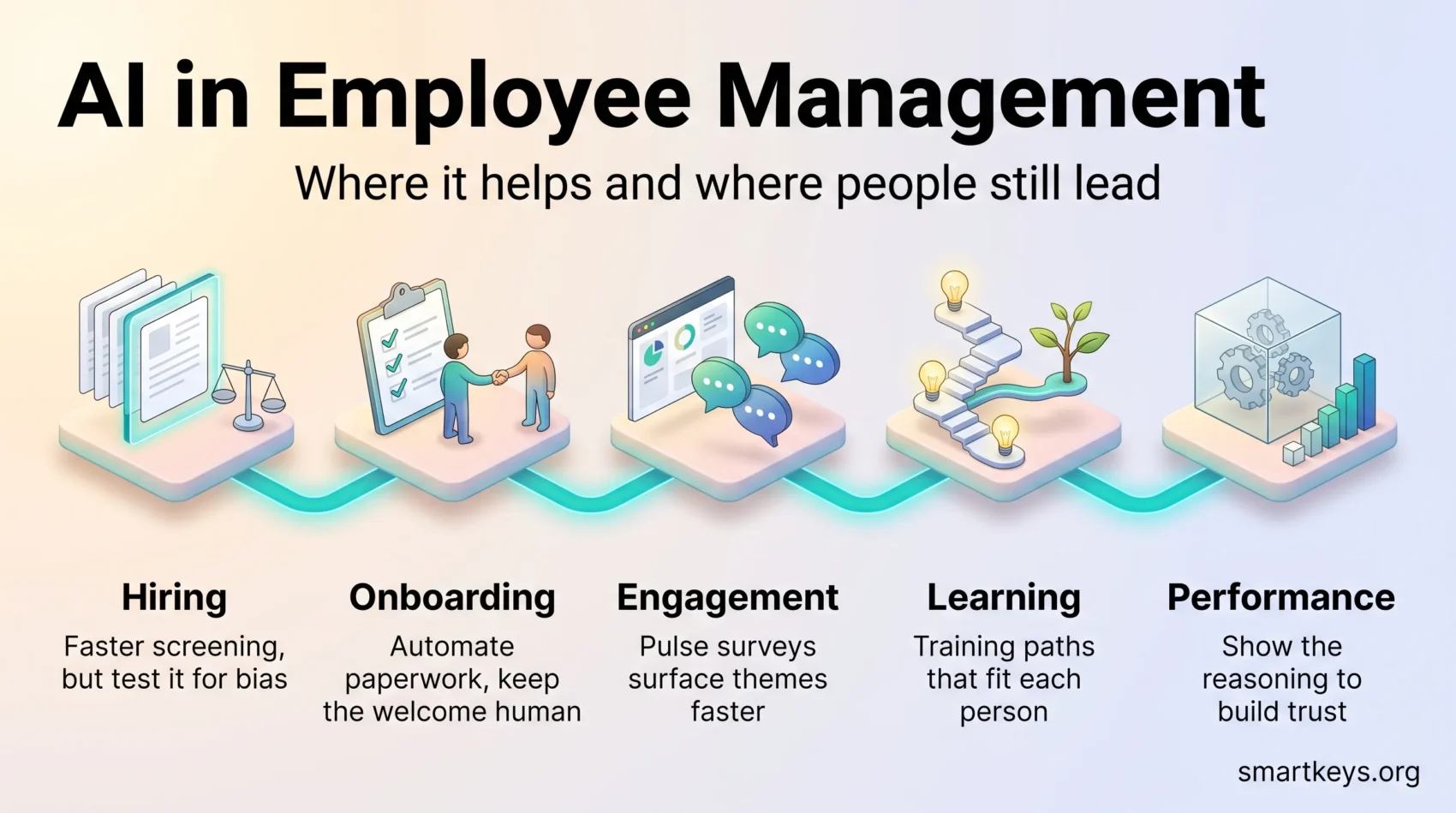
Artificial intelligence has entered everyday HR work, but not as fast or as evenly as the headlines suggest. In SHRM’s State of AI in HR 2026 report, based on a survey of more than 1,900 HR professionals, 39% of organisations said they had actually implemented AI somewhere in HR. Another 7% planned to start during the year, and 31% had no plans at all. Roughly four in ten HR teams use these tools; a third have deliberately stayed out.
That gap matters more than any forecast. AI in employee management is not one product but a set of tools applied to specific tasks: sorting applications, answering staff questions, recommending training, reading survey data. Each has its own payoff and failure mode. This guide covers where the tools genuinely help, where the evidence is thin, and which rules apply in 2026. For the wider picture, see our overview of AI and automation at work.
Key Takeaways
- About 39% of organisations have implemented AI in HR, according to SHRM’s 2026 research. Adoption is real but far from universal.
- Recruiting is the most common use, followed by HR technology and learning and development.
- Most HR functions never measure whether the tools paid off. Only 16% use return on investment as a metric.
- Automation does not remove bias by itself. Screening and performance tools can reproduce it in new ways.
- Rules already apply. Illinois has required notice since January 2026, New York City requires annual bias audits, and the EU AI Act sets duties for employers.
- The tools work best on administrative load. They work worst as a substitute for a manager’s judgement.
What AI in Employee Management Actually Means
Three distinct things are sold under this label. The first is automation of repetitive admin: sending offer paperwork, scheduling interviews, answering the same holiday-policy question 200 times. It is the least glamorous category, with the clearest payoff.
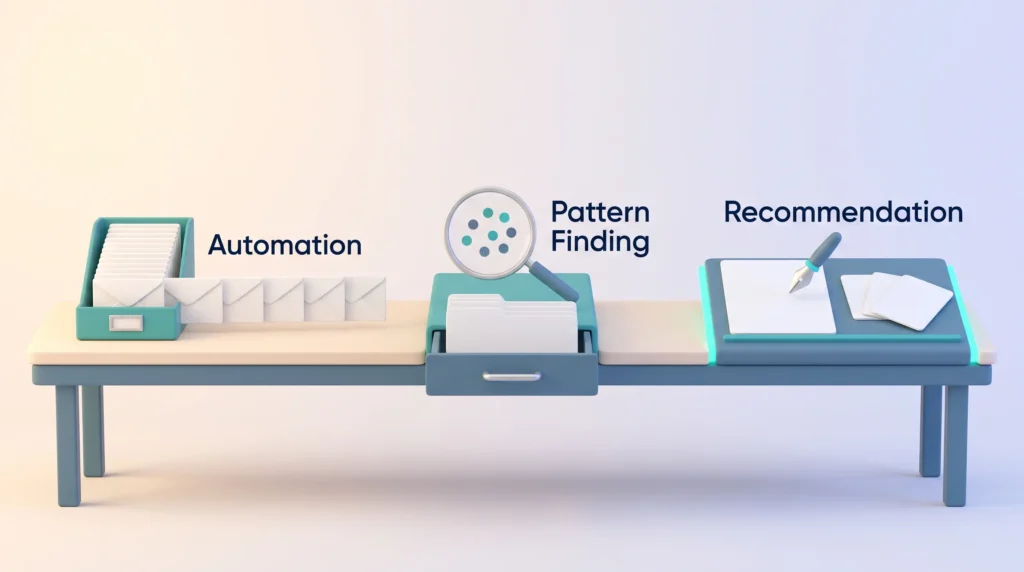
The second is pattern-finding in data you already hold. People analytics, meaning analysing workforce data to answer HR questions, has existed for years; machine learning makes it faster and works on messier inputs such as free-text comments.
The third is generation and recommendation: drafting a job advert, suggesting a training path, proposing a rating. This is where large language models arrived and where the risks concentrate, because the output looks authoritative whether or not it is right.
Where Companies Actually Use AI in HR
SHRM’s 2026 figures show a clear ranking. Recruiting leads at 27% of organisations, followed by HR technology at 21% and learning and development at 17%. Payroll, benefits and employee relations trail well behind. That is no surprise: recruiting has high volume, repetitive judgement and a measurable output, exactly the shape these tools suit, while employee relations involves conflict, context and confidentiality, exactly the shape they do not.
Among organisations using AI in HR, 87% told SHRM their efficiency improved. Treat that carefully: it reflects what HR teams believe, not an audited result. The same research found 56% of HR functions do not formally measure whether their AI investment worked, and only 16% look at return on investment. Enthusiasm is running ahead of evidence. There is a governance gap too: in 52% of organisations, HR is not involved in setting AI strategy, awkward given that HR usually owns the consequences when a workforce tool goes wrong.
Hiring: Faster Screening, and the Bias That Survives It
Recruitment is where most companies start, and where the volume problem is now acute. Job seekers use AI to write and submit applications, so recruiters receive far more of them; screening tools were adopted partly to handle a flood that other AI tools helped create.
What Automated Screening Does Well
Structured screening beats a tired human reading the 180th CV of the day. Software applies the same criteria to every application and does not get slower after lunch. It can also surface candidates a keyword filter would miss.
Scheduling is the other clear win: coordinating five interviewers across three time zones is a hard, boring problem, and handing it to software frees recruiter hours for the part that needs a person. Our guide to AI hiring tools and what the law requires covers the categories in detail, and we cover AI-written job descriptions separately.
Why Bias Does Not Disappear on Its Own
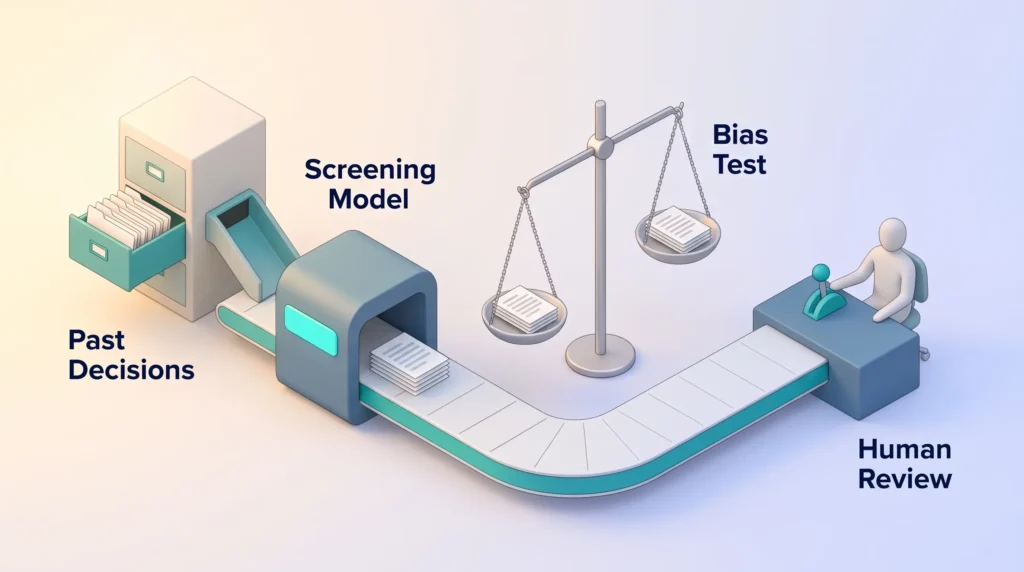
The common claim is that removing humans removes prejudice. It does not. A screening model learns from your past hiring decisions. If those decisions favoured one group, the model repeats that pattern faster and more consistently than any manager could.
Proxy variables make this harder to spot. A model told to ignore gender can still infer it from a sports club, a school or a career gap. Illinois wrote the problem into law: since January 2026 it has banned using ZIP codes as a stand-in for protected characteristics.
What helps is unglamorous: test the tool on your own historical data before deploying it, compare selection rates across groups, keep a human who can see the reasoning and overrule it, then repeat as your applicant pool changes.
Onboarding: Automate the Paperwork, Not the Welcome
Onboarding splits into two halves, and only one should be automated.
The administrative half is a good fit. Contracts, tax forms, equipment requests, system access and training reminders are rule-based, repetitive and easy to get wrong by hand. A workflow tool that chases the missing form on day three saves real time and stops new starters spending week one locked out of the systems they need.
The relational half is not. A new hire wants to know who to ask when something breaks and what the team is like, and no chatbot answers that. Research on onboarding consistently points to early manager contact and clear expectations as what makes people stay, and both need a person.
So let software carry the checklist and free managers for the conversation. Our guide to remote onboarding and training covers what works when the new starter is remote.
Engagement: What Sentiment Tools Can and Cannot See
Engagement software promises to tell you how people feel without waiting for the annual survey, and some of that holds up.
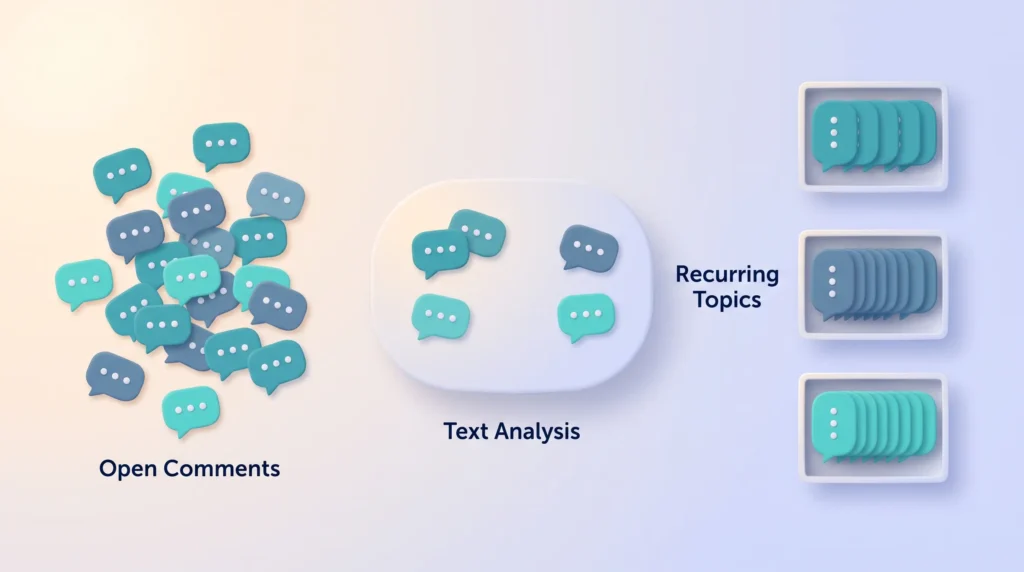
Short, frequent pulse surveys with automated analysis surface themes faster than a once-a-year questionnaire. Text analysis can group thousands of open comments into recurring topics in minutes, work no HR team would do by hand.
The limits are plain. These tools measure what people will type into a company system, so if trust is low the data is polite and useless. Sentiment analysis also reads tone badly in short text, where sarcasm and understatement look the same to a model.
Gallup’s State of the Global Workplace 2026 report puts the stakes in context: global employee engagement sat at 20% in 2025, down from a 2022 peak of 23%, and manager engagement fell to 22%. Measuring that more often does not fix it. The same report found fewer than a third of US employees in AI-adopting organisations strongly agree their manager supports the team’s use of the technology. The bottleneck is management attention, not measurement frequency. We look closer in our piece on remote employee engagement.
There is a line to watch. Analysing survey responses people chose to give is one thing; continuously scoring behaviour from messages, calendars and keystrokes is another, and it changes the relationship. Our article on AI in employee monitoring sets out where that line now sits legally.
Learning and Development: Training That Fits the Person
Learning is the third most common use, and the logic is sound. Most corporate training is built for an average employee who does not exist: someone who already knows the material sits through it anyway, and someone missing the basics gets lost in module two.
Adaptive systems, meaning platforms that change what they show you based on how you answer, address that directly. They skip what you have proven you know, slow down where you struggle, and point people at courses colleagues in similar roles found useful.
Two cautions. Personalised delivery does not fix bad content; a poorly designed course in a personalised order is still poorly designed. And skills-gap analysis is only as good as your skills data, which in most companies is incomplete and out of date.
On the jobs question SHRM is reassuring: 57% of organisations using AI in HR reported increased upskilling and reskilling opportunities, while 7% reported job displacement. The dominant effect so far is redirection, not removal. We cover the wider picture in our guides to upskilling and reskilling, remote corporate training, VR employee training and the skills employers are hiring for.
Performance Management: The Leniency Gap
Performance reviews look like an obvious target for automation: managers dislike writing them, ratings are inconsistent between teams, and there is plenty of data. The evidence on what happens next is more interesting than the sales pitch.
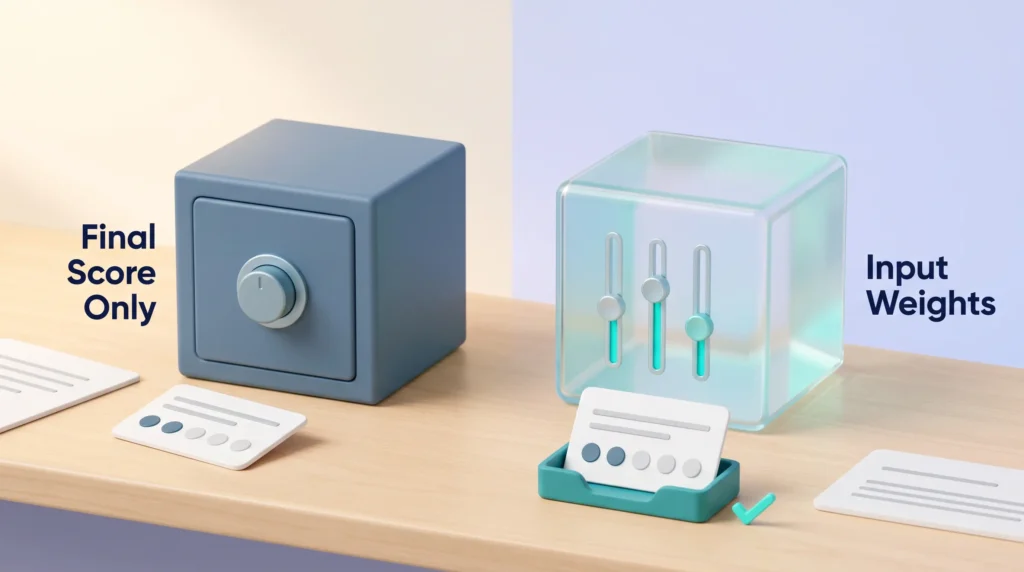
Researchers at UNSW Business School and the University of Western Australia ran a controlled experiment with 242 experienced managers, published in The Accounting Review. When an algorithm recommended a high rating, about 60% of managers accepted it; when it recommended a low rating, only 42% did. They were not doubting the maths, but protecting working relationships.
That asymmetry quietly defeats the point: if good scores stick and bad scores get overridden, the system inflates ratings while looking objective. As the researchers put it, the bias the algorithm was meant to remove came back through the side door.
The fix they found is specific. Letting managers adjust only the final score changed nothing; letting them adjust how the inputs were weighted raised acceptance of low ratings to 63% and closed the gap. Understanding the reasoning, not controlling the output, built trust.
The lesson applies beyond reviews: if you want people to act on a recommendation, show them how it was produced. Our article on AI in business decision-making develops that, and predictive analytics for employee outcomes covers forecasting.
The Rules That Apply in 2026
Employment AI is now regulated in a way it was not two years ago, and three points matter for anyone buying or running these tools.
In the European Union, some practices are already banned outright, including emotion recognition in the workplace. The AI Act’s duty to ensure staff have adequate AI literacy also already applies, and it covers employers, not just vendors. The heavier obligations for high-risk employment systems, meaning tools used for recruitment, selection, promotion, monitoring and dismissal, were originally set for August 2026. The Commission’s Digital Omnibus package proposes deferring them, potentially to December 2027 or August 2028, and was still under negotiation as this was written. Assume the requirements are coming and the date is uncertain.
In the United States the rules arrive state by state. New York City has required annual independent bias audits, a published results summary and at least ten business days’ notice to candidates since July 2023. Illinois HB 3773 took effect on 1 January 2026, requiring notice when AI is used in employment decisions and banning ZIP-code proxies. California’s FEHA rules on automated decision systems applied from 1 October 2025, and Colorado follows on 1 January 2027.
The common thread is one short list: tell people when a system is used, explain what it does, check it for disparate impact, and keep records. Build that in when you buy the tool, not when the first complaint arrives. Employee data rules apply on top, covered in data privacy at work, alongside AI ethics at work.
How to Introduce AI Without Losing Your Team’s Trust
The pattern that separates successful projects from abandoned ones is consistent, and not about the technology.
Start with a task, not a platform: “reduce time-to-schedule for interviews” is a project you can finish and measure, while “transform HR with AI” is not. Decide the measure before you buy, which puts you ahead of the 56% of teams that never assess the result. Keep a named human accountable for every decision that affects someone’s job. Tell people what you are using and why, since most of the new regulation requires disclosure anyway and finding out afterwards is what turns a useful tool into a trust problem. And involve HR in the strategy: the 52% that leave HR out are the ones most likely to find a compliance problem after deployment.
Done in that order, these tools do something modest and valuable: they take administrative weight off managers so they have time for the work only a person can do. With manager engagement at its lowest in a decade, that is no small prize. For the longer arc, see our pieces on HR trends in 2026, tools and employee retention, internal mobility and where work is heading.
Found this useful?
Make SmartKeys a preferred source on Google, and our articles will surface more often in your Top Stories, AI Overviews, and AI Mode.
Add as Preferred Source