Predictive analytics in employee management means using historical and current workforce data to estimate what is likely to happen next: who is at risk of leaving, which roles will be hard to fill, where a team is heading for a capacity gap. It sits between ordinary HR reporting, which describes what already happened, and the day to day judgement of managers, which it is meant to inform rather than replace.
The business case is easy to state and harder to earn. Gallup’s State of the Global Workplace put global employee engagement at 20% in 2025, its lowest level since 2020, with manager engagement down nine points since 2022. In the United States, the Bureau of Labor Statistics recorded 3.2 million quits in June 2026, a quits rate of 2.0%. Those two numbers describe the problem predictive HR analytics is sold against: steady, expensive voluntary turnover in an environment where managers themselves are stretched.
What changed most between the early people analytics wave and 2026 is not the maths. It is the law. Employment is one of the areas regulators watch most closely, and a model that scores employees now carries notice, documentation and review obligations in several jurisdictions. This guide covers what these models can realistically predict, the techniques behind them, the documented cases worth citing, the rules that now apply, and the reasons projects fail.
Key Takeaways
- Predictive HR analytics forecasts workforce outcomes such as turnover risk and hiring needs, rather than reporting what already happened.
- Gallup measured global engagement at 20% in 2025 and US quits ran at 2.0% a month in June 2026, which is the backdrop these tools are bought against.
- The strongest published cases, including Hewlett-Packard’s Flight Risk score, are more than a decade old and should be read as proof of concept, not as a benchmark.
- Illinois and California now impose direct duties on employers using AI in employment decisions, and Colorado’s rewritten law starts on 1 January 2027.
- The EU AI Act’s high-risk obligations for recruitment systems were pushed from August 2026 to December 2027 under the Digital Omnibus agreement.
- The same forecasts also size office space and software licences, which is easier to validate than any turnover score.
- Data quality, base rates and manager trust decide whether a model changes anything, not the choice of algorithm.
What Predictive HR Analytics Actually Does
Predictive HR analytics applies statistical models to employee data in order to assign a probability to a future outcome. The most common outputs are a turnover or flight risk score per employee, a forecast of headcount and skills demand, and a ranking of candidates or internal applicants against a performance definition.
The inputs are usually already in your systems: tenure, compensation history, promotion and job rotation records, performance ratings, absence, internal mobility, and survey scores. Platforms such as Visier, SAP SuccessFactors and UKG Pro, the product formerly sold as UltiPro before Ultimate Software and Kronos rebranded as UKG in 2020, package this into dashboards with prebuilt models. You can also build the same thing on your own data warehouse.
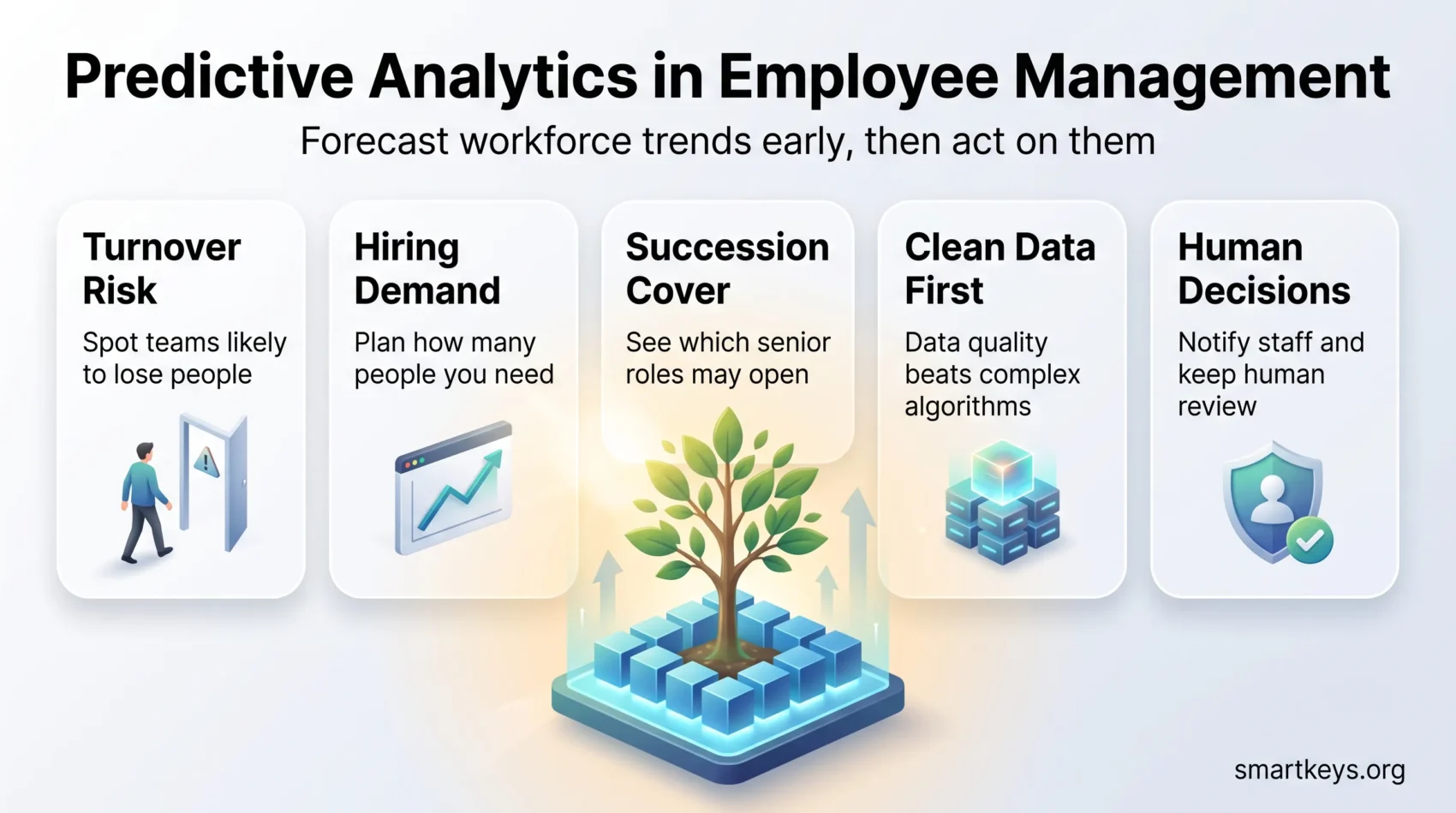
What the output is not is a verdict. A flight risk score says that a group with this pattern historically left at a higher rate. Using it as a reason to withhold a promotion is both bad management and, in several jurisdictions, a legal problem. The useful reading is aggregate: which teams, locations or job families are trending, and which retention levers are worth pulling there.
How It Differs From Standard HR Reporting
Standard HR reporting is descriptive: last quarter’s attrition rate, your time to fill, your engagement score by department. It is necessary, and most organisations still have gaps in it.
Predictive work adds a forecast on top of that description, and with the forecast comes a testable claim. A descriptive dashboard cannot be wrong in an interesting way. A model that says this cohort has a 30% chance of leaving within twelve months can be checked against what actually happened, which is the main reason to prefer it. If you never measure the model against outcomes, you have bought a more expensive dashboard.
The practical difference for HR teams is timing. Descriptive reporting tells you about a resignation after the notice arrives. A working forecast gives a manager a reason to have a career conversation a quarter earlier. That is the whole value proposition, and it depends entirely on somebody acting on the signal.
What These Models Can Realistically Predict
Turnover and Flight Risk
Voluntary turnover is the best studied application, because the outcome is unambiguous and the historical data is usually complete. Models typically combine tenure, time since last pay change or promotion, manager changes, commute or location shifts, and engagement survey trends.
Accuracy claims should be read carefully. A model that concentrates most of the people who eventually left into its highest risk band is genuinely useful even if it cannot pick individuals. Precision at the individual level tends to be poor, because most people in any high risk band do not leave. Treat the score as a prompt for a conversation, not as a prediction about a named person.
A score also tells you where risk sits, never why it sits there. Exit interview notes and the free text in engagement surveys are the cheapest way to close that gap, because they name the drivers a model can only approximate: a manager change, a pay review that never happened, a promotion route that quietly closed. Read them by team alongside the scores rather than case by case, and the pattern usually points at one fixable thing.
Hiring Demand and Skills Gaps
Workforce planning is the less glamorous and often more valuable use. Combining attrition forecasts with business volume projections gives a defensible view of how many people you need to hire, by when, and where. This is where predictive work connects to workforce contingency planning and to a serious digital skills gap analysis, and it usually pays for itself faster than individual scoring does.
The skills inventory you build for that forecast has a second use inside the company. Once you know which capabilities a specific team is short of, the training budget can go to those gaps instead of to a course catalogue that everyone is given access to and few people finish.
Succession and Leadership Cover
Leadership gaps are predictable in a way that individual resignations are not. Retirement eligibility, time in role, promotion history and internal application activity together give a reasonable view of which senior positions are likely to open in the next year or two. The same data shows which internal people already have a comparable track record.
The value here is timing rather than precision. A shortlist drawn up twelve months before a director leaves buys you a development plan. One drawn up the week after leaves you with an external search and an interim arrangement. Keep the same discipline as with turnover scores: the output ranks roles by the risk of being left uncovered, not people by who deserves the job.
Capacity Beyond Headcount
The same forecasts answer questions that are not about individuals at all. Projected headcount by location tells you how much office space a hybrid organisation actually needs, which is often less than the current lease assumes. Projected joiners and leavers by team tell you how many software licences to buy at renewal, where overbuying is common and rarely checked.
These uses carry less risk than scoring employees, because no decision about a named person depends on them. They are also far easier to validate, since the answer turns up on the next invoice or at the next lease review. For many teams this is the quickest way to show finance that cleaning up the workforce data is worth funding.
Performance and Selection
Predicting who will perform well is the hardest and most regulated of these uses. Performance ratings are noisy, frequently biased, and shaped by the manager as much as the employee, so a model trained on them learns the rating process rather than the work. Where selection models are used, structured, job-related predictors hold up far better than inferred traits. The regulatory risk is also highest here, which is covered below and in more detail in our guide to AI hiring tools and to bias in AI hiring.
Techniques and Algorithms Behind the Models
Data Mining Techniques
Most predictive HR work uses a small set of well understood methods:
- Regression analysis: quantifies how variables such as tenure, pay position and time since promotion relate to the probability of leaving.
- Decision trees: split the workforce into groups by the factors that best separate leavers from stayers, and are easy to show to a non technical audience.
- Survival analysis: models not just whether someone leaves but when, which is what workforce planning actually needs.
- Clustering: groups employees by similar patterns without a predefined outcome, useful for segmenting a population before modelling it.
Algorithms Used in Predictive Models
The algorithm matters less than the data, but the choice does affect what you can explain to a works council or a regulator:
- Logistic regression: the default for binary outcomes, and this algorithm predicts employee retention in a form that can be read coefficient by coefficient.
- Random forests and gradient boosting: ensembles of decision trees that usually improve accuracy at the cost of a direct explanation, which is why explainable AI techniques matter in HR settings.
- Support vector machines: classify complex data sets, though they have largely been displaced by tree ensembles in practice.

One caution applies to all of them. Employee data is small by machine learning standards. A company of 2,000 people with 200 leavers a year has a few hundred positive cases to learn from, which is not enough to justify a complex model. Simple methods, validated properly on held out data, usually win.
Documented Cases Worth Citing
Hewlett-Packard’s Flight Risk Score
The best documented example remains the oldest. In 2011, an HP analytics team in Bangalore built a Flight Risk score from two years of employee data covering salaries, raises, job ratings and rotations, and scored more than 330,000 employees. The top 40% of scores captured about 75% of the people who actually resigned, and HP put the potential global saving in replacement and lost productivity at around $300 million. A 300 person sales compensation team saw turnover fall from 20% to 15% in some regions.
Two caveats belong with that figure. The $300 million was an estimate of potential savings, not audited realised savings, and the project is now well over a decade old. Cite it as evidence that the approach can work at scale, not as a return you should expect.
Best Buy and the Engagement to Revenue Link
Best Buy is one of the companies profiled in Harvard Business Review’s October 2010 article “Competing on Talent Analytics” by Thomas Davenport, Jeanne Harris and Jeremy Shapiro, which describes retailers connecting employee engagement scores to store level performance. A specific dollar figure per store is widely repeated online but cannot be checked against the original article, so it is not reproduced here. The defensible version is narrower: at least one large retailer found engagement predictive enough of store performance to act on, in a retail context more than fifteen years ago.
What the Current Evidence Supports
The honest 2026 position is that adoption is broad and published proof is thin. SHRM’s research for 2026, based on surveys of 1,856 HR professionals, 2,079 US workers and 129 CHROs conducted in late 2025, found 92% of CHROs expecting greater AI integration in workforce operations and 57% naming reduced bias in AI hiring tools as a priority. Intent is not outcome. Treat any vendor case study without a control group the same way you would treat one in AI in business operations generally.
The Rules You Have to Work Within in 2026
Employment decisions are a regulated use of AI almost everywhere that regulates AI at all. Four regimes matter most for a company operating in the US and the EU.
European Union. Recruitment and employment systems sit in Annex III of the EU AI Act as high-risk. Those obligations were originally due to apply from 2 August 2026. Under the Digital Omnibus agreement reached on 6 May 2026 and confirmed by member states on 13 May, compliance for stand-alone Annex III systems was pushed back to 2 December 2027. The delay is a deferral, not a cancellation, and the transparency rules that already apply are unaffected. Our overview of EU AI Act compliance covers the wider scope.
Illinois. The amendment to the Illinois Human Rights Act made by HB 3773 took effect on 1 January 2026. Employers must notify workers when AI is used in decisions on recruitment, hiring, promotion, discipline, discharge or terms of employment, and may not use zip codes as a proxy for protected classes.
California. The Civil Rights Council’s automated-decision system regulations have applied since 1 October 2025. They treat discriminatory ADS use as unlawful under existing law, expect anti-bias testing to be documented, and require employment records including automated decision data to be kept for at least four years.
Colorado. The Colorado AI Act was substantially rewritten. Senate Bill 26-189 moved the effective date to 1 January 2027 and removed the impact assessment, risk management programme, annual review and attorney general reporting duties. What remains for employers is clear pre-use notice, a route to meaningful human review within 30 days of an adverse decision, and three year record retention.
The practical consequence is the same in every case: keep documentation of what the model does, tell people it is being used, and keep a human decision maker who can be overruled. That overlaps heavily with sound data governance strategy and with the wider question of data privacy at work.
Where Predictive HR Projects Fail
Data Quality and Fragmentation
The most common failure is mundane. Employee records live across an HRIS, a payroll system, a learning platform and half a dozen spreadsheets, with inconsistent job titles and no reliable history of who managed whom. Models trained on that produce plausible looking scores that track data collection quirks rather than employee behaviour. Fixing the data layer is unglamorous and is usually where most of the budget goes.
Privacy, Monitoring and Trust
Sentiment analysis of internal email or chat is technically possible and frequently proposed. It is also the fastest way to lose the trust the programme depends on, and in the EU it is difficult to justify under employment data protection rules. The distinction that matters is between analysing data employees know is collected for a stated purpose and inferring their intentions from private communication. Our piece on AI in employee monitoring looks at where that line currently sits, and algorithmic management covers the effects on how work feels.
Models Nobody Acts On
A flight risk dashboard that no manager opens changes nothing. Adoption depends on delivering the signal where the decision is made, with a concrete suggested action, and on managers having something to offer: a pay review, a development path, a move through an internal talent marketplace. Without that, the score is a source of anxiety rather than a tool.
Bias Baked Into the Training Data
A model trained on past hiring or promotion decisions learns those decisions, including their bias. Removing protected characteristics from the inputs does not solve it, because proxies remain, which is exactly why the Illinois rule names zip codes. Testing outcomes by group before and after deployment, and documenting the result, is now both good practice and, in California, an expectation.
Building a Programme That Holds Up
A defensible predictive HR programme tends to look the same across organisations.
Start with one question that has an owner. Regretted attrition in a specific job family is a better first project than a general people analytics platform, because somebody will act on the answer.
Fix the minimum data needed for that question rather than all of it. Agree definitions for regretted attrition, tenure and internal moves before modelling anything, and invest in a data literacy programme so the people receiving the output can question it.
Validate honestly. Hold back a period of data, check whether the model would have flagged the people who actually left, and report the result including the false positives.
Decide the intervention before you build the score. If the answer to a high risk manager is nothing you can offer, the model is not the bottleneck.
Write down governance: who can see scores, at what level of aggregation, how long records are kept, who reviews an adverse decision, and how employees are told. Most of this is required somewhere already, and none of it is wasted work.
Review the model on a schedule. Workforce patterns shift, and a model trained on 2023 turnover behaviour is describing a labour market that no longer exists. Pairing that review with your broader HR trends planning and with what you know about remote employee engagement keeps it grounded.
Conclusion
Predictive analytics in employee management is a mature idea with an uneven record. The technique is not in doubt: turnover can be forecast well enough to be useful, and workforce demand can be planned far better than most organisations plan it. What determines whether any of it matters is the unglamorous part, namely clean data, an owner, a decision the forecast can change, and governance that survives contact with a regulator.
The 2026 context sharpens that. Engagement is at a low, quits are steady rather than falling, and employment AI is squarely in the regulatory frame in Illinois, California, Colorado and the EU. Teams that treat prediction as one input into a human decision, document what they do, and measure whether the model was right will get value from it. Teams that buy a score and hope will not. For the wider picture of how these tools are reshaping the function, see our overview of AI in HR management and of AI and automation at work. For the analytics side of the business more broadly, our look at business analytics sets out the same trade-offs outside HR, and employee NPS covers one of the survey inputs these models rely on.
Found this useful?
Make SmartKeys a preferred source on Google, and our articles will surface more often in your Top Stories, AI Overviews, and AI Mode.
Add as Preferred Source