Business analytics is the practice of turning the data a company already collects (sales, costs, customer behaviour, machine readings) into decisions. For years that meant a dashboard someone looked at on Monday morning. Beyond 2026 it means software that forecasts what will happen, recommends what to do, and in some cases acts on its own.
The money is already moving. In McKinsey’s 2026 State of AI survey, nearly nine in ten organizations reported regular AI use in at least one business function. Only 37% could attribute any impact on earnings to it. Almost everyone is investing, and the gap between having analytics and profiting from it is where the next few years will be decided.
This guide maps the trends that matter beyond 2026 and shows you how to adapt without betting the budget. For a deeper look at the forecasting side, see our practical guide to predictive analytics tools.
Key Takeaways
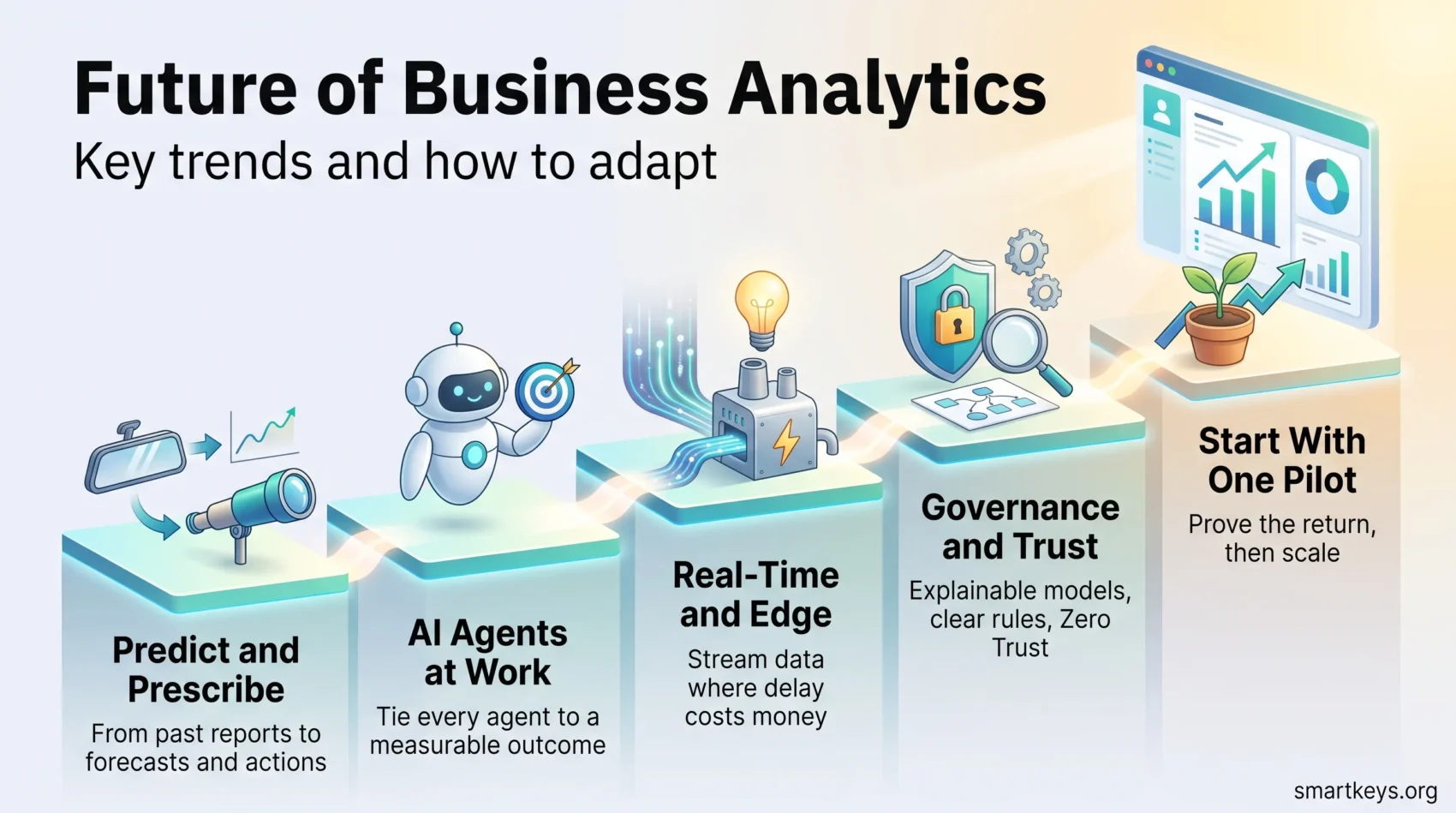
- Analytics is shifting from reports that describe the past to systems that forecast and recommend. The teams that act on that shift early gain the most.
- AI agents are entering ordinary business software fast, but Gartner also expects many agent projects to be cancelled. Clear business value beats novelty.
- Governance is no longer optional. EU AI Act transparency duties apply from August 2026, and high-risk rules follow in December 2027.
- Real-time and edge analytics pay off where delay costs money or safety. Everywhere else, a daily refresh is usually fine.
- Start with one measurable pilot, prove the return, then scale the pattern.
Why the future of business analytics matters now
The pace of investment means waiting is itself a decision. If your competitors move from monthly reports to daily forecasts, they see problems and opportunities before you do.
The evidence points the same way from two directions. In McKinsey’s 2026 survey, 80% of respondents said AI improved their individual productivity, yet only 6% of organizations qualified as “high performers” that attribute at least 5% of earnings to AI. The difference is rarely the technology. It is data quality, clear use cases, and an operating model that turns an insight into an action someone actually takes.
So the question is which parts to modernize first, and how to prove value quickly enough to keep support. Our analytics maturity model and its assessment stages are a useful way to see where you stand before you pick.
Macro shifts redefining analytics strategy beyond 2026
Two shifts sit underneath every other trend in this guide: from looking back to looking ahead, and from static charts to explanations a decision-maker can use.
From reactive to predictive and prescriptive decision-making
Analysts usually sort the work into four types. Traditional reporting is descriptive: it tells you what happened last quarter. Diagnostic analytics asks why it happened, for example by breaking a sales drop down by region, channel, and product. Predictive analytics uses past data to estimate what comes next, such as which customers are likely to cancel. Prescriptive analytics goes one step further and recommends an action: offer this customer a discount, reorder this part now.
The uses are concrete. A subscription business scores every account for churn risk and routes the highest scores to a retention call. A distributor forecasts demand by region and moves stock before the shortage shows up.
The core techniques behind the forecasts
You do not need to be a statistician to use these systems, but it helps to know what runs underneath. Four families of methods do most of the work:
- Regression estimates how one number moves with another, such as how price changes affect unit sales. It is the workhorse of sales forecasting.
- Classification sorts cases into groups you define in advance: will this customer churn or stay, is this payment fraud or legitimate.
- Clustering finds groups you did not define, such as customer segments with similar buying patterns.
- Time series analysis reads patterns over time, including seasonality, so a retailer can plan stock for December in September.
Machine learning, where software learns these patterns from examples instead of fixed rules, makes each method more accurate as data grows. What it cannot fix is bad input, which is why data quality comes up again and again in this guide.
Decision intelligence and data storytelling replace static reporting
Decision intelligence is the practice of designing how a decision gets made: which data feeds it, which model scores it, and who signs off. It blends the numbers with expert judgment and operational context rather than trusting either alone.
Data storytelling replaces a wall of charts with a short narrative that explains the “why,” not just the “what.” A manager who understands why churn rose in one region will act on it. See our guide to data storytelling for a format that works.
“Short learning loops that test hypotheses and tune models will make your work resilient to change.”
AI takes the driver’s seat: Agentic, adaptive, and generative capabilities
AI is moving from helper to operator, taking on planning, execution, and course-correction inside data workflows. That shift lets software run the routine work (pulling data, checking quality, flagging anomalies) so people can focus on judgment and strategy.

Agentic AI means software agents that plan a task, carry out the steps, and correct themselves when something goes wrong, rather than answering a single prompt. Gartner predicted in August 2025 that 40% of enterprise applications would feature task-specific AI agents by the end of 2026, up from less than 5% in 2025. In analytics, that looks like an agent that generates the weekly report, runs data quality checks, monitors KPIs, and drafts a scenario playbook when a threshold is crossed.
The same firm warned in June 2025 that more than 40% of agentic AI projects will be cancelled by the end of 2027 because of rising costs, unclear business value, or inadequate risk controls. Read those two predictions together: agents are coming to your software either way, and the ones that survive will be tied to a measurable outcome.
Adaptive models that learn in real time
Adaptive AI retrains itself as new data arrives, so a demand forecast built on last year’s patterns does not quietly go stale. You get faster decisions because nobody has to notice the drift and schedule a manual rebuild.
Generative intelligence for richer insights
Generative AI, the kind behind chat assistants, changes who can ask a data question. A regional manager types “why did margin drop in the Northeast last month?” and gets a narrative answer with the supporting chart. Generative tools also surface drivers, segments, and anomalies automatically. They also open up unstructured data, the emails, support tickets, contracts, and call transcripts that never fit neatly into a spreadsheet. For how storage, processing, and AI are changing at very large data volumes, see our look at big data analytics trends and predictions. Our guide to augmented analytics explains how this merges with traditional business intelligence.
Plan guardrails first: data quality checks, model governance, and clear limits on what an agent may do without a human. Those are what let these capabilities scale safely.
Frontier tech enablers: Quantum, AR/VR, and immersive dashboards
Two technologies get a lot of attention in analytics forecasts and deserve a sober look. Both are further from routine business use than the headlines suggest.
Quantum-assisted optimization for complex portfolio and routing problems
Quantum computing uses the physics of very small particles to explore many possible answers at once. In principle that suits problems where the number of options explodes: portfolio rebalancing, vehicle routing, and supply planning. In practice, the hardware is still experimental and most companies will access it through cloud services.
Where to pilot: pick one constrained optimization problem with a clear KPI, run a quantum solver alongside your classical algorithm, and compare. Treat it as research, not production. Our guide to quantum computing for business covers what is realistic in the next few years.
AR/VR data visualization to accelerate insight comprehension
Immersive dashboards turn dense data into something you can walk around, and real estate and logistics teams have experimented with them. They remain niche tools for specific spatial problems. For most teams, a well-designed flat dashboard still wins on cost and adoption.
Governance you can trust: Ethics, XAI, and AI TRiSM
Strong governance turns clever tools into tools your teams will actually use. Privacy laws such as the EU’s GDPR, California’s CCPA, and Brazil’s LGPD set the baseline your analytics program has to meet.
Enhanced data governance for the EU AI Act era
The regulatory picture for AI-driven analytics settled in 2026. The EU’s AI Omnibus amendment was published in the Official Journal on 24 July 2026. It moved the deadline for most “high-risk” AI systems (those used in hiring, credit scoring, education, and similar areas) to 2 December 2027. Transparency duties under Article 50, such as telling people when they are interacting with an AI system, still applied from 2 August 2026. If your analytics scores people rather than products, check which category you fall into. Our EU AI Act compliance guide walks through the risk tiers and dates.
Beyond the law, define roles, controls, and versioning so everyone knows who owns which dataset and how problems get fixed. A written AI governance model keeps that from living in one person’s head.
Explainable AI to satisfy regulated sectors and stakeholder trust
Explainable AI (XAI) means models whose decisions can be traced and understood by a human: why this loan was declined, why this claim was flagged. Clear explanations raise acceptance and lower operational risk. In regulated sectors they are increasingly a legal requirement. Our guide to explainable AI covers the methods and when each fits.
AI TRiSM: Model governance, fairness, resilience, and adoption at scale
AI TRiSM is Gartner’s shorthand for AI trust, risk, and security management. It is the set of practices that let you know what your models are doing and whether they still match what you intended. In practice it means standardizing model management: versioning, drift detection (noticing when a model’s accuracy decays), and a human-in-the-loop escalation path for edge cases. Gartner predicted that organizations operationalizing AI transparency, trust, and security would see a 50% improvement in adoption, business goals, and user acceptance by 2026.
Real-time analytics at the edge
Streaming platforms such as Apache Kafka let you react to live signals in seconds rather than at the next report. That matters where delay costs revenue or safety. It matters much less for a monthly board pack. Our guide to real-time data in business decisions helps you draw that line.
Streaming data processing to power instant decisions
Streaming pipelines capture events as they happen, enrich them, and update the current state in near real time. A retailer adjusts prices during a demand spike. A hospital reallocates staff during a surge. Both use the same basic flow: event in, rule or model applied, action out.
Edge computing for low-latency operations
Edge computing places compute close to where data is created (a factory line, a store, a vehicle) instead of sending everything to a distant cloud first. Sensors and machines get fast responses, and critical operations keep running even when the network is flaky. See our guide to edge computing for business data for deployment patterns.
Automated decision-making: dynamic pricing, inventory, and routing
Operationalize models so they push automated updates for pricing, inventory balancing, and routing without manual steps. Harden systems to handle bursts, noisy data, and partial failures at the source. For deployment patterns and governance, see the edge AI playbook for practical steps you can adopt today.
Cloud, data fabric/mesh, and cost optimization
When platforms scale, your priority shifts from hosting servers to curating reliable data products for teams. You need patterns that connect distributed datasets while keeping control and cost predictable.
Data fabric and data mesh to unify distributed teams
A data mesh gives ownership of each dataset to the business domain that knows it best (sales owns sales data, operations owns machine data). Each domain publishes its data as a trusted “product” others can use. A data fabric is the connecting layer of catalogues, metadata, and access rules that makes those products findable. Together they reduce the central-team bottleneck and speed time-to-insight.
Define domain ownership, simple governance rules, and discoverability so teams can find and trust shared outputs.
Cloud cost controls: right-sizing, autoscaling, and value tracking
Analytics workloads are among the easiest to overspend on, because queries and model training can run unnoticed. Right-size compute, use autoscaling so capacity follows demand, and pair workload scheduling with value tracking so spend maps to outcomes. Our guide to cloud cost optimization covers the mechanics.
Security-first analytics: Zero Trust and cybersecurity mesh
Security needs to be built into every data pipeline so your teams can trust what they build on. Gartner forecast in December 2025 that worldwide end-user spending on information security would reach $244.2 billion in 2026, up 13.3% on the prior year, with cloud security the fastest-growing segment. Analytics platforms concentrate a company’s most valuable data in one place, which makes them a natural target.

Start with continuous verification. Zero Trust is a security model that assumes no user, device, or workload is trusted by default, even inside the company network. Every request is checked. Our guide to zero-trust adoption covers how businesses are rolling it out.
Zero Trust: Verifying every user, device, and workload
Apply least-privilege access (people see only the data their role needs) and encryption in motion and at rest. Harden pipelines so models and reports run only on trusted inputs, and formalize incident response.
Cybersecurity mesh to protect multi-cloud, SaaS, and edge assets
A cybersecurity mesh places security controls near each asset, whether it sits in a cloud, a SaaS tool, or an edge device, and coordinates them centrally. It replaces the idea of one perimeter that no longer exists. Design controls for AI-enabled threats and run adversarial tests on your own models. Our guide to cybersecurity mesh architecture explains the layers.
Industry applications and outcomes to watch
Targeted pilots show where investment moves metrics fastest. The use cases below are where analytics is already changing daily operations. Treat vendor case studies with care: results depend heavily on data quality and the process around the model.
Healthcare: AI diagnostics, predictive care, and IoMT monitoring
Healthcare teams use AI to support the reading of medical images and to flag patients at risk of deterioration or readmission. Connected medical devices (the “Internet of Medical Things”) feed real-time monitoring so staff can intervene earlier.
Banking & finance: Risk analytics, fraud detection, and tailored products
In finance, analytics improves credit risk scoring and fraud detection, and lets banks tailor products to individual customers at scale. This is also the sector where explainability rules bite hardest, so the models that win are the ones a regulator can follow.
Insurance: Telematics, hyper-automation, and trustworthy AI
Insurers use telematics (driving data from a car or phone) to price risk more accurately, and automation to move simple claims through without a human touching them. Explainable AI keeps that under regulatory scrutiny without slowing it down.
Manufacturing: Digital twins, predictive maintenance, and edge analytics
Manufacturers build digital twins, virtual copies of a machine or line fed by live sensor data. They use them for predictive maintenance: fixing a part when the data says it is about to fail, not on a fixed schedule and not after it breaks.
Retail and eCommerce: Hyper-personalization and streaming insights
Retailers use streaming data for dynamic pricing and personalized offers that respond to demand in real time, with a value-based pricing strategy underneath. These applications lift conversion and customer lifetime value when the feedback loop from action to result is fast enough to learn from.
- Map use cases to outcomes: customer experience, efficiency, and revenue.
- Prioritize pilots where impact, measurability, and adoption converge.
How you adapt: Capabilities, tools, and operating models
To make data work for everyone, you need clear capabilities, simple tools, and an operating model that scales. Start small, prove value, then expand the patterns that repeat across teams.

Data quality and integration come first
Most analytics projects that stall do so for unglamorous reasons. Data sits in separate systems, the same customer appears three times under slightly different names, and nobody is sure which field is correct. Gartner research from 2020 put the average cost of poor data quality at $12.9 million a year per organization. Every forecast and every AI agent inherits those errors.
The fix is routine work done consistently. Validate data when it enters a system, remove duplicates, and assign an owner to each key dataset who is responsible for its accuracy. Monitor quality continuously rather than cleaning up once before a big project.
The people side matters as much as the pipelines. Teams resist new dashboards when they do not trust the numbers or do not see what is in it for them. Explain why the change is happening, train people on the specific decisions they will make with the data, and link each analytics goal to a business objective an executive already cares about.
Democratized analytics: self-service, no-code/low-code, and training
Self-service platforms such as Tableau, Power BI, and Looker let teams explore data without waiting on specialists. No-code and low-code tools widen access further, so a marketing manager can build a segment without writing a query. Our guides to choosing business intelligence tools and data democratization cover the options.
Pair tools with guardrails: role-based permissions, templates, and simple review flows keep quality high. Self-service without governance produces ten versions of “revenue” and no agreement on which is right.
Data literacy for professionals and cross-functional collaboration
Invest in capability building: data analysis basics, product thinking, and decision intelligence skills. Short, role-based learning paths fit into regular work so people grow while delivering value. A structured data literacy program is the fastest way to get there.
Create collaboration rituals (shared backlogs, office hours, playbooks) to reduce handoffs between product, data, and operations teams.
Prioritization roadmap: quick wins, scaling, and governance by design
Map a roadmap that targets early wins tied to clear KPIs. Stand up self-service with the right tools, then scale what shows measurable value, and track it so leaders see where to double down.
“Democratize access, then govern the results. That balance turns tools into repeatable value.”
Conclusion
The future of business analytics is less about new dashboards and more about decisions that happen faster, with better evidence, and sometimes without a human in the loop. Nearly every organization already uses AI somewhere; only a small minority can show it on the bottom line. The gap is closed by data quality, clear use cases, and governance, not by buying another tool.
Start with measurable pilots that cut costs or grow revenue. Expect AI agents to arrive in your business software regardless, and hold each one to a business outcome. Where delay costs money, move to streaming and edge analytics. Everywhere else, spend the effort on trust: explainable models, a written governance model, and the EU AI Act dates on your calendar.
Deploy Zero Trust, AI TRiSM, and a security mesh to protect access. Then track outcomes, share wins, and scale what actually helps your customers and your organization grow.
Found this useful?
Make SmartKeys a preferred source on Google, and our articles will surface more often in your Top Stories, AI Overviews, and AI Mode.
Add as Preferred Source