Quantum computing stopped being a pure research story in 2026. It is still early, and most of the useful machines do not exist yet. But the money, the deadlines and the first production pilots are real, and they now land on ordinary business calendars.
This guide explains what a quantum computer can and cannot do today, in plain language. No heavy math, no hype. The goal is that you can discuss timing, budget and risk with your own team and reach a defensible decision.
Two things are worth separating from the start. The first is opportunity: a small set of problems, mostly simulation and optimisation, may eventually run far faster than they do on normal computers. The second is risk: today’s public-key encryption has an expiry date, and in the United States that date is now written into law. The first is optional. The second is not.
Key Takeaways
- Quantum computing hit a commercial turning point in 2026, but the machines are still noisy and narrow.
- Private investment in quantum startups reached $12.6 billion in 2025, a 6.3x jump on 2024 (McKinsey Quantum Technology Monitor 2026).
- IBM targets its first large-scale fault-tolerant machine, Starling, for 2029. Treat anything earlier as an experiment.
- US federal systems must move to post-quantum encryption by the end of 2030. That deadline reaches contractors too.
- You can rent a real quantum processor by the minute through the cloud, so a first pilot costs staff time rather than capital.
Where quantum computing actually stands in 2026
The field crossed from research budget to business budget in the past two years. McKinsey’s Quantum Technology Monitor 2026 describes it as a commercial tipping point, and the numbers behind that phrase are worth knowing.
Private investment in quantum startups reached $12.6 billion in 2025, roughly six times the 2024 figure, and the mix flipped from public to private money. More than 300 companies worldwide now run quantum programmes of some kind. Around a third of the companies McKinsey studied spent over $10 million on quantum work in 2025. Vendor revenue passed $1 billion for the first time and is projected to reach $4.4 billion by 2028.
Two technical results changed the tone as well. In October 2025 Google ran its Quantum Echoes algorithm on the Willow chip and reported a result roughly 13,000 times faster than the best classical method on a leading supercomputer, and, more importantly, one that another machine of the same class can reproduce and check. Alongside UC Berkeley, the team used it to study the structure of two small molecules. IBM, meanwhile, published a dated engineering roadmap rather than a vision: Nighthawk in 2025, the Kookaburra memory module in 2026, entanglement between modules in 2027, and Starling, its first large-scale fault-tolerant system, in 2029.
Read those two facts together and you get the honest 2026 picture. Real advantage exists on narrow, carefully chosen problems. Broad, dependable advantage on your own workloads is still several years out. That gap is exactly where a sensible pilot programme lives.
What a quantum computer does differently
Everything follows from how the machine stores a number.
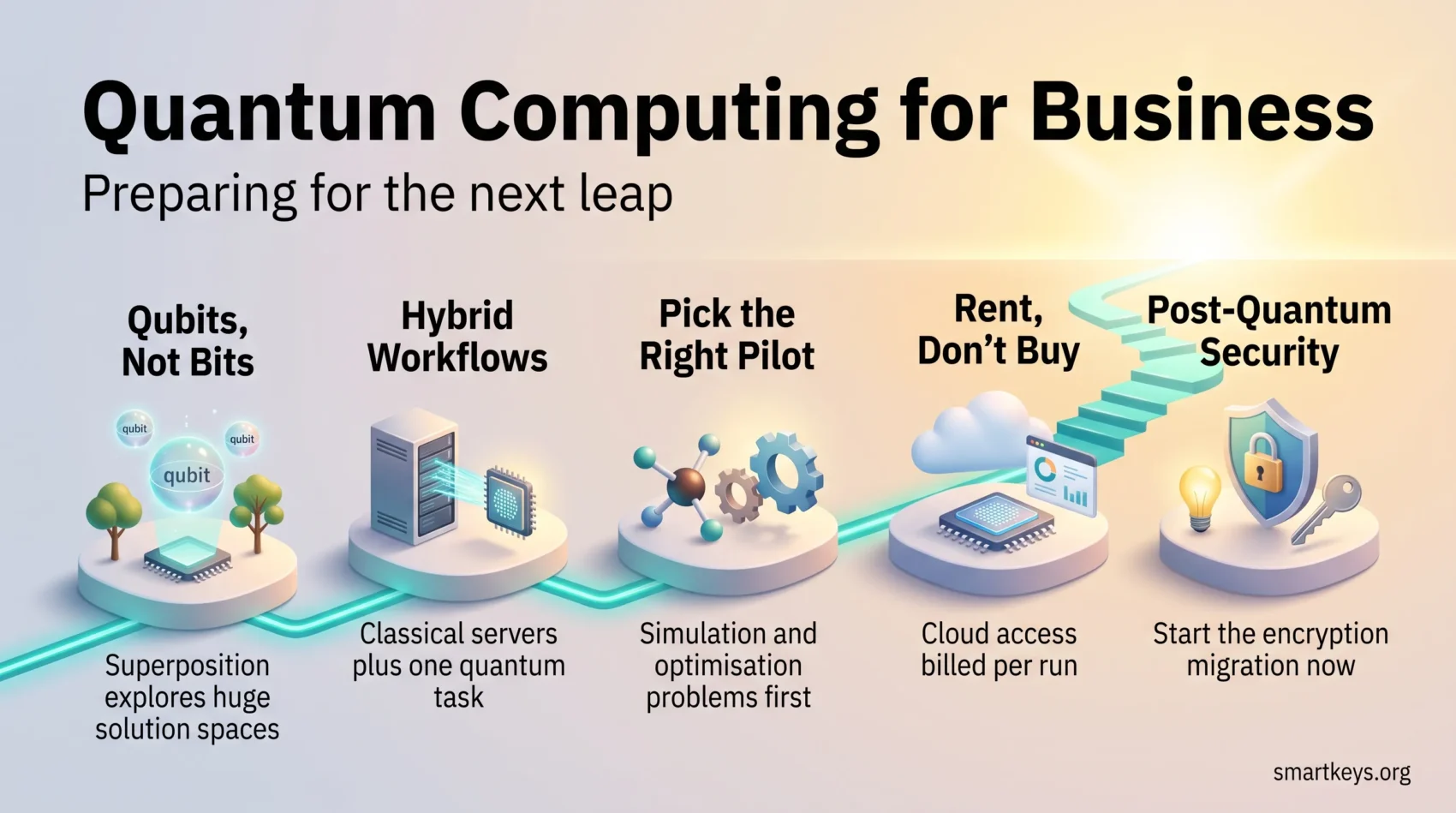
A normal computer stores information in bits. Each bit is either 0 or 1, and every operation is predictable. A quantum computer uses qubits. A qubit can sit in a superposition, meaning a weighted blend of 0 and 1 at the same time, until you measure it. Measuring forces it to one value, so results come out as samples across many repeated runs rather than as one exact answer.
That sounds like a weakness, and often it is. The advantage comes from scale. Each extra qubit doubles the size of the space the machine works in, so 100 qubits describe a space too large for any classical computer to write down. Problems whose difficulty grows the same way, such as modelling how electrons behave in a molecule, are the natural fit.
Three further ideas matter in practice:
- Entanglement links qubits so that measuring one tells you something about another. Ordinary bits cannot be correlated this way, and most useful algorithms depend on it.
- Interference is the steering mechanism. A well-built circuit makes the paths leading to correct answers reinforce each other and the wrong ones cancel out.
- Decoherence is the enemy. A qubit that touches its environment, through heat, vibration or stray electrical noise, loses its quantum behaviour within microseconds. This is why superconducting machines sit inside refrigerators colder than deep space.
None of this replaces your existing stack. In practice you keep data preparation, storage and reporting on classical servers, hand one hard subroutine to the quantum processor, and bring the answer back. That split is called a hybrid workflow, and it is how essentially every real project runs today. It sits close to the way teams already balance central and local processing in hybrid cloud strategy and edge computing decisions.
How a quantum computer runs a calculation
A quantum program is a circuit: a short, ordered list of operations applied to qubits, followed by a measurement.

The operations are called gates. Single-qubit gates rotate one qubit. The CNOT gate flips a target qubit only when a control qubit is in the 1 state, which is how entanglement gets created. Those two kinds of gate are enough to build any quantum program, in the same way that a handful of logic gates is enough to build any classical one.
Circuit depth, meaning how many gates run in sequence, is the number to watch. Every gate adds a little noise, and every microsecond gives decoherence more chance to spoil the state. On today’s machines a shallow circuit that runs hundreds of gates is realistic. A deep circuit running millions is not. Measurement is usually left to the very end so the fragile state survives as long as possible.
That single constraint explains most of what follows. It is why current pilots use variational methods, where a short quantum circuit runs thousands of times and a classical optimiser adjusts its settings between runs. It is also why the famous algorithms that break encryption remain out of reach for now.
The hardware you can rent today
There is no single quantum computer, only competing physical designs with different strengths. You do not have to pick a winner, but you should know which design suits your problem.
Superconducting circuits (IBM, Google, Rigetti) use tiny loops of metal cooled to near absolute zero. Gates are fast and the chips are made with familiar semiconductor methods. The cost is an enormous refrigerator and constant recalibration.
Trapped ions (IonQ, Quantinuum) hold individual charged atoms in place with electric fields and manipulate them with lasers. Qubits stay coherent far longer and error rates are lower, but gates run more slowly.
Neutral atoms (QuEra, Pasqal) hold uncharged atoms with focused laser beams, often near room temperature, and allow the connections between qubits to be reprogrammed.
Photonic systems (PsiQuantum, Xanadu) encode information in light. They fit naturally with fibre networks, which is why they feature heavily in work on the quantum internet and what it means for business networks.
Annealers (D-Wave) are a different animal. They do not run general circuits at all. They settle a physical system into its lowest-energy state, which suits certain optimisation problems if you can express yours in that form.
When you compare vendors, four numbers matter more than qubit count: coherence time, two-qubit gate fidelity, connectivity between qubits, and queue time on the cloud service. A machine with 1,000 poor qubits is worth less than one with 100 good ones.
NISQ limits and what “quantum advantage” really means
Today’s machines are described as NISQ, short for noisy intermediate-scale quantum. The phrase is honest: enough qubits to be interesting, too much noise to be reliable.
Error correction is the way out. The idea is to spread one reliable logical qubit across many physical ones so errors can be detected and fixed. The catch is the overhead. IBM’s 2029 Starling target is around 200 logical qubits, and delivering those takes vastly more physical qubits plus a working error-correction layer. That is the milestone the whole field is building towards.
Until then, three tactics do the practical work: keep circuits shallow, apply error mitigation, which uses extra runs and statistics to cancel predictable noise, and always run a classical baseline alongside.
That baseline matters more than any headline. “Quantum advantage” means a quantum machine beat the best known classical method on a specific task. It does not mean it beat it on your task, or that the task was useful. Google’s Quantum Echoes result was a genuine step because it was verifiable, but it measured molecular structure in a laboratory setting, not a business process. Judge every claim by asking what classical method it was compared against, and whether that comparison would survive a better classical algorithm next year.
The algorithms worth knowing
Three families cover almost everything you will hear about.
Shor’s algorithm factors large numbers efficiently, which would break RSA and Diffie-Hellman, the mathematics behind most encryption on the internet. It needs a fault-tolerant machine, so it is a future threat rather than a current one. It is also the reason the security section below is not optional.
Grover’s algorithm speeds up unstructured search, roughly squaring the efficiency of brute force. It does not break public-key encryption. It does mean symmetric keys should be longer, which is why guidance now points to AES-256 rather than AES-128.
Simulation algorithms are the near-term story. Richard Feynman’s original argument was that a quantum machine is the natural tool for modelling quantum systems, and that remains the clearest fit. Chemistry, materials and battery research need fewer qubits and tolerate shallower circuits, especially through variational methods.
For planning purposes, the split is simple. Simulation and optimisation belong in your pilot shortlist now. Anything that depends on Shor-scale hardware belongs in your risk register, not your project plan.
Where the early value sits
Value appears when a narrow, expensive problem meets a method that suits it. Across the industries running serious programmes, the pattern repeats.
Pharmaceuticals and materials. Simulating how molecules behave is the closest thing to a natural fit. Boehringer Ingelheim is among the named early movers in McKinsey’s 2026 study. The business case is fewer laboratory iterations rather than a finished drug, which also connects to broader healthtech trends.
Energy and utilities. Grid balancing and storage scheduling are optimisation problems that grow awkward fast. E.ON is one of the utilities running pilots, and the work overlaps with the modelling already used across climate tech.
Finance. Portfolio construction and risk aggregation map onto sampling and optimisation methods. JPMorgan Chase and Liberty Mutual both appear among early corporate adopters.
Logistics and manufacturing. Routing, scheduling and network design are classic combinatorial problems, and they sit alongside existing investment in supply chain resilience. Airbus is one of the named industrial participants.
One caveat is worth stating plainly. Many of these problems can also be attacked with quantum-inspired classical algorithms, which run on ordinary hardware today. If one of those solves your problem, use it. The point of a pilot is a better answer, not a quantum answer.
Cybersecurity: the deadline that already applies
This is the part of the topic that has a date attached, and it applies whether or not you ever run a quantum program.
The threat is called “harvest now, decrypt later”. An attacker copies encrypted data today and stores it until a machine capable of running Shor’s algorithm exists. Anything that must stay confidential for a decade is already exposed, which is why this belongs in your risk management framework rather than a research note.
NIST finalised its post-quantum encryption standards in August 2024: ML-KEM for key exchange, ML-DSA and SLH-DSA for digital signatures. In June 2026 US Executive Order 14409 attached deadlines to them. Federal high-value systems must migrate key establishment by 31 December 2030 and digital signatures by 31 December 2031, and contractors are given until the end of 2030 to meet the NIST standards. That pulled the previous 2035 target forward by several years.
A workable sequence looks like this:
- Inventory. Find where cryptography is used, including in vendor products and embedded devices. Most organisations underestimate this by a wide margin.
- Classify by lifetime. Data that must stay secret past 2035 moves first.
- Test. Add post-quantum algorithm checks to your build pipeline and confirm your partners can negotiate them.
- Migrate in stages. Start with external-facing systems and long-lived certificates. Our guide to quantum-safe encryption sets out the full roadmap.
- Assign an owner. A migration with no named owner and no budget line will not happen, a lesson familiar from every cybersecurity programme.
Quantum key distribution, which uses physics rather than mathematics to detect eavesdropping, is a separate and much narrower option. It needs dedicated fibre and suits a small number of high-value links. For nearly every organisation, migrating to post-quantum algorithms is the work that matters, and it fits naturally into a distributed security architecture and existing identity plans.
Software and cloud access: how you actually run something
You do not buy a quantum computer. You rent time on one.
Every major machine is reachable through a cloud service: IBM Quantum, Amazon Braket, Microsoft Azure Quantum, plus direct access from IonQ, Quantinuum and others. Braket and Azure act as marketplaces, giving one account access to several hardware types, which is useful while you are still deciding what suits your problem.
The software layer will look familiar to any Python team. Qiskit, Cirq and PennyLane let you build circuits in a notebook, test them on a simulator, and submit the promising ones to real hardware. Simulators are free or cheap and handle circuits up to roughly 30 qubits, so almost all early development happens there. Paid hardware time is for validation, not iteration.
Three practical points shape the cost:
- Machine time is billed by the task and the number of repeated runs, so the bill scales with how many samples you need for a statistically meaningful result.
- Queue time, not runtime, usually decides how fast you learn. Ask about it before you commit.
- The same discipline that keeps cloud costs under control applies here: batch jobs, cap credits per experiment, and prototype on simulators. A FinOps habit transfers directly.
On-premises hardware only makes sense if data residency rules forbid cloud processing entirely, and even then the facilities and staffing bill is severe. For almost everyone, cloud access is the sensible route, and it slots into the same procurement process as the rest of your cloud stack.
The team you need
You need fewer physicists than you probably expect, and more software engineering than you expect.
A workable first team is three people, none of them necessarily full time: a data scientist or applied mathematician who can frame the problem, a software engineer who can build and version the pipeline, and a domain expert who knows what a good answer looks like. Deep quantum physics knowledge can be bought in through a vendor, a university partnership or a consultancy, an approach we look at more closely in our guide to quantum computing at work.
The skills that actually block progress are linear algebra, comfort with probabilistic results, and disciplined experiment design. Vendors publish free courses and labs, and the material suits the short, repeated format described in our guide to microlearning. Run a skills gap analysis before you hire, because in most cases the gap is narrower than the job adverts suggest.
Two governance points are worth settling early: who owns intellectual property created with a vendor, and what data may leave your environment. Both are cheaper to agree before the first pilot than after it, and both fall under your existing data governance and privacy compliance work.
Running your first pilot
Treat the first project as an experiment with a hypothesis, not a proof of concept looking for applause.
Pick one problem that is expensive, well defined, and currently solved badly. Then check it against the three shapes that fit today’s hardware:
- Simulation first. Chemistry and materials questions where classical simulators already struggle.
- Variational. Short circuits repeated many times with a classical optimiser in the loop. Most NISQ-era work lands here.
- Annealing. Combinatorial optimisation that maps cleanly onto an energy model.
If your problem fits none of the three, it is not a quantum pilot yet.
Then set the measurement rules before you start. Define the classical baseline using the same inputs and constraints. Decide in advance what result would justify a second phase and what result would stop the work. Track the technical numbers (circuit depth, fidelity, number of runs) alongside the business ones (time to an answer, cost per experiment, quality of the solution).
Budget realistically. A first pilot is mostly staff time plus a few thousand dollars of machine time. The risk is not the invoice. It is the demo trap: an impressive result that never connects to a real workflow, which is the same failure pattern that stalls many digital transformation and AI projects.
Choosing a vendor
Insist on measured device data, not marketing slides.
Ask for coherence times, two-qubit gate fidelity, connectivity and calibration history, and ask how often those numbers change after a software update. Ask what the published roadmap actually commits to and what has slipped from earlier versions. Ask how many customers have moved from pilot to repeated production use, and whether you can speak to one.
On the commercial side, check reserved capacity and queue priority, the pricing model and how it behaves as run counts grow, data handling and compliance terms, and whether training credits or co-engineering time are included. Open SDKs matter more than they look: code written in Qiskit or PennyLane can often be pointed at another vendor’s machine, which protects you from betting on the wrong hardware design. The same logic applies to buying any industry-specific technology platform.
A realistic roadmap
Phase the work so each stage earns the next one.
Now to 12 months. Complete the cryptographic inventory and start the post-quantum migration plan, since that has a legal deadline. In parallel, run one or two small pilots on cloud hardware with clear baselines. Build internal literacy so your team can read a vendor claim critically.
One to three years. Fold the surviving pilots into hybrid workflows that sit beside your existing analytics and AI pipelines. Complete the migration for long-lived data. Decide which vendor relationships are worth deepening.
Three years and beyond. Watch for the signals that justify scaling: reproducible benchmarks on problems like yours, logical qubit counts that keep climbing, and pricing that makes repeated production runs affordable. IBM’s 2029 Starling target is the marker most of the industry is measuring itself against. If it arrives roughly on schedule, the case for a larger programme improves sharply. If it slips, you will have lost nothing but a few pilots and gained a team that can read the field.
Conclusion
The honest summary is that quantum computing deserves a small, disciplined slice of your attention in 2026, and one firm deadline.
The deadline is security. Post-quantum migration has dates attached, it reaches contractors, and it takes years. Start the inventory now.
The opportunity is narrower and slower. Pick one or two problems in simulation or optimisation, run them on rented cloud hardware against an honest classical baseline, and let the numbers decide whether to continue. Keep expectations grounded: today’s machines are noisy and the useful ones are years away. What compounds in the meantime is not hardware. It is a team that understands the problem shapes, a vendor relationship that is already open, and a security migration that is already underway.
Found this useful?
Make SmartKeys a preferred source on Google, and our articles will surface more often in your Top Stories, AI Overviews, and AI Mode.
Add as Preferred Source